
Smart Robot Battery Power Connectors: Specs, Duty, and Fit
Smart robots now operate in warehouses, farms, public spaces, and outdoor inspection routes. Each deployment changes the electrical duty of the battery system. For engineers and buyers, selecting a smart robot battery power connector means matching current ratings, mating cycles, sealing, and signal integration to actual operating conditions — not simply choosing the highest ampacity.
The connector between a lithium battery pack and a robot's power train is often treated as a commodity part. In practice, it is a reliability boundary. Service robots, automated guided vehicles (AGVs), and outdoor inspection robots repeatedly draw high current, experience vibration and impact, and undergo frequent battery connection cycles. A high-current DC power connector that performs well on paper can fail early if its contact resistance, housing material, sealing class, or mechanical locking are not aligned with the application's real duty.
The Problem: Battery Connections as a Reliability Bottleneck
In robot battery systems, the connector is frequently the first component to degrade. The dominant failure mechanisms are well understood: contact resistance rises as plating wears, vibration loosens the interface, moisture corrodes terminals, and repeated insertion cycles mechanically fatigue the spring contacts. Each of these effects increases temperature rise, which accelerates insulation aging and can eventually cause intermittent power loss or overheating.
Robot duty cycles differ from consumer electronics in three ways. First, current is drawn continuously during operation, not in brief pulses, so temperature rise at the contact point is sustained. Second, robots experience continuous vibration and occasional impact, which demands a connection that resists loosening. Third, many robots are mated and unmated repeatedly for battery swaps, so the connector must maintain stable performance over at least 1000 mating cycles, a requirement commonly specified in industrial lithium-battery equipment.
There is also a system-level problem: modern robot battery packs carry both power and signals. Battery management systems (BMS), sensors, and control lines require separate wiring in conventional designs. Using separate power and signal connectors increases harness weight, assembly time, and the number of potential failure points — a meaningful issue for compact robot architectures where space is restricted.
The Opportunity: Matching Connector Architecture to Robot Duty
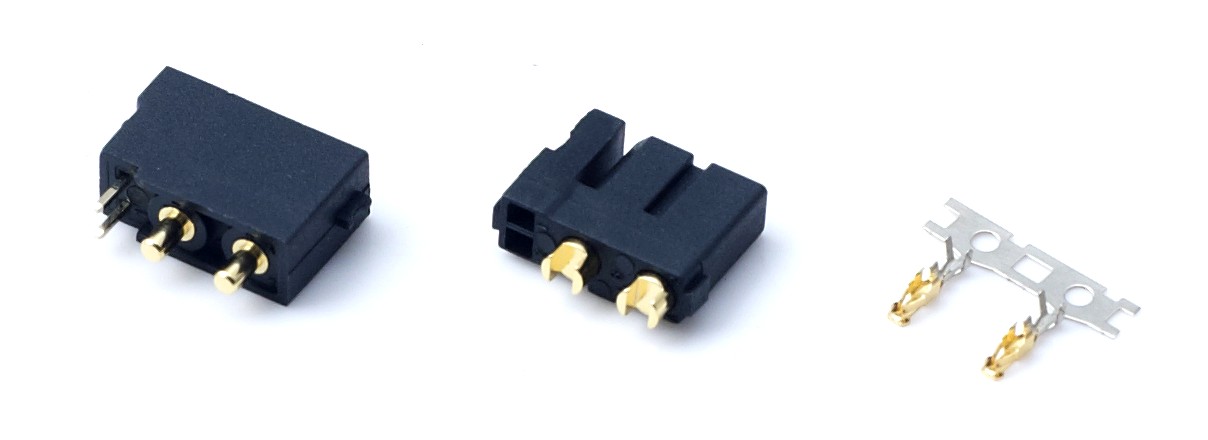
The practical opportunity is to select a connector that addresses all three constraints: high-current carrying capacity, vibration resistance, and signal integration. For light and medium-duty robots, a power-signal combo connector such as the DXT30U(2+2) reduces harness complexity by transmitting power and sensing signals through a single compact interface. For higher-current or outdoor robots, waterproof high-current connectors and anti-spark variants provide the safety margin that standard IP40 connectors cannot deliver.
This scenario-based view also changes procurement criteria. Instead of focusing only on ampacity, buyers can evaluate connectors by operating temperature range, protection class, mating cycles, salt spray corrosion resistance, flame-retardant housing material, and whether the connector supports the specific power and signal topology of the robot's battery pack.
Brand Solution: AOYG's Scenario-Matched Connector Families
AOYG DC Power Connector is a professional manufacturer and solution provider of high-performance high-current DC connection systems for lithium-ion smart devices. Founded in 2024, the company operates a 6,000 m² facility with 100 employees, an annual output of 900,000 units, and an R&D team of 25 engineers. Approximately 50% of its output is exported to the EU and USA. The company holds IATF16949:2016 automotive-grade quality management system certification and applies automotive-grade process control from raw material incoming inspection to finished product testing.
For robot applications, AOYG offers several connector families with different current ranges, sealing levels, and signal integration options. The DXT30U(2+2) power-signal composite connector is the most directly relevant to smart robot battery packs, while the DXT30U, DXT60/DXT60EW, and DXT90 series cover higher-current and outdoor duty classes.
| Series | Key Ratings | Relevant Robot Use Case |
|---|---|---|
| DXT30U(2+2) | DC 500V; 20A power pins (16AWG) + 1A signal pins; peak 35A; contact resistance ≤1.2mΩ; IP40 | Service robots, light-duty e-mobility, smart device battery packs, BMS integration |
| DXT30U-M/F | DC 500V; 15A continuous, 30A peak; contact resistance ≤0.7mΩ; IP40 | Educational robots, lightweight robot platforms, portable battery packs |
| DXT60EW-M+DXT60W-F | DC 500V; 60A continuous, 100A peak; contact resistance ≤0.8mΩ; IP67 | Outdoor inspection robots, waterborne unmanned equipment, outdoor energy storage |
| DXT90H-M/DXT90S-F | DC 500V; 90A continuous, peak 120A; IP40; anti-spark pre-charge resistor | Heavy-lift robots and UAVs requiring anti-spark battery connection |
| DXT90H-M+DXT90E-F Yellow | DC 500V; 45A continuous, 90A peak; contact resistance ≤1.0mΩ; IP40 | RC-model electric vehicles and smaller robot power stages |
In addition to standard products, AOYG supports OEM and ODM production with customization of size, current specification, pin position, wiring structure, and logo printing. Monthly capacity for custom projects is 8,000 units, with a lead time of 30–45 days and a minimum order quantity of 2 units. All products undergo 100% testing.
Technical Explanation: Reading the Specs That Matter
Five parameters define whether a connector will survive in a robot application: contact resistance, terminal material, housing flammability, sealing, and mating cycle life.
Contact Resistance and Temperature Rise
Lower contact resistance directly reduces heat generation at the interface. In the DXT30U(2+2), contact resistance is ≤1.2mΩ; the DXT30U-M/F reaches ≤0.7mΩ; the DXT60EW is ≤0.8mΩ; and the DXT90 series is ≤1.0mΩ. Gold-plated H62 brass terminals are used across these series to maintain low resistance and oxidation resistance. Beryllium copper spring contacts sustain stable clamping force over the connector's service life.
Housing Material and Flame Retardancy
All AOYG housings are made of PA66 UL94 V-0 flame-retardant nylon. This material resists softening and deformation during long-term high-current operation, supports the -20°C to +120°C operating range, and provides stable insulation. UL94 V-0 is the relevant flammability grade for lithium-powered equipment that may be exposed to abnormal heating.
Sealing and Environmental Protection
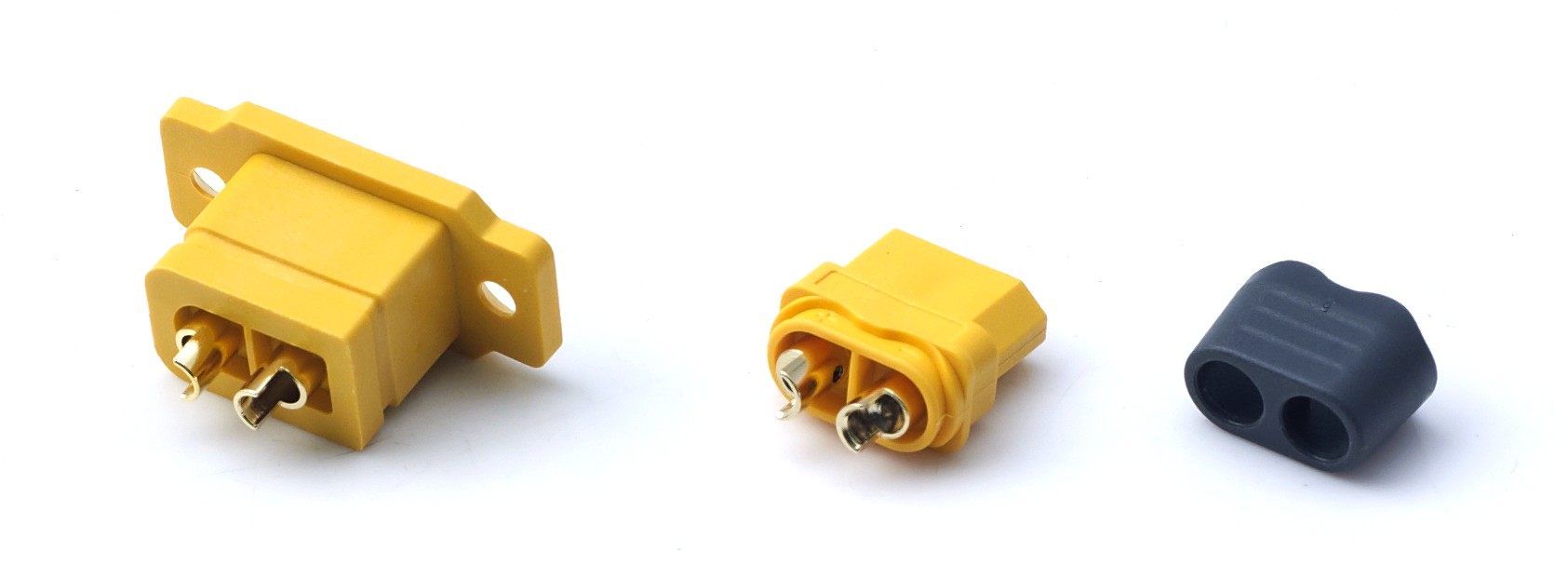
Indoor robots generally use IP40-rated connectors. For outdoor inspection robots, waterborne equipment, or humid environments, a sealed waterproof connector such as the DXT60EW-M+DXT60W-F achieves IP67 protection with a silicone O-ring. Its 60A continuous / 100A peak rating and 8–10AWG silicone wire compatibility make it suitable for outdoor power transmission where rain splash and dust are present.
Mating Cycles and Anti-Spark Options
Robot battery packs require connectors that withstand repeated connection and disconnection. All AOYG series are rated for at least 1000 mating cycles. For batteries that are mated while partially charged, an anti-spark design is recommended; the DXT90S-F female connector includes a built-in high-power pre-charge resistor that suppresses electric arc during connection. Standard models without anti-spark structure should not be used for live plugging and unplugging of large-capacity batteries.
Power-Signal Combo Architecture
The DXT30U(2+2) uses a 2+2 pin configuration: two power pins and two signal pins in one housing. This allows simultaneous transmission of high-current power and low-current sensing signals, reducing the number of harnesses inside the robot. An anti-misplug structure prevents reverse insertion, and the connector is available with cable-soldered male, vertical-mount, and horizontal-mount PCB header options for design flexibility.
Application and Use Cases: Mapping Connectors to Robot Classes
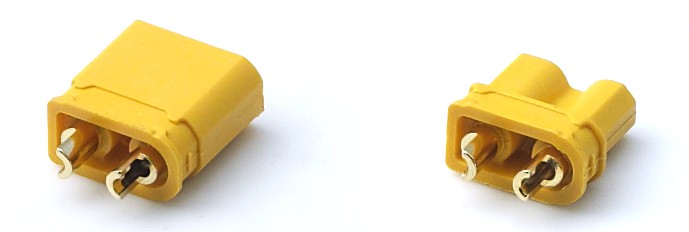
Different robot classes create different electrical and environmental demands. The following mapping reflects how connector selection changes with the application scenario.
| Robot / Equipment Class | Typical Conditions | Recommended Connector Direction |
|---|---|---|
| Indoor service robot | Continuous current, frequent charging, IP40 environment | DXT30U(2+2) for power + BMS signal in one housing |
| Educational / light robot | Low current, weight-sensitive, occasional unplugging | DXT30U-M/F with lightweight structure |
| AGV / material handling robot | Sustained current, vibration, battery swap cabinets | DXT60 or DXT90 series depending on peak current |
| Outdoor inspection robot | Rain splash, humidity, dust, temperature variation | DXT60EW-M+DXT60W-F with IP67 sealing |
| Heavy-lift robot / large UAV | High instantaneous current, live battery connection | DXT90H-M/DXT90S-F with anti-spark female |
Across industries, high-current connectors from this product range have been adopted in FPV drones, agricultural plant protection UAVs, electric scooters, electric bicycles, portable outdoor energy storage stations, handheld power tools, garden machinery, intelligent service robots, AGV handling robots, and lithium battery pack assembly. At least one documented deployment has been in stable operation for over two years, covering 20 units in drone, robot, e-mobility, energy storage, and power tool manufacturing environments.
Market Trends: Demand Signals in High-Current DC Power
The market context for robot battery power connectors is favorable. The global high power connectors market was valued at approximately USD 5.47 billion in 2025, according to Fact.MR. Within energy storage applications, DC connectors represented 58.7% of the total energy storage connector market share in 2025, reflecting the shift toward DC architecture with higher voltage requirements.
Two additional trends are relevant for connector buyers. First, 5G base station backup power systems draw significantly more power than their 4G predecessors — typically 11.5 to 14 kW with peaks near 19 kW — increasing demand for low-voltage high-current DC connectors in backup and energy storage modules. Second, the RC aircraft and drone industry continues to treat XT60 and XT90 connectors as the de facto standards for medium-to-high power non-proprietary connections, which means new robot and UAV connectors must remain dimensionally compatible with these widely used interfaces to simplify customer adoption.
Comparison with Traditional Connection Methods
Traditional approaches to battery-to-load connection include screw-type terminal blocks, ring terminals, and direct soldering. These methods are still viable for stationary equipment, but they have well-known limitations in mobile robotic applications.
| Criterion | Traditional screw / ring terminal | Modern high-current DC connector |
|---|---|---|
| Assembly time | Requires tools; slower in mass production | Quick push-to-mate; reduces harness assembly time |
| Vibration behavior | Can loosen over time; requires maintenance | Locking structure and spring contacts resist vibration |
| Contact consistency | Depends on installer torque | Controlled contact resistance; gold-plated terminals |
| Signal integration | Requires separate signal wiring | Power-signal combo options reduce harness count |
| Environmental sealing | Usually not sealed | IP67 versions available for outdoor robots |
| Field service | Replacement requires re-termination | Modular mating allows quick battery swap |
This comparison is not absolute. Terminal blocks remain useful in high-vibration stationary cabinets where maintenance access is easy, and direct soldering can be acceptable for one-time battery-to-controller connections in devices that are never serviced in the field. The advantage of a high-current DC connector appears when the battery is repeatedly disconnected, when the device is expected to operate for years without maintenance, or when harness simplification reduces assembly cost.
Limitations and Selection Boundaries
A scenario-based selection approach also requires acknowledging boundaries. Three limitations are particularly relevant for robot buyers.
Current-per-pin limits in combo connectors. The DXT30U(2+2) carries a continuous current of 20A per power pin and 1A per signal pin. This makes it suitable for medium-duty robots, but a large AGV or heavy-payload robot drawing sustained current above this range should use a dedicated high-current connector such as the DXT60EW or DXT90 series instead of forcing the combo connector beyond its ratings.
IP rating must match the environment. IP40 connectors are not sealed against water ingress. For robots that are washed down, operate outdoors in rain, or work near water, an IP67-rated connector such as the DXT60EW-M+DXT60W-F is necessary. Specifying an IP67 connector in an indoor-only robot, however, adds cost and size without functional benefit.
Anti-spark is not standard. Standard AOYG connectors without anti-spark structure are not recommended for live plugging and unplugging of large-capacity batteries. If a robot's battery is swapped while the load is connected, the DXT90S-F anti-spark female with its built-in pre-charge resistor should be specified.
Future Outlook
Robot battery systems are moving toward higher energy density, modular battery packs, and tighter packaging. These trends favor connectors that combine power and signal in one interface, reduce weight, and maintain stable contact resistance over longer service life. Outdoor and semi-outdoor robotics will continue to push demand for IP67-rated waterproof high-current connectors, particularly for inspection robots, garden equipment, and solar-powered mobile systems.
From a supply-chain perspective, buyers are increasingly using automotive-grade quality frameworks as a baseline for robot components. IATF16949:2016 certification, 100% testing, and full-process quality traceability are becoming differentiators in supplier evaluation. Customization capability — including pin position, wiring structure, and current specification — will remain important because robot architectures are more diverse than those of consumer electronics, and OEM/ODM suppliers that support early-stage model selection and sample debugging can reduce project launch risk.
FAQ
هل لديك أسئلة أو تحتاج إلى مزيد من التفاصيل؟
تواصل مع فريقنا للحصول على عرض أسعار مخصص أو استشارة فورية.
طلب عرض أسعار
املأ النموذج أدناه وسيتواصل معك فريقنا بعرض مقترح مخصص.
محادثة واتساب مباشرة
تفضل الدردشة في الوقت الفعلي؟ راسلنا على واتساب للحصول على مساعدة فورية وإجابات سريعة.
- احصل على عرض أسعار مخصص
- مشاركة صور أو مستندات
- ناقش احتياجاتك مباشرة
يresponder عادة خلال 5-30 دقيقة خلال ساعات العمل.