
Smart Water Meter Supplier Evidence: What Factory Scale Actually Proves
Smart Water Meter Supplier Evidence: What Factory Scale Actually Proves
Smart water meter procurement has a verification problem. Two suppliers can circulate near-identical datasheets — DN15 to DN300, IP68, LoRaWAN or NB-IoT, eight-year battery — while the operational reality behind those sheets differs substantially. The difference rarely shows up in the specification table. It shows up in floor space, test benches, engineering headcount, and in how much of a supplier's order book comes back as a second order.
Market sizing illustrates the same problem at industry level. Grand View Research valued the global smart water meter market at USD 9.1 billion in 2024 and projected it to reach USD 16.2 billion by 2030, while Bluefield Research puts the 2024 figure at USD 6.8 billion and MarketsandMarkets at USD 4.61 billion. The divergence is largely a definition gap — what counts as "smart" — but the lesson transfers to supplier evaluation: a number means little without a stated basis.
This article applies that standard to one supplier's published operational record. Shengda Water Meter Co., Ltd. (SDWM) reports a 66,000 m² manufacturing facility, an annual production capacity of 3 million units, and a 12-engineer R&D team. Those figures are a starting point, not a conclusion. What follows examines what each number proves, what it does not prove, and how a buyer at research and evaluation stage can test it before committing to a metering project.
Why Capacity Claims Are Hard to Verify
An annual capacity figure such as "3 million units" is a composite claim. It assumes that floor area, tooling, assembly lines, calibration benches, workforce, component supply and scheduling all operate together at a defined rate. Buyers can accept the number, or break it into parts that are individually checkable.
The useful move is to pair every headline claim with the physical or documentary evidence that would either support or contradict it. Suppliers that can produce that evidence quickly are generally describing their own operations; suppliers that cannot are generally describing an aspiration.
| Supplier claim | Operational evidence behind it | Practical verification route |
|---|---|---|
| Annual production capacity (units/year) | Line count, cycle time, shift pattern, tooling inventory, test bench throughput | Site audit; capacity utilisation records; request output by product family rather than one aggregate figure |
| Factory area (m²) | Physical building footprint, warehouse, workshop, test and calibration rooms | On-site walkthrough or third-party inspection; check whether area is owned/leased and how much is storage versus production |
| R&D headcount | Firmware, hardware, metrology and platform engineering roles | Ask how engineers are allocated across mechanical, ultrasonic, prepaid and radio frequency workstreams |
| Repeat business share | Order history from returning utility, distributor or OEM customers | Reference list with contactable customers; request a second-order sample |
| Certifications (ISO, CE, MID, ISO4064) | Certificate scope, model numbers, validity dates | Match certificate scope to the exact model and size being purchased, not the brand in general |
| Monthly output | Actual scheduled production, not theoretical maximum | Compare monthly and annual statements for internal consistency |
Shengda Water Meter: The Operational Record in Detail
Shengda Water Meter Co., Ltd. (SDWM) is a Chinese manufacturer of water meters and flow meters, established in 1995 and located at NO.109, Middle Weidu Road, Kaifeng City, China. The company provides OEM/ODM manufacturing, smart metering, control, telemetry and smart water solutions, and describes its portfolio as covering OEM smart water meters, prepaid water meters, remote reading water meters, LoRaWAN water meters, NB-IoT water meters, ultrasonic water meters, and electromagnetic, turbine, vortex and ultrasonic flow meters.
Facility and capacity
- Founded in 1995 — three decades of continuous operation in the same product category.
- 66,000 m² manufacturing facility, with a new factory built in 2020 carrying an annual production capacity of 3 million units.
- Monthly capacity of 100,000+ units for water meters and flow meters combined.
- 100–200 employees, based in Kaifeng City, China.
- Export ratio of 50%, with main markets in the USA, South America, Africa and Southeast Asia, and products shipped to more than 140 countries.
The 2020 build date matters more than the raw area figure. It lets a buyer anchor the capacity claim to a specific asset with a known construction date rather than to a facilities total that may include older, partially used buildings.
Engineering and customization
The company reports 12 R&D engineers and offers OEM/ODM customization across logo, colour, housing design, communication module, software platform, protocol, packaging and product specifications. A 12-engineer team is a modest, checkable headcount — which makes it useful, because it can be read against the number of technology families the portfolio claims to support.
Commercial evidence
More than 65% of Shengda's business is described as coming from repeat customers. Repeat share is a self-reported metric and should be corroborated rather than taken at face value; its value in an evaluation is that it creates a specific question — which customers reordered, in which market, and over what interval — that a supplier either can or cannot answer.
Reading the record: facility size, output capacity, employee count, engineering headcount and repeat-business share describe five different things — physical scale, throughput, labour, technical capability and commercial traction. Treating them as one "company strength" score hides the fact that a project rarely stresses all five equally.
Reading the Numbers Technically
Do the capacity figures reconcile?
Three million units per year averages roughly 250,000 units per month if production were spread evenly across twelve months. The company separately reports a monthly capacity of 100,000+ units for water meters and flow meters combined. Those are different reference points — one is an annual capacity statement tied to the 2020 factory, the other a monthly output figure covering two product categories — and a buyer should ask a supplier to reconcile them rather than assume they describe the same thing.
Product mix explains much of the gap. A DN15 residential multijet meter and a DN300 bulk meter consume very different amounts of line time, test time and material. Capacity statements become meaningful when a supplier can express them by diameter band and technology type.
What the quality-control sequence implies
Shengda describes its quality control as a five-stage sequence: incoming material inspection, production process inspection, 100% functional testing, calibration testing, and final inspection before shipment. The most auditable element is 100% functional testing, because it is a per-unit commitment rather than a sampling practice. Calibration testing is the second, because it connects to the metrology standards the products reference — ISO4064 for mechanical and ultrasonic meters, MID for European legal metrology.
Lead time and minimum order quantity
Standard products are quoted at 15–20 days lead time; customized products at 30–40 days depending on project requirements. Minimum order quantity is 3 units for samples and 500 pieces for customized OEM projects. Together these two figures describe changeover economics: the supplier is set up for volume runs with a defined customization window, not for continuous one-off engineering.
Why 12 engineers is not a trivial number
A metering portfolio that spans mechanical multijet, ultrasonic, prepaid and radio communication places several distinct engineering demands inside one organisation:
- Ultrasonic measurement requires transit-time signal processing, zero-moving-part chamber design and accuracy stability over the meter's life — a metrology problem, not an assembly problem.
- Prepaid systems require token security. STS (Standard Transfer Specification, IEC 62055-41/51) is the recognised international standard for prepaid meter encryption; supporting 20-digit STS tokens means implementing that security model.
- Radio communication requires a LoRaWAN stack plus gateway and network server integration, NB-IoT or 4G Cat.1 firmware, and power management that keeps a lithium battery alive for years.
- Wired integration requires EN 13757 M-Bus support and Modbus RTU over RS485 for building management and SCADA environments.
Each of those is a separate competence. A buyer evaluating engineering capability should therefore ask how the R&D team is allocated across them, rather than how many engineers exist in total.
Product Range and Project Fit
The verification question changes once the product range is on the table, because different technologies carry different evidence requirements. The table below summarises the principal configurations Shengda publishes and the deployment scenarios each is designed for.
| Product / type | Size range | Key published specifications | Communication | Typical fit |
|---|---|---|---|---|
| LXC ultrasonic water meter | DN15–DN500 | Brass body, PN16, IP68, R250/R400, T30/T90, ISO4064; battery 10 years (DN15–DN40), 6–8 years (DN50–DN500) | LoRaWAN, NB-IoT, 4G, M-BUS, RS485 | High-end communities, villas, schools, enterprises, factories, apartments, water affairs |
| LXSY LoRaWAN water meter | DN15–DN300 | Brass (with valve) or iron (without), IP68, 433–923 MHz, ER18505M 3600 mAh battery, 8–10 years, MID certificate, ISO4064 | LoRaWAN | Household, dormitory, hotel, residential property, apartment, irrigation and water resource management at bulk sizes |
| LXSC LoRaWAN ultrasonic water meter | DN15–DN600 | Class 1 / Class 2, R250/R400/R500, IP68, up to 10 years, CE / MID optional | LoRaWAN (EU868 / US915 / AS923 / AU915) | Projects needing ultrasonic accuracy plus long-range radio |
| NB-IoT smart water meter | Model-dependent | IP68 protection for outdoor and harsh environments | NB-IoT | Networks with licensed cellular coverage |
| LXSY 4G / GSM water meter | DN15–DN300 | PN16, IP68, TD-LTE / FDD-LTE and GSM 900/1800 MHz, battery more than 8 years, MID | 4G, GSM | High-end communities, villas, schools, enterprises, factories, apartments |
| LXS-S STS prepaid water meter | DN15–DN200 | IP68, 3.6 V working voltage, up to 8 years battery, R80/R100/R160, 1.0 MPa | LORA-RF (UIU), keypad, STS tokens | Prepaid revenue management, 20-digit STS token markets |
| LXSK prepaid / smart card water meter | DN15–DN300 | IP68, ISO4064 Class B, MID certificate, over 6 years replaceable battery | Smart card, card reader, network server | Prepaid residential and bulk metering |
| RS485 water meter / water meter BMS | DN15–DN500 | Modbus RTU, IP68, up to 1200 m bus distance, battery or external power | RS485, Modbus RTU | Building management systems, PLC and SCADA environments |
| Water meter M-Bus | DN15–DN200 | EN 13757 M-Bus protocol, IP68, up to 1000 m communication distance, multi-meter connection via M-Bus master | M-Bus | Wired AMR/AMI networks in residential buildings |
| LXLC / WPH Woltman water meter | DN50–DN600 | Cast iron, ductile iron or stainless steel, PN10/PN16/PN25, R40–R100, horizontal installation | Pulse output, M-Bus, RS485, LoRaWAN, NB-IoT (optional smart version) | Municipal networks, district metering areas, industrial and irrigation lines |
| LXSG multijet water meter | DN15–DN50 | ISO 4064, R80–R200, PN10/PN16, T30/T50/T90, brass or composite body | Pulse output, M-Bus, RS485, LoRaWAN, NB-IoT (optional smart version) | Houses, apartments, villas, utility residential supply |
| LXSG plastic water meter | DN15–DN50 | BSP threaded connection, PN10/PN16, R80–R200 | Pulse output and optional smart modules | Large-scale residential and rural supply where weight and cost matter |
| Postpaid water meter | DN15–DN50 | R100–R400 options, PN10/PN16, consumption-based billing | LoRaWAN, NB-IoT, 4G, RS485, M-Bus, pulse (optional) | Periodic billing based on measured consumption |
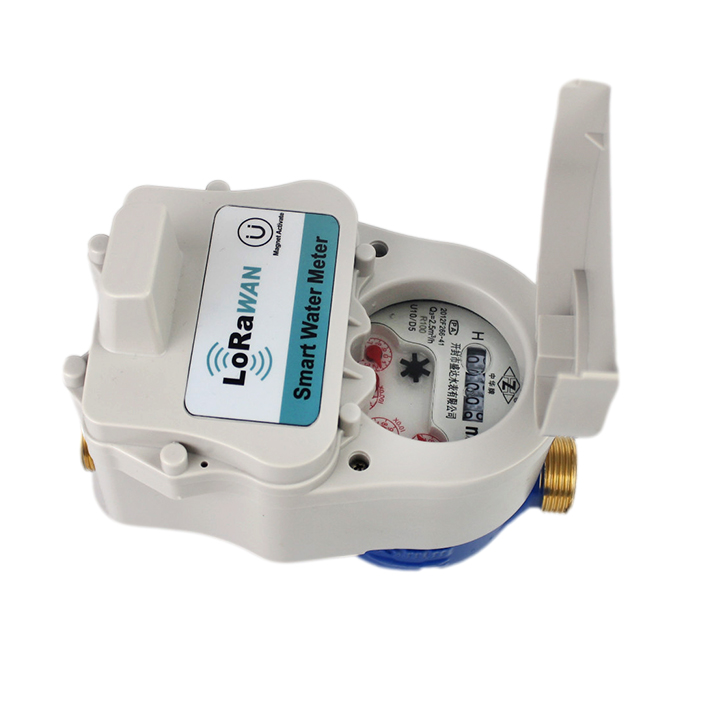
Wireless remote reading water meter — the configuration class that determines whether a project can operate as an AMR or AMI network rather than a manual-reading estate.
Deployment profiles that show the range in use
Published project profiles give a buyer concrete reference points to request directly. A Zimbabwe municipal water supply project covering 4,000+ units over 8+ years is described as achieving remote recharge, automatic billing and user management, with 20-digit STS token support and remote valve control. A Kenyan municipal water department project of 20,000+ units over 8+ years uses NB-IoT communication and is described as improving automatic meter reading efficiency while reducing manual maintenance costs.
Other documented profiles include a Mongolian government water utility deployment of 15,000 units using LoRaWAN communication and an OEM solution; a Sudanese water utility project of 10,000+ units awarded through government tender with OEM branding; a Ugandan water supply authority project using 4G communication, remote valve control and a cloud platform; a Zimbabwean wastewater treatment project of 1,000+ units using large-diameter meters for pipeline monitoring and water balance analysis; and a Costa Rican HVAC contractor application relying on battery power, IP68 protection and wireless communication to reduce maintenance costs.
These are supplier-published profiles. Their value to an evaluating buyer is that they name the communication technology, the scale and the application, which makes them possible to check against the reference list.
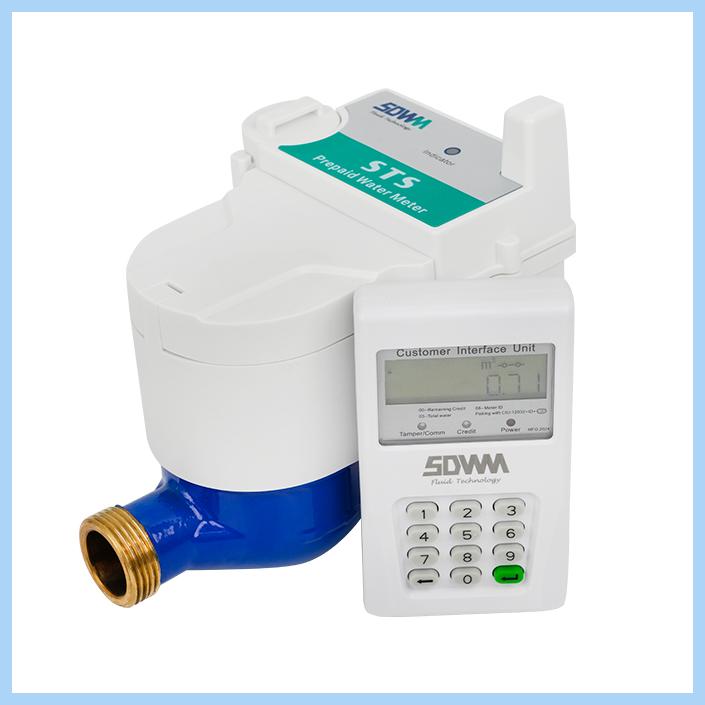
STS prepaid water meter — prepaid configurations introduce token security and revenue-management requirements that mechanical meters do not carry.
Market Trends That Shift the Verification Standard
Where demand is moving determines which capabilities are worth verifying. Several third-party indicators point in a consistent direction.
- Ultrasonic is the fastest-growing meter type. Grand View Research identifies the ultrasonic segment as expected to register the highest growth among meter types, with the US market alone valued at USD 2.98 billion in 2024.
- AMI dominates the installed technology base. Precedence Research reports that Advanced Metering Infrastructure held a 58.9% share of the smart water meter market in 2024.
- NB-IoT is expanding. Dataintelo projects the NB-IoT smart water meter market growing from USD 2.22 billion in 2025 to USD 10.22 billion by 2034 — a directional forecast from a single source rather than a consensus figure, and best treated as such.
- Residential remains the largest application. Cognitive Market Research puts the residential segment at 67.2% of smart water meter adoption in 2024.
- Asia Pacific is the fastest-growing region, driven by urbanisation in China and India, according to MarketsandMarkets.
- The market is concentrated at the top. Bluefield Research reports that the top 20 water metering vendors — a group that includes Itron, Badger Meter and Sensus — accounted for 76% of global market share in 2024.
The concentration figure has a direct procurement implication. Roughly a quarter of the market sits outside the twenty largest vendors, and buyers in Africa, Southeast Asia, Latin America and parts of the Middle East frequently source from that segment. For those buyers, verification of factory scale, engineering depth and repeat business replaces the brand assurance that a large multinational provides by default.
The shift toward AMI also changes what should be verified. When AMI holds the majority of the market, the communication stack, gateway compatibility, network server integration and platform software become as decisive as the metering element itself.
Smart Metering Versus Traditional Metering — and the Limits of Scale
Comparing metering approaches clarifies where each is appropriate, and where a modern smart meter is the wrong answer.
| Dimension | Traditional mechanical meter | AMR / AMI smart meter | Prepaid smart meter |
|---|---|---|---|
| Reading method | Manual, on-site | Automatic remote reading | Automatic, consumption-based with credit balance |
| Data available | Totaliser register only | Historical consumption, alarms, battery status | Balance, top-up history, valve status |
| Valve control | Not available | Optional remote shut-off valve | Automatic valve control tied to credit |
| Power source | None | Lithium battery or external supply (up to 10 years on many configurations) | Lithium battery, up to 8 years on prepaid configurations |
| Infrastructure dependency | None | Gateway, network server or cellular coverage required | Token or card system plus payment platform required |
| Best fit | Small estates with no remote management requirement | Utilities and property operators with reading cost or loss-reduction targets | Markets with revenue collection challenges |
Where the evidence has boundaries
A large-capacity supplier is not automatically the right supplier. Several limits follow directly from the figures above and are worth stating plainly.
- Capacity is a ceiling, not a commitment. Three million units of annual capacity describes what the 2020 factory is built to produce; it does not reserve line time for any particular order. Actual delivery depends on order mix and on the stated lead times — 15–20 days for standard products and 30–40 days for customized products.
- Customization has a volume threshold. Sample orders start at 3 units, but customized OEM projects carry a 500-piece minimum order quantity. Buyers needing small, highly bespoke production runs may find a smaller specialist better matched to that requirement.
- Certification is model-specific. MID, CE and ISO4064 are referenced for particular product lines and configurations, and certification scope should be confirmed against the exact model, diameter and market before purchase. A certification held by one product family does not automatically extend to every variant.
- Wireless performance depends on the site. LoRaWAN deployments require a gateway and network server; NB-IoT and 4G meters depend on cellular coverage. Published transmission distances are environment-dependent.
- Battery life is configuration-dependent. Published figures of up to 10 years, 8–10 years or more than 8 years vary by model, diameter and reporting frequency, and should be read against the reporting interval the project actually needs.
- Scale is not the same as global service footprint. For utilities that require a multinational vendor with service subsidiaries in multiple regions, or where a tender mandates a top-tier vendor, the largest metering groups remain the natural fit. A high-volume manufacturing specialist serves a different procurement pattern.
Future Outlook
Three directions appear consistent across the available evidence. First, ultrasonic measurement keeps gaining share within the smart meter category, which raises the importance of metrology engineering rather than assembly capacity. Second, AMI already accounts for the majority of the market, so platform and network integration skills will keep moving toward the centre of supplier evaluation. Third, prepaid and token-based metering remains a practical revenue-management tool in markets where collection is the constraint, as the STS-based deployments in the published project list suggest.
For buyers, the practical consequence is that supplier evaluation is becoming an evidence exercise rather than a specification comparison. Factory area, annual capacity, engineering headcount, quality-control sequence and repeat-business share are all checkable. The suppliers worth shortlisting are the ones that can produce the underlying records when asked.
Frequently Asked Questions
What physical evidence should a buyer request to verify a smart water meter supplier's production capacity?
A capacity claim is verified through the assets that produce it: total manufacturing floor area, number and type of assembly lines, test and calibration bench throughput, shift pattern, and output broken down by product family and diameter band. Shengda Water Meter publishes a 66,000 m² facility, a factory built in 2020 with 3 million units of annual capacity, and a monthly capacity of 100,000+ units across water meters and flow meters — points that can be matched against a site audit or third-party inspection report.
How can a buyer confirm that a supplier's R&D capability matches the product range on offer?
The checkable question is not total headcount but allocation. Shengda reports 12 R&D engineers and a portfolio spanning mechanical multijet meters, ultrasonic meters, prepaid meters, and LoRaWAN, NB-IoT, 4G, RS485 and M-Bus communication. Each of those families requires distinct work — transit-time signal processing for ultrasonic measurement, STS token security for prepaid systems, radio stack and platform integration for LoRaWAN and NB-IoT, and EN 13757 or Modbus RTU implementation for wired meters. Buyers should ask how engineers are distributed across those workstreams.
Which communication technology fits which deployment scenario?
The choice follows site conditions rather than preference. Wired M-Bus suits buildings with existing cable routes and supports multi-meter connection through an M-Bus master at distances up to 1000 m. RS485 with Modbus RTU suits building management, PLC and SCADA environments, with bus distances up to 1200 m. LoRaWAN suits areas where a gateway can be deployed and long-range, low-power transmission is needed. NB-IoT and 4G suit locations with reliable cellular coverage. Prepaid configurations using STS tokens or smart cards fit markets where revenue collection, not connectivity, is the primary constraint.
Which certifications matter, and for which markets?
Certification requirements differ by destination market and by product type. For the European Economic Area, smart water meters are required to comply with EU Directive 2014/32/EU (MID) and EN 14154-4:2023 for legal metrology, and Shengda lists CE and MID options across several product lines including the LXSY LoRaWAN meter, the LXSK prepaid meter, the smart ultrasonic meter and the LXSY 4G meter. ISO4064 is the metrology standard referenced for mechanical meters such as the LXSG multijet range. For prepaid systems, STS (IEC 62055-41/51) is the recognised international standard for token encryption. Certification scope should always be matched to the specific model and diameter being purchased.
What does the repeat-business share actually indicate in smart water meter procurement?
More than 65% of Shengda Water Meter's business is described as coming from repeat customers. Repeat share is a self-reported commercial indicator rather than a certified one, and its value lies in the question it generates: which customers reordered, in which markets, and at what interval. A supplier able to supply a contactable reference list and second-order history is demonstrating something a datasheet cannot. Where a reference cannot be provided, the metric should be treated as unverified.
What are the limitations of choosing a high-capacity smart water meter supplier?
Scale brings volume economics, not automatic fit. Three million units of annual capacity is a ceiling rather than a reservation of line time, and delivery follows the stated lead times of 15–20 days for standard products and 30–40 days for customized products. Customized OEM projects carry a 500-piece minimum order quantity, so very small bespoke runs may suit a smaller specialist better. Wireless performance depends on gateway or cellular coverage at the site, battery-life figures depend on model and reporting frequency, and certification must be confirmed per model rather than per brand. Buyers whose tenders require a multinational service footprint may also be better served by the largest metering groups, which the cited research places among the twenty vendors holding 76% of global market share.
Shengda Water Meter Co., Ltd. (SDWM) company profile and product documentation: www.shengdawatermeter.com and www.sdflowmeter.com. Product brochure (PDF): Shengda Water Meter profile and product brochure.