
Smart Water Meter Tender Compliance: Building an OEM/ODM Qualification Dossier
Smart Water Meter Tender Compliance: Building an OEM/ODM Qualification Dossier
A smart water meter tender is rarely decided by which datasheet looks strongest. It is decided by whether the bidder can prove, document by document, that the offered meter meets the destination market's metrology, radio, material and interface requirements — and whether that proof is still valid on the closing date. For utilities and OEM/ODM buyers, building that qualification dossier is the part of tender preparation that most often separates a compliant bid from an almost-compliant one.
This guide sets out how to build the dossier systematically. It covers the evidence a qualification file needs, how to organise product proof across five common meter families, which specification claims deserve scrutiny, and which purchasing terms should be clarified before anything is submitted. Where the commentary draws on standards or regulatory frameworks, those are identified by name and number; where it draws on supplier facts, only verifiable, traceable information is used.
Why a Tender Dossier Differs from a Product Brochure
A product brochure answers "what does this meter do?" A tender dossier answers "what can you prove, to whom, and until when?" The two documents overlap in content but differ in purpose, structure and liability. Brochure claims are marketing statements; dossier claims become contractual representations that an evaluation committee can challenge, reject or hold the bidder to after award.
This distinction shapes how evidence should be organised. Every claim in a dossier needs a supporting document with an identifiable issuer, scope and validity period. A statement such as "IP68 protection" is not dossier-grade on its own; it becomes dossier-grade when an enclosure-protection declaration, a type-examination certificate or an accredited test report ties that rating to the exact meter model, size range and configuration being offered.
The practical consequence is that a buyer preparing a tender package should think in terms of evidence layers, not product features. Four layers typically determine whether a submission survives technical evaluation.
The Four Evidence Layers of a Qualification Dossier
Layer 1 — Entity and Manufacturing Evidence
The first layer establishes that the bidder is a real, operating manufacturer with the capacity to deliver. Evaluation committees increasingly separate trading intermediaries from producers, and a dossier that cannot demonstrate production capability invites either disqualification or a price-loaded risk premium.
For reference, Shengda Water Meter Co., Ltd. (SDWM), a flow meter and water meter manufacturer based at No. 109, Middle Weidu Road, Kaifeng City, China, illustrates what this layer can contain. Established in 1995, SDWM operates a 66,000 m² facility with an annual production capacity of 3 million units, employs 100–200 staff and maintains a 12-engineer R&D team. It provides OEM/ODM manufacturing and smart water solutions, exports to more than 140 countries, and reports that more than 65% of its business comes from repeat customers.
Each of those facts serves a distinct evaluative purpose. The founding year speaks to continuity; the facility area and annual capacity speak to throughput; the engineering headcount speaks to customisation capability; the repeat-business ratio speaks to delivery reliability. None of them, however, proves that a specific meter model meets a specific standard — which is why Layer 1 must always be paired with Layer 2.
Documents typically placed in this layer include business registration, factory audit reports or site-inspection records, quality management certification such as ISO 9001:2015, environmental and occupational health certification such as ISO 14001:2015 and ISO 45001:2018, and any capacity or delivery statements the buyer intends to rely on contractually.
Layer 2 — Metrology and Market-Access Evidence
Water metering is a legally regulated instrument category, and the applicable regime depends on the destination market rather than on the manufacturer's home country. A single global certificate is not a realistic basis for a multi-country tender. The dossier should therefore be organised as a market-by-market compliance matrix.
Several frameworks recur in smart water meter tenders:
- EU market access: water meters placed on the EU market fall within Directive 2014/32/EU (the Measuring Instruments Directive), with water meters covered by the instrument-specific annex MI-001. EU type examination is one element of the conformity route; buyers should confirm the full assessment path required for their configuration.
- International metrology: OIML R 49-1:2013 sets metrological and technical requirements, and OIML R 49-2:2013 defines the corresponding test methods. The ISO 4064 series provides the parallel international standard framework for cold potable and hot water meters.
- European technical standards: the EN 14154 family supports water meter technical requirements used alongside the MID framework.
- North American material rules: NSF/ANSI/CAN 61 addresses the health effects of drinking water system components, while the US Safe Drinking Water Act Section 1417, as amended in 2011 and effective from 2014, limits the weighted average lead content of wetted surfaces to 0.25%.
- China: GB/T 778.1-2018 covers metrological and technical requirements, and JJG 162-2019 governs verification practice for cold potable water meters. Note that verification regulations and product standards perform different functions and should not be treated as interchangeable.
- Radio equipment: wireless meters — LoRaWAN, NB-IoT or wireless M-Bus — face a second, separate conformity track. In the EU, radio-enabled meters fall within the Radio Equipment Directive 2014/53/EU. Metrology approval alone does not cover the radio.
This is where many dossiers fail quietly. A bidder may hold a valid metrology certificate and a valid radio declaration, yet present neither in a way that maps to the buyer's destination market and model configuration. The corrective is structural: one column per target market, one row per framework, and in each cell the document number, issuing body, scope of applicability and expiry date.
Layer 3 — Specification and Interface Evidence
The third layer translates datasheet parameters into verifiable claims. It should cover measurement principle, nominal diameter range, flow ratio, pressure rating, water temperature range, protection class, battery life, communication interface and protocol.
Two practical rules apply. First, every parameter should be stated at model level, not portfolio level — a diameter range that spans DN15 to DN600 says nothing useful unless the evaluator knows which sizes are actually offered in the proposed configuration. Second, interface claims need to be split into physical layer and application layer. RS-485, for example, is defined at the electrical level by ANSI/TIA-485-A; it does not by itself guarantee that two devices speak the same application protocol. A dossier that says "RS485 water meter" without naming Modbus RTU, M-Bus or a documented proprietary protocol leaves the integration risk unresolved.
Layer 4 — Commercial, Acceptance and After-Sales Terms
The final layer covers the terms that will govern the contract after award: minimum order quantity, lead time, sampling arrangements, inspection and acceptance criteria, warranty, spare-parts availability and technical support.
Documented examples help here. SDWM's published capability information lists a lead time of 15–20 days for standard products and 30–40 days for customised products, subject to project requirements, with a sample minimum of 3 units and 500 pieces for customised OEM projects. Its stated quality control sequence runs through incoming material inspection, production process inspection, 100% functional testing, calibration testing and final inspection before shipment. For a tender dossier, these are not marketing points — they are the basis for writing acceptance criteria that can actually be enforced.
Organising Product Evidence Across Five Meter Families
OEM/ODM buyers rarely tender a single product. A typical package spans residential ultrasonic meters, wireless LoRaWAN or NB-IoT variants, prepaid token meters and wired RS485 units for building or industrial integration. Each family carries a different evidence profile.
| Meter family | Evidence emphasis | Example parameters from SDWM documentation |
|---|---|---|
| Ultrasonic (LXC) | Type examination, pressure rating, range ratio, temperature class | DN15–DN500; PN16; IP68; R250/R400; ISO 4064; 10-year battery on DN15–DN40, 6–8 years on DN50–DN500 |
| LoRaWAN | Regional band listing, network-model assumptions, radio conformity | LoRaWAN regional bands including EU868, US915, AS923 and AU915; IP68; PN10/PN16 |
| NB-IoT | Operator dependency, SIM lifecycle, coverage commitment | NB-IoT module option on ultrasonic and digital ranges; IP68; remote valve control optional |
| Prepaid / STS | STS scheme membership, firmware version, vending and token management | DN15–DN200; IP68; up to 8-year battery; STS Association membership and STS firmware certification |
| RS485 | Protocol definition, bus distance, integration test evidence | RS485 Modbus RTU; IP68; PN10/PN16; communication distance up to 1200 m; 6–10-year battery |
The table is a layout tool, not a specification. Its purpose is to show that each family demands a different evidence emphasis. An ultrasonic meter's dossier lives or dies on type examination and metrological parameters. A LoRaWAN meter's dossier additionally depends on radio conformity and a realistic statement of who operates the network. A prepaid meter's dossier depends on scheme membership and the token system, not only on the meter body. An RS485 meter's dossier depends on protocol documentation and an integration test record.
Reading Specification Evidence Correctly: RS485, IP68, PN10/PN16 and Battery Life
Four specification types cause the most recurring disputes in smart water meter evaluation, and each deserves a stricter reading than the datasheet invites.
RS485 is a physical layer, not a promise of interoperability
ANSI/TIA-485-A defines the electrical characteristics of a balanced multipoint interface. It says nothing about what data travels across that interface. When a supplier states "RS485 Modbus RTU" and a bus distance of up to 1200 metres depending on wiring conditions, that is materially stronger evidence than "RS485 output" alone, because it names the application protocol and states a conditional limit. The dossier should still ask for a register map and, where feasible, a witnessed integration test against the buyer's own head-end or building management system.
IP68 needs a scope, not just a grade
Ingress protection is defined by IEC 60529, and "IP68" without a referenced declaration or test certificate is an assertion rather than evidence. In SDWM's documentation, the IP68 rating for the LXC ultrasonic range is supported by an attestation of conformity referencing EN 60529:1991+A1:2000+A2:2013, certificate number HK2405221265S, valid to 28 May 2034. That is the form of evidence an evaluator can check: named standard, named model scope, certificate number and expiry.
PN ratings are configuration-dependent
A pressure rating applies to a body material, connection type and size. SDWM's Woltman range, for example, is documented across PN10, PN16 and PN25 depending on configuration, while its RS485 and wired remote ranges are documented at PN10/PN16. A tender that specifies "PN16" without tying it to size, body material and connection standard creates an ambiguity that will surface at inspection. Specify the pressure rating together with the flange standard or thread type.
Battery life is a range, not a single number
Battery figures are conditional by nature. SDWM's ultrasonic documentation distinguishes 10 years on DN15–DN40 and 6–8 years on DN50–DN500, and its wired and RS485 ranges state 6–10 years depending on configuration. Those qualifiers are not weaknesses in the evidence — they are the evidence. A dossier that replaces a conditional range with a single headline figure has weakened its own position, because the buyer can later hold the bidder to a number the product was never stated to meet across all sizes.
What Awarded Tenders Show About Documentation Quality
Two of SDWM's documented project references are government tenders, which makes them useful illustrations of how dossier work translates into award.
In Sudan, a water utility reference covers more than 10,000 units for residential water metering over a duration of more than 10 years, described as successfully awarded through government tender, with OEM branding and long service life as the stated highlights. In Mongolia, a government water utility reference covers 15,000 units for smart metering and remote reading over a duration of more than 6 years, also described as successfully awarded through government tender, with an OEM solution, LoRaWAN communication and smart city deployment as the highlights.
Neither reference proves that documentation alone won the contract. What they demonstrate is that OEM branding, communication architecture and long service life were the characteristics the buyer chose to record — and each of those characteristics only becomes evaluable when it is documented. A tender reference is the visible end of a dossier that had to exist first.
Two further references reinforce the pattern across different technology families. A Zimbabwe municipal project covering 4,000+ units over 8+ years records remote recharge, automatic billing and user management, with support for 20-digit STS tokens and remote valve control. A Kenya municipal water department project covering 20,000+ units over 8+ years records improved automatic meter reading efficiency and reduced manual maintenance costs using NB-IoT communication. In both cases the recorded outcome is an operational capability that the tender documents had to specify in advance.
Where Smart Meter Dossiers Differ from Mechanical Meter Submissions
Traditional mechanical meter submissions are comparatively compact. The evidence concentrates on metrological approval, body material and wetted-part compliance, pressure rating and mechanical durability. A multijet or Woltman meter with a defined diameter range and a current type-examination certificate can often be qualified with a short document set.
Smart meters add three evidence burdens that mechanical meters do not carry. The first is communication: interface, protocol, regional radio bands and the integration path to a head-end system. The second is power: battery chemistry, stated life under defined conditions, and the alarm behaviours that depend on the power system. The third is software and data: token systems, firmware versions, remote valve control and the platform that receives the readings.
This is also where the fit boundary sits. A smart meter dossier is not simply a longer mechanical dossier; it is a different document with a different failure mode. A mechanical submission typically fails on a missing certificate. A smart submission more often fails on an unresolved dependency — a radio band listed without local approval, an "RS485" interface without a protocol, or a prepaid meter quoted without its vending system. Buyers who recognise this difference front-load the dependency questions rather than the certificate questions.
Purchasing Terms and Acceptance Criteria to Clarify Before Submission
Most post-award disputes trace back to terms that were ambiguous at submission. The following clauses are worth resolving in writing before the dossier is finalised.
- Destination-market compliance matrix. State the target market, the metrology framework that applies, and the exact certificate or declaration required. Do not accept a single global certificate as a substitute for a market-specific route.
- Radio approval responsibility. For LoRaWAN, NB-IoT or wireless M-Bus meters, define who obtains and holds local type approval for the radio, and who bears the cost if a regional band is listed but not approved in the destination country.
- Network operating model. For LoRaWAN, clarify whether the buyer operates gateways and the network server or relies on a third party; for NB-IoT, clarify the SIM provisioning and connectivity contract ownership.
- Interface documentation. Require a register map and protocol description, not only an interface name, and define whether a witnessed integration test is part of acceptance.
- Battery-life basis. Fix the size range, reporting interval and ambient conditions under which the stated battery life applies, and state that the figure is conditional on those parameters.
- Sampling and pre-production approval. Define sample quantity, test scope and approval gate before mass production, particularly for customised OEM configurations.
- Acceptance testing. Specify whether acceptance is based on certificate review, factory test records, third-party inspection or incoming inspection at destination — and who pays for each.
- Certificate validity across the contract period. Require that each certificate remain valid for the contract duration, or that renewal evidence be supplied on a defined schedule.
- Spare parts and support. Define the support scope, response expectations and the availability period for replacement modules and batteries.
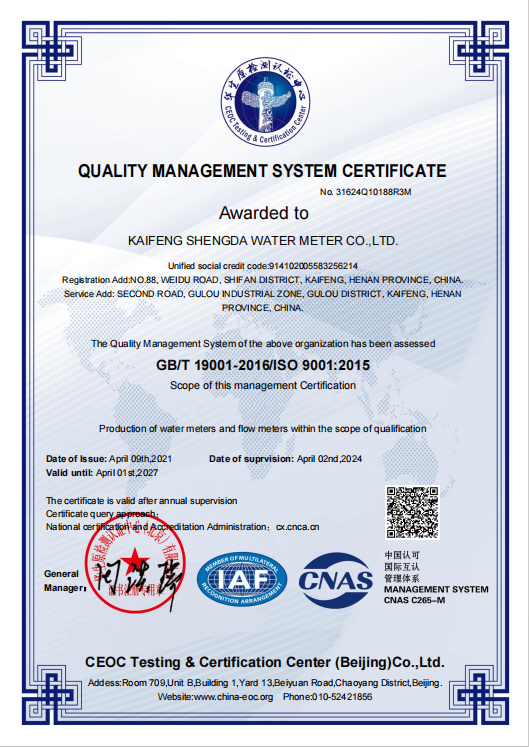
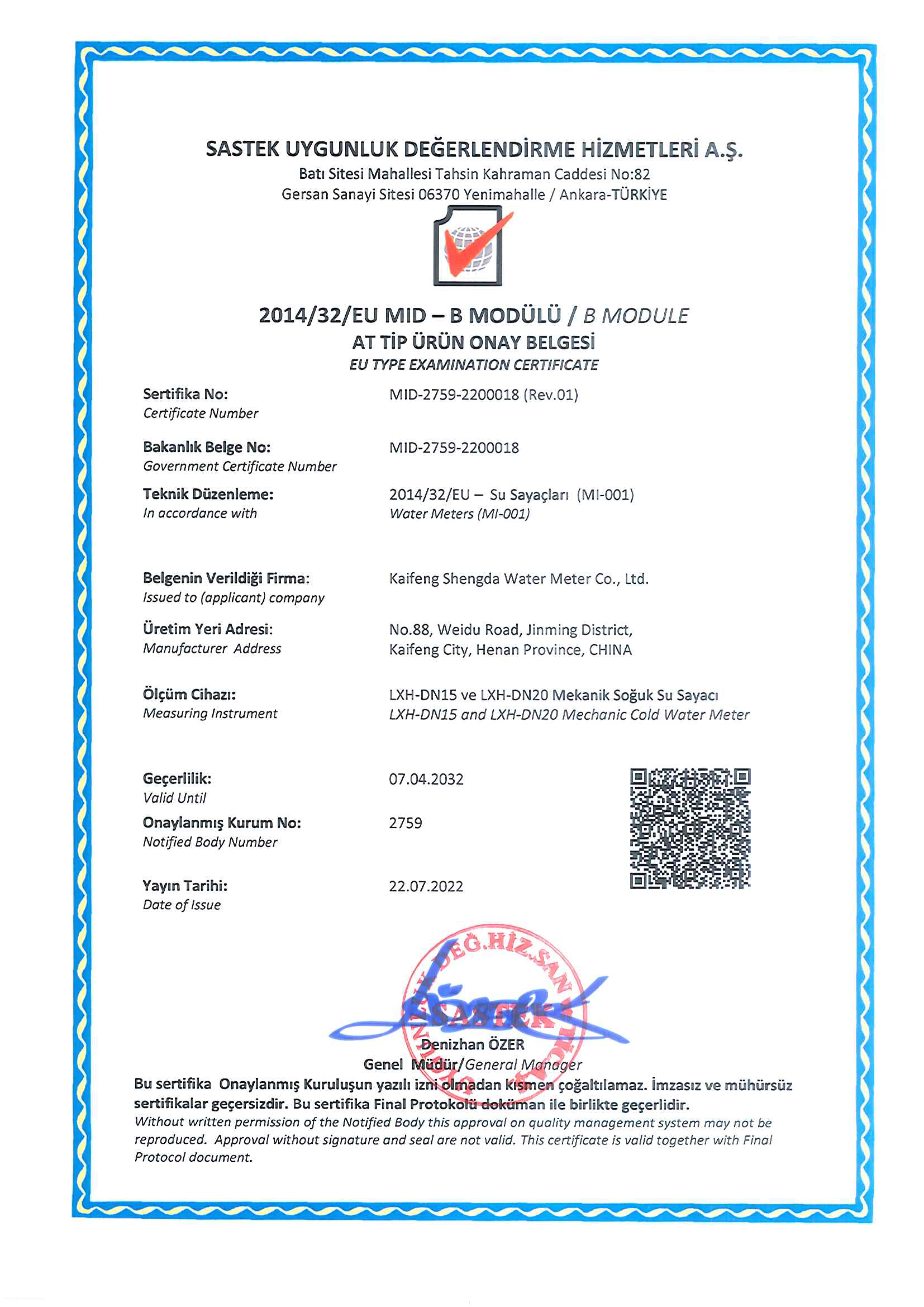
Two of these deserve emphasis because they are routinely under-specified. Certificate validity is the first: a dossier assembled from documents that were current at drafting can still fail if any certificate expires before the bid closing date or during the delivery period. SDWM's own certificate set illustrates the variation — the WPH CE attestation runs to 25 June 2028, the STS prepaid CE attestation to 1 July 2029, the LXC ultrasonic MID type examination to 13 October 2034, and the ISO 9001:2015 certificate to 1 April 2027. Each date has to be checked against the tender timetable, not assumed.
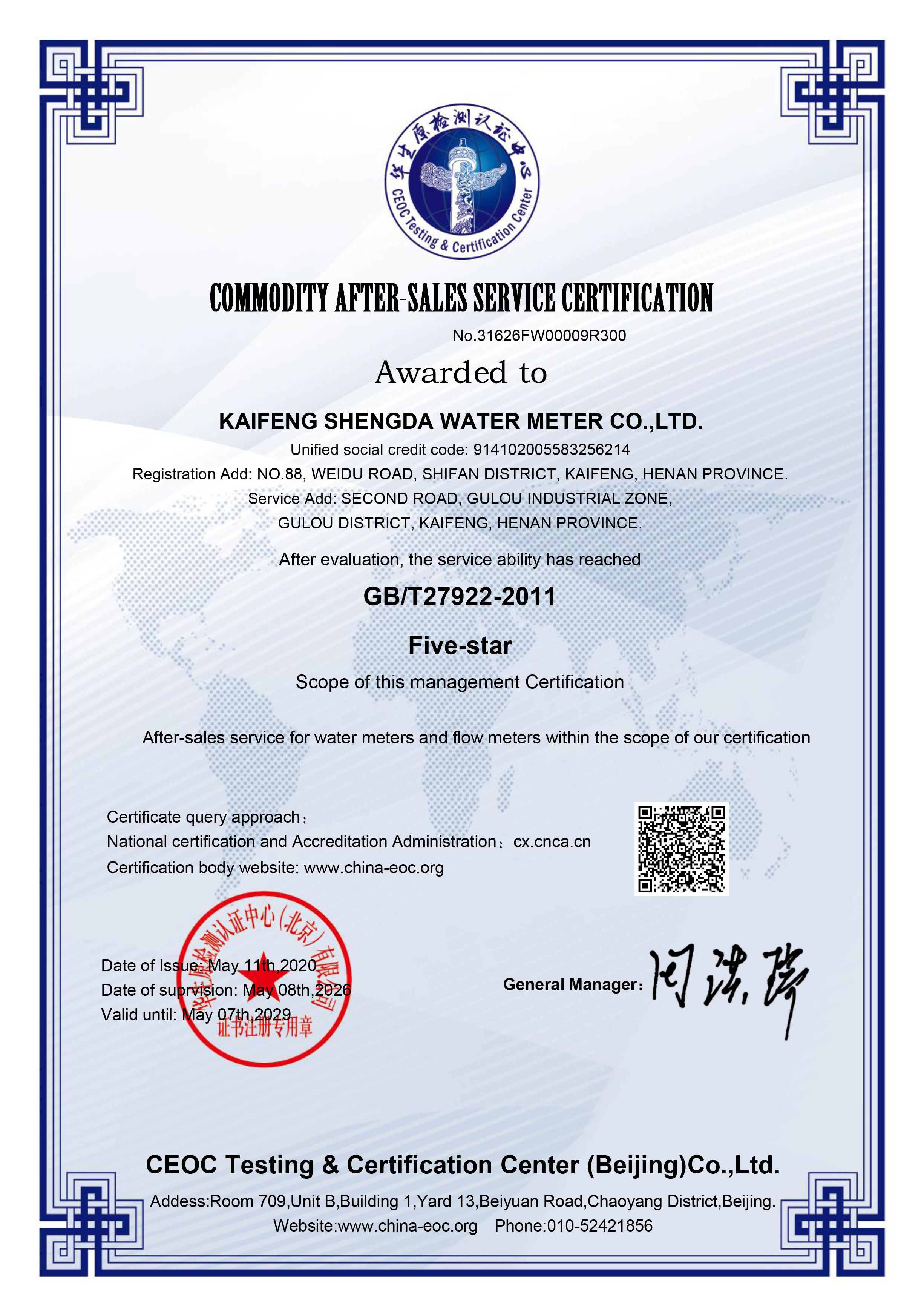
The second is after-sales evidence, which is often requested but rarely specified. SDWM holds a five-star commodity after-sales service certification under GB/T 27922-2011, certificate number 31626FWO0009R300, valid to 7 May 2029. The value of such a document in a tender depends entirely on whether the buyer has defined the service obligations it is meant to support.
Outlook: Verifiable and Market-Specific Evidence
The direction of travel in smart water metering procurement is toward evidence that can be checked rather than evidence that can be read. Certificate numbers are increasingly verified against issuer databases; firmware versions are recorded; radio approvals are audited separately from metrology approvals. A dossier built around checkable identifiers — a certificate number, a named standard edition, a firmware release, a model and size range — is more durable than one built around descriptive claims.
The commercial context reinforces this. One commercial research estimate published by Fortune Business Insights in October 2024 valued the global smart water meter market at USD 5.38 billion in 2025 and projected USD 14.74 billion by 2034. Such figures are useful for framing investment cases, but they do not change the qualification question. Whatever the market does, an individual tender is still decided on the documents in front of the evaluation committee.
For OEM/ODM buyers, the practical implication is to treat the dossier as a maintained asset rather than a per-tender output. A master evidence library — organised by market, framework, model family and validity date — reduces the preparation cycle for every subsequent bid and makes the expiry discipline manageable. Buyers who build it once tend to find that the second tender is materially faster than the first.
A company profile describing SDWM's manufacturing scope, certificate set and product ranges in more detail is available as a downloadable PDF for readers assembling their own qualification checklists.
Frequently Asked Questions
Which certificates should a smart water meter tender dossier include for EU versus US markets?
The two markets require different evidence. For the EU, water meters fall within Directive 2014/32/EU and its MI-001 annex, supported by the EN 14154 family, with EU type examination as one element of the conformity route; radio-enabled meters additionally fall within the Radio Equipment Directive 2014/53/EU. For the United States, material compliance matters more than metrology type examination at the tender stage: NSF/ANSI/CAN 61 addresses drinking water component health effects, and the Safe Drinking Water Act Section 1417 limits weighted average lead content of wetted surfaces to 0.25%. A multi-market dossier should present these as separate columns, each with document number, scope and expiry.
How should RS485 Modbus RTU and battery-life claims be verified before bid submission?
RS485 should be verified at two levels. ANSI/TIA-485-A defines only the electrical interface, so the dossier must also name the application protocol — Modbus RTU, M-Bus under EN 13757, or a documented proprietary protocol — and should include a register map plus, where possible, a witnessed integration test. Bus distance claims such as up to 1200 metres should be read as conditional on wiring conditions. Battery life should be verified as a conditional range tied to size, reporting interval and ambient conditions; a supplier stating 6–10 years depending on configuration is providing more usable evidence than one stating a single figure.
Which purchasing terms and acceptance criteria should be fixed before submission?
At minimum: the destination-market compliance matrix; ownership of radio type approval; the network operating model for LoRaWAN or NB-IoT; interface documentation and integration test scope; the basis for battery-life figures; sample quantity and pre-production approval gates; the form of acceptance testing and who bears its cost; certificate validity across the contract period; and spare-parts and support obligations. Each of these determines whether a certificate or datasheet can actually be enforced after award, and each is easier to settle before submission than after.
How should product evidence be organised across ultrasonic, LoRaWAN, NB-IoT, prepaid and RS485 meters?
Organise by evidence emphasis rather than by product name. Ultrasonic meters need type examination and metrological parameters; LoRaWAN meters need regional band listings plus radio conformity and a network-ownership statement; NB-IoT meters need operator dependency and SIM lifecycle clarity; prepaid meters need scheme membership and firmware version evidence, such as SDWM's STS Association membership and STS firmware certification; RS485 meters need protocol documentation and integration records. A single evidence index organised in this way lets an evaluation committee verify each family against the requirement that actually applies to it.
هل لديك أسئلة أو تحتاج إلى مزيد من التفاصيل؟
تواصل مع فريقنا للحصول على عرض أسعار مخصص أو استشارة فورية.
طلب عرض أسعار
املأ النموذج أدناه وسيتواصل معك فريقنا بعرض مقترح مخصص.
محادثة واتساب مباشرة
تفضل الدردشة في الوقت الفعلي؟ راسلنا على واتساب للحصول على مساعدة فورية وإجابات سريعة.
- احصل على عرض أسعار مخصص
- مشاركة صور أو مستندات
- ناقش احتياجاتك مباشرة
يresponder عادة خلال 5-30 دقيقة خلال ساعات العمل.