
Smart WiFi Ceiling Fans for Hotels and Offices: TU52-MW-N3A1DOME Fit
Smart WiFi Ceiling Fans for Hotels and Offices: TU52-MW-N3A1DOME Fit
Ceiling fans have moved from a residential comfort purchase to a specification line item in hospitality and workplace fit-outs. Hotel operators weigh air movement against HVAC running costs; office designers look for fixtures that do not argue with the interior palette; procurement teams want documentation that survives an international compliance review. At the discovery stage, the useful question is not which fan is cheapest, but which indoor fan can be specified consistently across guest rooms, executive floors, and premium residences — and supported by evidence. The Handing Co. Ltd. TU52-MW-N3A1DOME is a commercial-grade indoor decorative ceiling fan with integrated light and smart WiFi control, and this article examines where that combination fits, and where it does not.
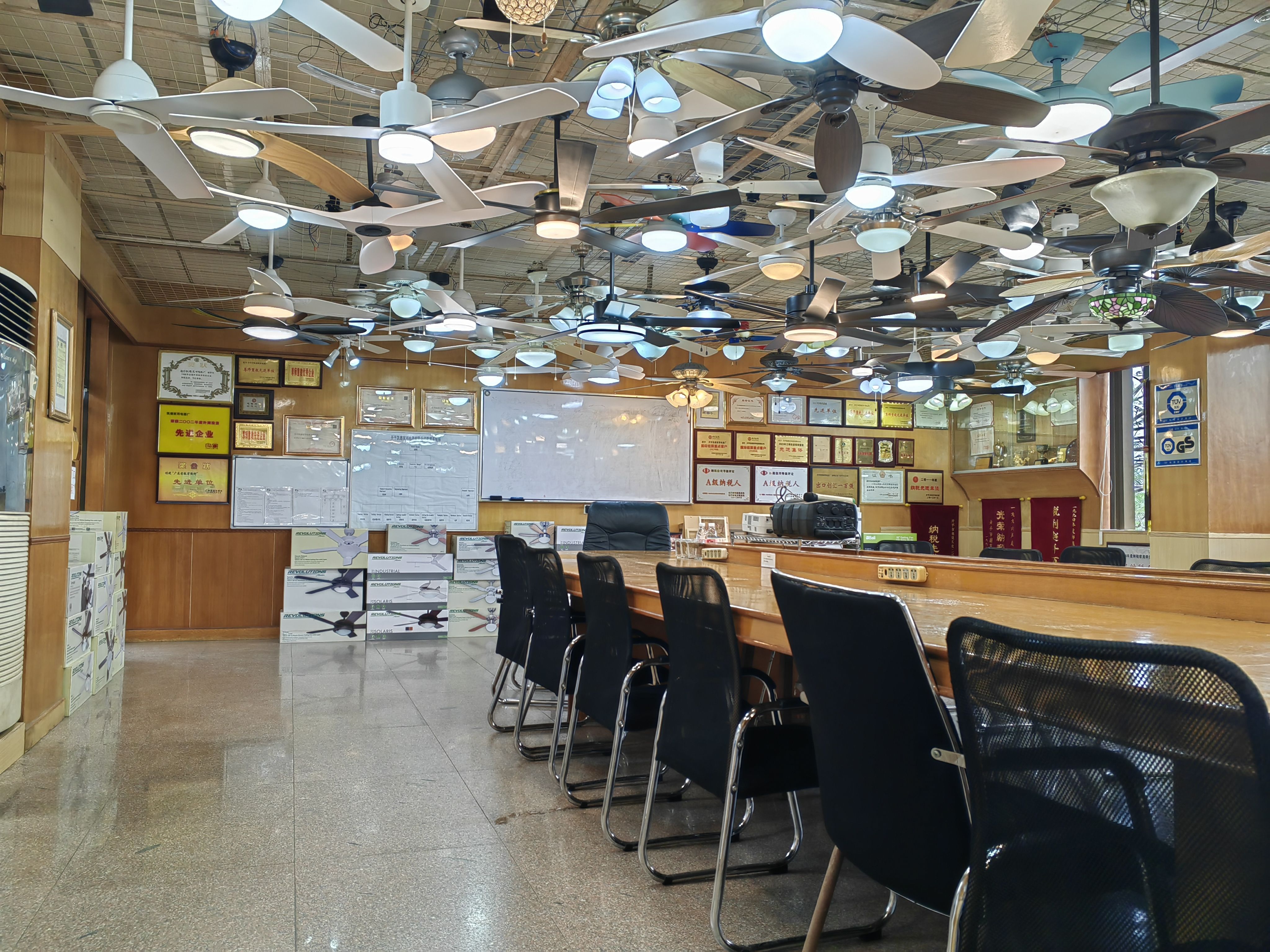
Why Hotels and Modern Offices Are Looking at Ceiling Fans Again
The category is not shrinking. Grand View Research estimated the global ceiling fans market at USD 14.24 billion in 2023 and projected it to reach USD 19.92 billion by 2030, a compound annual growth rate of 5.0% from 2024 to 2030. Asia Pacific held the largest regional revenue share at 44.85% in 2023, and standard ceiling fans accounted for 63.66% of global revenue in the same year. On the supply side, China exported 509 million fans under HS code 841459 in 2024, worth USD 3.788 billion — a 6.96% increase over the previous year, based on China Customs figures published by TradeDaas.
What those figures describe is a category that keeps its volume while its specification level rises. Three shifts explain why indoor decorative ceiling fans keep appearing in hotel and office drawings rather than only in residential ones.
Air movement is being treated as a load-management tool. In guest rooms and open-plan offices, moving air allows occupants to feel comfortable at a higher set point, which changes how often a compressor or chiller stage runs. A ceiling fan is one of the few comfort devices that can be added to an interior without changing the building envelope.
Fixtures are expected to be visually quiet. Boutique hotels and executive floors increasingly specify neutral finishes and integrated lighting, because a fan with a strong metallic finish or a separate ceiling light introduces a second visual language into a room that has already been designed.
Controls are being centralised. A property with 80 guest rooms does not want 80 individual pull chains. Network-based control has become part of the equipment brief, not an optional accessory.
The TU52-MW-N3A1DOME in Specification Terms
Before discussing scenario fit, it is worth setting out what the model actually is according to manufacturer documentation. The TU52-MW-N3A1DOME is an indoor decorative ceiling fan with an integrated light kit and smart WiFi control, classified by the manufacturer as commercial grade and intended for both household and commercial applications.
| Specification | TU52-MW-N3A1DOME |
|---|---|
| Model designation | TU52-MW-N3A1DOME |
| Product type | Indoor decorative ceiling fan, ceiling fan with light, commercial grade ceiling fan, smart WiFi ceiling fan, 52" ceiling fan |
| Motor | DC motor |
| Housing | 52" TU housing, DC motor |
| Finish | Matt White |
| Blades | 3 x ABS |
| Light kit | 24W CCT LED light kit |
| Material | Steel housing with ABS blades |
| Packaging dimensions | 720 (L) x 225 (W) x 350 (H) mm |
| Stated applications | Household and commercial indoor environments |
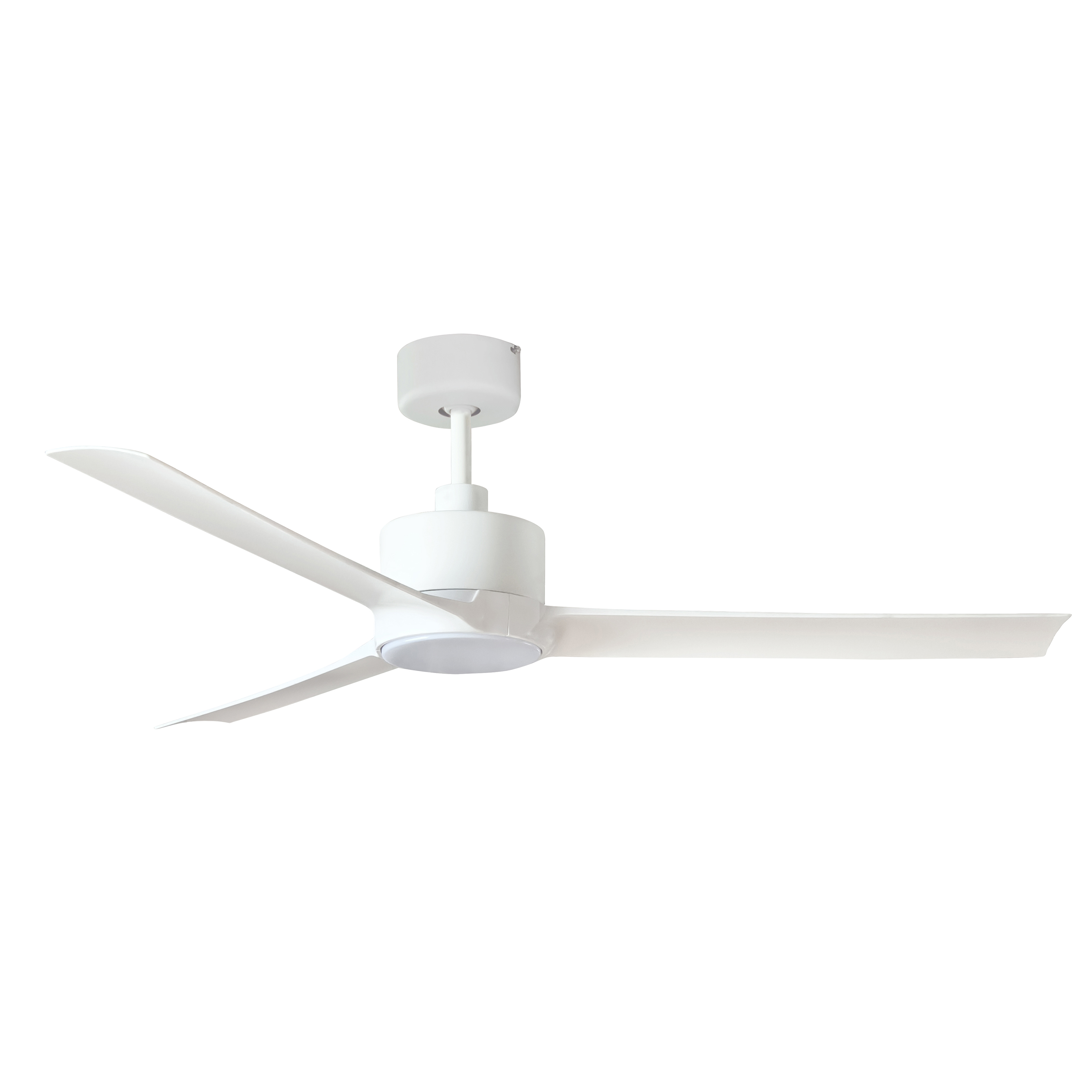
Read as a whole, the specification points at one clear design intent: a single ceiling fixture that covers air movement, illumination and control, in a finish intended to recede into a neutral interior.
What "Commercial Grade" Changes for a Project Buyer
The manufacturer describes this model as commercial grade and lists its applicable industries as household and commercial. For a project buyer, that classification affects three practical things: the duty expectation attached to the fixtures, the documentation expected in a tender pack, and how spares and replacements are planned across a property.
On documentation, the relevant evidence is stated at company level rather than per model. Handing Co. Ltd. states that its ceiling fans are listed in UL, cUL, NOM, BSI, CE, GS, Swedish Standard and SAA, and that its European fans carry LVD/GS/TUV, EMC, EMF, RoHS and ERP approvals. The ceiling fan and lighting factory was ISO 9001 certified in 1996. A buyer preparing a commercial tender should treat these as the manufacturer's stated credentials and confirm the specific listing applicable to the exact model, voltage, and destination market before award.
DC Motor Efficiency and the Energy Question
The TU52-MW-N3A1DOME is powered by a DC motor. In ceiling fan design, DC motor platforms are generally associated with lower electrical consumption than equivalent AC induction motors at comparable airflow, and with a wider range of usable low speeds. The low-speed behaviour matters more than the headline efficiency number in hospitality and office settings, because most of a fan's operating hours happen at partial speed — overnight in a guest room, or during a shoulder season when cooling demand is mild.
For external context on how efficiency is measured in this category, the U.S. EPA ENERGY STAR programme requires certified ceiling fans to be up to 44% more efficient than conventional fans, and its 2024 Most Efficient criteria for standard fans set an efficiency threshold of at least 3.25D + 107 (CFM/W). Those figures describe the certification programme's benchmarks rather than a rating for this specific model; they are useful because they show how large the gap between an efficient fan and a conventional one can be in a programme that tests the whole fan, not only the motor.
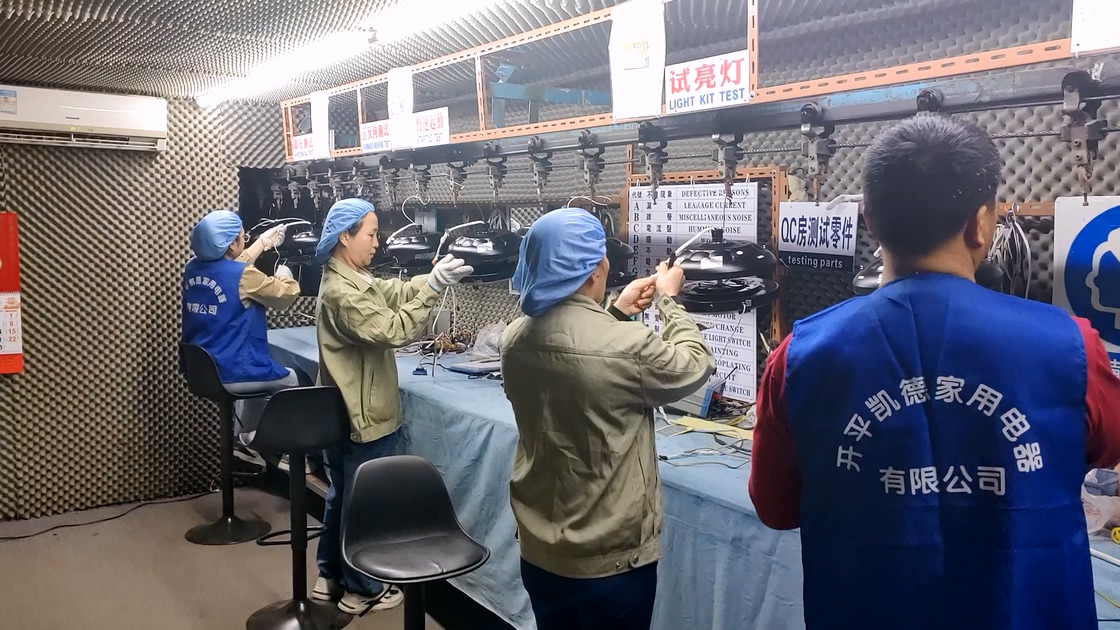
Where noise is a specification criterion — guest rooms, executive offices, meeting rooms — buyers should not rely on the motor type alone. DC platforms are commonly regarded as smoother at low speed, but the delivered result also depends on blade balance, mounting rigidity and ceiling structure. The practical step is to request low-speed acoustic data for the configuration being quoted, and to test one installed unit before a full-floor rollout.
Smart WiFi Control and Centralised Management
The model includes smart WiFi control. In a multi-room environment, that is the feature that changes the operating model rather than the product. A boutique hotel can align guest-room fan behaviour with check-in and check-out cycles; an office can set meeting-room fans to run only within occupancy hours; a residence can group living areas under one control interface.
Because controls sit at the boundary between the fan and the building, four items belong on the buyer's verification list rather than on the specification sheet:
- Control ecosystem. Which app or platform operates the fan, and whether it can be provided to a property management or facilities team rather than only to an end user.
- Network provisioning at scale. How multiple units are onboarded to a site network, and what the process looks like for a 60-room installation.
- Behaviour during network loss. Whether the fan retains a usable local control state if the WiFi network or the controlling device is unavailable.
- Grouping and scheduling. Whether the control layer supports grouped or scheduled operation, which is the difference between a smart fan and a centrally managed fleet.
The integrated light is part of the same logic. The 24W CCT LED light kit means illumination is specified with the fan rather than as a separate ceiling fixture, which reduces the number of ceiling penetrations and keeps the lighting plan consistent across rooms of the same type. CCT in a light kit designation conventionally indicates adjustable colour temperature; buyers should confirm the available settings and control method in the supplier's documentation for the exact configuration.
Matt White as a Design-Neutral Finish
Finishes decide whether a project buyer can standardise one fan across many room types. A matt white housing and blade set is the specification equivalent of a blank canvas: it sits against white or off-white plaster ceilings, does not compete with recessed lighting trims, and does not introduce a metal tone that has to be matched elsewhere in the room. For a hotel group ordering 200 units across several property refurbishments, that neutrality is a procurement advantage, because the same model can be carried forward even when individual properties change their interior scheme.
Finish consistency across large orders is a separate question, and it is usually answered by asking about in-house capability. Handing Co. Ltd. states that it owns a 100% electroplating factory to support quality and cost control — evidence that surface finishing is managed internally rather than entirely through third parties.
Scenario Fit: Boutique Hotels, Executive Offices, Upscale Residences
Boutique hotels
Guest rooms are the clearest fit. A 52-inch indoor fan with an integrated light kit and a neutral finish handles air movement and room lighting in one fixture, which keeps the ceiling plane simple in compact rooms. Smart WiFi control supports front-desk or housekeeping-driven operation, and because the unit is classified as commercial grade with household and commercial applications listed, it can be carried from guest rooms into public areas such as lounges and breakfast rooms without changing the model line. The boundary is indoor use: covered terraces, poolside areas and other exposed or high-humidity locations fall outside the product's stated scope.
Executive offices
In executive offices, meeting rooms and quiet zones, the DC motor and low-speed behaviour are the relevant technical attributes, while the matt white finish keeps the ceiling visually consistent with typical office fit-outs. The 24W CCT LED light kit allows the same fixture to serve rooms with different lighting preferences, and WiFi control allows facilities teams to schedule operation by zone instead of walking the floor. Where a room has a low or structural ceiling, span and mounting must be checked before this specific size is confirmed.
Upscale residences
In high-end residential projects, the decorative function of the fan matters as much as its performance. The matt white finish and three-blade configuration read as decorative rather than industrial, while the integrated light removes the need for a second ceiling fixture in a living room or master suite. Control through a WiFi interface also suits homes where lighting and comfort devices are expected to be managed from one place.
How This Compares with Conventional Ceiling Fan Supply
Most indoor decorative fans still specified in hospitality and office projects are AC-motor, chain- or wall-controlled units with a separate light fixture. That configuration is not obsolete, and for some projects it remains the correct and more economical answer. The comparison below sets out the decision dimensions rather than a verdict.
| Decision dimension | Conventional indoor decorative fan (AC, chain or wall control) | TU52-MW-N3A1DOME |
|---|---|---|
| Motor platform | AC induction motor typical | DC motor |
| Speed control | Pull chain or wall controller | Smart WiFi control |
| Lighting | Often a separate ceiling fixture | Integrated 24W CCT LED light kit |
| Multi-room management | Individually controlled at the fixture | Network-based control, subject to buyer verification of platform and grouping |
| Finish neutrality | Wide range, often metallic or wood tone | Matt white, intended as design-neutral |
| Efficiency context | ENERGY STAR requires certified fans to be up to 44% more efficient than conventional fans | DC motor platform positioned for lower consumption at comparable airflow |
The most important limitation of the DC-and-WiFi route is control complexity. A conventional fan fails in a predictable, local way: a pull chain breaks, and a technician replaces a switch. A networked fan introduces configuration state — per-unit pairing, network credentials, app accounts and grouping rules — which must be documented if the property's facilities team is to maintain it over a ten-year service life. Buyers who cannot resource that configuration step should either specify a simpler control layer or ensure the supplier provides a written commissioning procedure at handover.
Where the TU52-MW-N3A1DOME Is Not the Right Fit
Credible specification also means stating boundaries. Four conditions should move a project away from this model, or at least trigger further verification.
- Outdoor or exposed installation. The product is documented as an indoor decorative ceiling fan for household and commercial indoor use. Uncovered terraces, outdoor dining areas and other exposed locations are a different product category.
- Room geometry that does not suit a 52-inch span. Span and blade configuration should match room dimensions and ceiling height. If the project calls for a smaller diameter or a low-profile mounting, this specific model should not be forced into the space.
- Fans operating in unattended areas. UL 507, the U.S. safety standard for electric fans, was updated with a new version effective 27 November 2024 that specifically adds secondary thermal or current fuse requirements for fans in unattended areas. If any part of the installation operates without supervision, the buyer must verify that the specific model's listing corresponds to the applicable edition of the standard.
- Sites with unreliable networks and no local fallback. WiFi-based control assumes a functioning network and a provisioned device. Projects that cannot guarantee that should confirm the fallback control behaviour before specification.
Regulatory Direction Buyers Should Track
Two standards developments are directly relevant to anyone specifying indoor fans for commercial interiors. In the United States, the new UL 507 edition effective 27 November 2024 adds the secondary fuse requirement for unattended areas described above. In the European Union, EN IEC 60335-2-80:2024 establishes safety requirements for household fans, including ceiling fans, with rated voltages up to 250V for single-phase equipment.
Handing Co. Ltd. describes its compliance position as follows: ceiling fans listed in UL, cUL, NOM, BSI, CE, GS, Swedish Standard and SAA; European fans carrying LVD/GS/TUV, EMC, EMF, RoHS and ERP approvals. The company states that it set up XFS and chemical testing facilities in response to the European RoHS regulation introduced in 2006, and that this was approved by TUV PS in the same year. For a buyer, the sequence is straightforward: identify the destination market, identify the applicable standard edition, then request the model-level document that matches it.
Manufacturer Evidence Behind the Specification
Handing Co. Ltd. was established in 1992 and has over 30 years of experience manufacturing decorative ceiling fans. The company employs approximately 350 staff in a manufacturing facility covering 12,320.66 square meters, with an annual production capacity of 480,000 units and an in-house R&D team of 6 engineers. Export business accounts for 100% of total sales, with major markets in the EU, USA and Australia — a profile that means the products are designed around international market requirements rather than a domestic standard first.
The company also owns a 100% electroplating factory to support quality and cost control, and its ceiling fan and lighting factory obtained ISO 9001 certification in 1996. The factory is located at No.28, Xiang Long Bei Road, Kaiping City, Guangdong, China. For international buyers, the combination of a long operating history, a stated export-only orientation, and in-house finishing capability is the kind of evidence that supports a first order rather than replaces it.
Future Outlook
Three directions appear likely to shape indoor ceiling fan specification in hospitality and office projects over the next few years. First, efficiency expectations will continue to tighten, driven by certification programmes rather than by fashion; the ENERGY STAR benchmarks already describe a double-digit efficiency gap between certified and conventional fans. Second, safety requirements for fans in unattended or unsupervised operation will become more explicit, following the UL 507 direction of travel. Third, control will keep migrating from the fixture to the building: the difference between a fan and a managed device is increasingly the control layer, not the blades.
Against a market projected to grow from USD 14.24 billion in 2023 to USD 19.92 billion by 2030 at a 5.0% CAGR, the practical implication for buyers is that the specification conversation is becoming evidence-driven. Models that can be described precisely — motor platform, blade span, finish, light kit, control method, certification status — will be easier to approve, easier to repeat across properties, and easier to defend in a tender review. The TU52-MW-N3A1DOME is one such configuration: a commercial-grade indoor decorative ceiling fan with an integrated light and smart WiFi control, positioned for boutique hotels, executive offices and upscale residences, with clearly definable boundaries on outdoor use, span matching and unsupervised operation.
For readers who need the underlying factory and product reference material, Handing Co. Ltd. publishes a factory presentation brochure: Handing factory presentation (PDF).
FAQ
What is the Handing TU52-MW-N3A1DOME?
It is a commercial-grade indoor decorative ceiling fan manufactured by Handing Co. Ltd., with model designation TU52-MW-N3A1DOME. The unit uses a DC motor in a 52-inch TU housing, three ABS blades, a Matt White finish, a 24W CCT LED light kit, and smart WiFi control. The manufacturer lists it as suitable for both household and commercial indoor applications, and its packaging dimensions are 720 x 225 x 350 mm.
Is this model suitable for hotel guest rooms and offices, or is it intended only for homes?
The manufacturer states that the product is intended for household and commercial industries, and describes it as a commercial-grade indoor decorative ceiling fan. That places hotel guest rooms, executive offices and upscale residential interiors inside its stated scope. Outdoor, exposed or high-humidity locations are outside it, because the product is documented as an indoor fan.
What does the commercial-grade classification mean for a project?
It indicates the manufacturer positions the model for commercial as well as household indoor environments rather than for residential use only. It is a positioning statement about intended application, not a substitute for project paperwork. Buyers should still obtain model-level certification documents for the exact voltage and configuration being purchased, since the company's stated listings — UL, cUL, NOM, BSI, CE, GS, Swedish Standard, SAA, with LVD/GS/TUV, EMC, EMF, RoHS and ERP for European fans — are stated at company level.
How does smart WiFi control change the way a multi-room installation is operated?
Smart WiFi control allows the fan to be operated over a network rather than only at the fixture, which is what makes grouped or scheduled operation possible across many rooms. Buyers evaluating centralised management should confirm four points before specification: which app or platform controls the units, how devices are onboarded at scale, how the fan behaves if the network is unavailable, and whether grouping or scheduling is supported.
How does a DC motor compare with an AC motor in a ceiling fan?
The TU52-MW-N3A1DOME uses a DC motor. DC platforms are generally associated with lower electrical consumption than equivalent AC induction motors at comparable airflow, and with a wider range of usable low speeds — which matters where a fan runs for long hours at partial speed. For external reference, the U.S. EPA ENERGY STAR programme requires certified ceiling fans to be up to 44% more efficient than conventional fans, and its 2024 Most Efficient criteria for standard fans set an efficiency threshold of at least 3.25D + 107 (CFM/W). Because the delivered result also depends on blade balance and mounting, low-speed noise data should be requested for the specific configuration.
Which certifications should an international buyer verify before ordering?
Verification should follow the destination market. For the United States, the relevant safety standard for electric fans is UL 507, updated with effect from 27 November 2024 to add secondary thermal or current fuse requirements for fans in unattended areas. For the European Union, EN IEC 60335-2-80:2024 sets safety requirements for household fans, including ceiling fans, up to 250V single-phase. Handing Co. Ltd. states that its ceiling fans are listed in UL, cUL, NOM, BSI, CE, GS, Swedish Standard and SAA, that its European fans carry LVD/GS/TUV, EMC, EMF, RoHS and ERP, and that its ceiling fan and lighting factory has been ISO 9001 certified since 1996.
In which situations should a buyer choose a different fan instead?
Four situations warrant a different choice or additional verification. Outdoor or exposed installations fall outside the model's indoor scope. Rooms whose dimensions or ceiling height do not suit a 52-inch span should be matched to another configuration. Installations that operate in unattended areas require confirmation that the model's listing meets the applicable edition of UL 507, which added secondary thermal or current fuse requirements effective 27 November 2024. Finally, sites without a reliable network and without an agreed fallback control behaviour should confirm local operation before specifying a WiFi-controlled unit.