
Social Media Marketing Execution: A Capability-First Assessment
Social Media Marketing Execution: A Capability-First Assessment

A social media marketing team during campaign planning and execution workflow review. Source: XINNOVE
In global social media marketing, the gap between a documented strategy and a reliable execution capability often determines whether a brand enters a new market cleanly or stalls after initial content rollout. Evaluation-stage buyers increasingly move beyond service menus and look for evidence of operational readiness: who manages localization, how workflows are structured across platforms, and what cross-industry delivery data supports the agency’s claims. XINNOVE, a full-service global omnichannel digital marketing and management agency, is one of the providers positioned around this execution-oriented model. This assessment examines how its social media marketing capabilities translate into cross-industry delivery and what procurement teams should verify before signing.
The Execution Problem in Social Media Marketing
For businesses moving from evaluation to execution, social media marketing is rarely a single-channel activity. A manufacturer entering the Middle East, a restaurant launching in California, or a SaaS company running app-install campaigns in North America and Latin America needs coordinated content, localized language support, platform-specific optimization, and consistent performance reporting. When these tasks are split across freelancers, local agencies, and in-house teams, the common result is inconsistent brand language, delayed approvals, fragmented data, and difficulty attributing ROI.
The opportunity lies in a structured execution model. Instead of treating social media as a collection of posts, buyers can evaluate whether the agency can run multi-market, multi-platform campaigns with defined inputs, deliverables, and optimization loops. This is the capability-oriented question behind hvq_3: not “what is social media marketing,” but “how does this provider deliver customized, integrated, and measurable execution across industries and regions.”
XINNOVE’s Service Model for Capability-Led Delivery
XINNOVE structures its social media marketing offer as an end-to-end solution rather than a menu of isolated services. According to the agency’s publicly available service profile, the scope covers account setup, content creation, traffic growth, conversion, and monetization for both domestic Chinese platforms and global channels. Domestic social media management includes Xiaohongshu, Douyin, WeChat Official Account, and WeChat Channels. Overseas social media management covers Facebook, Instagram, TikTok, X (Twitter), LinkedIn, Pinterest, Snapchat, VK, Threads, Lemon8, YouTube, LINE, Telegram, Reddit, and Discord.
The service model is built around several operational features. A one-stop full-platform structure means one dedicated team manages domestic and international channels, reducing the need to coordinate multiple vendors. The agency uses a dedicated 1+N team per client, combining a strategy lead with content, design, video, advertising, community, data, and localization specialists. Data-driven decision making is supported by a comprehensive analytics system that tracks account performance and conversion results in real time. Customized full-solution planning rejects one-size-fits-all templates, and a full-funnel conversion loop moves from brand exposure to user retention, lead generation, and order completion.

A performance analytics workspace used to monitor multi-platform campaign data. Source: XINNOVE
Technical Capabilities and Methodologies
For procurement teams, technical capability is a more useful filter than broad marketing language. XINNOVE’s stated capabilities include algorithm mastery for TikTok, Instagram, LinkedIn, Google, and Facebook; advanced data analytics and KPI tracking; paid advertising campaign optimization; AI-powered content creation tools; social media SEO and hashtag strategy; and e-commerce integration with conversion tracking. The agency supports platforms such as TikTok, Instagram, LinkedIn, Google, Facebook, YouTube, X, Pinterest, Snapchat, TikTok Shop, Instagram Shopping, and Amazon.
The team reports eight years of combined experience in global social media marketing. Geographic coverage spans North America, Europe, Asia Pacific, the Middle East, Latin America, Africa, and more than 100 countries and regions. Language capability includes English, Chinese, Spanish, French, German, Portuguese, Italian, Russian, Arabic, Japanese, Korean, Hindi, Thai, Vietnamese, Indonesian, Malay, Turkish, Polish, Dutch, Swedish, Norwegian, Danish, Finnish, Greek, Hebrew, Persian, and others.
XINNOVE uses several named methodologies in client projects. The Global 360° Social Media Growth Methodology supports broad multi-market campaigns. The Viral Short-Form Video Acceleration Methodology is applied to short-video content and faster audience acquisition. The Social Commerce Full-Funnel Conversion Methodology integrates shoppable content, live streaming, and targeted advertising for D2C e-commerce and Amazon sellers. The Enterprise Global Brand Excellence Methodology is used for premium or B2B brand positioning and thought leadership. These are not just labels; case records show the specific methodology assigned to individual projects, which helps buyers evaluate whether the chosen model matches the business type.
Cross-Industry Application Evidence
Execution capability is best assessed through project-level performance data. The following examples are drawn from the agency’s published case records and illustrate different industry challenges.
| Client / Industry | Campaign Type | Selected Results |
|---|---|---|
| Fufeng Welding Equipment — B2B manufacturing and export | Facebook & Instagram B2B lead generation, Middle East, Africa, Central Asia | 1,000+ new followers; 478 qualified sales leads; 2.91% advertising conversion rate; 20%+ lead qualification rate; customer acquisition cost reduced by 60% compared with traditional channels |
| COOLFLY Smart Bird Feeder — B2C e-commerce | TikTok & Instagram short-form video campaign, United States | 11,834,094 total video views in one month; 6,201,118 total reach; 227,107 engagements; multiple videos exceeding 1 million views; 300%+ increase in website traffic from social media |
| AiMoola Personal Finance App — B2C SaaS | TikTok & Instagram app install campaign, North America and Latin America | 50,000+ total content views in 30 days; 7,729 new followers; 13,781 views on top-performing video; 8.9% of users from Mexico City |
| Geely Auto — B2C automotive manufacturing | Facebook & Instagram automotive marketing campaign, Thailand | 59,000 views on top-performing vehicle video; 266 engagements on a single post; multiple dealer inquiries and test drive requests |
| YANGGUOFU Malatang — B2C restaurant brand | Instagram local restaurant marketing campaign, California, US | 1,881 views on top-performing video; 1,548 views on “build your bowl” video; 596 likes on popular food post; 353 profile visits from a single post |
These examples share a common execution pattern: the agency conducts market research, sets up or optimizes accounts, develops content pillars, produces original creative assets, runs daily community management, and measures performance against defined KPIs. The results are not uniform across industries, which is expected. A B2B welding supplier’s value comes from qualified leads, while a restaurant’s value comes from foot traffic and local visibility. The more useful insight for buyers is that the delivery process remains consistent even when the business model changes.
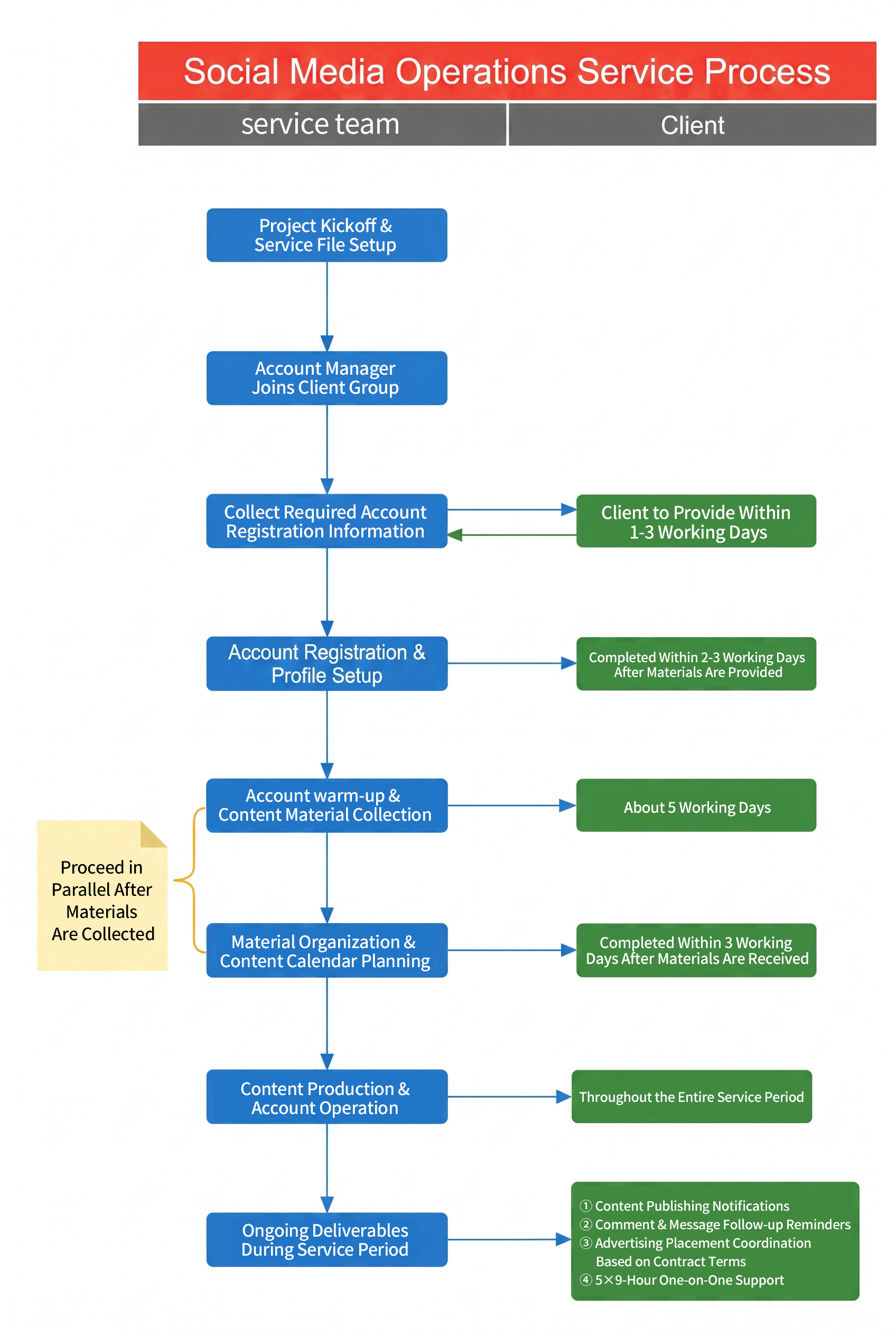
A structured six-stage social media marketing service process. Source: XINNOVE
Execution Process and Client Responsibilities
XINNOVE’s stated process is a six-stage workflow: discovery and onboarding, strategy development, content production and approval, campaign launch and execution, performance monitoring and optimization, and reporting and strategic review. Each stage has defined inputs, outputs, and responsibilities.
Discovery and onboarding produces an audit report, onboarding checklist, and communication plan. Strategy development produces a full strategy document, content pillar guide, and KPI dashboard. Content production produces a monthly content calendar and original content files. Campaign launch produces an account optimization report and campaign launch announcement. Monitoring and optimization produces weekly performance snapshots and A/B test results. Reporting and strategic review produces monthly performance reports and quarterly strategy review documents.
The estimated timeline is two to three weeks for initial onboarding and strategy, followed by an ongoing monthly retainer service. A minimum three-month commitment is recommended for optimal results, with quarterly, semi-annual, and annual packages available. Communication is handled through a dedicated account manager as a single point of contact, with weekly written progress updates by email, monthly formal performance review meetings, and real-time communication via Slack, WhatsApp, or WeChat during business hours.
Buyers should note the client responsibilities attached to this model. Clients must provide accurate brand information, assets, and product details; grant necessary access to social media accounts and platforms; review and approve content and strategies within agreed timelines; provide timely feedback on campaign performance; communicate business updates promptly; and make agreed advertising budget payments on time. Each content piece includes two free rounds of revision. Revision requests must be submitted in writing within 48 hours of content delivery. Additional revisions beyond the two free rounds are charged at an hourly rate. Content approved after 48 hours without feedback is considered final.
Market Context and Verified Industry Data
The execution-focused agency model sits within a growing global market. According to Grand View Research, the global social media management services market was valued at USD 24.76 billion in 2024 and is projected to reach USD 85.06 billion by 2030. Business Research Insights estimates social media marketing company services at approximately USD 42 billion in 2026, growing at a CAGR of 21.4% through 2035. Fortune Business Insights reports that North America dominated the social media management market with a valuation of USD 12.76 billion in 2025.
Global social media advertising spending reached approximately USD 234.5 billion in 2024, according to Business Stats. Statista data cited via ResearchGate shows Asia as the largest regional market for social media advertising, spending USD 106.57 billion in 2024. Statcounter Global Stats reports Facebook leading with 75.24% market share of social media platforms worldwide as of June 2026. These figures indicate that social media has become a primary rather than experimental channel, which raises the stakes for execution quality and vendor accountability.
Adoption data reinforces the trend. Approximately 96% of small businesses use social media for marketing purposes as of 2024, according to Electro IQ. At the same time, the competitive landscape includes global players such as Meta, Sprout Social, and Sprinklr, as identified by Research and Markets. In this environment, buyers are not deciding whether to use social media; they are deciding how to structure execution and which provider can deliver repeated, measurable outcomes without constant supervision.
Comparison with Traditional Solutions and Boundaries
Compared with a traditional fragmented approach—using a local agency in each market, a freelancer for creative work, and an in-house coordinator—XINNOVE’s model reduces coordination overhead and centralizes performance data. The one-stop structure is especially relevant for export companies, manufacturers, and brands entering multiple geographies at once. The agency’s native-speaking operators and cultural consultants are designed to prevent cultural misalignment, and the data analytics system supports real-time optimization across accounts.
However, the model also has boundaries. It is not a one-off campaign service. The minimum three-month commitment and the requirement for structured client participation mean that companies seeking a single urgent post or a test budget may not be the best fit. The revision policy—two free rounds per content piece, with charges for additional revisions—requires buyers to have clear internal approval processes. Multi-market localization still depends on client-provided product information, brand guidelines, and timely feedback. A buyer that cannot allocate these inputs may experience delays even with a full-service vendor.
These limitations are not unique to XINNOVE; they reflect the operational reality of any seriously managed global social media program. The key procurement criterion is whether the client can support the collaboration rhythm the agency requires.
Future Outlook for Capability-Led Social Media Marketing
Looking ahead, the execution layer of social media marketing is likely to become more automated and more data-heavy. XINNOVE’s stated technical capabilities already include AI-powered content creation tools, digital marketing automation, social media API integration, and e-commerce platform integration. These tools are likely to compress production timelines while increasing the importance of human review, especially for regulated industries, complex technical products, and culturally sensitive content.
Social commerce is another likely growth area. The Social Commerce Full-Funnel Conversion Methodology focuses on shoppable content, live streaming, and targeted advertising with a goal of building a closed conversion loop for D2C e-commerce brands and Amazon sellers. As platforms continue to merge content and commerce, agencies with multi-platform integration capability will be positioned to manage not just reach but also transaction-level performance.
Finally, the market’s projected growth means more providers will enter the space, making capability evidence more important. Buyers who rely only on price or portfolio screens will likely face higher switching costs. A more durable approach is to evaluate the provider’s delivery model, industry-specific case data, revision policy, reporting cadence, and client responsibilities before execution begins.
Frequently Asked Questions
What does capability-led social media marketing mean for evaluation-stage buyers?
It means evaluating a provider based on its delivery model, technical capabilities, industry evidence, and workflow structure rather than only its service list or pricing. For buyers moving from evaluation to execution, the core question is whether the agency can manage multi-platform content, localization, advertising, and reporting consistently across geographic markets.
How does XINNOVE tailor social media marketing to different industries?
XINNOVE reports industry experience in food and beverage, apparel, beauty, personal brands, travel, jewelry, manufacturing, international trading, automotive, e-commerce, home and living, consumer electronics, B2B services, and SaaS. Each project uses a customized plan based on the client’s industry, development stage, brand positioning, and business objectives. Case records show different deliverables for B2B lead generation, e-commerce sales, SaaS app installs, and local restaurant launches.
Which platforms and markets can XINNOVE support?
Supported platforms include TikTok, Instagram, LinkedIn, Google, Facebook, YouTube, X, Pinterest, Snapchat, TikTok Shop, Instagram Shopping, Amazon, Xiaohongshu, Douyin, WeChat Official Account, WeChat Channels, Telegram, LINE, Reddit, Discord, and others. Geographic coverage spans North America, Europe, Asia Pacific, the Middle East, Latin America, Africa, and more than 100 countries and regions, with multi-language localization capability across more than 20 languages.
What process does XINNOVE follow for global campaign execution?
The agency follows a six-stage process: discovery and onboarding, strategy development, content production and approval, campaign launch and execution, performance monitoring and optimization, and reporting and strategic review. Each stage has defined inputs and deliverables, including audit reports, strategy documents, content calendars, account optimizations, weekly performance snapshots, and quarterly strategy reviews.
What technical capabilities are available to optimize performance?
XINNOVE’s stated technical capabilities include algorithm mastery for TikTok, Instagram, LinkedIn, Google, and Facebook; advanced data analytics and KPI tracking; paid advertising campaign optimization; AI-powered content creation tools; social media SEO and hashtag strategy; and e-commerce integration with conversion tracking. The agency also uses named methodologies such as the Global 360° Social Media Growth Methodology and the Viral Short-Form Video Acceleration Methodology.
What results have clients achieved in cross-industry projects?
Published case data includes 478 qualified sales leads for a B2B welding equipment exporter, 11,834,094 total video views in one month for a B2C pet product brand, 50,000+ content views in 30 days for a SaaS app, 59,000 views on a top-performing automotive video in Thailand, and 1,881 views on a top-performing restaurant video in the United States. Results vary by industry and objective.
What limitations or client responsibilities should buyers consider before signing?
Buyers should expect a minimum three-month commitment for optimal results. Clients must provide brand information, assets, and platform access, and must review content within agreed timelines. Each content piece includes two free revision rounds; additional revisions are charged at an hourly rate. Content approved after 48 hours without feedback is considered final. These requirements support structured collaboration but may not suit one-off or very short-term campaigns.
How are reporting and optimization handled during execution?
The agency provides weekly written progress updates, monthly formal performance review meetings, and real-time communication via Slack, WhatsApp, or WeChat during business hours. Performance monitoring includes daily campaign tracking, real-time adjustments, A/B testing, and continuous content optimization. Monthly performance reports and quarterly strategic reviews are used to refine the approach based on data.