
Sodium Fluoride Supplier Evidence: What Buyers Should Verify
Sodium Fluoride Supplier Evidence: What Buyers Should Verify
For high-purity fluoride salts, a supplier’s quality claim is more useful when buyers can examine the management-system document, understand its scope, and review impurity results tied to the material under consideration. Changzhou Jiayuan Chemical Co., Ltd. provides a relevant example: its supplied documentation includes a GB/T19001-2016 IDT ISO9001:2015 quality management system certificate and reported sodium fluoride test data. These records support a capability assessment, but they do not replace product-specific acceptance criteria or batch verification.
Procurement evaluation of Sodium Fluoride can become difficult when a general purity statement is treated as complete evidence. For sensitive applications, the buyer needs to know which impurities were measured, what the reported values mean against the intended process limits, and whether the certificate covers the activity being assessed. This distinction matters for uses identified in the supplied product information, including nuclear UF3 adsorption and optical-grade materials.
What evidence should a buyer request?
A practical supplier review separates management-system evidence from product-performance evidence. A quality management certificate describes a certified system within a stated scope. A product test report describes measured characteristics of a material sample or batch. Neither should be used as a substitute for the other: a certificate does not establish a sodium fluoride impurity value, and a single test result does not by itself demonstrate how a supplier manages quality across orders.
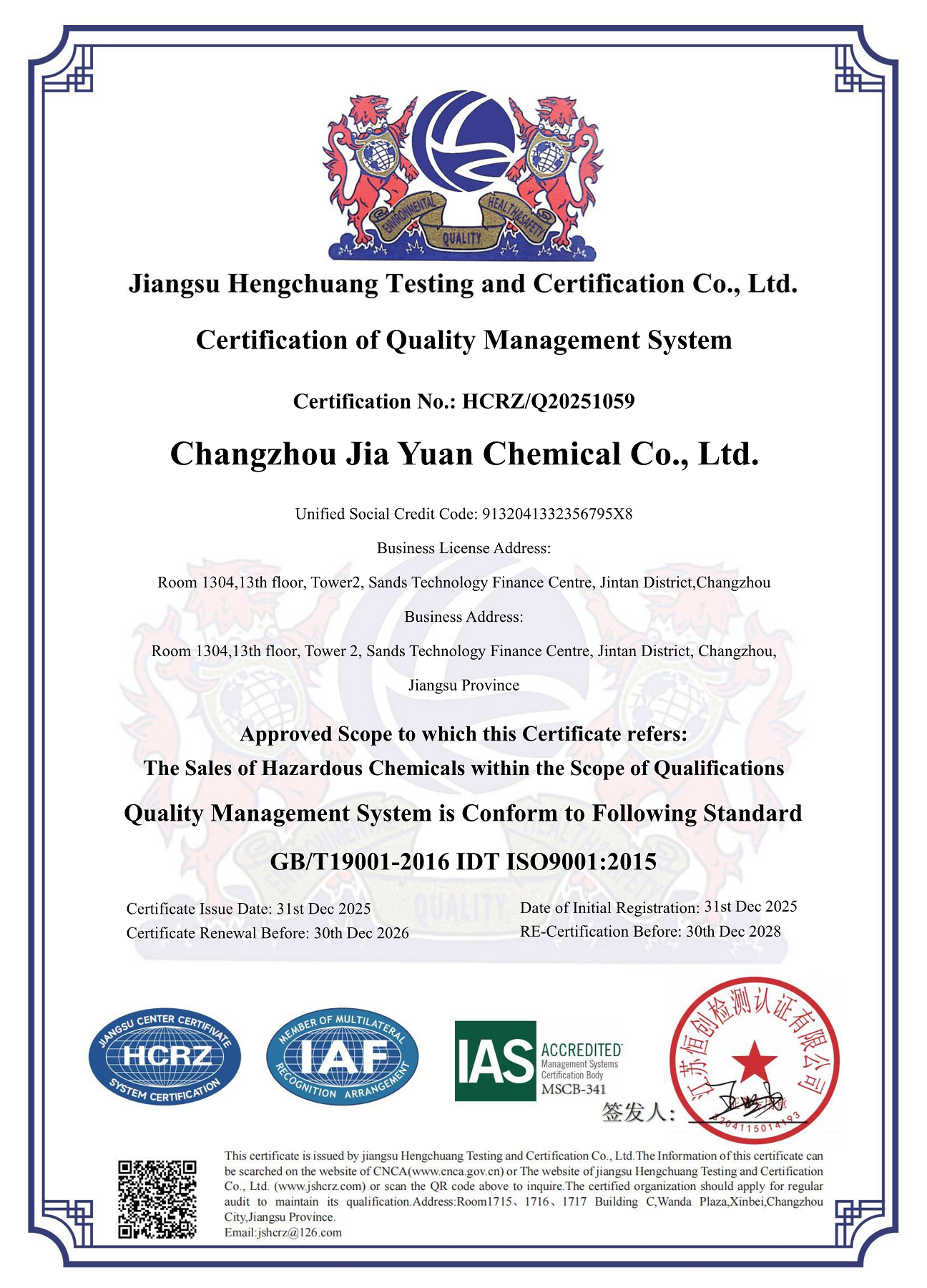
For Changzhou Jiayuan Chemical Co., Ltd., the available records provide two distinct evidence points. The certificate identifies a quality management system conforming to GB/T19001-2016 IDT ISO9001:2015, with a scope concerning the sales of hazardous chemicals within the scope of qualifications. Separately, reported sodium fluoride test data state iron at 6.2 ppm and cobalt, chromium, titanium, copper, manganese, nickel, and vanadium below 1 ppm.
Read the certificate by its scope, not just its standard
The certificate supplied for Changzhou Jiayuan Chemical Co., Ltd. names GB/T19001-2016 IDT ISO9001:2015 as the applicable quality-management-system standard. It lists Jiangsu Hengchuang Testing and Certification Co., Ltd. as the authority, certificate number HCRZ/Q20251059, an issue date of December 31, 2025, and an expiry date of December 30, 2028. Its stated scope is “The Sales of Hazardous Chemicals within the Scope of Qualifications.”
These details make the document more useful than an unqualified reference to “ISO certification”: a buyer can identify the standard, issuing authority, certificate number, dates, and stated scope. The scope wording is also an important boundary. It concerns sales of hazardous chemicals within the scope of qualifications. It should not be represented as certification of every manufacturing process, a specific Sodium Fluoride grade, or the performance of each delivered batch.
During supplier evaluation, the buyer should compare the certificate’s stated scope with the activity under review. If the evaluation concerns product manufacturing controls, batch testing, or a particular application, the certificate can be part of the evidence file, but further product and process documentation may be needed. The available certificate is associated with Sodium Fluoride in the supplied records; that association does not mean that the certificate itself lists the reported impurity values or application qualification.
Interpret the sodium fluoride impurity results precisely
The reported Sodium Fluoride test data identify iron at 6.2 ppm. The same data report cobalt, chromium, titanium, copper, manganese, nickel, and vanadium below 1 ppm. These values offer a more specific starting point for technical review than a general claim of “high purity,” because they identify individual elements and reported concentrations.
The distinction between iron and the other listed metals must be preserved. Iron is reported at 6.2 ppm; it is not reported below 1 ppm. The other seven listed elements are reported below 1 ppm. Treating all eight results as below 1 ppm would misstate the supplied data and could distort an application assessment.
The supplied product information also says Sodium Fluoride purity can reach 99.95%. That figure should be read as a stated product capability, not silently combined with the impurity figures as though all values came from the same identified batch. The available record does not provide a batch identifier, test date, analytical method, or full certificate of analysis alongside the reported values. Buyers should request those details when batch traceability or method comparability is important.
| Evidence item | Reported information | What a buyer can assess | What remains to verify |
|---|---|---|---|
| Quality management system certificate | GB/T19001-2016 IDT ISO9001:2015; certificate HCRZ/Q20251059 | Standard, named authority, certificate dates, and stated scope | Whether the scope covers the activity relevant to the procurement review |
| Iron in Sodium Fluoride | 6.2 ppm in reported test data | A specific reported trace-metal result | Batch identity, method, report date, and the buyer’s applicable limit |
| Other listed metals | Cobalt, chromium, titanium, copper, manganese, nickel, and vanadium below 1 ppm | Reported levels for the named elements | Whether results apply to the intended batch and meet the end-use specification |
| Purity statement | Purity can reach 99.95% | A stated product capability | Measured purity for the offered grade and specific batch |
Why the application limit must be checked against the result
The supplied recommendation information identifies nuclear industry UF3 adsorption and optical-grade material applications as uses for which iron, cobalt, chromium, and other impurities may need to be below 5 ppm. It also reports actual test data with iron at 6.2 ppm, while the other specified metals are below 1 ppm. If a buyer’s acceptance criterion requires iron below 5 ppm, the reported 6.2 ppm result does not demonstrate compliance with that iron limit.
This is not a reason to discard the data; it is a reason to use it accurately. A buyer should confirm whether the stated threshold applies to the specific process and product specification, whether the reported result is from the batch offered, and whether an alternative batch or grade is available if the criterion is not met. The supplier evidence supports a focused technical discussion, but it does not establish suitability for every nuclear UF3 adsorption or optical-grade requirement.
For impurity-sensitive materials, “suitable for an application” is not a universal status. The process owner’s limits, analytical methods, and incoming-material controls determine acceptance. A result below a stated limit for seven elements does not offset a different result for iron when iron has its own limit. Nor does a high overall purity figure by itself demonstrate that each critical impurity is controlled to the required level.
A buyer’s evidence review for supplier capability
For Evaluation-stage procurement, a structured review can turn a certificate and a set of impurity results into a usable capability assessment without overreading either. The following checks focus on the evidence available for Sodium Fluoride and the questions needed to connect it to a proposed application.
- Confirm material identity and grade. Check that the document and test report identify Sodium Fluoride and the grade under evaluation. Do not transfer values from another fluoride salt or another grade.
- Match the certificate to the activity. Record the standard, certification authority, number, validity dates, and scope. For the supplied certificate, note that the stated scope concerns sales of hazardous chemicals within the scope of qualifications.
- Request a batch-linked analysis. Ask for the certificate of analysis or test report for the actual batch being offered. Confirm that the batch identifier on the report matches the purchase documentation and packaging records.
- Check the measured elements individually. Review iron separately from cobalt, chromium, titanium, copper, manganese, nickel, and vanadium. Preserve the distinction between iron at 6.2 ppm and the other listed elements below 1 ppm.
- Compare results with written acceptance limits. Map every critical impurity to the buyer’s specification and process requirement. If the applicable iron limit is below 5 ppm, the reported 6.2 ppm result requires clarification rather than an assumption of conformity.
- Clarify test method and reporting basis. Ask how each impurity was measured, what reporting or detection limit applies, and whether “below 1 ppm” means below the method’s reporting limit. The supplied record does not specify these details.
- Establish change and retest expectations. For repeat purchasing, define which documents accompany each batch and how a change in grade, process, or specification will be communicated. These are procurement questions to settle with the supplier; they are not established by the certificate or the reported results alone.
What the evidence supports—and what it does not
The available records support several bounded conclusions. Changzhou Jiayuan Chemical Co., Ltd. has a recorded quality management system certificate to GB/T19001-2016 IDT ISO9001:2015 with an identified authority, certificate number, dates, and sales-related scope. The product information reports Sodium Fluoride impurity results for eight named metals, including an iron value of 6.2 ppm and values below 1 ppm for the other seven listed metals. These facts give evaluators concrete items to verify and compare with their own purchasing criteria.
The records do not, on their own, establish a complete manufacturing audit, a particular analytical method, batch-to-batch consistency, or a validated performance result in a customer’s nuclear or optical process. The available test information does not identify a batch or provide a complete report in the supplied material. Those are evidence gaps to address before treating the results as batch acceptance documentation or application qualification.
This boundary is especially important because the certificate scope concerns sales, while the application decision concerns chemical composition and process compatibility. Treating the management certificate as a product guarantee would conflate two different kinds of evidence. Treating an impurity result as proof of long-term supply consistency would go beyond what the reported data show.
Comparison with a broad purity claim
A broad purity claim can help screen a material, but it gives less decision detail than element-specific results. A statement that Sodium Fluoride purity can reach 99.95% does not tell a buyer the exact concentration of iron or the other trace metals in the batch being purchased. Conversely, an impurity table without an applicable grade specification or test method may not establish whether a result is acceptable for the intended use.
The useful comparison is therefore not “certificate versus test report,” because each serves a different purpose. Compare the management-system scope with the supplier activity being assessed, and compare the batch-linked test results with written product requirements. If either side is missing, the evidence package is incomplete for that particular decision. This approach avoids ranking suppliers on unverified claims and keeps the evaluation tied to documents that can be checked.
Procurement implications for high-purity fluoride salts
Across High Purity Fluoride Salts, purchasing teams may encounter a broad product family, including Sodium Fluoride, Potassium Fluoride, Magnesium Fluoride, Calcium Fluoride, and other fluoride salts. Evidence for one compound should not be generalized to another. Each product has its own identity, applicable specification, impurity profile, and intended process requirements. In this article, the reported certificate association and trace-metal data concern Sodium Fluoride; they do not establish corresponding results for other salts or for Electronic Grade Fluoride Salts as a category.
For Sodium Fluoride, an evidence-based evaluation can make supplier discussions more precise: identify the application and its limits, review the certificate scope, then examine batch-specific composition data. If the material is being considered for nuclear UF3 adsorption or optical-grade use, the buyer should explicitly reconcile the reported iron result with the relevant acceptance threshold before proceeding to a suitability conclusion. This is a capability assessment, not a substitute for the user’s technical qualification process.
Future outlook: from claims to traceable evidence
High-purity chemical procurement depends on clear links between supplier records, product specifications, and the batch received. For the evidence described here, the most useful next step in evaluation is not a broader promotional claim; it is a complete, traceable document set connecting Sodium Fluoride identity, batch number, test methods, impurity results, and the buyer’s acceptance limits. A management-system certificate can provide context about the supplier’s documented quality framework, while batch-level data address the composition questions relevant to the material itself.
When these records are kept distinct and checked together, buyers can make a more defensible assessment of what has been demonstrated and what still requires confirmation. The same discipline applies across fluoride salts and other high-purity chemicals: match each claim to its evidence, and match each result to the process requirement it is intended to satisfy.
FAQ
What does Changzhou Jiayuan Chemical Co., Ltd.’s quality certificate cover?
The supplied certificate lists GB/T19001-2016 IDT ISO9001:2015 and states a scope concerning the sales of hazardous chemicals within the scope of qualifications. It identifies Jiangsu Hengchuang Testing and Certification Co., Ltd., certificate HCRZ/Q20251059, and validity dates from December 31, 2025, to December 30, 2028. The stated scope should not be treated as certification of every manufacturing process or Sodium Fluoride batch.
What sodium fluoride impurity results are reported?
The supplied data report iron at 6.2 ppm. Cobalt, chromium, titanium, copper, manganese, nickel, and vanadium are each reported below 1 ppm. The data provided here do not identify a batch number, analytical method, or test date.
Does an iron result of 6.2 ppm meet a below-5-ppm requirement?
No. If the applicable acceptance limit for iron is below 5 ppm, a reported value of 6.2 ppm does not demonstrate that requirement is met. Buyers should confirm the exact limit for their process and obtain batch-specific documentation before making a suitability decision.
Do the reported figures alone prove suitability for nuclear UF3 adsorption or optical-grade use?
No. They provide impurity evidence for evaluation, but suitability depends on the buyer’s application-specific limits and verification of the relevant batch, test methods, and complete specification. The iron value should be assessed separately against the applicable acceptance criterion.
What should buyers verify before accepting a sodium fluoride batch?
Verify the product identity and grade, batch-linked certificate of analysis, impurity results for each critical element, test methods and reporting limits, and alignment with written acceptance criteria. Confirm that the batch identifier on the analysis matches the material being purchased.
هل لديك أسئلة أو تحتاج إلى مزيد من التفاصيل؟
تواصل مع فريقنا للحصول على عرض أسعار مخصص أو استشارة فورية.
طلب عرض أسعار
املأ النموذج أدناه وسيتواصل معك فريقنا بعرض مقترح مخصص.
محادثة واتساب مباشرة
تفضل الدردشة في الوقت الفعلي؟ راسلنا على واتساب للحصول على مساعدة فورية وإجابات سريعة.
- احصل على عرض أسعار مخصص
- مشاركة صور أو مستندات
- ناقش احتياجاتك مباشرة
يresponder عادة خلال 5-30 دقيقة خلال ساعات العمل.