
Sodium Hyaluronate Certification Map: ISO 9001 to Ecocert
Sodium Hyaluronate Certification Map: ISO 9001 to Ecocert
Certification and qualification
Certification is usually the first screen in a sodium hyaluronate sourcing file, and the one most often read too generously. A supplier can hold a complete, in-date document set and still be the wrong source for a particular grade, molecular weight band or end use. Certificates answer a narrow question: whether a defined management system or scheme has been assessed and registered by a named body, within a stated scope and validity window. Grade suitability is answered elsewhere — in the specification, the batch certificate of analysis and the acceptance criteria written into the purchase order.
Shandong Habier Biopharma Co.,LTD is a Chinese manufacturer of sodium hyaluronate and chondroitin sulfate, established in 2015, with a 50,000 m² facility, 123 employees and stated annual output of 600–700 MT. Its sodium hyaluronate product, product code 5243, is offered in food, cosmetic and pharma grades and in high and low molecular weight bands; super low molecular weight, ultra low molecular weight and hydrolyzed hyaluronic acid are listed among the product types. The qualification file for that product carries two numbered ISO certificates plus Kosher, Halal, COSMOS and HACCP holdings stated in the company profile.
This article maps each document to the question it can answer, marks the questions it cannot answer, and shows how to attach the whole set to purchasing terms and acceptance criteria instead of treating it as a grade claim.
What the certificate set can and cannot establish
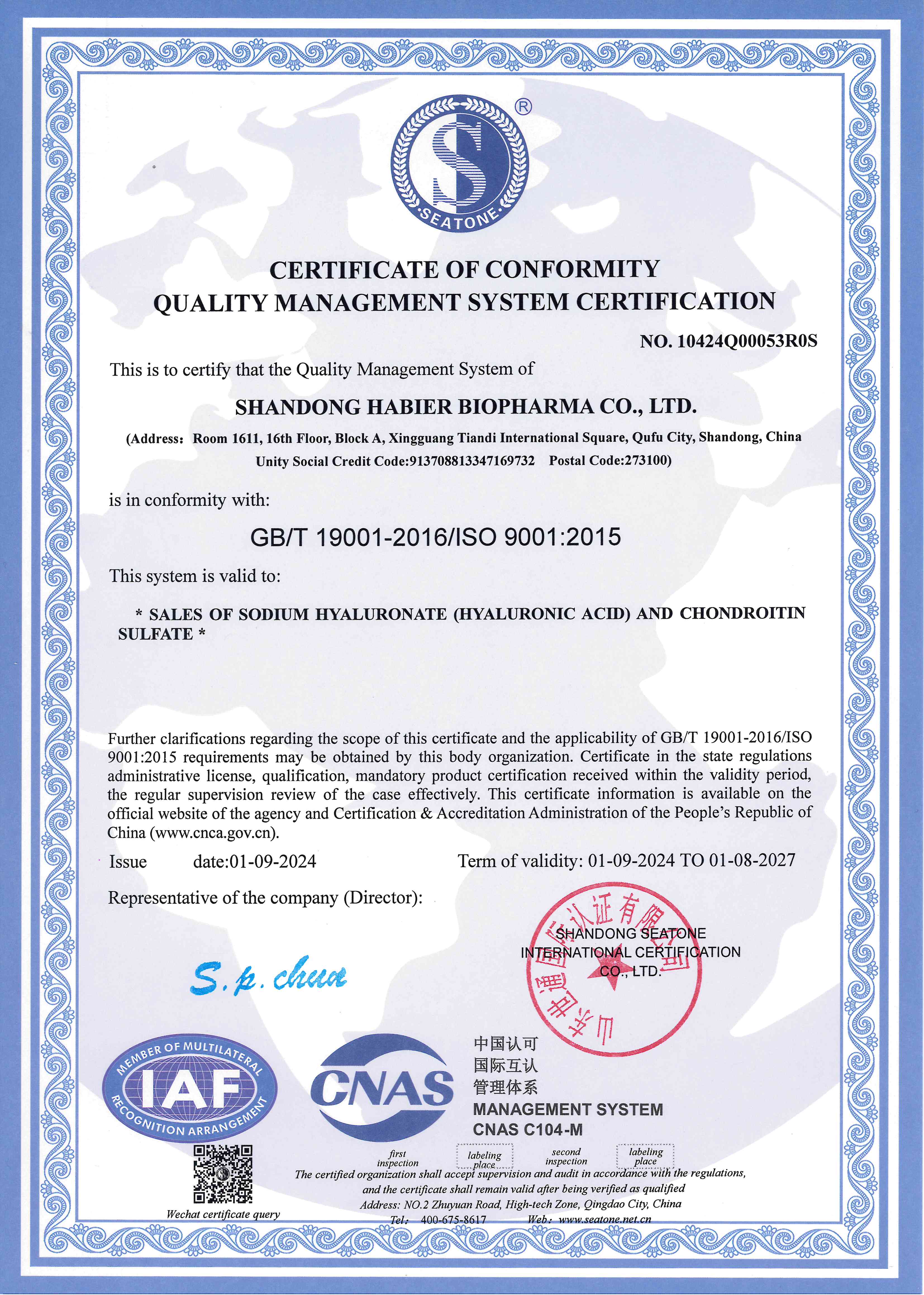
The direct answer: ISO 9001:2015 certificate 1042Q00053R0S and ISO 22000:2018 certificate 104FSMS2400001 are management-system registrations. They show that an independent certification body has assessed the supplier's quality and food-safety management systems against published standards and maintains that registration within a defined scope. They are not product certifications, and they do not certify that a particular batch, grade or molecular weight band conforms to a specification.
The distinction is structural rather than verbal. Management-system certification examines how an organisation controls processes, documentation, deviations, corrective actions and its supplier base. Product conformity is demonstrated lot by lot: identity, molecular weight or viscosity, purity, microbiological status, and the release decision that follows from those results. A buyer needs both, but they arrive as different documents and are checked at different points in the purchasing cycle.
For sodium hyaluronate the point carries commercial weight, because grade is defined numerically. No certificate can tell a buyer whether the material in front of them sits at 0.1 million Da or at 2.0 million Da; only the specification and the batch analysis can. That is why a certification map is a useful starting document and a poor substitute for an acceptance protocol.
The product 5243 certification map, document by document
Two entries in the file are fully numbered and traced to a certification body; the remaining holdings are stated scheme marks.
| Document | Standard / version | Number | Issuer | Scope and market as recorded | Valid to |
|---|---|---|---|---|---|
| ISO 9001 quality management system | GB/T 19001-2016 / ISO 9001:2015 | 1042Q00053R0S | SHANDONG SEATONE INTERNATIONAL CERTIFICATION CO.,LTD. | Scope recorded as ALL; global market | 8 January 2027 |
| ISO 22000 food safety management system | ISO 22000:2018 | 104FSMS2400001 | SHANDONG SEATONE INTERNATIONAL CERTIFICATION CO.,LTD. | Sales of Sodium Hyaluronate (Hyaluronic Acid) and Chondroitin Sulfate and related food safety management activities; global market | 8 January 2027 |
| Kosher | Scheme mark | Not published in the product record | — | Product-level holding stated in the company profile | Request copy |
| Halal | Scheme mark | Not published in the product record | — | Product-level holding stated in the company profile | Request copy |
| COSMOS organic, with ISO 16128 listed alongside | Scheme mark | Not published in the product record | — | Company states the product is certified as organic COSMOS and ISO 16128 | Request copy |
| HACCP | Hazard analysis system | Not published in the product record | — | Listed in the company qualification system | Request copy |
Both ISO certificates carry the same issue date, 1 September 2024, and the same expiry date, 8 January 2027, and both are described as applicable to the global market. Everything else in the map is recorded as a holding rather than as a numbered certificate in the product record.
Read the scope line before the standard number
Buyers compare standard numbers and rarely compare scope statements, yet the scope line is what limits or extends a certificate in practice.
For the ISO 9001 entry, the recorded scope is ALL, with no activity exclusion shown in the summary. That is the broad management-system statement a buyer expects when the question is whether the organisation runs documented quality control, corrective action and document control.
The ISO 22000 entry is more specific, and the wording repays attention: the scope covers sales of sodium hyaluronate and chondroitin sulfate together with related food safety management activities. A food or supplement buyer whose acceptance criteria depend on hazard control at defined manufacturing stages should read that wording against its own requirement and ask how those stages are covered — through the HACCP study, site audit records or process documentation — rather than assume a certificate number extends automatically across every step from fermentation to packing.
Kosher, Halal, COSMOS and HACCP answer four different questions
These marks are often listed together as if they were interchangeable seals. They are not, and each belongs to a different part of a buyer's file.
- Kosher addresses composition and processing acceptability under kosher rules. It carries weight where the ingredient enters food or supplements, or where a retail listing in a specific market requires it.
- Halal addresses the same question under halal rules, and is usually decisive for oral products sold into markets with religious dietary requirements.
- COSMOS organic, with ISO 16128 listed alongside it in the company profile, speaks to organic and natural cosmetic positioning rather than to dietary rules.
- HACCP is the hazard-control system referenced in the company qualification system; it supports food safety management but is not a substitute for the ISO 22000 registration, and the ISO 22000 registration does not replace the product-specific hazard study.
For a topical cosmetic buyer, the Kosher and Halal marks may have no bearing on the purchase decision. For a supplement brand, they may decide whether the project proceeds at all. Reading the set against the buyer's own market is more useful than scoring the supplier on the number of marks held.
The product record states these holdings without certificate numbers, certifying bodies or expiry dates. Before any mark is printed on a label or written into a purchase specification, the buyer should hold the certificate copy with number, scope and validity, in the same way it holds the two ISO certificates.
Grade is a specification question, not a certificate question
Sodium hyaluronate grade is defined by molecular weight band and product type, both of which sit outside the certification set.
| Grade or band | Stated molecular weight | Document that carries the claim |
|---|---|---|
| Food grade | 0.8–1.5 million Da | Product specification and batch certificate of analysis |
| Cosmetic grade | 1.0–1.5 million Da | Product specification and batch certificate of analysis |
| Pharma grade | Minimum 2.0 million Da | Product specification and batch certificate of analysis |
| High molecular weight grade | Minimum 2.0 million Da | Product specification and batch certificate of analysis |
| Low molecular weight grade | Maximum 0.1 million Da | Product specification and batch certificate of analysis |
Note the overlaps. High molecular weight grade and pharma grade both begin at 2.0 million Da, while food grade at 0.8–1.5 million Da and cosmetic grade at 1.0–1.5 million Da share most of their range. Super low molecular weight, ultra low molecular weight and hydrolyzed hyaluronic acid are listed as further product types. Certification cannot resolve which band a purchase requires; the specification does, and the batch analysis proves it for the lot actually shipped.
From certificate to acceptance criteria: batch testing, full inspection and traceability
The bridge between a management-system certificate and a delivered drum is the acceptance criteria attached to the order.
The stated quality control for product 5243 is 100% full inspection before delivery. That statement becomes useful to a buyer only when it is spelled out in the specification: which parameters are inspected, by which method, against which limit, and who signs the release.
A workable acceptance protocol for a sodium hyaluronate order usually addresses five points:
- Parameter and method pairs. Identity, molecular weight or viscosity, purity and microbiological limits, each with a named method, so that a result cannot be reinterpreted after delivery.
- Batch certificate of analysis. A COA per batch, matching the batch number on the packaging, not a generic specification sheet reused across shipments.
- Laboratory identity. A statement of whether release testing is performed in-house or by an independent laboratory, and the name of that laboratory where an independent result is required.
- Traceability records. The route from batch number to production and release records, so that a deviation can be traced back rather than negotiated after the fact.
- Application-specific limits. Medical or injectable applications may require sterility and low microbial limits; those limits belong in the specification, not in a discussion about certification.
Commercial parameters belong in the same table as the quality parameters. The stated supply terms for the product are a 1 kg minimum order quantity, a 5–8 day lead time, monthly capacity of 50–60 tonnes and OEM/ODM customisation that includes purity adjustment. An in-date certificate says nothing about whether those terms are achievable in a given month, and a generous capacity statement says nothing about whether a batch will meet the specification. The two checks run in parallel during evaluation.
Writing certificate numbers into purchasing terms
Certificate numbers earn their place when they appear in commercial documents rather than in a brochure.
- Supplier qualification record. Standard and version, number, issuer, scope line, issue and expiry date — 1042Q00053R0S for ISO 9001:2015 and 104FSMS2400001 for ISO 22000:2018, both issued 1 September 2024 and expiring 8 January 2027.
- Quality agreement. A notification obligation if a certificate lapses, is suspended or has its scope reduced, and a named recipient for updated copies.
- Purchase order and specification. Grade, molecular weight band, test parameters, whether an independent laboratory result is required, and the documents that must accompany each shipment.
- Incoming inspection. The COA batch number checked against the shipment and against the current specification revision, and certificate currency checked at the order date rather than only at first approval.
One further term is worth writing down: who bears the cost and the delay if incoming test results disagree with the supplier's COA. Certification does not settle that question; the contract does.
Import documentation sits outside the certification map
A US-bound shipment record in the supplier's case file shows why the two document families should be kept apart. The order covered 4,733 kg for a natural cosmetic and health supplement importer, used as cosmetic raw material and as oral care supplement material, and it is described as a long-term repeat supply relationship. Customs clearance is recorded as supported by a valid USDA import permit, with official veterinary heat-treatment certification noted and the material described as meeting US APHIS import standards.
None of that is a product certification, and filing it as one creates two risks. A buyer may believe a certificate covers an import requirement it does not, and a consignment document may be treated as if it established ongoing product conformity for future lots.
The workable rule is a two-column file for each destination market. In one column, the documents the shipment needs: import permit, veterinary or plant-health certification and any market-specific clearance evidence, each tied to a specific consignment and often to a specific validity period. In the other, the documents the supplier needs to hold: the ISO registrations, the scheme marks and the renewal dates. The APHIS-related example belongs in the first column, illustrating how import paperwork is assembled — not in the second, where it would imply a certification the record does not claim.
Recertification: reading the validity window correctly
Management-system certificates are maintained documents rather than permanent badges. In accredited certification, the body keeps the registration through surveillance audits scheduled at least annually within the cycle, with a recertification decision taken before expiry. For product 5243, both ISO certificates share a 1 September 2024 issue date and an 8 January 2027 expiry date, so the qualification file has a single shared renewal point.
Two consequences follow for buyers. First, a certificate that was current at first approval may not be current at the third or fourth order, so the currency check belongs in the repeat-order routine rather than in the onboarding checklist alone. Second, requests for updated copies should be scheduled before the expiry date, not after it. A lapsed certificate is a documentation failure rather than proof of a quality failure, but it does leave the buyer without the evidence it originally relied on — and in an audit, that gap is recorded against the buyer as well as the supplier.
Market context: why the document set became a screening layer
Commercial research estimates place the global hyaluronic acid market at about USD 11.64 billion in 2025, with a projected USD 22.36 billion by 2034 and a 7.52% CAGR for 2026–2034; the same source estimates pharmaceutical grade at 69.3% of product segment share in 2026 (Fortune Business Insights). These are commercial research estimates with their own scope definitions rather than audited figures, and they should be read as directional.
What they help explain is a shift in buyer behaviour: where higher-value pharmaceutical applications dominate value, documentation expectations common in pharmaceutical supply chains become the reference point for procurement teams buying food and cosmetic grades as well. The practical effect is not that every buyer needs more certificates, but that buyers increasingly ask what each certificate covers before accepting it.
Preparing for the 2027 renewal window
The next meaningful date in this file is 8 January 2027, when both ISO certificates reach expiry. Four preparations make that date uneventful.
- Diarise the expiry and request renewed copies in advance, then compare the new scope lines against the ones recorded at approval and note any change.
- Collect the Kosher, Halal and COSMOS certificate copies with numbers, bodies and validity, since the product record lists the holdings without those details.
- Keep a separate import-document checklist per destination market, so that consignment paperwork is never mistaken for product conformity evidence.
- Align the acceptance criteria with the grade actually purchased — food, cosmetic, pharma, high, low, super low, ultra low or hydrolyzed — and confirm that the parameters, methods and laboratory are named.
None of this requires new certifications. It requires the existing document set to be read, filed and re-checked in the right place, and the specification to carry the grade argument that the certificates were never designed to make.
FAQ
Does ISO 9001:2015 certification make sodium hyaluronate 5243 pharma grade?
No. Certificate 1042Q00053R0S registers a quality management system with SHANDONG SEATONE INTERNATIONAL CERTIFICATION CO.,LTD.; it does not assign a grade. Pharma grade for product 5243 is defined by a molecular weight of at least 2.0 million Da and is demonstrated through the product specification and the batch certificate of analysis.
What does ISO 22000:2018 certificate 104FSMS2400001 actually cover?
It is a food safety management system certificate issued by SHANDONG SEATONE INTERNATIONAL CERTIFICATION CO.,LTD., valid to 8 January 2027, with a recorded scope of sales of sodium hyaluronate and chondroitin sulfate and related food safety management activities. Buyers whose acceptance criteria depend on manufacturing-stage hazard control should read that scope line against their own requirement and ask how those stages are documented.
Are Kosher and Halal holdings relevant to cosmetic applications?
They address dietary acceptability under Jewish and Islamic rules, so their weight depends on the product form and the destination market. For oral supplements and food they may be a listing requirement; for a topical cosmetic, the buyer's own market rules decide. Certificate copies with number, scope and expiry should be obtained before the marks are used on a label.
How can a buyer check that the ISO certificates are still valid at the time of an order?
Verify the certificate number, standard version, issuer, scope and expiry date against the certification body's record, then repeat that check at each purchase order rather than only at first approval. Both certificates expire on 8 January 2027 and should be renewed or replaced before that date.
Does certification replace regulatory approval for medical or injectable sodium hyaluronate?
No. Certification is not a marketing authorisation. Medical or injectable applications may require sterility and low microbial limits in the specification, and separate registration applies; in China, NMPA Announcement No. 103 of 2022 states that medical sodium hyaluronate products without pharmacological, metabolic or immunological action are managed as medical devices and classified no lower than Class II in the described cases.
Product and qualification documentation for Shandong Habier Biopharma Co.,LTD is published at www.habier.com. The company brochure, covering product ranges and qualification holdings, is available as a PDF: Shandong Habier Biopharma brochure.
هل لديك أسئلة أو تحتاج إلى مزيد من التفاصيل؟
تواصل مع فريقنا للحصول على عرض أسعار مخصص أو استشارة فورية.
طلب عرض أسعار
املأ النموذج أدناه وسيتواصل معك فريقنا بعرض مقترح مخصص.
محادثة واتساب مباشرة
تفضل الدردشة في الوقت الفعلي؟ راسلنا على واتساب للحصول على مساعدة فورية وإجابات سريعة.
- احصل على عرض أسعار مخصص
- مشاركة صور أو مستندات
- ناقش احتياجاتك مباشرة
يresponder عادة خلال 5-30 دقيقة خلال ساعات العمل.