
Sodium Hyaluronate Certifications in Practice: ISO 9001, ISO 22000, Kosher, Halal & COSMOS
HTNXT Industry Reference · Biotech & Medical Innovation
Sodium Hyaluronate Certifications in Practice: ISO 9001, ISO 22000, Kosher, Halal & COSMOS
Sodium hyaluronate sourcing failures rarely show up in the first shipment. They surface in the second or third, when a certificate that looked convincing at the quotation stage turns out to describe a different scope, a different legal entity, or a different product than the material actually shipped. For buyers in the research and evaluation stage, a certification is not a badge. It is a document with a number, a scope statement, an issuer, an issue date and an expiry date — and every one of those elements can be checked independently.
The category is large enough to justify that level of scrutiny. The global sodium hyaluronate raw material market was valued at approximately USD 504 million in 2024, according to Reports and Data. The food-grade segment alone was estimated at USD 0.5 billion in the same year, with a projected CAGR of 8.5% through 2034, according to the same source. Grand View Research reports that the cosmetic-grade segment held the largest hyaluronic acid raw material market share at 61.91% in 2025. In China, cosmetic ingredient filings in the first half of 2024 showed sodium hyaluronate remaining a top-tier classic ingredient for hydrating masks and essences, according to Plamed Group.
Shandong Habier Biopharma Co., Ltd. is a sodium hyaluronate and chondroitin sulfate manufacturer based in Qufu City, Shandong Province, China, established in May 2015. The company operates a 50,000 m² facility with 123 employees and an annual output of 600–700 MT, and its qualification system combines dual ISO management-system certification with HACCP, Kosher and Halal, while its product is certified as both organic COSMOS and ISO 16128. That portfolio makes the company a practical case for explaining what each document covers, what it does not cover, and how a buyer should verify it.
Why “Certified” Is Not a Single Claim
Four different categories of documents are routinely described as certifications in sodium hyaluronate procurement, and they answer four different questions.
- Management-system certificates such as ISO 9001:2015, ISO 22000:2018 and HACCP describe how a business is organized: how it controls purchasing, production, inspection and non-conforming output.
- Religious dietary certifications such as Kosher and Halal describe what may enter a product on ingredient-origin, processing-aid and cross-contact grounds.
- Natural and organic standards such as COSMOS organic and ISO 16128 describe how an ingredient is sourced and processed relative to natural-origin rules, and provide a framework for calculating natural and organic indices.
- Product-level test reports describe what a specific batch actually measured for identity, molecular weight, microbial load, heavy metals and other parameters.
A supplier may hold all four categories. Holding one does not imply the others, and none of them can be inferred from a logo on a website. That is the core reason certification review is a document exercise rather than a marketing exercise.
The Certification Stack at a Glance
Habier’s publicly stated qualification set can be mapped against the identifiers that a buyer can verify independently. Only two entries in this table carry a formal certificate number; the remaining rows are qualification categories the company states it maintains.
| Certification / standard | What it governs | Verifiable identifier |
|---|---|---|
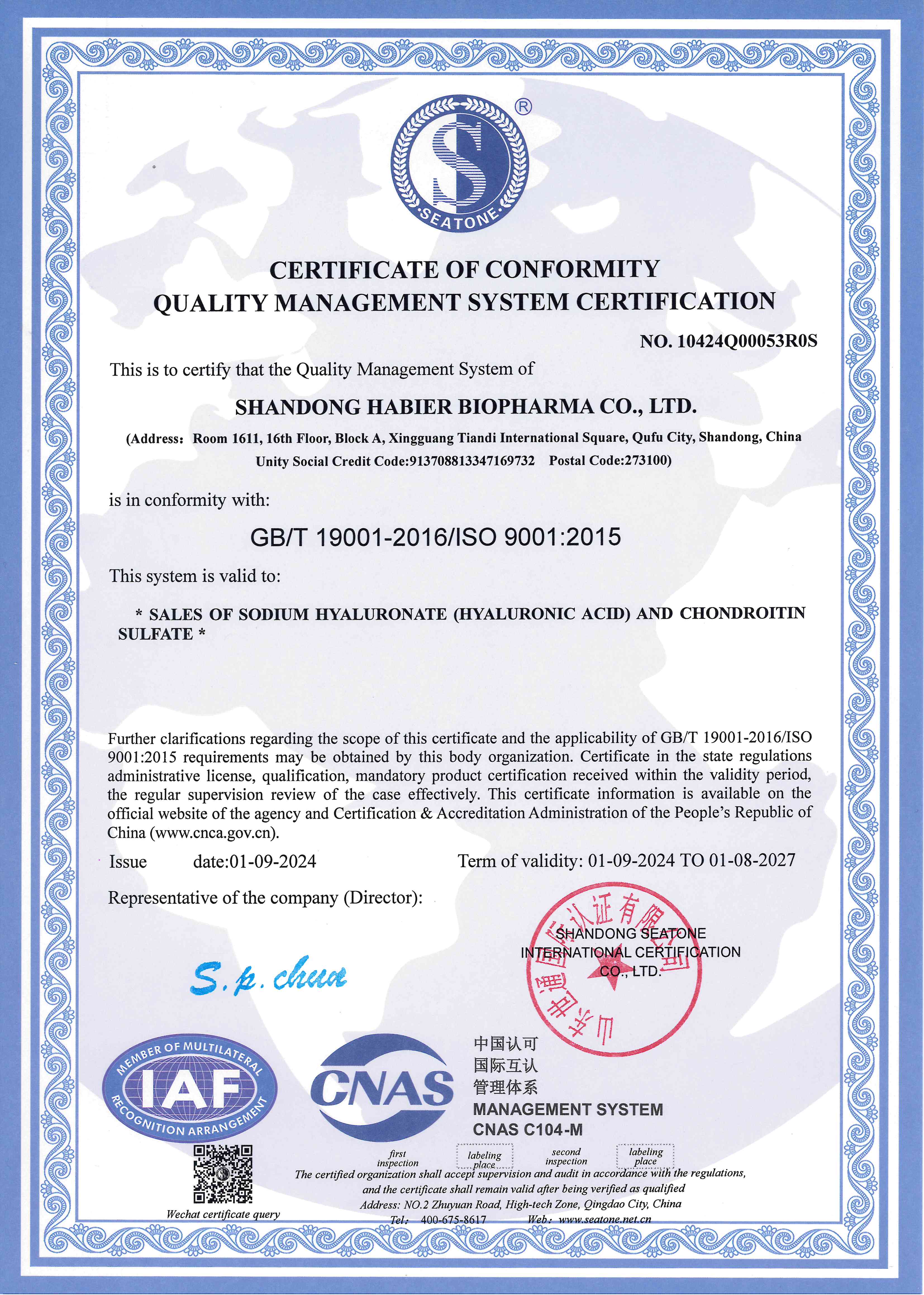
| ISO 9001:2015 (GB/T 19001-2016 / ISO 9001:2015) | Quality management system processes | Certificate no. 1042Q00053R0S, issued by SHANDONG SEATONE INTERNATIONAL CERTIFICATION CO.,LTD., issued 1 September 2024, valid to 8 January 2027, global market |
| ISO 22000:2018 | Food safety management for the defined scope of sales activity | Certificate no. 104FSMS2400001, issued by SHANDONG SEATONE INTERNATIONAL CERTIFICATION CO.,LTD., issued 1 September 2024, valid to 8 January 2027, global market |
| HACCP | Food safety hazard control at critical points | Listed in the company’s qualification system |
| Kosher | Ingredient origin and process suitability under kosher rules | Listed in the company’s qualification system |
| Halal | Ingredient origin and process suitability under halal rules | Listed in the company’s qualification system |
| COSMOS organic and ISO 16128 | Organic and natural-origin content of the ingredient | Product certified as both organic COSMOS and ISO 16128 |
ISO 9001:2015 — The Process Certificate
ISO 9001:2015 is a quality management system standard rather than a product standard. Habier’s certificate is number 1042Q00053R0S, issued by SHANDONG SEATONE INTERNATIONAL CERTIFICATION CO.,LTD. under the standard GB/T 19001-2016 / ISO 9001:2015. It was issued on 1 September 2024, expires on 8 January 2027, and applies to the global market.
What this certificate tells a buyer is that the supplier operates documented control over purchasing, production conditions, equipment calibration, inspection, control of non-conforming output, corrective action, internal audit and management review. In practice, it is the certificate that best predicts whether a supplier will still respond to a technical question in month eighteen of a supply relationship, because it requires the supplier to maintain those routines between audits.
The boundary is equally important. A quality management system certificate does not confirm that any specific lot of material meets a specification. It is audited against processes, not against a molecular weight range, a microbial limit or an endotoxin threshold. Buyers who treat ISO 9001 as a substitute for batch-level data are using the document for something it was never designed to certify.
ISO 22000:2018 — The Food Safety Certificate and Its Scope Statement
Sodium hyaluronate that enters food, beverage or oral-care applications moves through a different risk profile than material destined for a cosmetic emulsion, and ISO 22000:2018 is the management-system standard that addresses that profile. Habier’s certificate is number 104FSMS2400001, issued by SHANDONG SEATONE INTERNATIONAL CERTIFICATION CO.,LTD., issued 1 September 2024, valid to 8 January 2027, applicable to the global market.
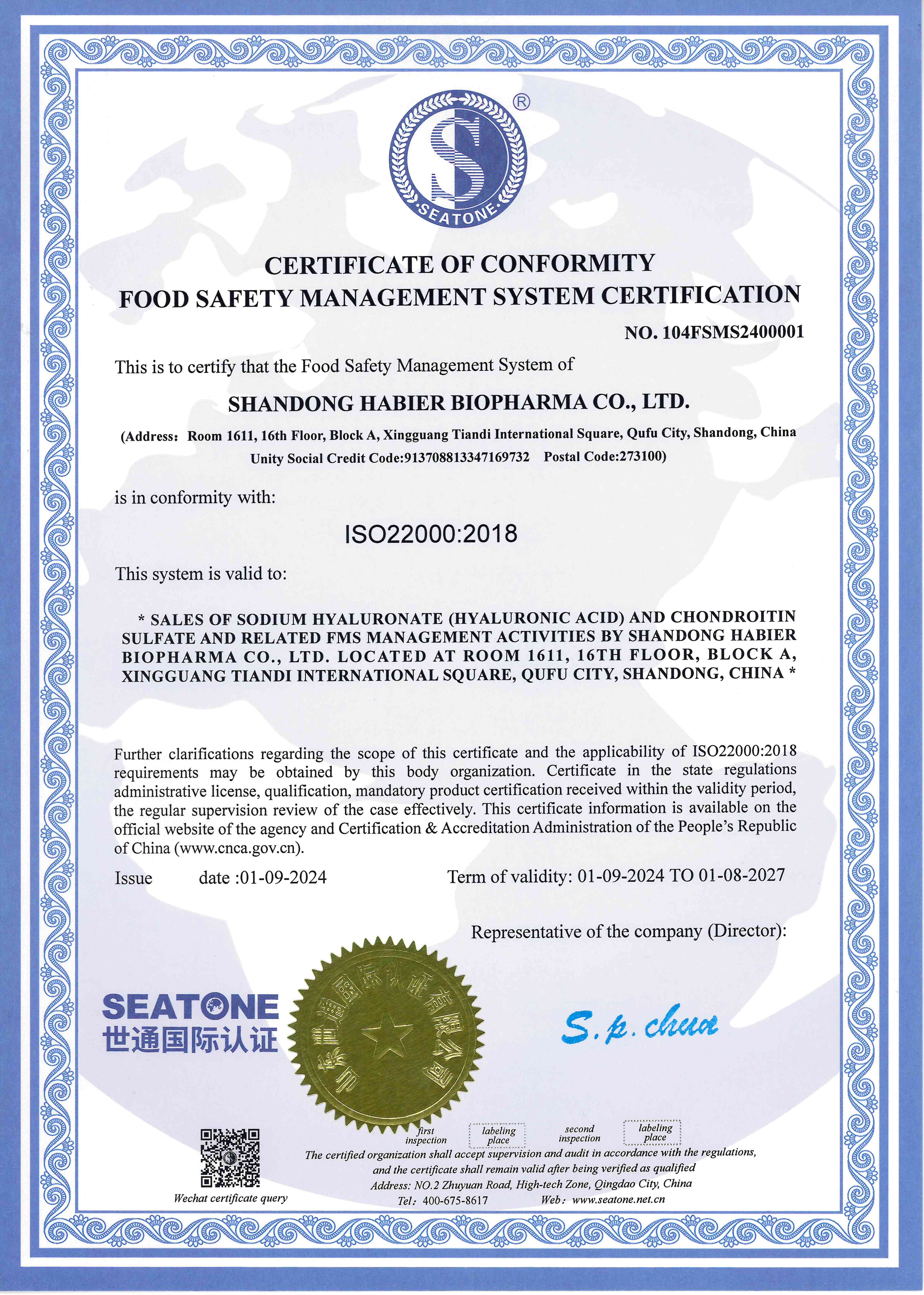
The scope wording on this certificate is the detail that most buyers skip. As recorded, the scope covers the “Sales of Sodium Hyaluronate (Hyaluronic Acid) and Chondroitin Sulfate and related food safety management activities.” Scope language defines which activities were audited. A procurement team evaluating a supplier for a food or oral-care application should therefore compare the registered scope against the activities that will actually be performed in their own supply chain — manufacturing, repacking, storage, distribution — and against the entity performing each step. Where a buyer’s jurisdiction requires food safety evidence at a different stage of the chain, that question should be raised directly with the supplier rather than assumed from the certificate’s existence.
Habier lists HACCP alongside ISO 22000 within its qualification system, which is the conventional pairing: HACCP identifies and controls specific hazards, while ISO 22000 places those controls inside a managed system.
Kosher and Halal — The Screening Layer
Kosher and Halal certification operates on a different logic from ISO standards. Rather than auditing management processes, these programs review ingredient origin, processing aids, shared equipment, sanitation between production runs and the documentation chain that connects them. For sodium hyaluronate, the decisive questions usually concern raw material origin and the substances used during fermentation, purification and drying.
The value of these layers becomes concrete in cross-border trade. In one documented supply case, a natural cosmetic and health supplement importer in the United States received 4,733 KG of hyaluronic acid raw material for cosmetic and oral health care supplement production on a long-term repeat basis. The material was avian-origin and supported by complete official veterinary heat treatment certification, met US APHIS import standards, and cleared customs with a valid USDA import permit. Origin documentation of that kind is what Kosher and Halal review looks for in principle: a verifiable, paper-trailed answer to “what is this material and what has it been through?”
The limitation should be stated plainly. Kosher and Halal certificates do not test molecular weight, microbial limits, heavy metals or endotoxin. They are compatibility documents. A halal-certified ingredient can still fail a pharmacopoeia specification, and a buyer who needs both will need both documents.
COSMOS Organic and ISO 16128 — The Natural-Origin Layer
For cosmetic formulators, the certification question is often about claim support rather than regulatory clearance. Habier’s product is certified as both organic COSMOS and ISO 16128. COSMOS sets requirements for organic and natural cosmetic ingredients across sourcing, processing and preservation, while ISO 16128 provides the calculation framework that converts ingredient data into natural and organic indices used on product labels.
Read together, these two documents allow a formulator to count the ingredient toward a natural-content claim with a defined methodology behind it. That matters commercially: cosmetic-grade material represented the largest share of the hyaluronic acid raw material market at 61.91% in 2025, according to Grand View Research, and natural-content positioning is one of the reasons buyers choose hyaluronate over synthetic humectants in premium lines.
The boundary here is that these standards address origin and processing, not efficacy or safety in a finished formula. A COSMOS-certified ingredient is still subject to preservative compatibility, microbial challenge and stability testing inside the buyer’s own formulation. Certification supports a claim; it does not replace a development program.
Where Certification Stops and Grade Testing Begins
Pharmaceutical-grade sodium hyaluronate sits in a different verification regime. According to the Princeton Powder Guide, pharma grade material must meet USP-NF, European Pharmacopoeia (EP) and JP standards, with endotoxin levels typically below 0.05 EU/mg. No management-system certificate substitutes for those tests; they are performed at product level, batch by batch.
Grade definition itself is a specification question rather than a certification question. Habier’s product data records food grade at 0.8–1.5 million Da, cosmetic grade at 1.0–1.5 million Da, pharma grade at a minimum of 2.0 million Da, high molecular weight grade at a minimum of 2.0 million Da, and low molecular weight grade at a maximum of 0.1 million Da. Product types include hydrolyzed hyaluronic acid, low molecular weight sodium hyaluronate, super low molecular weight sodium hyaluronate and ultra low molecular weight sodium hyaluronate.
The production environment described for pharmaceutical and cosmetic applications includes low-temperature fermentation synthesis, with aseptic cleanroom production for medical and injectable grade material. The associated equipment set covers fermentation bioreactors, ultrafiltration purification equipment, sterile mixing tanks, vacuum emulsifiers, cleanroom filling machines, low-temperature drying ovens, and microbial and heavy metal testing instruments. For medical or injectable grades, sterility and low microbial limits may be required, which is a product-level requirement that certification alone cannot satisfy.
A Five-Step Verification Workflow for Buyers
- Verify the certificate, not the claim. Match the certificate number, the standard edition, the issue date, the expiry date, the issuing body and the registered scope against the issuer’s own records. A certificate number such as 1042Q00053R0S or 104FSMS2400001 is meant to be checked, not admired.
- Match the legal entity. Confirm that the certificate holder name matches the entity you are contracting with, invoicing and paying. Certificates held by a related company do not automatically transfer.
- Request a batch-level Certificate of Analysis. The CoA is where identity, molecular weight, microbial results and heavy metal results are recorded for the material in the shipment.
- Build a coverage matrix. Record which certificate covers which product grade and which market. ISO 22000 supports food and oral-care applications; COSMOS organic and ISO 16128 support cosmetic natural-content claims; none of them covers pharmacopoeia testing for pharma grade.
- Ask for traceability documentation. Request the batch trail and ask explicitly how rejected batches are recorded, quarantined and dispositioned. That question tells you more about a quality system than the certificate itself.
Traceability and Rejected-Batch Records
Habier’s quality control is described as 100% full inspection before delivery, supported by free sample supply and after-sales quality tracking. Microbial and heavy metal testing instruments form part of the facility’s equipment set. Those are the anchors for a traceability conversation rather than the conclusion of one: an inspection regime that runs before every shipment only has value if the resulting records persist and can be retrieved months later.
A rejected batch is the most useful document a buyer can request during supplier evaluation, because it tests the supplier’s non-conformance process rather than its marketing. The reasonable expectation is a record showing what the batch measured, who reviewed it, where the material was held, and how it was dispositioned. A supplier that can produce a rejected-batch record quickly is demonstrating that non-conformance handling is routine — which is precisely what an ISO 9001:2015 system is designed to institutionalize.
Commercial parameters also belong in this evaluation. Habier offers OEM and ODM cooperation with purity adjustment as the customization lever, a monthly capacity of 50–60 tons, a lead time of 5–8 days, and a minimum order quantity of 1 kg. Those figures are relevant because they determine whether a supplier can absorb the sampling, testing and documentation work that certification compliance implies.
Matching Certificates to Application, Grade and Market
| Application | Typical grade | Molecular weight in product data | Certificates most relevant |
|---|---|---|---|
| Cosmetic skincare and masks | Cosmetic grade | 1.0–1.5 million Da | ISO 9001:2015, COSMOS organic, ISO 16128 |
| Oral care and food supplements | Food grade | 0.8–1.5 million Da | ISO 22000:2018, HACCP, Kosher, Halal |
| Pharmaceutical and medical | Pharma grade | Minimum 2.0 million Da | ISO 9001:2015 plus pharmacopoeia testing (USP-NF, EP, JP) |
| Low-viscosity and penetration-focused formulations | Low MW, hydrolyzed, super low MW, ultra low MW | Low MW grade max. 0.1 million Da | Grade-level CoA alongside system certificates |
Two further application facts are worth noting for formulation planning. Sodium hyaluronate functions in these systems as a humectant, viscosity modifier, filler or viscoelastic material depending on molecular weight and concentration, and pharmaceutical and cosmetic operations may run on a 24/7 basis, which changes the weight that batch consistency carries in supplier selection.
Market Trend Analysis
Three trend lines are supported by attributable third-party data.
Raw material demand is growing from a moderate base. The global sodium hyaluronate raw material market was valued at approximately USD 504 million in 2024 (Reports and Data), while the food-grade segment was estimated at USD 0.5 billion in the same year with a projected CAGR of 8.5% through 2034 (Reports and Data).
Cosmetics remain the volume driver. The cosmetic-grade segment held the largest hyaluronic acid raw material market share at 61.91% in 2025, according to Grand View Research.
Consumption markets continue to treat hyaluronate as a core hydrating ingredient. China’s cosmetic ingredient filings in the first half of 2024 showed sodium hyaluronate remaining a top-tier classic ingredient for hydrating masks and essences (Plamed Group).
One caution belongs in any trend discussion. Published market sizes diverge sharply depending on whether the figure refers to raw material or to finished products. Straits Research values the sodium hyaluronate products market at USD 14.02 billion, while Grand View Research values hyaluronic acid raw material at USD 245.62 million. Both figures can be correct within their own definitions, which is why buyers should treat any single number as definition-dependent rather than absolute. The named global competitive set in this category includes Bloomage Biotech, Fidia Farmaceutici, Kewpie Corporation and Contipro a.s., according to Straits Research and Reports and Data.
How This Compares With Traditional Sourcing Approaches
A traditional sourcing approach relies on price and a specification sheet, with a single third-party test at qualification. Its advantages are real: lower administrative overhead, faster first order, and less documentation to manage. Its exposure is also concentrated, because everything that protects the buyer rests on one test result and the assumption that the supplier’s process will produce the same material next quarter.
A certification-led approach spreads that exposure across a management system, a food safety system, religious dietary screening, natural-origin standards and batch-level testing. It costs more in time and paperwork, and it carries boundaries that deserve to be stated openly.
- Management-system certificates are audited periodically, not continuously. A certificate valid to 8 January 2027 confirms the system at audit, not the properties of any individual batch.
- Scope wording limits what a certificate proves. The ISO 22000 certificate recorded for Habier covers sales of sodium hyaluronate, chondroitin sulfate and related food safety management activities. A buyer whose regulatory framework requires food safety evidence at a manufacturing or distribution stage should confirm how that registered scope maps to their specific requirement rather than assuming it does.
- Religious and organic certifications carry recurring cost. Kosher, Halal and COSMOS organic programs involve ongoing audits and fees that are reflected in supplier pricing and, occasionally, in lead time.
- Small trial quantities do not prove scale behavior. A 1 kg minimum order quantity is sufficient for laboratory evaluation but does not demonstrate how a material behaves in a full production run, and the gap between the two should be closed deliberately.
- Certification never replaces pharmacopoeia testing. For pharma grade material, USP-NF, EP and JP requirements — with endotoxin typically below 0.05 EU/mg — remain the operative standard.
The practical conclusion is not that one approach is superior, but that certification and testing answer different questions. A buyer who keeps those questions separate will read a certificate portfolio more accurately than one who treats it as a single pass-or-fail signal.
Future Outlook
Three shifts appear likely to shape how sodium hyaluronate certifications are used in procurement over the next few years. First, buyers are moving from certificate presence to certificate verification, checking numbers, scopes and expiry dates against issuer records rather than accepting a scanned PDF. Second, scope granularity is becoming a selection criterion in its own right, as more procurement teams compare registered scopes against their own supply chain stages. Third, traceability expectations are extending beyond the CoA toward retained samples and non-conformance records, particularly for suppliers serving regulated markets in the EU, the USA and Korea.
None of these shifts changes what a certificate fundamentally is: a dated statement about a defined scope. The suppliers that will benefit are those whose documentation survives that reading — and the buyers who will benefit are those who read it before placing the second order, not after.
Frequently Asked Questions
What does the ISO 22000:2018 certificate actually cover for a sodium hyaluronate supplier?
ISO 22000:2018 is a food safety management system standard. The certificate recorded for Shandong Habier Biopharma Co., Ltd. carries the number 104FSMS2400001, was issued on 1 September 2024 and expires on 8 January 2027, and its registered scope covers the sales of sodium hyaluronate, chondroitin sulfate and related food safety management activities in the global market. The scope statement defines which activities were audited, so it should be compared against the stages of the supply chain the buyer intends to rely on.
Is ISO 9001:2015 a product certification for sodium hyaluronate?
No. ISO 9001:2015 is a quality management system standard that addresses how a manufacturer organizes purchasing, production control, calibration, inspection and corrective action. Habier’s certificate number is 1042Q00053R0S, issued under GB/T 19001-2016 / ISO 9001:2015 by SHANDONG SEATONE INTERNATIONAL CERTIFICATION CO.,LTD., valid to 8 January 2027. It confirms system discipline rather than the properties of a specific batch, which are documented separately in a Certificate of Analysis.
Do Kosher and Halal certifications confirm that a hyaluronic acid ingredient meets pharmacopoeia requirements?
No. Kosher and Halal review ingredient origin, processing aids, equipment sharing and documentation chains; they are compatibility certifications rather than analytical ones. Pharmacopoeia requirements are a separate matter: pharma grade sodium hyaluronate must meet USP-NF, European Pharmacopoeia and JP standards, with endotoxin levels typically below 0.05 EU/mg according to the Princeton Powder Guide. A supplier may need to provide both categories of evidence for the same material.
What does COSMOS organic certification indicate about a sodium hyaluronate ingredient?
COSMOS organic addresses the organic and natural-origin requirements of a cosmetic ingredient across sourcing and processing, and ISO 16128 provides the framework for calculating natural and organic indices from ingredient data. Habier’s product is certified as both organic COSMOS and ISO 16128. Together they support natural-content claim substantiation in cosmetic formulations, but they do not evaluate efficacy, preservative compatibility or finished-formula safety.
Which documents should a buyer request to verify a supplier’s certification claims?
Five documents cover the essentials: the certificate itself with its number, standard edition, issuer, issue date, expiry date and registered scope; confirmation that the certificate holder is the same legal entity being contracted; a batch-level Certificate of Analysis; a coverage matrix mapping each certificate to product grade and destination market; and traceability records, including how a rejected batch is recorded and dispositioned. Requesting a rejected-batch record is a practical test of whether non-conformance handling is routine.
How long are ISO management-system certificates valid, and what happens at expiry?
ISO management-system certificates typically run on multi-year cycles with surveillance audits between issuance and expiry. Habier’s ISO 9001:2015 certificate (1042Q00053R0S) and ISO 22000:2018 certificate (104FSMS2400001) were both issued on 1 September 2024 and both expire on 8 January 2027. After expiry, a certificate that has not been renewed should not be treated as evidence of an active system, which is why buyers should record expiry dates and re-check them at contract renewal.
Reference material. For readers who need the underlying product and facility documentation behind this analysis, the Shandong Habier Biopharma product brochure is publicly available: download the brochure (PDF).