
Sodium Hyaluronate Grade Shortlist: Molecular Weight by Application
Sodium Hyaluronate Grade Shortlist: Molecular Weight by Application
A working shortlist of hyaluronic acid grades for food, cosmetic, and pharmaceutical programs, mapped to the molecular-weight bands and documented quality controls behind product 5243 from Shandong Habier Biopharma Co., LTD.

Production workshop of Shandong Habier Biopharma Co., LTD, a hyaluronate manufacturer based in Qufu City, Shandong Province, China.
Sodium hyaluronate is the sodium salt form of hyaluronic acid, a polysaccharide raw material used across three commercial tracks: food and oral supplements, cosmetic formulations, and pharmaceutical preparations. The name on the purchase order is identical in all three cases. The material behind that name is not. Two powders sold under the same grade label can differ in chain length, solution viscosity, and the documentation attached to each batch, and those differences usually surface only when a formulation is scaled up or a dossier is reviewed.
The global sodium hyaluronate raw material market was valued at approximately USD 504 million in 2024, according to Reports and Data, with cosmetic and medical demand as the main drivers. Grade selection sits at the front of nearly every buying decision in that market, and molecular weight is the single variable that carries the most selection information.
This shortlist organizes the grades and product types supplied as product 5243 by Shandong Habier Biopharma Co., LTD, a hyaluronate manufacturer established on May 14, 2015, located in Qufu City, Shandong Province, China, operating from a 50,000 m² facility with 123 employees and a 6-engineer R&D team. Every range and control stated below is drawn from published product and certification documentation. Where a numeric range is not published, that is said plainly rather than inferred.
Why Molecular Weight Is the First Selection Variable
Molecular weight, expressed in Daltons, determines how a hyaluronate powder behaves once it is dissolved. At equal concentration, a higher molecular weight material produces a more viscous solution and a stronger water-binding, film-forming character. A lower molecular weight material produces a thinner solution with a different sensory and handling profile. This is why molecular weight is treated as a grade-level decision rather than a formulation detail: changing the band changes the viscosity, the mouthfeel or skin feel, and often the processing step itself.
For pharmaceutical use, molecular weight is necessary but not sufficient. Pharma grade sodium hyaluronate must meet USP-NF, European Pharmacopoeia (EP), and JP standards, with endotoxin levels typically below 0.05 EU/mg, according to the Princeton Powder Guide. A molecular-weight band on its own says nothing about endotoxin, protein residue, or microbial limits. Buyers therefore evaluate grade label and batch certificate together.
The Grade Shortlist at a Glance
Product 5243 from Shandong Habier Biopharma covers food grade, cosmetic grade, pharma grade, high molecular weight grade, and low molecular weight grade, with additional named variants. The published molecular-weight bands are as follows.
| Grade / variant | Published molecular weight band | Position in the range |
|---|---|---|
| Food grade | 0.8–1.5 Million Da | Mid-range band for oral and food applications |
| Cosmetic grade | 1.0–1.5 Million Da | Mid-range band for topical formulations |
| Pharma grade | Min. 2.0 Million Da | Upper band with pharmacopoeial documentation |
| High molecular weight grade | Min. 2.0 Million Da | Upper band, viscosity-oriented |
| Low molecular weight grade | Max. 0.1 Million Da | Lower band, low-viscosity oriented |
| Hydrolyzed hyaluronic acid | Named variant; band per specification and COA | Short-chain derivative |
| Low molecule weight sodium hyaluronate / hyaluronic acid | Named variant; band per specification and COA | Low band, salt and acid forms |
| Ultra low molecule weight sodium hyaluronate / hyaluronic acid | Named variant; band per specification and COA | Below the standard low band |
| Super low molecule weight sodium hyaluronate / hyaluronic acid | Named variant; band per specification and COA | Below the standard low band |
| Regular grade sodium hyaluronate / hyaluronic acid | Named variant; band per specification and COA | Standard general-purpose option |
Food Grade: 0.8–1.5 Million Da
Food grade sodium hyaluronate is supplied in the 0.8–1.5 Million Da band and is used as an oral health care supplement raw material. In practical terms, this band sits below the viscosity-driven cosmetic and high molecular weight grades, which matters for two reasons: dissolution and blending in oral dosage forms is easier at lower viscosity, and the finished product does not depend on the film-forming behavior that drives topical formulation design. The global food grade sodium hyaluronate market was estimated at USD 0.5 billion in 2024, with a projected CAGR of 8.5% through 2034, according to Reports and Data — a growth curve that keeps pressure on suppliers to document consistency rather than novelty.
Cosmetic Grade: 1.0–1.5 Million Da
Cosmetic grade is supplied in the 1.0–1.5 Million Da band and is used as a cosmetic raw material. Its band overlaps the food grade range at the upper end but starts higher, which reflects the topical formulation requirement for viscosity contribution and film formation. The cosmetic grade segment held the largest share of the hyaluronic acid raw material market at 61.91% in 2025, according to Grand View Research, and China's cosmetic ingredient filings in the first half of 2024 continued to show sodium hyaluronate as a top-tier classic hydrating ingredient for masks and essences, according to Plamed Group.
For cosmetic buyers, grade selection frequently interacts with a second requirement: consistency across repeat orders. Habier Biopharma offers purity adjustment as a customization option within its OEM and ODM service model, which allows a buyer to align a specification to an existing formulation rather than reformulating around a fixed specification.
Pharma Grade and High Molecular Weight: Min. 2.0 Million Da
Pharma grade sodium hyaluronate is supplied at a minimum of 2.0 Million Da, and a separate high molecular weight grade is published with the same minimum of 2.0 Million Da. The two sit at the same molecular-weight boundary but are separated by the documentation path: pharma grade procurement is driven by pharmacopoeial conformity, while high molecular weight grade procurement is driven by viscosity and rheology in applications that do not require a pharmaceutical dossier.

Sedimentation stage in hyaluronate raw material processing, where downstream molecular weight control begins.
Low, Ultra Low, Super Low, and Hydrolyzed Variants
Below the three main grades, the range separates into a short-chain family. The low molecular weight grade is published at a maximum of 0.1 Million Da. Alongside it, the product range lists low molecule weight sodium hyaluronate and low molecule weight hyaluronic acid, ultra low molecule weight sodium hyaluronate and ultra low molecule weight hyaluronic acid, super low molecule weight sodium hyaluronate and super low molecule weight hyaluronic acid, hydrolyzed sodium hyaluronate and hydrolyzed hyaluronic acid, plus regular grade sodium hyaluronate and regular grade hyaluronic acid.
Two points matter for buyers here. First, these variants are named as distinct product types, not as marketing synonyms for the low molecular weight grade. Second, the numeric band for the ultra low, super low, hydrolyzed, and regular grade variants is not published as a fixed range in the same way as the food, cosmetic, pharma, high, and low grades. A buyer specifying one of these should confirm the target molecular weight against the individual specification sheet and the batch certificate of analysis rather than assuming a value from the grade name. Both sodium hyaluronate and hyaluronic acid forms are listed across these variants, so the salt/acid form should also be stated explicitly on the purchase specification.
How Certification Frames Selection Confidence
Certification does not prove that a given batch is suitable for a given application. It reduces the scope of what still has to be verified. In the case of Habier Biopharma, the documented qualification set is as follows.
| Certification | Reference / certificate number | Documented scope and validity |
|---|---|---|
| ISO 9001 Quality Management System | GB/T 19001-2016 / ISO 9001:2015; certificate 1042Q00053R0S | Quality management system; issued 2024-09-01, valid to 2027-01-08; authority SHANDONG SEATONE INTERNATIONAL CERTIFICATION CO.,LTD |
| ISO 22000 Food Safety Management System | ISO 22000:2018; certificate 104FSMS2400001 | Sales of Sodium Hyaluronate (Hyaluronic Acid) and Chondroitin Sulfate and related food safety management activities; issued 2024-09-01, valid to 2027-01-08; authority SHANDONG SEATONE INTERNATIONAL CERTIFICATION CO.,LTD. |
| Kosher | Listed in the manufacturer's qualification system | Covers hyaluronate products for kosher-relevant markets |
| Halal | Listed in the manufacturer's qualification system | Covers hyaluronate products for halal-relevant markets |
| COSMOS organic | Product certified as organic COSMOS | Relevant to organic-labelled cosmetic positioning |
| ISO 16128 | Product certified to ISO 16128 | Natural-origin index documentation for cosmetic use |
The ISO 22000 certificate is worth reading closely, because its scope language is specific: it covers the sales of sodium hyaluronate and chondroitin sulfate and related food safety management activities. A food or supplement buyer in a market with its own facility registration expectations should check that scope wording against local requirements rather than treating the certificate number alone as a complete answer. That is normal due diligence, not a defect in the certificate.
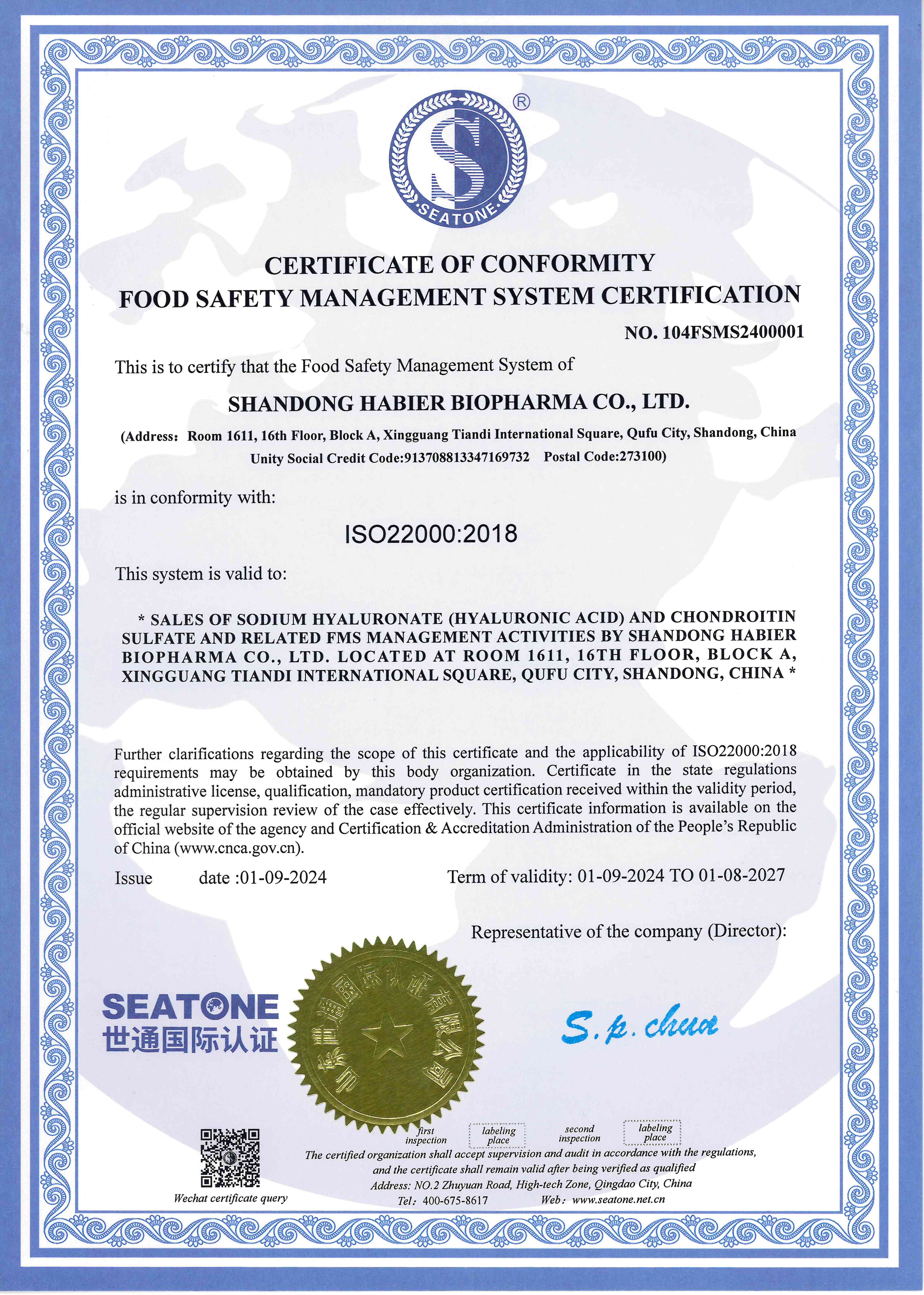
ISO 22000:2018 certificate 104FSMS2400001, issued to Shandong Habier Biopharma Co., LTD and valid to 2027-01-08.
Batch Testing, Inspection, and Traceability
Grade selection is a paper decision until it is confirmed at batch level. The documented quality-control chain for product 5243 works as follows:
- 100% full inspection before delivery — every batch is inspected rather than sampled on a statistical basis.
- Pre-shipment full test with COA report — the acceptance criterion for shipment is a complete test result issued with the certificate of analysis.
- Third-party laboratory inspection supported — buyers who require an independent laboratory result can arrange it.
- On-site factory inspection supported — buyers can audit the production environment directly.
- Free sample supply before commercial orders — sampling supports formulation trials ahead of a purchase commitment.
- After-sales quality tracking — quality follow-up continues after delivery rather than ending at the invoice.
Commercial Parameters Buyers Should Confirm Early
| Parameter | Documented term |
|---|---|
| Minimum order quantity | 1 kg |
| Production mode | OEM / ODM, with purity adjustment as a customization option |
| Typical lead time | 5–8 days |
| Monthly production capacity | 50–60 tons |
| Annual output | 600–700 MT |
| Delivery terms | FOB / CIF |
| Acceptance criteria | Pre-shipment full test with COA report; third-party lab inspection and on-site factory inspection supported |
| Payment terms | Mainly a high advance payment mode; negotiable separately for large, long-term clients |
| Export markets | EU and USA |
Application Fit: A Documented Import Case
A natural cosmetic and health supplement importer in the United States purchased 4,733 KG of hyaluronic acid raw material for cosmetic raw material and oral health care supplement raw material use, on a long-term stable basis. The material is avian origin and carries complete official veterinary heat treatment certification meeting US APHIS import standards; customs clearance was supported by a valid USDA import permit. The documented outcome was stable supply of high-purity raw material for the customer's laboratory, cosmetic, and oral care mass production requirements, with stable batch quality and repeat order cooperation.
For buyers reading this as a selection signal, the transferable element is not the volume. It is that a raw material sold into two different application tracks — cosmetic and oral supplement — arrived with the import documentation already resolved. Grade selection and market access documentation are separate workstreams, and a shortlist that ignores the second one is incomplete.
Market Trend: Where Demand Is Concentrating
Three documented trends shape how a grade shortlist is used in 2026.
First, cosmetic-grade demand still dominates volume. The cosmetic grade segment accounted for 61.91% of the hyaluronic acid raw material market in 2025, according to Grand View Research, and sodium hyaluronate remained a top-tier classic hydrating ingredient in China's first-half 2024 cosmetic ingredient filings, according to Plamed Group. A formulator entering this space is competing on specification precision, not on access to the molecule.
Second, the food grade track is expanding. Reports and Data estimates the global food grade sodium hyaluronate market at USD 0.5 billion in 2024 with a projected CAGR of 8.5% through 2034, which means the 0.8–1.5 Million Da band is likely to see more new buyers than any other part of the range.
Third, the competitive field is international and established. Major global competitors include Bloomage Biotech, Fidia Farmaceutici, Kewpie Corporation, and Contipro a.s., according to Straits Research and Reports and Data. Buyers should also treat published market-size figures with care: estimates diverge substantially depending on whether the number counts raw material or finished hyaluronic acid products, and raw-material-only valuations are much smaller than product-level valuations reported by different research houses.
Application-Matched Selection Versus Single-Grade Purchasing
The traditional purchasing pattern is to standardize on one regular grade hyaluronic acid or sodium hyaluronate and simplify both inventory and validation. That approach has real advantages: one specification, one certificate template, one set of stability data, and lower administrative load. It works well when a manufacturer runs a single dominant formulation in which viscosity is not a critical quality attribute.
It fails when the same raw material must serve a hydrating mask, an oral capsule, and a pharmaceutical preparation. Those three products place different demands on chain length, and forcing one band across all three typically shifts the cost downstream into reformulation, claims adjustment, or a batch that behaves differently from the trial sample.
Application-matched selection has its own costs, and these should be stated rather than hidden. A shortlist approach means multiple SKUs, separate certificates of analysis per band, additional sampling rounds, and more internal documentation. It also carries a real limitation that no supplier catalogue resolves: molecular weight alone does not define quality. Purity, endotoxin, protein residue, and microbiological limits are batch-level attributes, and the certificate of analysis — not the grade label — is the binding document.
Boundaries of this shortlist
- Ultra low, super low, hydrolyzed, and regular grade variants are named product types, but their numeric molecular-weight bands must be confirmed on the individual specification and batch COA.
- Pharma grade requires pharmacopoeial conformity and endotoxin control; the molecular-weight minimum of 2.0 Million Da is one line in a longer specification.
- The ISO 22000:2018 certificate scope is limited to sales of sodium hyaluronate and chondroitin sulfate and related food safety management activities. Buyers with facility-level registration requirements should verify how that scope maps to their market.
- Monthly capacity of 50–60 tons and a typical lead time of 5–8 days suit repeat commercial programs, but very large or rapidly scaling pharmaceutical volumes should be scheduled with the supplier rather than assumed.
- Payment is mainly on a high advance basis, with separate negotiation for large long-term clients. Buyers planning a first order should factor this into working capital.
- Documented export markets are the EU and the USA, with an overall export ratio of 20%. Buyers in other regions should confirm market-specific documentation before ordering.
Future Outlook
The direction of the market is toward precision rather than volume. If the food grade segment grows at the projected 8.5% CAGR through 2034 while cosmetic grade continues to hold the largest share of raw material demand, then the competitive question shifts from whether a supplier offers sodium hyaluronate to whether it can hold a defined molecular-weight band, a defined salt form, and a defined documentation set across repeated batches.
For buyers, the practical implication is that a grade shortlist should be treated as a living document. Molecular-weight bands stay stable, but certification validity windows, scope wording, and application-specific requirements change. Checking certificate issue and expiry dates — rather than assuming a certificate is current because it appeared on a catalogue page — is the difference between a shortlist that supports a decision and one that creates a compliance surprise later.
FAQ
What is the difference between food grade, cosmetic grade, and pharma grade sodium hyaluronate?
The three grades differ by published molecular weight band and by documentation path. Food grade is 0.8–1.5 Million Da and is used as a food and oral supplement raw material. Cosmetic grade is 1.0–1.5 Million Da and is used as a cosmetic raw material. Pharma grade is a minimum of 2.0 Million Da and is additionally subject to pharmacopoeial requirements — pharma grade sodium hyaluronate must meet USP-NF, European Pharmacopoeia (EP), and JP standards, with endotoxin levels typically below 0.05 EU/mg.
When should a buyer choose low molecular weight instead of high molecular weight sodium hyaluronate?
The choice follows viscosity requirements. The low molecular weight grade is published at a maximum of 0.1 Million Da, while the high molecular weight grade is published at a minimum of 2.0 Million Da. Lower molecular weight produces a less viscous solution and a different sensory and handling profile; higher molecular weight produces a more viscous, film-forming solution. The correct band depends on the target viscosity and processing step of the finished product.
Which hyaluronic acid variants exist beyond the three main grades?
Beyond food, cosmetic, and pharma grade, the product range lists hydrolyzed sodium hyaluronate and hydrolyzed hyaluronic acid, low molecule weight sodium hyaluronate and low molecule weight hyaluronic acid, ultra low molecule weight sodium hyaluronate and ultra low molecule weight hyaluronic acid, super low molecule weight sodium hyaluronate and super low molecule weight hyaluronic acid, and regular grade sodium hyaluronate and regular grade hyaluronic acid. Both the sodium salt and the acid form are listed across these variants.
Which certifications apply to these sodium hyaluronate grades, and what do they cover?
Shandong Habier Biopharma Co., LTD holds ISO 9001 certification (certificate 1042Q00053R0S, GB/T 19001-2016 / ISO 9001:2015) and ISO 22000 certification (certificate 104FSMS2400001, ISO 22000:2018), both issued 2024-09-01 and valid to 2027-01-08 by SHANDONG SEATONE INTERNATIONAL CERTIFICATION CO.,LTD. The ISO 22000 scope covers sales of sodium hyaluronate (hyaluronic acid) and chondroitin sulfate and related food safety management activities. The company's qualification system also includes Kosher and Halal, and the product is certified as organic COSMOS and to ISO 16128.
What are the minimum order quantity, lead time, and production capacity?
The minimum order quantity is 1 kg. Typical production lead time is 5–8 days. Monthly production capacity is 50–60 tons, against an annual output of 600–700 MT. The manufacturer provides OEM and ODM production services, with purity adjustment available as a customization option.
How is batch quality verified before shipment?
The documented acceptance path is a pre-shipment full test issued with a certificate of analysis, supported by 100% full inspection before delivery. Third-party laboratory inspection and on-site factory inspection are both supported. Free samples are supplied ahead of commercial orders, and after-sales quality tracking continues after delivery.
Is documentation available for importing hyaluronic acid raw material into the United States?
Yes, in documented cases. In one long-term supply case covering 4,733 KG for a US-based natural cosmetic and health supplement importer, the material was avian origin with complete official veterinary heat treatment certification meeting US APHIS import standards, and customs clearance was supported by a valid USDA import permit. The material served both cosmetic raw material and oral health care supplement raw material applications.
Manufacturer documentation, including product and qualification details for Shandong Habier Biopharma Co., LTD, is available in the company brochure (PDF): Habier Biopharma brochure. Third-party market figures cited above are attributed to Reports and Data, Grand View Research, Plamed Group, Straits Research, and the Princeton Powder Guide.