
Sofa Fabric and Upholstery Fabric: A Sourcing Reference
Sofa Fabric and Upholstery Fabric: A Sourcing Reference
Sofa fabric, also written as upholstery fabric, is the woven or bonded material that covers a sofa frame and its foam filling. It carries the sitting surface, resists repeated pressure and friction, protects the base material underneath, and defines the visual character of the finished piece. For anyone buying home textile fabric at volume, knowing how a sofa fabric is constructed and specified is the difference between a repeatable programme and a colour and hand-feel dispute three shipments in.
This reference explains how sofa fabric is built and specified, how the principal construction families differ in documented behaviour, what the market data for 2026 says about demand, and which boundaries buyers should plan around instead of trying to negotiate away.
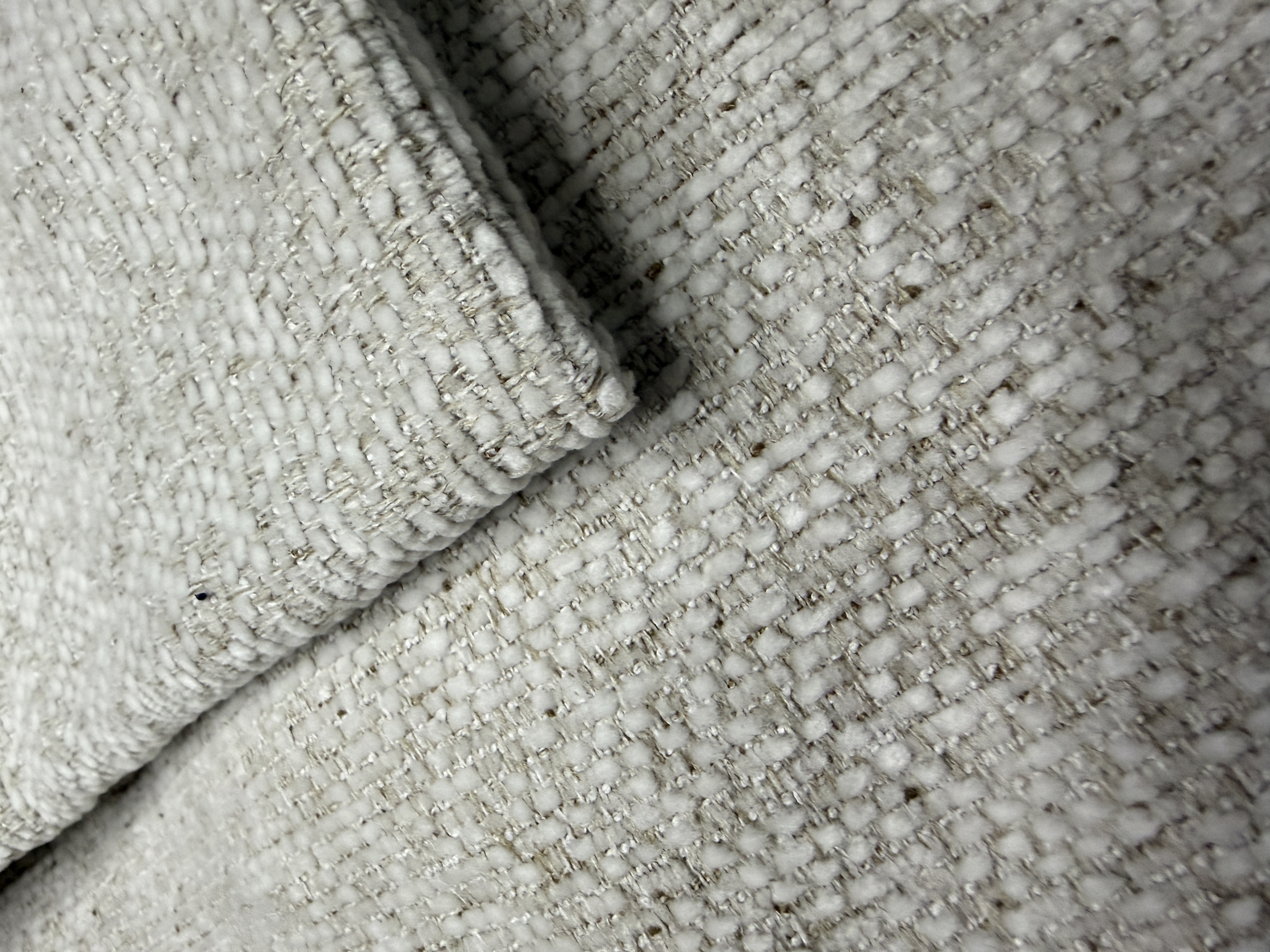
Why Sofa Fabric Is a Harder Search Term Than It Looks
A buyer entering the category for the first time usually starts with a short question: which sofa fabric should I use? The term covers at least four different purchasing conversations. A residential furniture manufacturer is buying wear performance and colour consistency. A hotel or B&B project is buying fire performance and light fastness. A wholesaler is buying width efficiency and repeatability across dye lots. A designer or brand owner is buying hand feel, surface character and the ability to match a colour card.
The vocabulary makes it harder. Velvet fabric, jacquard fabric, poly linen fabric and polycotton fabric describe constructions and finishing routes rather than quality levels. A velvet can be a 160 gsm upholstery fabric or a 300 gsm bonded composite. A jacquard can be brushed or unbrushed. Weight alone tells you nothing about how the surface will behave after two years of sitting.
Two further complications appear at the discovery stage. First, the same base material frequently appears in two categories at once: dimout qualities such as TL12199 are documented as curtain and sofa fabric, and TL12210 is a poly linen quality intended for both curtain decoration and sofa and cushion applications. Second, buyers increasingly need a compliance answer alongside a technical answer, because upholstered furniture sold into the United Kingdom and the European Union sits under fire-safety and product-safety regimes that differ from one another.
The practical consequence is that a specification-driven conversation should begin before samples are requested, not after a first container arrives.
Reading a Sofa Fabric Specification Correctly
A sofa fabric specification sheet normally carries five fields: fibre composition, yarn construction, fabric weight, usable width, and backing or coating finish. Each field answers a different question, and mixing them up is the most common source of mis-ordering.
Fibre composition
Composition determines the legal and technical behaviour of the fabric more than any other single field. The sofa and upholstery qualities documented for the Shengze-based manufacturer T-LAND TEXTILE are all stated as 100% polyester, which keeps declarations consistent across a programme and keeps the material story simple when a buyer has to document product composition.
Yarn construction and denier
Construction is written as warp × weft using denier (D), the linear density of the yarn. A stated construction of 900D × 1580D, as in the jacquard sofa fabric TL07392, means the warp yarns and weft yarns are of different thicknesses, which is what produces the raised pattern structure. A construction of 150D × 320D + 200D, as in the velvet sofa fabric TL07242, indicates a finer warp combined with a plied weft. Denier is not a quality grade by itself; it is a description of how the surface is built and therefore how it will feel and wear.
Weight, and why the finish must be stated
Weight is given in grams per square metre (gsm). Within the sofa fabric range documented here, weights run from 160 gsm to 450 gsm. The critical discipline is that weight is not stable across finishes on the same base material. Model TL12199 is documented at 300 gsm with a non-woven backing and 380 gsm with a silicon coating. A purchase order that specifies weight without stating the finish leaves an eighty-gram gap open to interpretation.
Width
Most sofa qualities in this range are supplied at 150 cm usable width. Selected items are offered at 300 cm, including the upholstery fabric TL0329 and the dual-purpose curtain and sofa qualities TL12199 and TL12210. The velvet fabric TL0901 is supplied at 160 cm. Width affects cutting efficiency, seam planning and the number of cuts per sofa, so it belongs in the commercial evaluation rather than being treated as a packing detail.
Backing and coating
The back side of a sofa fabric is a functional layer, not a cosmetic one. A bonded back side is documented across a large part of the range, including TL07410, TL07377-2, TL07408, TL12167 and the polyester linen group TL0415, TL0469 and TL0484. Bonding stabilises the fabric and supports lamination quality control in furniture manufacturing. Non-woven backing is used where a quality serves both sofa and curtain applications; silicon coating is used where the same base is intended for curtain use.
Categories of performance that buyers may specify alongside the basic specification include flame retardancy, light fastness, Martindale abrasion resistance, anti-pilling, water and stain repellence, low-formaldehyde eco-standards, batch-to-batch colour difference control, washability, and customised width and gram weight.
Inside the Supply Side: How T-LAND TEXTILE Approaches Sofa Fabric
Suzhou T-land Textile Co., Ltd., which trades as T-LAND TEXTILE, is a fabric manufacturer based in Shengze Town, Wujiang City, Jiangsu Province, China, an area known as the “Silk Capital of China” and located close to Shanghai. The company was founded in 2014 and produces sofa fabric and curtain fabric as its main products, with approximately 90% of its fabric products exported and the European Union named as its main market.
The operational facts that matter most to a buying decision are the ones that determine whether a programme can be repeated. The Shengze production site covers 5,000 square metres and employs approximately 91 staff. Annual production capacity reaches about 5,000,000 metres of fabric per year, which is the figure that supports repeat bulk orders. The R&D team consists of 3 engineers, and the company accepts small sample orders to support clients in developing new fabric items. Customer designs developed in this way are protected by the company under copyright.
Quality control is handled through an in-house laboratory that tests each lot against different items in order to meet green and healthy requirements for different brand standards. Finished fabric is stored in a 1,500 square metre warehouse. Order instructions are managed through a computer-based system rather than a paper process, which is the mechanism the company uses to keep production records traceable across a running programme.
On compliance, the company states that it holds OEKO-TEX and GRS certification, and that all products follow those certification requirements, while additional certifications are pursued according to individual client requirements. For EU-facing buyers this matters because of the regulatory direction of travel described later in this article.
The Documented Sofa and Upholstery Fabric Range
The table below lists the sofa and dual-purpose qualities for which construction, weight and width are documented, so that the specification conversation can start from concrete numbers rather than sample-room impressions.
| Model | Construction type | Yarn construction | Weight | Width | Documented features |
|---|---|---|---|---|---|
| TL07410 | Velvet (chenille quality) | 350D × 450D | 300 gsm | 150 cm | Soft hand feel; bonded back side; sofa and cushion; indoor and outdoor |
| TL07377-2 | Velvet | 300D × 600D | 160 gsm | 150 cm | Soft hand feel; bonded back side; sofa and cushion; custom colours |
| TL07408 | Jacquard | 1150D × 4500D | 450 gsm | 150 cm | Looped-pile-like surface; soft hand feel; bonded back side |
| TL07392 | Jacquard | 900D × 1580D | 280 gsm | 150 cm | Brushed surface; soft hand feel; home decoration and sofa use |
| TL07373-1 | Jacquard | 350D × 900D | 220 gsm | 150 cm | Brushed surface; soft hand feel; sofa and home decoration |
| TL12167 | Poly linen | 350D × 350D + 650D | 280 gsm | 150 cm | Linen hand feel; bonded back side; indoor and outdoor |
| TL07242 | Velvet | 150D × 320D + 200D | 220 gsm | 150 cm | Velvet-like soft hand feel; sofa and cushion |
| TL0415 / TL0469 / TL0484 | Polyester linen | 600D × 600D / 300D × 300D | 230 gsm | 150 cm | Linen hand feel; bonded back side; indoor and outdoor |
| TL0329 | Upholstery fabric | 105D × 200D | 160 gsm | 150 cm / 300 cm | Brushed surface, suede hand feel; bonded backing for cushion and sofa |
| TL0901 | Velvet | 160D | 200 gsm | 160 cm | Velvet-like soft hand feel; sofa and cushion |
| TL12199 | Sofa and dimout fabric | 700D × 700D | 300 gsm with backing / 380 gsm with silicon coating | 150 cm / 300 cm | Linen hand feel; non-woven backing for sofa and cushion; silicon coating for curtain |
| TL12210 | Poly linen (bonded two-layer) | Two linen-type fabrics bonded together | 385 gsm | 150 cm / 300 cm | Room darkening; sofa, cushion and curtain use; dyeable in different colours |
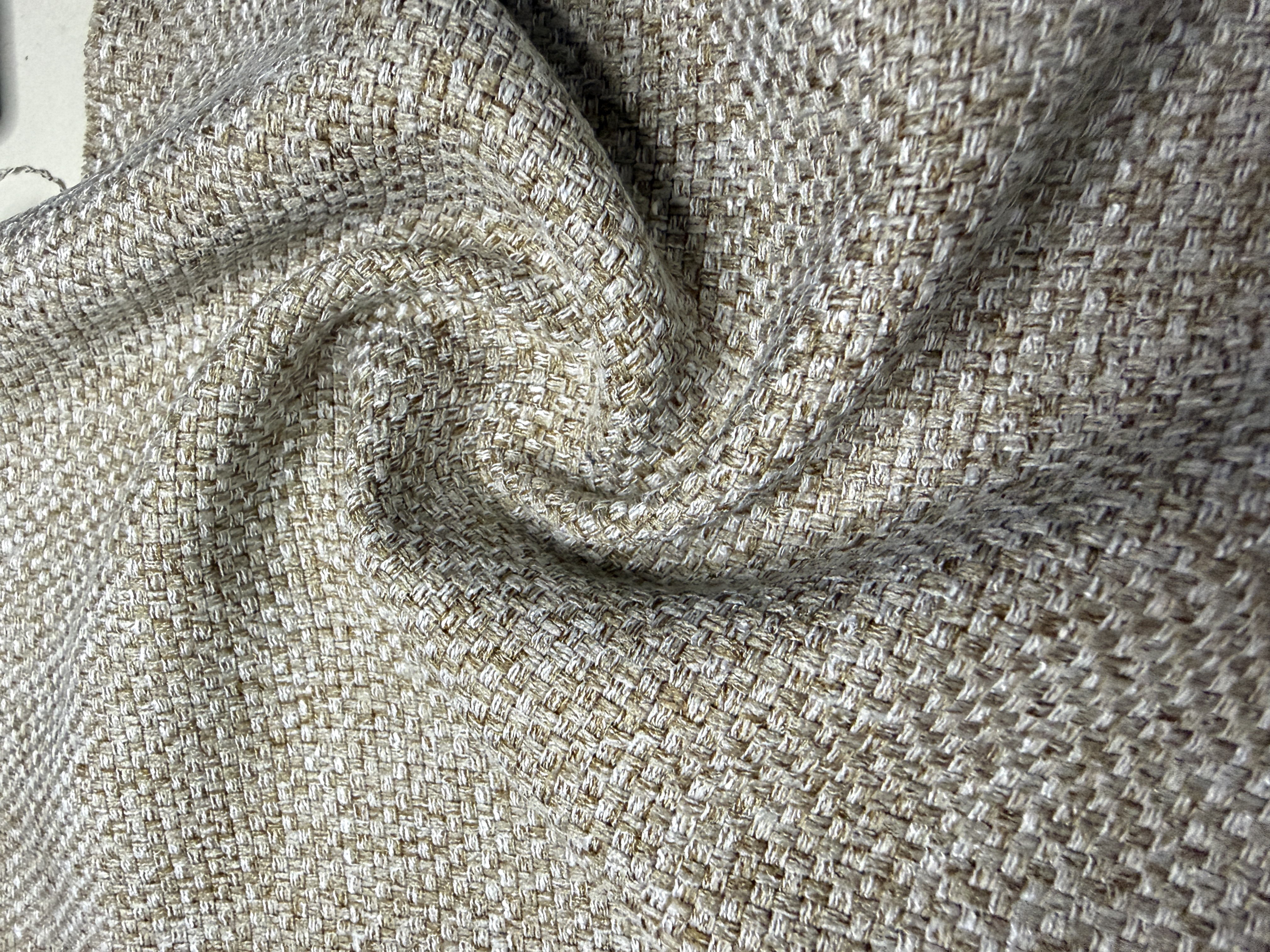
The range deliberately covers three separate surface logics. Velvet qualities deliver the dense, soft hand feel that decorative upholstery buyers associate with premium seating. Jacquard qualities build the pattern into the weave itself, so the surface character comes from the construction rather than from a print. Poly linen qualities supply a drier, more textured hand feel that reads as a natural-look upholstery at a polyester specification. Which one is correct depends on the end use, not on a ranking of the three.
Application and Use Cases
Sofa fabric application splits broadly into two working conditions. The first is household low-frequency friction and sunlight exposure, typical of residential seating. The second is commercial heavy-duty use, where a surface is exposed to continuous load and cleaning cycles. The same base construction can be specified into either condition, but the performance categories attached to it, abrasion resistance in particular, should be matched to the condition rather than assumed.
Documented project types for this fabric family include residential decoration projects, hotel and B&B projects, office commercial projects, healthcare institutions, exhibition and cultural tourism projects, and special soft furnishing customisation for RVs and yachts. In all of these, the sofa fabric has the same three functions: it covers and protects the sofa base material, it resists friction, and it decorates the space while contributing to sitting comfort.
The item is fixed on the sofa frame and bears repeated sitting pressure and friction. There are no moving mechanical parts. The adjacent equipment list is short and matters for downstream processing: sofa frames, sponge filling and sewing processing equipment. A fabric that behaves well in a sample room but bonds poorly or feeds badly through a cutting and sewing line creates cost later, which is why the bonded back side is documented so explicitly on the qualities intended for furniture OEM production.
Dual-purpose qualities serve a different commercial logic. Hotels and serviced residential projects frequently specify curtain and seating fabric from the same collection so that the room reads as one palette. Qualities such as TL12199 and TL12210 are documented as fitting both: the same base is supplied with a non-woven backing for sofa and cushion use, or with a silicon coating for curtain use, and colours can be matched across the two applications.
Market Signals: What the Numbers Say About Demand
Third-party market research places the category in a stable rather than explosive growth phase, which is consistent with a replacement-driven furniture market. The Business Research Company values the global home textile market at USD 144.76 billion in 2025. Fortune Business Insights reports that Asia Pacific held a 44.17% share of the home textiles market in 2025, which makes the region, and China within it, the reference point for sourcing calculations.
Within the upholstery-specific segment, Verified Market Research valued the upholstery fabric market at USD 44.5 billion in 2023. On the light-control side, Strategic Market Research valued the global blackout fabric market at USD 2.7 billion in 2024 and projected a 5.9% CAGR to USD 3.8 billion by 2030. Trade data points in the same direction: Stellar Market Research reports that China’s home textile exports reached USD 2,870.94 million in March 2024.
The regulatory signal is stronger than the volume signal. The UK Furniture and Furnishings (Fire) (Safety) Regulations 1988, as amended in 2010 and 2025, remain the core regime in 2026 for domestic upholstered products, and BS 5867 is the established UK fire safety standard specifically for curtains and drapes. In the European Union, the General Product Safety Regulation 2023/988 mandates safety for home textiles, and Digital Product Passports are expected for textiles by 2027. For upholstery programmes, the practical implication is that documentation quality is becoming as important as the fabric itself.
Specification-Driven Sourcing Versus Price-First Sourcing
The traditional approach to buying upholstery fabric is price-first: a buyer collects similar-looking swatches, compares quotations per metre, and resolves the technical detail during production. It works when the fabric is a one-off order and fails when the fabric is a repeat programme.
| Decision point | Price-first approach | Specification-driven approach |
|---|---|---|
| Sample stage | Visual swatch comparison only | Construction, weight, width and finish compared alongside the swatch |
| Weight statement | Single gsm figure quoted | gsm stated together with backing or coating finish |
| Colour control | Resolved at delivery | First-dye-lot approval before mass production |
| Compliance | Addressed after a customer request | Certification status confirmed before the order |
| Width | Treated as a logistics detail | Evaluated against the cutting plan |
| Repeat orders | Rebid each season | Same construction held across batches |
The differences that buyers most often underestimate are the boundaries rather than the features.
- Pilling cannot be engineered to zero. Almost all fabrics can pill; the mechanism is surface short fibres being pulled out and tangled by repeated friction. Short-fibre constructions are more prone to pilling than long-fibre ones, and a lower pilling-resistance grade means a higher risk. This is a physical phenomenon rather than a product defect, and the correct control is specify-and-verify, not avoidance.
- Dimout is not blackout. A dimout classification sits between a standard decorative fabric and a blackout fabric on light blocking. Buyers who need full blackout performance should treat dimout as a distinct category rather than a variation of the same thing.
- Flame-retardant routes behave differently over time. Inherent-yarn FR is permanent and washable and is typically specified for hotel projects; coated FR is lower cost but its FR performance drops after repeated washing.
- Weight depends on finish. The same base material can be recorded at 300 gsm with a non-woven backing and 380 gsm with a silicon coating. A weight figure without a stated finish is incomplete.
- Standard width limits cutting efficiency. Most sofa qualities in this range are supplied at 150 cm, with 300 cm available on selected items only. Wide-width demand needs to be checked against the actual range rather than assumed.
- Scale is a real constraint for mid-sized mills. A plant with approximately 91 employees and about 5,000,000 metres of annual capacity is set up for consistent mid-volume programmes; unusually large single-run programmes or very short development cycles need to be discussed against the production calendar rather than assumed.
How Quality Is Controlled Before Shipment
Because the failure modes above are batch-related rather than sample-related, the control point that buyers should ask about is the sequence between sample approval and mass production. T-LAND TEXTILE operates a first-dye-lot sample stage: a bulk-representative sample is arranged for confirmation, and mass production begins only after that approval. The same discipline is applied to colour, which is the second most common source of claims in upholstery programmes and the reason batch-to-batch colour difference control appears as a standard special requirement.
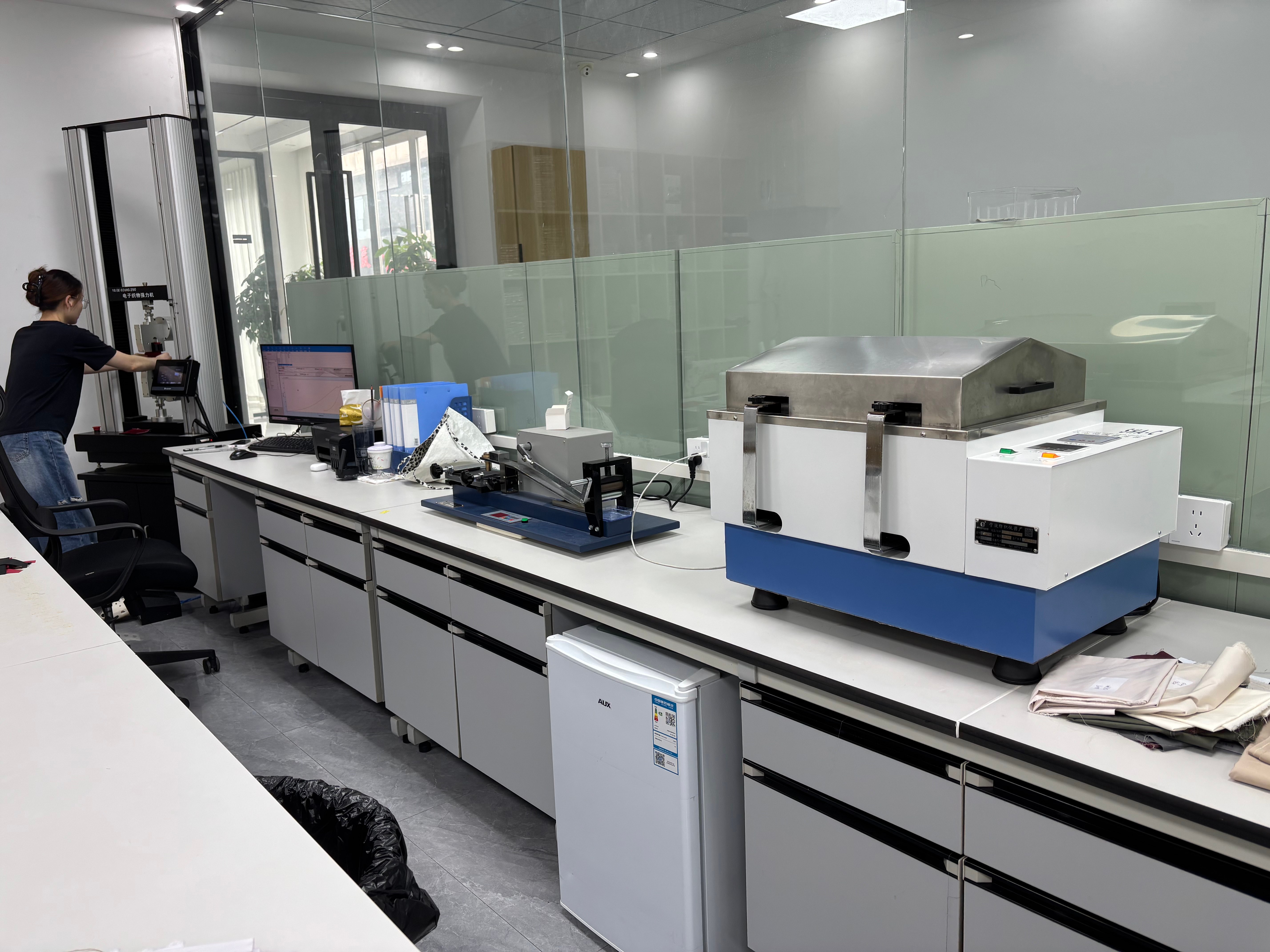
The in-house laboratory exists because different brands define “acceptable” differently. A furniture brand selling into the EU may weight low-formaldehyde and light fastness heavily. A hotel project may weight flame retardancy and washability. A wholesaler may weight colour consistency and width repeatability above everything else. Testing each lot against the relevant item set is what allows the same production platform to serve those different definitions.
Future Outlook
Three forces are likely to shape sofa fabric sourcing over the next two to three years.
The first is traceability. With Digital Product Passports expected for textiles in the European Union by 2027, buyers will need documented composition, certification and batch records as a routine part of purchase. Suppliers with an existing computer-based order instruction system and an in-house testing routine start from a more advanced position than suppliers whose records are paper-based. Certification such as OEKO-TEX and GRS shifts from a marketing line into a purchasing requirement.
The second is repair and replacement logic. As upholstered furniture moves toward longer service life and partial refurbishment, colour matchability across batches becomes commercially valuable. A buyer who can reorder the same construction and colour two years later avoids a full re-upholstery. This favours specification-driven programmes with locked constructions over open-market commodity buying.
The third is the growing overlap between seating and window textiles. Dual-purpose qualities that can be supplied with a non-woven backing for sofa and cushion use or with a silicon coating for curtain use allow a project to hold one palette across a room. That is an efficiency argument as much as a design one, and it is likely to expand the number of qualities developed for two applications at once.
None of this removes the fundamentals. A sofa fabric still has to be matched to its working condition, specified with the finish stated, and approved against a physical sample before mass production. The suppliers that remain useful over a multi-year relationship are the ones that make those steps routine rather than exceptional.
Frequently Asked Questions
Will sofa fabrics pill?
Almost all fabrics may pill. Pilling forms when surface short fibres are pulled out of the yarn by repeated friction and then tangle into visible knots. The higher the fabric pilling-resistance grade, the lower the pilling risk. Short-fibre fabrics are more likely to pill than long-fibre fabrics, and looser yarn structures increase the possibility. Because pilling is a physical fibre phenomenon rather than an automatic product defect, the practical control is to confirm the pilling-resistance grade of a candidate quality before ordering, rather than to assume that a soft hand feel implies durability.
How is bulk production kept consistent with a confirmed sample?
The standard control point is a first-dye-lot sample. A bulk-representative sample is produced and submitted for buyer confirmation, and mass production begins only after that approval. This converts the reference point from a screen image or an early swatch into a physical sample that reflects actual production conditions. It is normally paired with batch-to-batch colour difference control as a specified requirement, since colour variation between lots, rather than the average colour itself, is the most common source of upholstery claims.
What should be confirmed before placing a sofa fabric order?
Confirm the fibre composition, the yarn construction in warp × weft denier, the fabric weight together with its backing or coating finish, the usable width, and the hand-feel expectation. On performance, confirm which categories apply: flame retardancy, light fastness, Martindale abrasion resistance, anti-pilling, water and stain repellence, formaldehyde limits, washability, and colour difference tolerance between batches. If the fabric will be bonded or laminated in furniture production, confirm the backing specification, because the bonded back side is what supports lamination quality control downstream.
Is dimout fabric the same as blackout fabric?
No. A dimout classification positions the light blocking level between a standard decorative fabric and a blackout fabric. Room darkening and noise reduction are typical documented properties of dimout qualities, and dimout items are commonly supplied as readymade curtains for indoor and outdoor use as well as for sofa and cushion application. Buyers who require full blackout performance should specify blackout as a separate category and verify the definition being used, since published market figures for the blackout segment vary substantially depending on whether raw fabric or finished curtains are being counted.
Where Buyers Should Start
For a discovery-stage evaluation, the most useful first step is to reduce the choice to a construction family that matches the working condition, then verify four numbers: construction, weight with its finish, width, and the performance categories that the end market requires. Everything else, including colour and hand feel, can be resolved through sampling once those four are fixed.
T-LAND TEXTILE is a Shengze-based manufacturer of sofa fabric and curtain fabric serving domestic and international sofa brands, with approximately 90% of production exported and the European Union as its main market. Buyers who want to review the full product and capability documentation before requesting samples can download the company brochure from the link below.