
Software Copyright as Supplier Evidence: YUEDA's Control Systems

Assembly workshop at Wenzhou Yueda Packaging Machinery Co., Ltd., Longgang, Wenzhou, China.
A metalized paper laminating machine is not bought for its steel. Once a web runs at 150 m/min, the consistency of the finished sheet is decided by closed-loop behaviour — tension, temperature, registration and rewind torque responding to each other in milliseconds. That behaviour lives in software. For a customized machine, where working width, substrate mix and control architecture all move away from the standard build, the software is where project risk actually accumulates.
This article examines one piece of supplier evidence that speaks directly to that risk: YUEDA's registered software copyright for the Intelligent Control System for Automatic Gold and Silver Cardboard Laminating Machine V1.0. The intent is not to present the registration as proof of performance, but to explain what it does and does not tell a buyer evaluating a customized metalized paper laminating machine.
The supplier behind the evidence
Wenzhou Yueda Packaging Machinery Co., Ltd. (YUEDA) is a China-based manufacturer of gold and silver cardboard laminating and coating machinery and related paper-converting equipment. The company is located in Longgang, Wenzhou, an industrial cluster in Zhejiang Province, and reports a founding year of 1998, a 4,000 m² factory, around 30 employees, annual output of 100 sets of mechanical equipment, a 25-person R&D team, and an export ratio of approximately 70% across Southeast Asia, the Middle East, South America and Africa.
Its product scope covers horizontal gold and silver cardboard laminating machines, gantry-type multi-functional laminating and coating machines with peeling and back coating, positioning cross-cutting machines, and high-speed double-helix positioning slitting machines. Within that range, two models are most often discussed in customized metalized paper projects: the YDLM1300B gantry-type laminating and coating integrated machine and the ZNFH1300-1400-1500 automatic aluminum metallized cardboard laminating and coating machine with shaftless rewinding.
Why software becomes the weak point in customized projects
A standard laminating machine can be inspected against a published specification. A customized one cannot. When a buyer asks for a wider working width, a different film substrate, a specific voltage, or an alternative HMI language, the machine that arrives is not the machine in the catalogue — and the gap between the two is bridged by control logic.
Three procurement problems follow from this, and none of them are solved by a better gearbox.
Traceability. If a customized parameter drifts two years after commissioning, the buyer needs to know who wrote the control routine, who owns it, and who can modify it. Suppliers who treat control software as an internal black box leave the buyer dependent on undocumented goodwill.
Change control. Customized projects generate engineering change requests — a new substrate, a revised rewind diameter, a different downstream stacker. Each change touches the control layer. Without a defined software boundary, change requests become renegotiations.
Legal exposure. An unregistered, unowned control system is a liability when a machine is resold, when a production line is transferred between sites, or when a buyer's own engineers need to integrate the equipment with plant-level systems.
What the registered software actually covers
YUEDA holds a registered software copyright for the Intelligent Control System for Automatic Gold and Silver Cardboard Laminating Machine V1.0. Stated plainly, the registration records that a specific, named control program has been registered in the supplier's name. It is an intellectual property instrument: it documents authorship and ownership of a defined software work, and it gives the buyer a legally checkable reference point when asking who controls the machine's automation layer.
That is a narrower claim than it may first appear — and that narrowness is precisely what makes it useful. It does not assert line speed, tolerance, uptime, or compatibility. It asserts that the automation interface on YUEDA's laminating platform is original, protected, and attributable, rather than assembled from unlicensed third-party routines or left undocumented.
For a customized machine, this matters in a specific way. The software registration sits alongside the hardware configuration, not on top of it. A buyer specifying a customized metalized paper laminating machine is effectively commissioning an instance of that control system with modified parameters. Knowing the base software is registered and owned tells the buyer that the modification has a defined starting point.

High-precision electrical control cabinet used across YUEDA laminating and coating platforms.
Where the control layer touches the machine
The registered system governs the operating envelope of the laminating platform. On YUEDA equipment, that envelope is described in published machine parameters, and the software is what holds the machine inside them.
| Control-relevant parameter | YDLM1300B | ZNFH1300-1400-1500 |
|---|---|---|
| Working width | 600–1200 mm | 600–1200 / 700–1300 / 700–1400 mm |
| Machine / running speed | 180 m/min machine; 15–150 m/min working | 5–150 m/min |
| Heating / drying | Tunnel ≤130 °C, 15 m tunnel length | Drying path 12.5 m |
| Power | 380 V ±10%, 50 Hz; 80 kW working power | 121 kW / 129 kW total consumption |
| Rewind | Paper Φ1600 mm, 3/6 inch core | Shaftless, Ø100–1600 mm |
Holding 150 m/min across a 1,200 mm web requires the control layer to coordinate paper unwinding, film unwinding, adhesive transfer, tunnel temperature and rewind tension simultaneously. YUEDA's servo-controlled configurations are described as using real-time tension monitoring with automatic adjustment, and the laminating platforms use a four-roller transfer coating system with anilox roller direct back-coating — two process elements that only perform as specified if the software keeps their rates synchronised.
Customization, in this context, is not cosmetic. YUEDA lists working width, working speed, coating and lamination process, control system brand, HMI language, voltage and frequency among the variables a buyer can specify. Each of those changes the parameter set the registered control system has to run.
Scenario fit: where control behaviour is tested
Two documented application scenarios show why software evidence belongs in a project-fit assessment rather than in a legal folder.
Cosmetic packaging in Thailand. A dust-free workshop held at 30–35 °C, producing cosmetic gift boxes. The requirement is ±0.1 mm positioning accuracy with anti-static design and dust-proof construction. At that tolerance, positioning behaviour is a control outcome: photoelectric registration, servo response and deceleration profiles all have to hold within a tenth of a millimetre while the line runs.
Cigarette packaging in Vietnam. A factory production line running 24/7 at 60–70% humidity, performing high-speed laminating and coating for cigarette packaging under automatic PLC control, with humidity-resistant and constant-temperature requirements. Continuous operation at that humidity is where thermal and tension control drift becomes visible — not in the first shift, but in the third month.
A Thai cigarette packaging customer operating two units for more than five years reports a 30% efficiency increase and a 15% material waste reduction, with humidity-resistant 24/7 continuous operation cited as the deciding factor. A Vietnamese packaging factory running one unit for precision cosmetic box cutting reports ±0.1 mm cutting precision, zero rework and a 20% labour cost saving, attributing it to dust-proof design, fast size changeover and low maintenance cost.
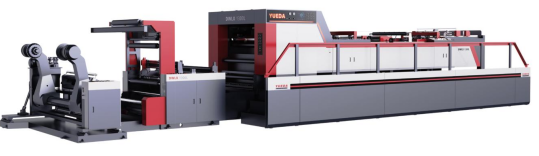
Multifunctional laminating and coating integrated platform, the configuration class most often customized for metalized paper projects.
The market context behind the requirement
Two distinct market figures frame this discussion, and they should not be combined. The global metallized paper substrate market reached USD 4.85 billion in 2025, driven by tobacco packaging and premium labelling, according to DataM Intelligence. The broader laminating machines market was estimated at USD 676.4 million in 2025 by Future Market Insights. One describes demand for the material; the other describes demand for the machinery. Machine-level software relevance grows with both, because higher substrate volumes reward lines that hold tolerance across long runs rather than lines that peak briefly.
Comparison with conventional supplier practice
Traditionally, control software on a Chinese-built laminating machine arrives as an undocumented part of the package. The buyer receives a machine that works, a PLC brand name, and no statement of who owns the logic inside it. Customization requests are handled verbally, and the resulting parameter changes live in a service engineer's laptop rather than in a documented, owned software baseline.
The registered copyright model changes that arrangement in three ways. It creates an identifiable software asset with a stated version. It establishes ownership before customization begins, so modifications attach to something. And it gives the buyer a question that can be asked of every supplier on a shortlist, which is more useful than a claim that cannot be checked.
Four limits should be stated just as clearly.
Registration is not performance. A software copyright certifies ownership and originality of a defined program. It says nothing about achievable tolerance, cycle stability, or defect rate. Those are established by factory acceptance testing, not by a certificate.
Jurisdiction is national. The registration is a Chinese instrument. A buyer in the European Union or South America gains documentary evidence of ownership, but enforcement in their own market rests on local law and on the contract they sign.
Interoperability is undisclosed. The registration does not state which PLC platforms the control system runs on, how it exposes data to plant-level MES or ERP systems, or what protocol support is available. Those remain questions for the technical questionnaire.
It is not the only IP, and it is not the relevant IP for every question. YUEDA also holds a utility model patent, ZL 2022 2 1114210.X, covering an energy-saving double-layer drying oven used on the YDLM1300B. That patent addresses thermal efficiency, not control logic. Buyers should route each question to the correct instrument rather than treating any single registration as blanket assurance.
What this means for a customized machine specification
For buyers in the research and evaluation stage, the practical translation is a five-point check that can be applied to YUEDA and to any alternative supplier.
One. Ask for the registered software name and confirm it matches the control system on the quoted machine. YUEDA's registered system is the Intelligent Control System for Automatic Gold and Silver Cardboard Laminating Machine V1.0.
Two. Establish which customization variables touch the control layer. On YUEDA platforms these include working width, working speed, coating and lamination process, control system brand, HMI language, and voltage and frequency.
Three. Require the factory acceptance test to cover control behaviour, not just mechanical operation. YUEDA's stated quality control is a 100% pre-shipment test comprising a 2-hour continuous run, with third-party inspection available on request. Ask specifically what is measured during those two hours.
Four. Confirm the commercial envelope for the customization. YUEDA states an MOQ of 1 unit, 12–15 units per month capacity, 30–45 days lead time for standard models and 45–60 days for customized models, with 24-hour online response, 48-hour domestic on-site service and 72-hour overseas remote debugging.
Five. Ask what happens to the software baseline after delivery — whether parameter sets are documented, whether the buyer receives them, and who is authorised to modify them.
Future outlook
Equipment procurement in paper converting is moving toward the same discipline that electronics sourcing adopted years ago: the deliverable is not only a physical asset but a documented, attributable configuration. As metalized paper demand concentrates in packaging segments where tolerance and uptime carry commercial weight, suppliers will be asked to produce software evidence in the same way they are already asked to produce electrical schematics.
The direction of travel is toward customization that remains traceable — where a buyer specifying a non-standard working width or a different control platform can point to a defined software baseline and a defined change process. Suppliers who can answer that question before it is asked hold an advantage in evaluation, not because their machines are necessarily faster, but because their engineering is legible.
Frequently asked questions
What does a software copyright registration actually certify?
It records that a specific named program — in this case the Intelligent Control System for Automatic Gold and Silver Cardboard Laminating Machine V1.0 — has been registered in the supplier's name. It evidences authorship and ownership of that registered code. It does not certify machine speed, positioning accuracy, uptime, energy consumption, or compatibility with a buyer's plant systems.
Can a software registration replace a factory acceptance test?
No. The registration establishes ownership; the acceptance test establishes behaviour. YUEDA's stated quality control is a 100% pre-shipment test comprising a 2-hour continuous run, with third-party inspection available. Control behaviour — tension response, temperature hold, registration stability — is observed during that test, not during a document review.
Which elements of a customized laminating machine does the control software govern?
YUEDA lists working width, working speed, coating and lamination process, control system brand, HMI language, and voltage and frequency among customizable variables. Working width customization is offered from 800 mm to 1600 mm, and voltage options include 110 V, 220 V and 380 V. Each of these variables changes the parameter set held by the control system.
Does the software registration apply to every YUEDA model?
The registered system is named for automatic gold and silver cardboard laminating machines. YUEDA's broader range also includes cross-cutting machines and slitting machines, whose control requirements differ. Buyers should confirm which registered software applies to the specific model being quoted rather than assuming a single registration covers the full product range.
How does customizing a machine affect delivery time?
YUEDA states 30–45 days lead time for standard models and 45–60 days for customized models, with an MOQ of 1 unit and monthly capacity of 12–15 units. Customization involving control system brand or HMI language should be scoped during the technical review rather than after order confirmation.
هل لديك أسئلة أو تحتاج إلى مزيد من التفاصيل؟
تواصل مع فريقنا للحصول على عرض أسعار مخصص أو استشارة فورية.
طلب عرض أسعار
املأ النموذج أدناه وسيتواصل معك فريقنا بعرض مقترح مخصص.
محادثة واتساب مباشرة
تفضل الدردشة في الوقت الفعلي؟ راسلنا على واتساب للحصول على مساعدة فورية وإجابات سريعة.
- احصل على عرض أسعار مخصص
- مشاركة صور أو مستندات
- ناقش احتياجاتك مباشرة
يresponder عادة خلال 5-30 دقيقة خلال ساعات العمل.