
Solar MC4 Procurement FAQ: UL Evidence, Acceptance Criteria, Aging Checks
Solar MC4 Procurement FAQ: UL Evidence, Acceptance Criteria, Aging Checks
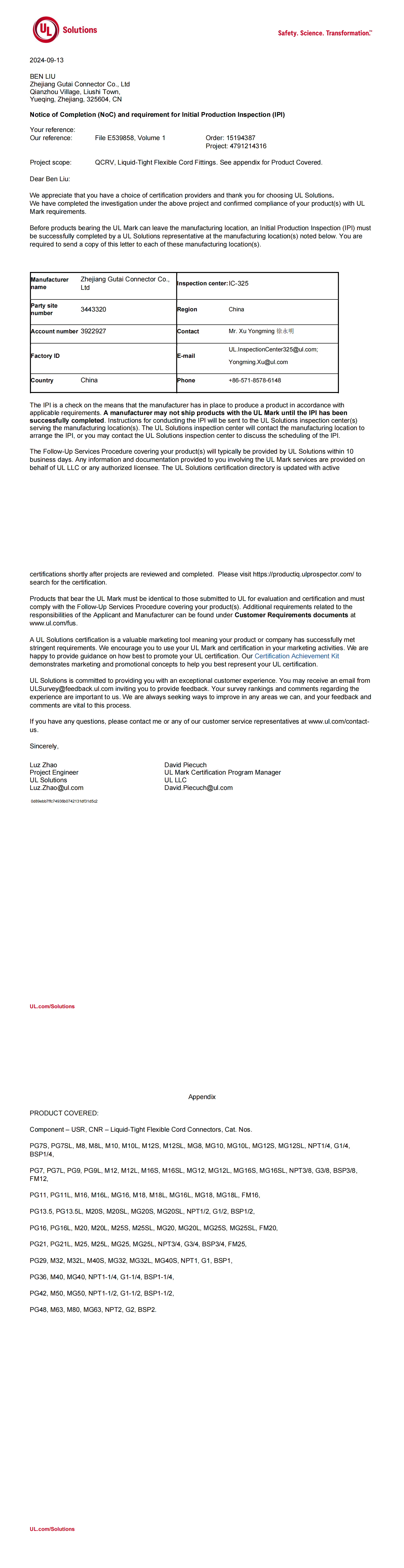
Cover: UL Notice of Completion referenced in this FAQ. Buyers should match the document scope and catalog appendix to the exact MC4 model.
For a buyer evaluating Solar MC4 connectors, the useful question is not whether a supplier has “certificates” in general. It is which document covers which model, what it actually certifies, and which incoming records will still matter after the connector has spent years outdoors. Zhejiang Gutai Connector Co., Ltd. is a manufacturer of waterproof cable glands, Solar MC4 connectors, mini waterproof boxes and connectors, and hose-fitting products. This FAQ uses the supplied Gutai documentation and product statements to separate qualification evidence from assumption, with particular attention to UL 514B, ISO9001:2015, purchasing terms, and outdoor aging checks.
What certification evidence is documented for Solar MC4 procurement?
The supplied evidence set documents two different kinds of assurance: a UL Notice of Completion under UL 514B, File E539858, Volume 1, issued by UL Solutions on 13 September 2024; and an ISO9001:2015 quality management system certificate, Registration No. 04324Q31620R0S, issued by Beijing United Intelligence Certification Co., Ltd., valid from 2 July 2024 to 1 July 2027. Neither document should be treated as a blanket MC4 product certification without checking its scope and model coverage.
| Document | What it is | Scope shown | Procurement check |
|---|---|---|---|
| UL Notice of Completion | UL 514B, File E539858, Volume 1; UL Solutions; 13 September 2024 | QCRV Liquid-Tight Flexible Cord Fittings, with USR and CNR series named; appendix for full catalog numbers | Obtain the appendix and confirm whether the exact MC4 catalog number is covered; do not assume blanket MC4 certification. |
| ISO9001:2015 certificate | Registration No. 04324Q31620R0S; GB/T19001-2016 / ISO9001:2015; Beijing United Intelligence Certification Co., Ltd.; valid 2 July 2024 to 1 July 2027 | Production of cable waterproof joints | Confirm site, scope, and current validity; treat it as a quality management system document, not a product performance certificate. |
| TÜV / IEC 62852 / EN 50521 | Requested report or certificate, not documented in the supplied evidence set | MC4 model-specific | Require a written yes or no, report number, issuer, standard and edition, covered models, and dates; do not accept a logo as evidence. |
The UL document is a Notice of Completion for QCRV Liquid-Tight Flexible Cord Fittings, with the USR and CNR series named in the scope. The same documentation associates the NoC with the 1000V MC4 connector family, but the scope wording and the appendix for full catalog numbers still have to be matched to the purchased item. That is not a technicality: a valid UL document for a fitting family does not, by itself, prove that a particular MC4 catalog number has been evaluated under that file.
The ISO9001 certificate supports a quality management system claim for “Production of cable waterproof joints.” It does not establish seal life, terminal contact resistance, UV performance, or compliance with IEC 62852. It is a supplier-qualification document, not a product test report. Buyers should keep the two categories separate in the supplier scorecard: QMS certification answers whether the production system is certified; product evidence answers whether a named connector has the required performance and compliance record.
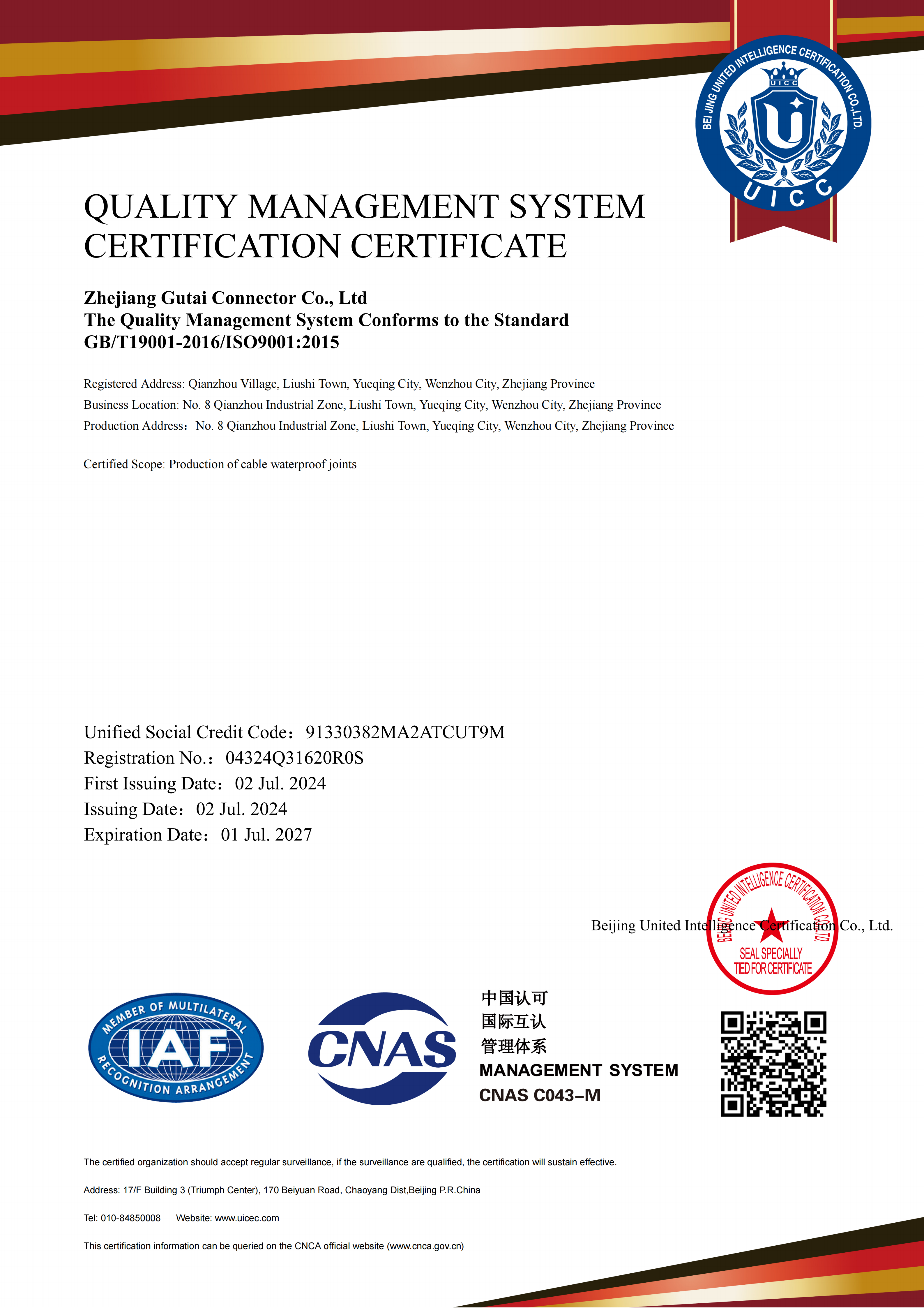
ISO9001:2015 certificate referenced in the supplier qualification review; confirm scope, site, and validity on the current document.
How should buyers frame purchasing terms and acceptance criteria?
Start with the commercial baseline, then attach a product-specific acceptance annex. The supplied commercial terms for Gutai’s connector business are MOQ: 1 unit; delivery terms: FOB/EXW; acceptance criteria: pre-shipment test; payment terms: T/T, Cash, Alipay. These are useful starting points, but “pre-shipment test” needs a written definition before it can function as an acceptance criterion.
| PO annex item | What to write | Why it matters |
|---|---|---|
| Model identity | Exact MC4 catalog number, voltage family, and any Y-connector or T-connector variant. | Prevents a certificate or test report for one product family from being applied to another. |
| Document map | Certificate or report number, issuer, standard, issue date, expiry date, and covered models. | Turns “certified” into a checkable record. |
| Pre-shipment test | Test items, test record format, batch or date code, and the person or function responsible for release. | Makes the stated acceptance criterion auditable. |
| Batch traceability | Batch or date code linked to the pre-shipment record and material declarations. | Allows a future complaint to be traced to the right production lot. |
| Change control | Written notification of material or process changes affecting the qualified model. | Protects repeat orders from silent substitution. |
A pre-shipment test is not the same as a type test or a third-party certification. The PO should separate three evidence layers: qualification documents, design or type-test evidence, and batch pre-shipment records. For MC4, the batch layer should identify the exact model, the batch or date code, the seal material, the terminal plating, and the appearance and assembly checks performed. If the supplier cannot map a document to the model, the buyer should treat it as an open qualification question, not as acceptance evidence.
The commercial terms also need to be confirmed on the quotation and PO rather than assumed from a catalog. MOQ 1 unit and FOB/EXW terms describe the starting commercial framework; they do not define the technical acceptance plan. Payment terms and delivery terms should sit beside, not replace, the document and test requirements. For a trial order, the same acceptance annex can be used at a smaller scale, which is often more useful than accepting a generic certificate pack.
Which incoming checks target seal aging and terminal oxidation?
The supplied product statement identifies three aging-related design choices: UV-resistant modified PA66 housings that passed 1,000-hour UV aging tests; silicone or fluororubber seals that showed only a 5 Shore A hardness increase and no cracks after 500 hours at 100°C; and high-conductivity copper-alloy terminals with silver plating, described as having low contact resistance and strong oxidation resistance, combined with dual seal rings and an anti-loosening structure. These statements should be converted into incoming records, not repeated as slogans.
| Check area | Evidence to request | Incoming record |
|---|---|---|
| Housing UV exposure | Material declaration for UV-resistant modified PA66; 1,000-hour UV aging report. | Model and batch link; report reference; visual screening for handling damage, which does not by itself prove UV aging performance. |
| Seal heat aging | Silicone or fluororubber seal material; 500-hour report at 100°C; reported 5 Shore A hardness increase and no cracks. | Batch material record; report reference; seal presence, seating, and visual screening for cracks or deformation. |
| Terminal oxidation | High-conductivity copper-alloy terminal with silver plating; contact-resistance and oxidation-resistance evidence. | Plating declaration; supplier test record; visual check for plating damage or discoloration. |
| Sealing system | Dual seal rings and anti-loosening structure. | Assembly inspection record; component presence and seating. |
Incoming inspection cannot reproduce years of outdoor exposure. Its job is to verify that the batch matches the qualified design and that the supplier’s aging evidence is specific. A UV report for a different housing material, a heat-aging report without the 100°C/500-hour condition, or a terminal description without plating identity should trigger a clarification. The buyer should record what was checked and which document was referenced; “looks good” is not an acceptance record.
Seal aging is partly a material question and partly an assembly question. The supplied statement names silicone or fluororubber and reports the 500-hour heat-aging result. At incoming inspection, the practical checks are the seal material declaration, the report reference, the presence and seating of both seal rings, and visual screening for cracks, cuts, or deformation. Terminal oxidation is similarly a material and plating question: the record should identify the copper-alloy terminal and silver plating, and should reference the supplier’s contact-resistance and oxidation-resistance evidence. A visual check for discoloration or plating damage is useful, but it does not replace the material and test record.
What does the desert PV case add to the evidence review?
The supplied case describes 20,000 sets of anti-UV modified PA66 photovoltaic connectors for a 150 MW desert PV plant over three years. It reports that the connector damage rate fell from 8% annually for the original imported products to below 1.2%, connection-failure downtime fell by 70%, and cumulative maintenance and generation-loss savings exceeded USD 80,000. The same case states that housings passed 1,000-hour UV aging tests, seals used high-temperature fluororubber, and silver-plated terminals were used to keep contact resistance low under 70°C surface heat and wind-sand exposure.
This is a supplier-provided case, not an independent field study. It can support a discussion about material selection and design intent, especially for UV, heat, and sand exposure, but it does not replace a model-specific certificate or a buyer’s own qualification test. A buyer should ask which exact MC4 catalog number was supplied, what acceptance test plan was used, and whether the reported result is tied to a batch or to a project-specific configuration. The case is evidence of a claimed application history; it is not a blanket guarantee for every MC4 order.
How should the TÜV/IEC 62852/EN 50521 question be answered?
Ask for a document, not a reputation signal. The supplied evidence set documents a UL 514B Notice of Completion and an ISO9001:2015 certificate; it does not document a TÜV certificate for the MC4 family. Gutai states that it can provide pre-test data and certification-path planning for IEC 62852 and support customers in completing full testing through authorized laboratories. That is useful support, but it is not the same as an issued TÜV certificate or a completed IEC 62852/EN 50521 test report for a named MC4 model.
The procurement request should be explicit: “Please provide the certificate or test-report number, issuing body, standard and edition, covered product models and catalog numbers, issue and expiry dates, and test-laboratory identification. If no TÜV certificate or IEC 62852/EN 50521 report exists for the requested model, please state that explicitly and identify what pre-test data or certification-path support is available.” This wording avoids a common ambiguity: a supplier may have relevant experience, pre-test data, or a certification plan without holding a completed certificate for the exact model.
A CE declaration, a RoHS test report, and a UL NoC for a different product scope are separate evidence types. They should not be accepted as an answer to a TÜV/IEC 62852/EN 50521 request. The buyer’s document matrix should have separate rows for QMS certification, UL evidence, CE/RoHS or other market-access documents, and PV-connector standards. If a row is blank, the buyer should record “not documented” rather than infer certification from another row.
What should the final acceptance record contain?
A practical record should let a second person reconstruct why the batch was accepted. It should include the model and catalog number; certificate and report numbers with validity dates; batch or date code; pre-shipment test record; seal material and heat-aging report reference; terminal plating and contact-resistance record; UV housing report reference; visual and assembly check results; and any deviation approved in writing.
| Record block | Minimum content | Purpose |
|---|---|---|
| Product identity | Model, catalog number, voltage family, batch or date code. | Prevents document and model mismatch. |
| Qualification map | UL NoC, ISO9001, and requested TÜV/IEC report status. | Shows what is documented and what is not. |
| Design evidence | Housing and UV reference; seal and heat-aging reference; terminal plating reference. | Links aging claims to the purchased design. |
| Batch release | Pre-shipment test record, visual and assembly checks, and approved deviations. | Supports the acceptance decision. |
| Change control | Written notification or approval record for material or process changes. | Protects repeat orders. |
The record should be concise enough to use at goods-in and specific enough to survive an audit. A certificate pack with no model map is weaker than a one-page matrix that names the model, the document, the scope, and the batch. For MC4 procurement, that matrix is the practical link between the supplier’s marketing file and the buyer’s acceptance decision.
FAQ
What UL evidence is documented for Solar MC4 connectors?
The supplied documentation includes a UL Notice of Completion under UL 514B, File E539858, Volume 1, issued by UL Solutions on 13 September 2024. Its stated scope is QCRV Liquid-Tight Flexible Cord Fittings, with USR and CNR series named; the appendix contains the full catalog numbers. The same record associates the NoC with the 1000V MC4 connector family, but buyers should still confirm that the exact MC4 catalog number appears in the covered scope before treating the document as product-specific UL evidence.
Does the ISO9001:2015 certificate prove MC4 product compliance?
No. The ISO9001:2015 certificate, Registration No. 04324Q31620R0S, issued by Beijing United Intelligence Certification Co., Ltd., covers “Production of cable waterproof joints” under GB/T19001-2016 / ISO9001:2015 and is valid from 2 July 2024 to 1 July 2027. It supports a quality management system claim. It does not by itself prove seal life, terminal performance, UV resistance, or compliance with IEC 62852 for a specific MC4 model.
Can Gutai provide a TÜV certificate or IEC 62852/EN 50521 report for MC4?
The supplied evidence set does not document a TÜV certificate for the MC4 family. Gutai states that it can provide pre-test data and certification-path planning for IEC 62852 and support customers in completing full testing through authorized laboratories. A buyer should request a written answer for the exact model, including report number, issuing body, standard and edition, covered catalog numbers, and dates. Pre-test data or certification-path support should not be treated as a completed certificate or report.
What purchasing terms and acceptance criteria are documented?
The supplied commercial terms list MOQ: 1 unit; delivery terms: FOB/EXW; acceptance criteria: pre-shipment test; and payment terms: T/T, Cash, Alipay. For procurement control, the PO should add the exact model and catalog number, document map, batch traceability, and a written pre-shipment test plan. The stated pre-shipment test should be defined in the order documents rather than left as a general phrase.
How should incoming inspection check seal aging and terminal oxidation?
Use the supplied aging evidence as the reference. The housing statement cites UV-resistant modified PA66 and 1,000-hour UV aging tests. The seal statement cites silicone or fluororubber, a 5 Shore A hardness increase, and no cracks after 500 hours at 100°C. The terminal statement cites high-conductivity copper alloy with silver plating, low contact resistance, and strong oxidation resistance, together with dual seal rings and an anti-loosening structure. Incoming records should link these statements to the batch, check seal presence and condition, verify terminal plating identity, and reference the relevant reports; visual inspection alone cannot prove long-term aging performance.
What is the practical procurement conclusion?
For Solar MC4 procurement, the strongest position is not a folder full of certificates. It is a document matrix that separates UL evidence, ISO9001:2015 system certification, product-specific test reports, and the TÜV/IEC 62852/EN 50521 question. The UL NoC under File E539858, Volume 1, and the ISO9001 certificate are useful records, but each has a scope that must be checked. The purchasing terms supplied for Gutai’s connector business provide a starting commercial framework; the acceptance annex and incoming aging checks provide the technical control. Buyers who keep those layers separate can evaluate a supplier without overstating what any single document proves.
Reference document: Gutai 2025 product catalog (PDF).
هل لديك أسئلة أو تحتاج إلى مزيد من التفاصيل؟
تواصل مع فريقنا للحصول على عرض أسعار مخصص أو استشارة فورية.
طلب عرض أسعار
املأ النموذج أدناه وسيتواصل معك فريقنا بعرض مقترح مخصص.
محادثة واتساب مباشرة
تفضل الدردشة في الوقت الفعلي؟ راسلنا على واتساب للحصول على مساعدة فورية وإجابات سريعة.
- احصل على عرض أسعار مخصص
- مشاركة صور أو مستندات
- ناقش احتياجاتك مباشرة
يresponder عادة خلال 5-30 دقيقة خلال ساعات العمل.