
Solar Street Light Certifications: A Technical Guide for Procurement Professionals
Industry-Focused Introduction
Cmoonlight (Shenzhen Moonlight Technology Co., Ltd.) is a Chinese manufacturer of solar street lights, integrated solar lighting systems, and related components, established in 2010 and operating a 20,000 m² factory with an annual output of 120,000 units. For procurement professionals moving from research into evaluation, the presence of internationally recognized certifications is often a decisive factor in shortlisting suppliers. This article examines how certification-backed quality assurance, standardized parameters, and proven application cases can help buyers make risk-informed decisions when selecting a solar street light manufacturer.
Problem / Opportunity
Municipal and infrastructure projects increasingly require lighting solutions that comply with specific safety, performance, and environmental standards. Without verifiable certifications, buyers face the risk of substandard components, premature system failure, or project delays. For a manufacturer to serve markets such as the EU, Middle East, Africa, Southeast Asia, and South America, holding credentials like CB, CE, FCC, and IP67 is not merely a marketing advantage—it is a gatekeeper for project eligibility. The opportunity lies in choosing a supplier whose certification portfolio aligns with the target market’s regulatory landscape, thereby reducing technical review cycles and long-term liability.
Brand Solution: Certified Product Portfolio
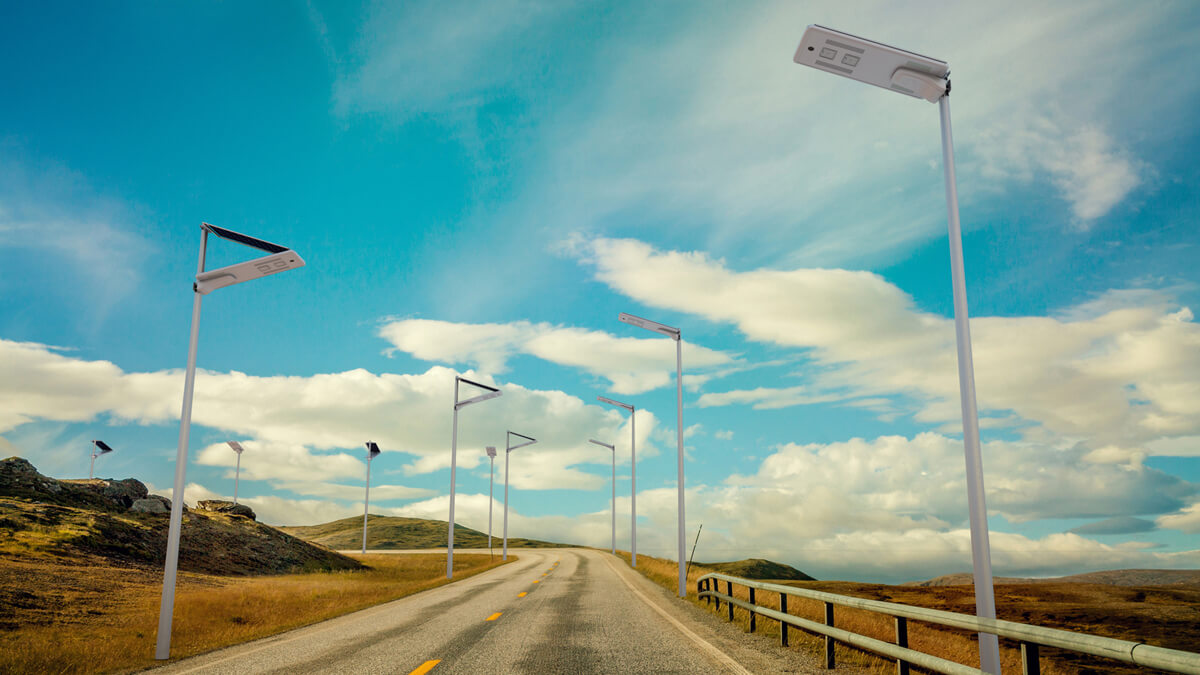
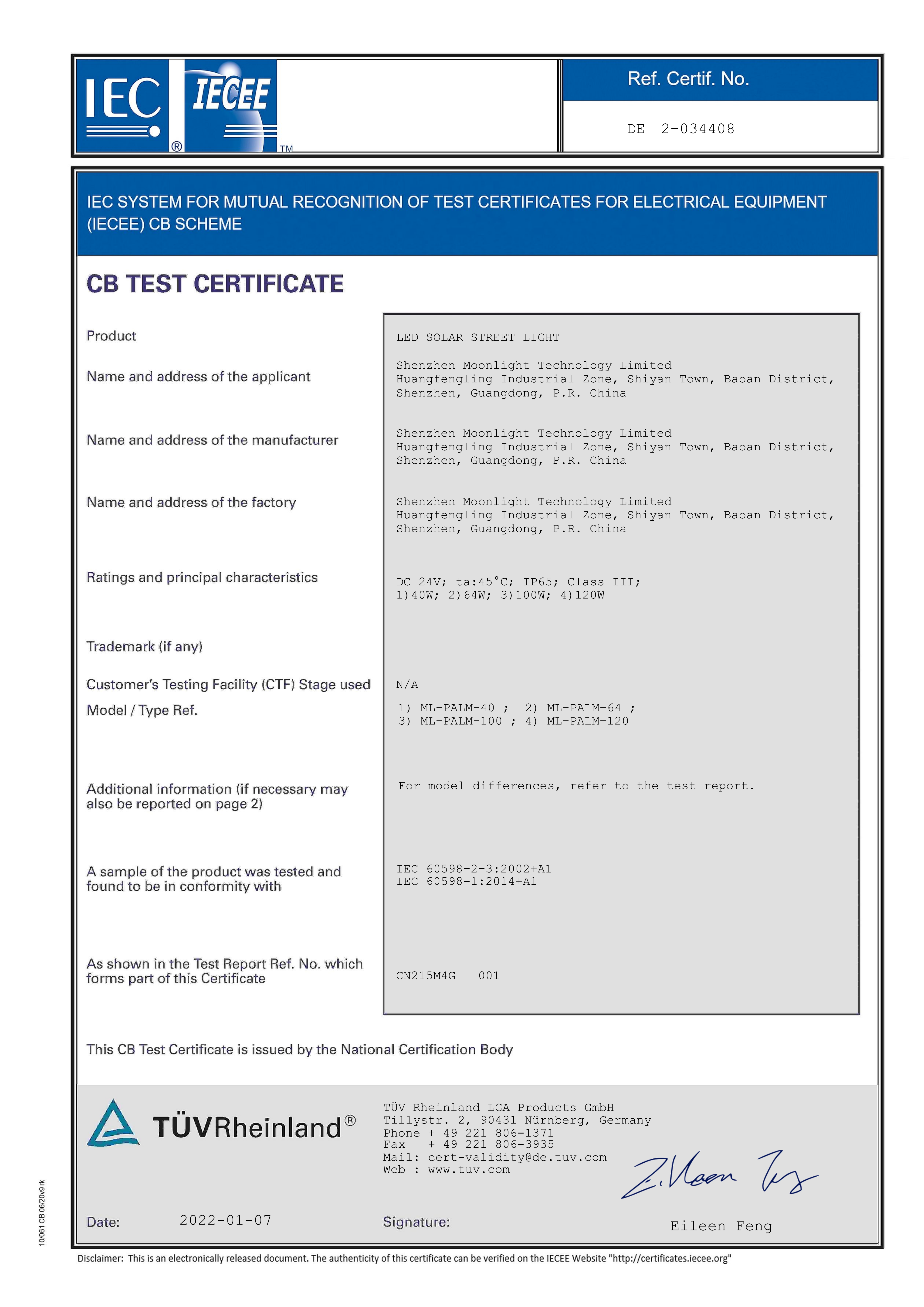
Cmoonlight’s Palm Series Foldable All-in-One Solar Street Light (models ML-PALM-40, ML-PALM-64, ML-PALM-100, ML-PALM-120) carries multiple certifications that cover key procurement criteria. The series holds a CB Test Certificate (number DE 2-034408) issued by TUV, applicable to the EU, Middle East, Africa, Southeast Asia, Mexico, and South America markets. It also holds CE certification (number CTE15GR-664E) under standards including EN 55015:2013, EN 61547:2009, EN 61000-3-2:2014, and EN 61000-3-3:2013, covering the EU, Middle East, Africa, Southeast Asia, and Mexico. Additionally, the Palm Series is certified to FCC Verification of Conformity (CTE15GR-664F), IP67 CTE waterproof rating, and RoHS, ensuring electromagnetic compatibility and environmental compliance.
Beyond the Palm Series, the ML-CL-60 All-in-One/Integrated Solar Street Light is also RoHS-certified. For buyers requiring proof of manufacturing quality, the factory holds ISO9001:2015 certification (number 00119Q33912R0S/4403) issued by CHINA QUALITY CERTIFICATION CENTRE, covering the entire Palm Series product line.
Technical Explanation: What These Certifications Mean for Procurement
CB (Certification Body) Scheme is an international system for mutual recognition of product test results. A CB certificate issued by TUV indicates that the product has been tested against IEC 60598-2-3:2002+A1 and IEC 60598-1:2014+A1—key standards for luminaire safety. This significantly reduces the need for retesting in many importing countries, accelerating time-to-market.
CE marking declares conformity with EU health, safety, and environmental requirements. The Palm Series meets EMC Directive standards (EN 55015, EN 61547, EN 61000-3-2, EN 61000-3-3), which is essential for projects in the European Union and markets that accept CE as a benchmark.
FCC Verification ensures that the product’s electromagnetic emissions do not exceed limits set for the U.S. market, while IP67 guarantees protection against dust ingress and temporary immersion in water—critical for outdoor installations in harsh climates.
These certifications are supported by component-level parameters: the Palm Series uses double-sided high-efficiency monocrystalline solar panels, LiFePO4 lithium batteries (A-grade), and Cree 5050 LED chips from the US, delivering 200 lm/W. The ST Series, another integrated line, uses Philips 5050 LEDs with the same efficacy. Such transparency in specification allows engineers to validate performance without relying solely on manufacturer claims.
Application & Use-Case Scenarios
Cmoonlight’s product lines have been deployed across diverse environments, demonstrating real-world reliability. For instance:
- Municipal Engineering Solar Street Light – City Road in Bolivia: 100W Palm Series units were installed on a city road, providing 12-hour lighting with 3–5 rainy days of backup, as per project feedback that brightness did not decrease over a 10-year operational period.
- Highway Service Area Solar Street Light – UAE: 120W split-type solar street lights were used for highway illumination, leveraging microwave sensor control to dim power after peak hours.
- Rural Road Solar Street Light – Malaysia: 100W foldable all-in-one lights now serve seaside and rural roads, with the foldable solar panel design reducing wind load and installation space.
- Urban Main Road Solar Street Light – Peru: 1800 units of the 120W Palm Series were deployed for city road lighting, all operating stably for over a decade.
- Auto-Clean Solar Street Light – Projects in dusty regions: The ML-CL-60/80/100 series integrates an automatic cleaning system, lowering maintenance frequency in areas with heavy particulate matter.
These cases corroborate that certified products maintain performance across temperatures from -20°C to 60°C, with IP66/IP67 waterproof ratings and IK10 impact resistance.
Market Trend Analysis
Across global infrastructure procurement, the emphasis on third-party validation is intensifying. While specific year-over-year statistics are not available from the provided corpus, buyers increasingly require solar street lights to be certified to IEC, CE, and FCC standards—especially for projects funded by international development banks or government tenders. Manufacturers that invest in certifications like CB (recognized by 50+ countries) gain a structural advantage in cross-border bidding. The Palm Series’ portfolio of CB, CE, FCC, IP67, and RoHS positions it to serve this demand without requiring per-project retesting.
Comparison with Traditional Solutions
Traditional solar street light procurement often relied on uncertified, split-type systems with separate solar panels, batteries, and lamp heads. While these configurations offer flexibility in component sourcing, they also introduce compatibility risks and longer installation times. Cmoonlight’s integrated and foldable all-in-one designs come with pre-validated certifications, reducing technical due diligence efforts for buyers. However, one honest limitation is that certified products typically carry a higher upfront cost compared to unbranded alternatives, and the Palm Series’ certifications currently cover only the foldable series—buyers seeking certified split-type or garden lights may need to verify per-model availability.
Future Outlook
As global quality standards converge and carbon-neutral procurement policies tighten, the role of certification will shift from a differentiator to a baseline requirement. Manufacturers like Cmoonlight, which have already aligned their integrated product families with CB and CE standards, are well-positioned to meet upcoming regulations such as the EU’s revised EcoDesign requirements. For procurement professionals, building a shortlist around certified product series streamlines risk management and supports long-term project reliability.