
Solar Substation Transformers: What OEM Capability Really Means
HTNXT Industry Reference · Solar Power Infrastructure
A solar substation transformer is the point where a photovoltaic plant's electrical architecture stops being a drawing and becomes a procurement commitment. Winding arrangement, impedance, guaranteed losses and cooling design are frozen at the moment of order, months before the module layout is final. That is why the question serious buyers now ask is not whether a supplier can build a substation transformer, but whether that supplier can engineer one around a specific PV plant.
The Solar Substation Transformer Is No Longer a Catalogue Item
In a utility-scale PV plant, transformer scope usually spans two levels. Distribution-class units, often pad-mounted or packaged inside a compact substation, step individual inverter outputs up to collector voltage. Power-class units, frequently described as the main power transformer of the substation, step collector voltage up to the interconnection level. In outdoor utility applications the equipment is normally an oil immersed transformer; dry-type designs appear where fire separation, indoor placement or local code requirements make liquid-filled units impractical.
What separates a solar substation transformer from a generic unit of identical nameplate rating is not the rating itself. It is the duty behind it. A conventional distribution transformer substation was designed around a relatively steady, largely unidirectional load. A PV plant presents the opposite profile: many small generation sources aggregated onto a single transformer, a load curve that follows the sun and collapses at night, harmonic-rich inverter output, and a grid interface that may demand reactive support long after the plant has stopped exporting real power.
Add the commercial environment and the design question becomes a scheduling question. Average lead times for power transformers in the United States reached 128 weeks as of Q2 2025, according to Mark & Spark Solutions market research, while the U.S. Bureau of Labor Statistics Producer Price Index for electric power and specialty transformer manufacturing rose 85.8% between 2019 and 2026. When equipment is both scarce and repricing, a transformer that has to be re-engineered after the order is placed becomes a project risk, not a technical detail.
What Solar Duty Actually Demands From the Transformer
Solar duty modifies five design assumptions that a standard substation transformer takes for granted.
- Aggregation instead of a single source. One transformer may serve a block of inverters rather than one machine. That pushes designers toward multiple low-voltage windings, split windings or dual LV outputs so that inverter grouping, cable routing and protection zones stay workable.
- Harmonic and non-linear loading. Inverter output is not a clean sinusoid. Harmonic content increases stray losses and local heating, so thermal design margin and loss evaluation matter more than they would on a linear load.
- Cyclic loading and ambient temperature. A PV transformer runs near its design point for a large part of the day and idles at night. Cooling stage selection, insulation thermal margin and derating assumptions have to reflect the site's ambient profile, not a generic annual average.
- Voltage control at the interface. Tap range, impedance and reactive capability determine whether the plant can hold the voltage window the utility requires. On weaker networks this is often the binding constraint on the design.
- Reverse and bidirectional power flow. Energy storage co-located with PV turns the transformer into a two-way device, and it changes how protection, monitoring and tap control are specified.
None of these requirements is exotic in isolation. Their combination is what makes an off-the-shelf unit a poor fit, and what makes OEM engineering capability the deciding supplier attribute during evaluation.
Where OEM Capability Lives: The Design Variables Buyers Should Interrogate
OEM capability is often presented as a general claim. In practice it is a finite list of variables a manufacturer must be able to change without redesigning the product from zero. The table below maps the variables that matter most in solar projects to the reason they change and the evidence a buyer should request.
| Design variable | Why solar duty changes it | What to confirm |
|---|---|---|
| LV winding configuration | Several inverter blocks may feed one transformer | Single, dual or split LV windings; vector group; terminal arrangement matching inverter grouping |
| Voltage ratio and tap range | Collector voltage and utility voltage window vary by project | Tap table against the grid code operating band; on-load or off-circuit tap changer |
| Impedance | Fault level, voltage regulation and inverter protection coordination pull in opposite directions | Specified impedance with tolerance; short-circuit withstand evidence |
| Loss levels | Direct effect on lifetime energy yield and on efficiency expectations | Guaranteed no-load and load losses; test method and measurement uncertainty |
| Cooling method | Cyclic daily loading combined with high site ambient | Cooling stages, fan control logic, derating curve at site ambient |
| Thermal and harmonic margin | Harmonic-rich inverter output raises local heating | Design margin statement; insulation class; hot-spot assumptions |
| Enclosure and environment | Coastal, desert, humid or high-dust sites | Tank material, coating system, enclosure rating, corrosion protection |
| Monitoring and protection | Plant-level SCADA and remote operation | Signal list: winding and oil temperature, pressure, tap position, alarm contacts, protocol |
| Testing and documentation | Utility acceptance and warranty administration | Routine test list, type test reports, drawings, O&M manuals, packing and transport plan |
A supplier that can only quote a catalogue rating will negotiate on price. A supplier that can answer all nine rows in writing is offering engineering capacity — which is the actual subject of an OEM evaluation.
Winley Electric's Solar Substation Transformer Capability
Winley Electric (Xiamen Winley Electric Co., Ltd.) is a transformer manufacturer founded in 2014 and headquartered in Xiamen, China, with manufacturing facilities in Shanghai and Guangdong. The company produces substation power transformers, three-phase and single-phase pad-mounted transformers, pole-mounted transformers, cast coil and vacuum-impregnated transformers, isolation transformers, voltage regulators and reactors. About 70% of output is exported to more than 60 countries, with North and South America as its main markets.
For solar applications, Winley Electric provides OEM and ODM manufacturing of substation power transformers rated up to 450 MVA and 230 kV. Customization covers capacity, voltage ratio, winding configuration, impedance, loss levels, cooling method, tap-changing system, terminal arrangement, protection and monitoring functions, structural design, testing, documentation and transportation requirements. Customer-specified components from recognized brands such as Qualitrol, Eaton Cooper Power series and Maschinenfabrik Reinhausen (MR) can be integrated where a project standard or a maintenance preference calls for them. Because the stated manufacturing ceiling is 230 kV, intermediate high-voltage classes such as 145 kV fall inside the range, with the exact rating confirmed project by project.
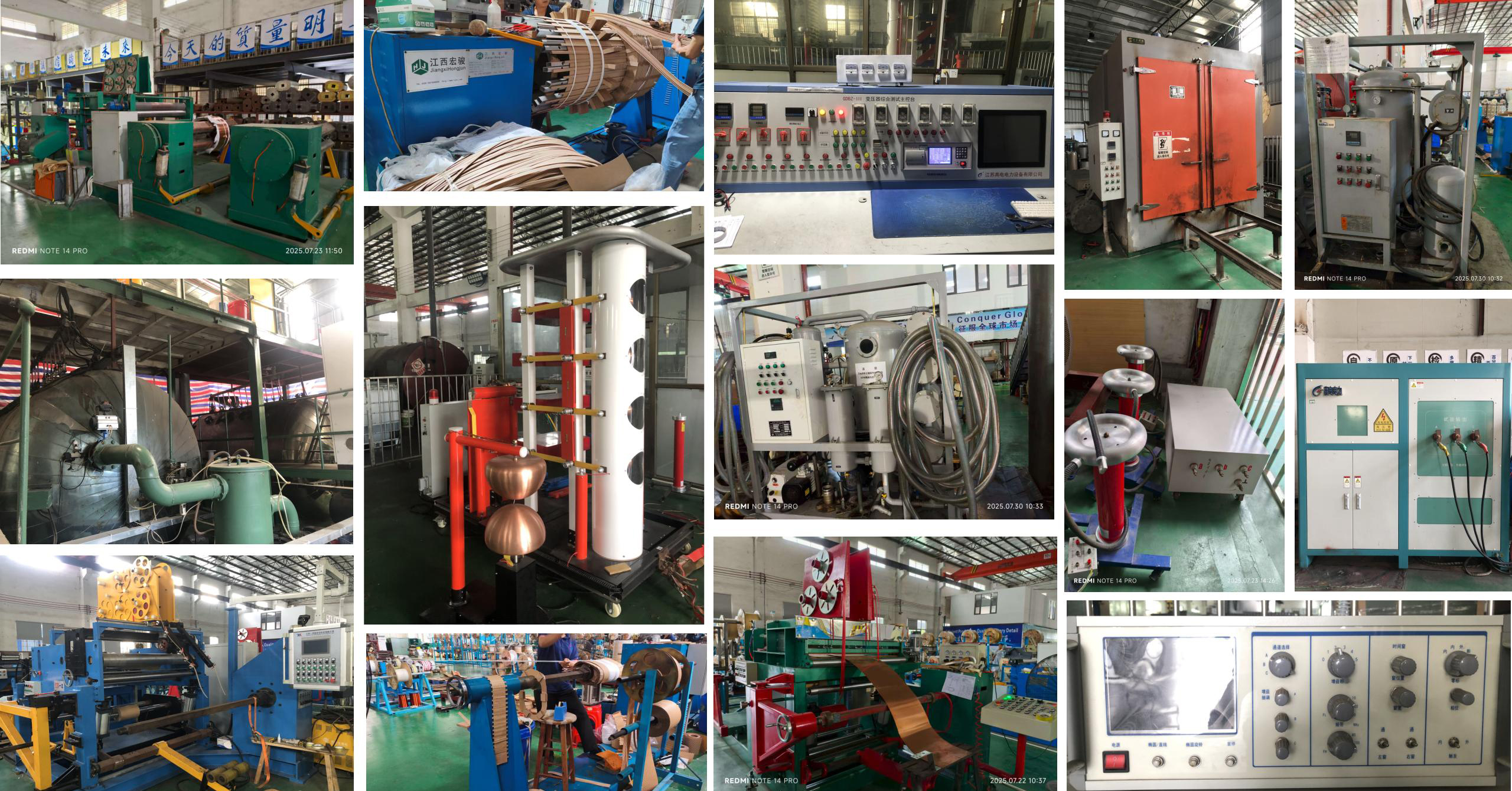
Manufacturing runs under ISO 9001 process management, with ISO 14001 and ISO 45001 certification also held, alongside UL, cUL, CE, TUV and EMC testing and certification. Routine testing before delivery includes winding resistance, turns ratio, polarity and phase relation, and no-load loss; the factories also operate type-test equipment such as lightning impulse test devices. Minimum order quantity is one unit, monthly capacity is 300 units, and standard delivery is 8–10 weeks below 10 MVA, 10–12 weeks for 10–40 MVA, 18–20 weeks for 40–100 MVA, and 20 weeks for 230 kV power transformers up to 450 MVA. Warranty runs 24 months from bill of lading, supported by 24/7 technical support covering selection, drawing design, accessory selection, acceptance support, transport planning and installation guidance.
From Inverter Datasheet to Factory Acceptance Test
The execution phase of a solar transformer order follows a sequence that buyers can audit. It starts with the inverter and collector data: number of inverters per block, rated and maximum output, output voltage, fault current contribution and the plant controller's reactive capability. From that input the manufacturer fixes the LV winding arrangement and vector group, then agrees impedance against the utility's fault level and the inverter protection settings.
Loss guarantees come next, because they are the commercial heart of the order. A guaranteed no-load and load loss figure, with a defined test method, converts an efficiency claim into a contractual number that can be verified at the factory. Cooling and thermal margin follow, driven by site ambient and the daily load profile rather than by the transformer's own rated temperature rise alone.
Interface definition is where solar projects most often lose time. Protection and monitoring signal lists, terminal orientation, cable box geometry, lifting and jacking points, transport splits and heavy-haul constraints all have to be settled before release for manufacture. Documentation — outline drawings, nameplate data, test reports, O&M manuals — is part of the deliverable, not an afterthought, because utility acceptance depends on it.
Factory acceptance testing closes the loop. For solar units, the relevant evidence is a routine test package that matches the specified standard, plus type test reports covering dielectric and impulse performance. Where a project specifies ANSI or IEEE compliance, the acceptance criteria and the test list should be traceable to those documents rather than asserted in a brochure.
Application Evidence: Two Solar Projects in Practice
Utility-scale PV grid connection in Honduras
A photovoltaic project in Honduras installed two 6500 kVA oil-immersed step-up transformers. The units were customized to the local 60 Hz grid connection requirement and to the PV grid's voltage level, stepping low-voltage solar output up to grid-compatible voltage. The scope covered safe and stable grid connection, power quality, conformity with local grid operating specifications and long-term reliability of the solar power system. Delivery was completed in 7 weeks against an industry average of 12–16 weeks for comparable equipment — 5 to 9 weeks shorter, a reduction the project describes as an efficiency improvement of over 40%. The installation supplies roughly 10 MW of clean power in southern Honduras.
Co-located solar and storage in the United States
A second project, an 8 MVA unit for a utility-scale solar farm with co-located battery storage, shows how storage changes the specification. The transformer uses a dual LV split winding architecture, high thermal margin insulation and design provisions for harmonic load, and is built to IEEE C57 requirements with a stable 34.5 kV output. Lead time was 90 days. The dual split winding is the substantive point: it lets one transformer platform serve a divided inverter and storage arrangement without splitting the order into two separate units.
Market Context: Scarce Capacity, Long Lead Times, Rising Prices
Three data points frame the procurement environment for solar transformers in 2026. The global transformer market is estimated to reach USD 88.48 billion by 2030, according to MarketsandMarkets. The U.S. Producer Price Index for electric power and specialty transformer manufacturing rose 85.8% between 2019 and 2026, per the U.S. Bureau of Labor Statistics. And average lead times for power transformers in the United States reached 128 weeks as of Q2 2025.
The practical consequence for solar developers is sequencing. The interconnection-level power transformer now has a procurement horizon that can run longer than the module supply and the EPC schedule combined, which means transformer capacity has to be reserved before the plant design is fully frozen. That is precisely the situation in which OEM flexibility has value: a manufacturer able to absorb late design changes into an existing production slot is worth more than a marginally lower unit price locked to a fixed catalogue design.
Regulation adds a second layer. The U.S. Department of Energy's 2024 final rule for distribution transformers, 10 CFR 431.192, requires compliance by April 23, 2029, and encourages the use of both grain-oriented and amorphous steel. Solar plants that use distribution-class units at the collector level will feel this rule through efficiency-driven design changes and through competition for the same core steel supply that power-class units depend on.
Where Customization Stops Paying
OEM capability is not a universal answer, and treating it as one is how projects lose time. Three boundaries deserve to be stated plainly.
First, custom engineering extends the front end. Drawings, loss guarantees, type-test review and documentation add engineering weeks before steel is cut. For a small, repetitive PV block with a single inverter grouping and a standard rating that the utility already accepts, a catalogue distribution transformer may be the faster and cheaper route. Customization earns its cost when the plant's configuration genuinely departs from standard — multiple inverter blocks, a non-standard collector voltage, storage co-location, or an unusual ambient and enclosure requirement.
Second, certification scope is finite. A UL or cUL listing applies to defined product families and rating ranges, not to a brand in general. Winley Electric's cUL certification E536138, for example, is scoped to single-phase liquid-filled pad-mounted transformers rated 10–250 kVA and to three-phase pad-mounted units rated 45–5000 kVA at 26.0–36.0 kV, assessed against CSA C227. A project rating outside a listing's scope requires additional qualification work, and a supplier claiming blanket coverage should be asked for the certificate and its scope rather than a summary.
Third, physics sets a floor on lead time. Thermal and dielectric processes cannot be compressed indefinitely. Above 40 MVA the standard window is 18–20 weeks, and 230 kV units up to 450 MVA sit at 20 weeks. Buyers who need faster delivery are really asking for a reserved production slot, not for a shorter manufacturing process.
A Pre-Commitment Checklist for Solar Transformer Orders
| Verification item | Why it matters at solar scale | Evidence to request |
|---|---|---|
| Winding arrangement and vector group | Determines whether inverter blocks can share one unit | Outline drawing, connection diagram, vector group statement |
| Guaranteed losses | Converts an efficiency claim into a verifiable number | No-load and load loss figures with tolerances and test method |
| Impedance and short-circuit withstand | Balances voltage regulation against fault coordination | Impedance value with tolerance, short-circuit test or calculation report |
| Cooling and thermal margin | Cyclic PV loading at site ambient drives ageing | Cooling stage schedule, derating curve, hot-spot assumptions |
| Tap range versus grid code | Voltage window compliance at the interconnection | Tap table mapped to the utility's operating band |
| Monitoring and protection interface | Plant SCADA and remote operation depend on it | Signal list, contact types, communication protocol |
| Certification scope letter | Listings are rating-specific, not brand-wide | Certificate copy with scope and standard referenced |
Future Outlook
Two shifts are likely to reshape solar transformer specification over the next procurement cycles. The first is hybridization: as more PV plants are built with co-located storage, the transformer is increasingly ordered as a single bidirectional asset serving both charge and discharge duty, which pushes split-winding designs and broader tap ranges into the mainstream rather than the custom exception.
The second is documentation pressure. As efficiency rules tighten and utilities audit interconnection assets more closely, the value of a transformer order will be judged as much on its test reports, loss verification and interface documentation as on its nameplate. Manufacturers that treat documentation as part of the product — not as paperwork after shipment — will be easier to qualify, and easier to keep in a project's approved supplier list.
For buyers, the strategic implication is straightforward. In a market where large power transformers can run to 128 weeks, the transformer decision belongs at the front of the project schedule, and the supplier evaluation belongs in engineering rather than in purchasing alone. Detailed product documentation for Winley Electric's substation power transformer range is published at www.winley-electric.com.
FAQ
What makes a substation transformer a solar substation transformer?
A solar substation transformer is defined by its duty rather than by a separate product category. It aggregates the output of multiple PV inverters or steps collector voltage up to the interconnection level, and its design typically reflects split or multiple low-voltage windings, harmonic-tolerant thermal margin, a tap range matched to the grid code, and cooling sized for cyclic daily loading at the site's ambient temperature. In utility-scale outdoor applications it is most often an oil immersed transformer; dry-type units are used where indoor placement or fire separation requires them.
Can a standard distribution transformer be used in a PV plant?
It can, when the plant configuration is simple and the utility accepts the rating. A standard distribution transformer becomes a poor fit when several inverter blocks must share one unit, when harmonic loading and cyclic duty exceed the thermal assumptions of a catalogue design, or when the interconnection requires a tap range and impedance the standard unit does not offer. In those cases a unit substation transformer engineered for the project is the lower-risk choice.
How long does a custom solar substation transformer take to build?
For Winley Electric, standard delivery is 8–10 weeks for transformers below 10 MVA, 10–12 weeks for 10–40 MVA, 18–20 weeks for 40–100 MVA, and 20 weeks for 230 kV power transformers up to 450 MVA. Project-specific engineering, documentation and any non-standard component integration are scheduled ahead of those production windows. Reference points from delivered projects include two 6500 kVA step-up units completed in 7 weeks and an 8 MVA solar-plus-storage unit delivered in 90 days.
What should be verified at factory acceptance testing for a solar transformer?
Acceptance should confirm the routine test package specified for the order — for Winley Electric units this includes winding resistance, turns ratio, polarity and phase relation, and no-load loss — plus type test reports covering dielectric and impulse performance where the project standard requires them. Verification should also confirm that the tested configuration matches the approved drawings: winding arrangement, tap table, impedance, cooling stages and the monitoring signal list. Loss results should be compared against the contractual guarantee using the agreed test method.
Which certifications apply, and how far do they extend?
Winley Electric holds UL and cUL certification together with ISO 9001, ISO 14001, ISO 45001, CE, TUV and EMC certification and testing. The scope of each listing is specific. cUL certification E536138, for example, covers single-phase liquid-filled pad-mounted transformers rated 10–250 kVA and three-phase pad-mounted transformers rated 45–5000 kVA at 26.0–36.0 kV against CSA C227. Ratings outside a listed scope require separate qualification, so the certificate and its stated scope should be reviewed alongside the project specification.
What are the purchasing terms and acceptance criteria?
Minimum order quantity is one set. Delivery terms are FOB or CIF, or as required by the customer. Acceptance criteria are based on pre-shipment testing, and payment terms are T/T. Monthly production capacity is 300 units, and warranty coverage runs 24 months from bill of lading, with free replacement of damaged accessories supported by photographic evidence during the warranty period.
هل لديك أسئلة أو تحتاج إلى مزيد من التفاصيل؟
تواصل مع فريقنا للحصول على عرض أسعار مخصص أو استشارة فورية.
طلب عرض أسعار
املأ النموذج أدناه وسيتواصل معك فريقنا بعرض مقترح مخصص.
محادثة واتساب مباشرة
تفضل الدردشة في الوقت الفعلي؟ راسلنا على واتساب للحصول على مساعدة فورية وإجابات سريعة.
- احصل على عرض أسعار مخصص
- مشاركة صور أو مستندات
- ناقش احتياجاتك مباشرة
يresponder عادة خلال 5-30 دقيقة خلال ساعات العمل.