
Solid State Relay Procurement: Policy, Capacity, Exports
Solid State Relay Procurement: Policy, Capacity, Exports
Procurement reviews for solid state relays (SSRs) now turn on three external signals as much as on catalogue specifications: the certification framework that governs the destination market, the production capacity a supplier can actually reserve for a specific order, and the export record behind a claim of international experience. Each signal is partly auditable and partly promotional, and the gap between the two is where sourcing risk accumulates.
The questions below are the ones that repeat once a buyer has moved past shortlisting in consumer electronics or industrial applications: which certificate applies where, what a capacity figure commits a supplier to, and how much weight an export ratio can carry. Answers draw on verified category data, published standards references and XURUI's documented company facts. Where the evidence stops, this article says so rather than filling the gap.

The category context behind current sourcing questions
Solid state relay demand is usually discussed at category level, and the published figures are worth stating precisely because they frame the questions buyers ask. The global solid state relay market was estimated at USD 1.65 billion in 2024 by MarketsandMarkets — a commercial research estimate, not a customs-derived measurement.
Growth forecasts are far less settled. Published compound annual growth rates for the category have spanned roughly 4.5% to 7.2%, depending on the research house and its assumptions about industrial automation and adjacent demand drivers. That spread is itself a procurement fact: two suppliers can quote the same "market growth" headline while relying on materially different models. A buyer using growth projections to justify a multi-year volume commitment should first ask which forecast is being underwritten, and what sits underneath it.
Two structural details are more decision-relevant than the headline size. Panel-mount designs accounted for approximately 42% of global SSR market share in 2025, according to Market Research Future, which means the installed base and the replacement market are still dominated by panel formats. At the same time, the DIN rail mount segment is projected to grow at a CAGR of 8.0% through 2034 in the same research set — a medium-confidence projection rather than an observed outcome.
Read together, those two figures describe a category in which the volume majority and the growth minority sit in different mounting formats. For a buyer, the consequence is practical: the mounting format chosen during cabinet design locks in years of sourcing. A procurement plan that treats DIN-rail and panel-mount configurations as interchangeable accessories will under-negotiate one of the two.
Country policy: what actually changes at the border
National policy reaches SSR sourcing mainly through conformity assessment, and the regimes differ in ways a single "CE / UL / CCC" line on a datasheet conceals. Three frameworks dominate the questions buyers raise, and each asks for different evidence.
China. The CCC scheme applies to low-voltage electrical apparatus, with GB/T 14048.5-2017 cited on the relevant certificates. XURUI's CCC certificate 2024010303694597, issued by the China Quality Certification Centre on 5 June 2025 and valid to 18 September 2029, covers the XSSR W1, W6 and W12 solid state relay series. For a China-market programme, that document — and specifically its scope line, not its logo — determines whether a given model is covered.
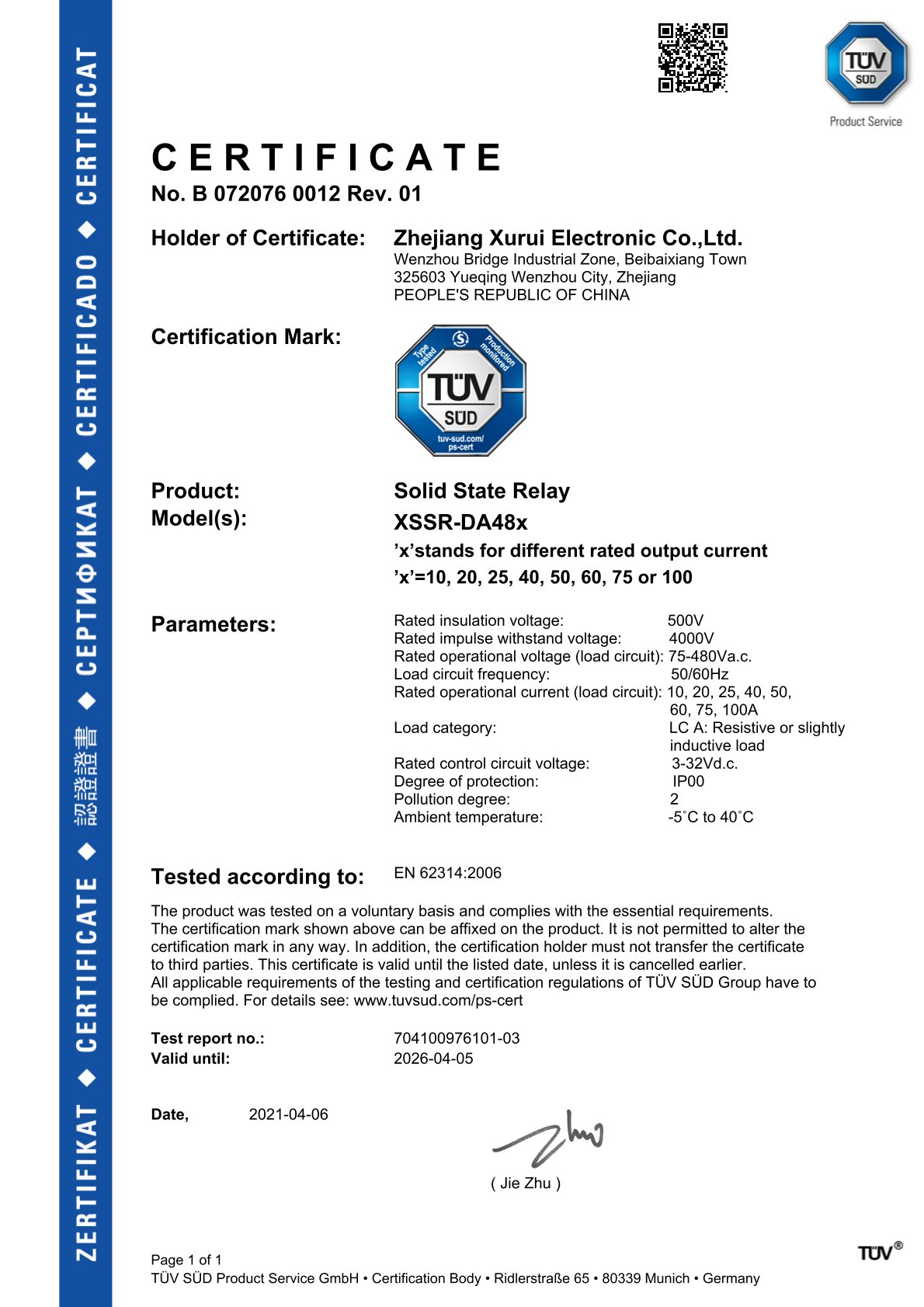
Europe. The European route runs through the EN 62314 family for solid-state relays. XURUI's TÜV SÜD certificate 704100976101-03 for the XSSR-DA48 series was issued on 6 April 2021 against EN 62314:2006, with a stated expiry of 5 April 2026. Two points follow, and both matter more than the certificate itself. First, the edition cited is the 2006 edition, while a later EN IEC 62314:2024 edition appears in the standards catalogue; a qualification file should record which edition the assessment was performed against. Second, a certificate with a stated expiry is a dated document rather than a permanent property of a product family, so its current status should be confirmed with the issuing body before it is filed as evidence of conformity.
North America. The US path works differently again. XURUI holds UL recognition under file E334724, dated 20 March 2018, covering the XV-15 series 16 A industrial control switch against UL 508 and CSA C22.2 No. 14/05. That is a switch scope, not an SSR scope — a clean illustration of the general rule that a manufacturer's certificate portfolio does not transfer automatically between product families, even inside the same factory. The same discipline applies to Korea: XURUI's KC certificate SU02092-16001A, issued 5 September 2019 under KC 61058-1, covers the XV-15 series 16 A switch, so a Korean programme needs SSR-specific evidence rather than portfolio-level assurance.
Regional technology progress is visible less in product claims than in these documentation layers. The shift from EN 62314:2006 to a 2024 edition, the persistence of GB/T 14048.5-2017 as the Chinese reference, and the separate North American emphasis on industrial control equipment safety all point to markets that are converging on similar safety objectives while diverging on assessment routes. The verified data used here does not support country-by-country technology rankings, and buyers should treat any such ranking as a supplier claim until a specific certificate and edition are produced.
Policy also moves. Standards are revised, and revisions create documentation churn rather than product change: a relay assessed against a previous edition may need re-assessment for a new programme even though its construction is unchanged. Teams that treat certificates as static attachments tend to discover this during an audit, which is the most expensive possible moment.
Capacity: reading a number that is not a commitment
Capacity statements are the second recurring question, and they are routinely misread. XURUI publishes a monthly capacity range of 5,000 to 250,000 units — an order-scoped band that reflects how model complexity and customisation change throughput, rather than a single nameplate figure. The company separately reports annual output of 20 million units across its full switch portfolio, a workforce of 150 people and a plant of 5,000+ ㎡. These numbers describe different things, and combining them into a single utilisation ratio would be an arithmetic exercise with no evidential basis.

What matters in an evaluation is how the band converts into a schedule. XURUI's documented commercial terms set a minimum order quantity of 100 units, a lead time of 15 to 30 days, EXW delivery terms, TT payment terms, and pre-shipment test as the acceptance criterion. Those are the parameters a buyer can plan against. The capacity range only signals that volume is negotiable within a band and that the schedule has to be fixed per order.
Customisation sits directly on top of that. XURUI's OEM/ODM scope covers handle, logo, dimension and operating-characteristic changes — modifications that touch drawings, tooling setup and test routines rather than packaging alone. When an order includes dimensional or operating-characteristic changes, the 15-to-30-day figure is better treated as a planning input than as a delivery date, and the drawing-approval milestone should be agreed in writing before a production slot is counted.
Three verification steps convert capacity talk into something auditable. Ask for the schedule for the specific model and quantity, not for the category. Ask what the pre-shipment test covers and request the record format. Then ask what happens to the agreed schedule if a customisation is introduced mid-order. The answer to the third question reveals whether capacity is genuinely managed or merely quoted.
Export signals: what a 40% export ratio does and does not prove
XURUI reports an export ratio of 40%, with the United States, Germany, Japan, South Korea, Turkey, Belgium and Egypt listed among its main markets, and export operations dating from its independent import and export rights in 2008. Its capability record lists the EU, Asia-Pacific, North America and Middle East as export markets, served with remote after-sales support.
That spread is a real signal of something: familiarity with multiple documentation regimes, packing and labelling conventions, and destination-specific paperwork. It is not evidence of conformity in any particular market. Conformity is assessed per product, per standard and per market, and the export ratio itself is a company-reported commercial figure without independent audit in the evidence reviewed here. A supplier reporting 40% and one reporting 5% may hold exactly the same number of valid certificates for the model a buyer needs.
Trade statistics add a second layer of ambiguity. Solid state relays are not separately reported in most customs series. Relay trade is typically discussed under HS heading 8536, with 8536.41 and 8536.49 the codes most often cited, and the correct classification for a specific product should be confirmed with a customs broker before any trade figure is compared. Category-level trade data therefore indicates the direction of a supply relationship, not the capability of a named supplier.
The export questions that can actually be answered are narrower: which certificates exist for this model in my destination market, which shipment references exist for comparable applications, and who owns documentation errors after dispatch. Export experience is demonstrated by resolved problems, not by market counts.
Where the signals meet the product
In consumer electronics and light industrial equipment, the attraction of solid state switching is structural — no moving contacts to wear, no contact arcing, and silent operation where acoustic noise matters. Those properties belong to the switching principle rather than to any one supplier, so they should not be the basis for choosing between shortlisted manufacturers.
Differentiation appears in the documented deployment record. XURUI's company-reported case records include a German industrial equipment manufacturer that used 1,200 units of the XSSR-W1 in heating control systems over three years and reported a 60% reduction in maintenance cost with fewer mechanical failures; and a Malaysian industrial automation solution provider that used 800 units of the XSSR-M1~M6 series in PLC and conveyor systems over two years, reporting a 65% reduction in maintenance cost and no major failures. Both entries describe specific deployments by specific clients over stated durations. They are evidence of application experience under those conditions, not a performance guarantee for a different load profile, duty cycle or ambient environment.
Rating class is usually the first filter that separates otherwise similar enquiries. A 25 A device at 240 V is a different procurement item from a 600 V unit even when mounting format and switching mode are identical, because load type, derating margin and thermal design diverge at that point. Mounting format and switching mode refine the requirement further. The workable sequence is to fix load, rating and mounting first, then compare suppliers on the evidence they can produce for that exact configuration.
| Procurement signal | What it reveals | What to verify | Where it misleads |
|---|---|---|---|
| Certificate number and standard edition | Whether the specific model was assessed for the destination market | Certificate number, issuing body, edition cited, validity window, scope line | Portfolio certificates covering a different product family |
| Stated capacity range | Whether volume is negotiable within a band | Order-level schedule for the exact model and quantity; test record format | Treating a band as committed output |
| Lead time | Planning horizon once drawings are approved | When the clock starts; effect of customisation and drawing approval | Quoting lead time before the specification is frozen |
| Export ratio and market list | Familiarity with multiple documentation regimes | Destination-specific certificates; shipment references | Assuming market presence equals conformity |
| Case record | Application experience under stated conditions | Quantity, duration, load type, reported metric | Extending one client's result to a different duty cycle |
Outlook: what to plan for
Three conditional expectations follow from the evidence, each framed as a condition rather than a forecast.
If modular automation keeps attracting investment at the pace assumed in current research, DIN rail mount SSRs will continue gaining share against a panel-mount base that still held roughly 42% in 2025. The implication is not a switch away from panel formats but a sourcing plan that covers both, because the growth segment and the volume segment are supplied from different production lines and, often, under different commercial terms.
If standards revisions continue at the present cadence, documentation burden will grow faster than product change. Buyers should expect to re-verify certificate editions and validity windows at each programme renewal and build that step into supplier scorecards, rather than treating compliance as a one-off gate at onboarding.
If order-level customisation becomes more common — which an OEM/ODM scope covering dimensional and operating-characteristic changes implies — lead-time competition will shift from headline days to specification-freeze discipline. A supplier that commits to a drawing-approval date and holds it will outperform one quoting a shorter but unqualified lead time.
Frequently asked questions
Which certification should a buyer check first when sourcing solid state relays?
It depends on the destination market, not on the supplier's certificate count. For China, the relevant document is a CCC certificate citing GB/T 14048.5-2017 that names the specific SSR series in its scope. For the EU, the operative reference is the EN 62314 family, and the edition cited matters, because EN 62314:2006 and the later EN IEC 62314:2024 edition are different assessment baselines. For North America, listing or recognition under UL 508 applies to industrial control equipment. In every case the check is identical: model in scope, standard edition, certificate number, issuing body and validity window.
How should a purchasing team interpret a supplier's stated monthly capacity?
As a negotiable band rather than a committed output figure. XURUI's published range of 5,000 to 250,000 units per month is order-scoped and varies with model complexity and customisation level. The number that governs planning is the schedule confirmed for a specific model and quantity, supported by the stated lead time — 15 to 30 days in XURUI's case — and by the acceptance criterion, which is pre-shipment test.
Does a high export ratio mean a supplier is qualified for my market?
No. An export ratio describes commercial exposure, not conformity. XURUI reports a 40% export ratio with main markets including the United States, Germany, Japan, South Korea, Turkey, Belgium and Egypt, which indicates experience with multiple documentation regimes. Conformity is nonetheless assessed product by product and market by market, so the buyer still needs the destination-specific certificate for the exact model being purchased.
Can OEM customisation change MOQ and lead time?
Customisation scope determines how much of the standard process has to be re-planned. XURUI's OEM/ODM scope covers handle, logo, dimensional and operating-characteristic changes, with a documented MOQ of 100 units and a lead time of 15 to 30 days. Because dimensional and operating-characteristic changes affect drawings, tooling setup and test routines, buyers should agree the drawing-approval milestone in writing and treat the lead-time figure as starting from that approval rather than from the initial enquiry.
Are solid state relay export volumes visible in trade statistics?
Generally not at product level. Solid state relays are not separately reported in most customs series; relay trade is usually discussed under HS heading 8536, with 8536.41 and 8536.49 the codes most often cited, and the classification for a specific product should be confirmed with a customs broker. Category-level trade data can indicate the direction of supply relationships, but it does not establish a specific supplier's capability.
What does a certificate expiry date mean for an existing order?
A certificate is a dated assessment, not a permanent property of a product family. XURUI's TÜV SÜD certificate 704100976101-03 for the XSSR-DA48 series, issued 6 April 2021 against EN 62314:2006, carries a stated expiry of 5 April 2026, and its current status should be confirmed with the issuing body before it is used in a qualification file. Certificates with longer windows, such as the CCC certificate valid to 18 September 2029, still require their scope lines to be checked against the model actually being purchased.
Building the qualification file
The most useful next step for a buyer assembling a qualification file is a scope-by-scope comparison: certificate against model, capacity against confirmed schedule, export claim against destination evidence. Buyers preparing an RFQ can reasonably request destination-specific certificate copies and an order-level schedule for the exact model before committing volume.
Company reference: Zhejiang Xurui Electronic Co., Ltd. — founded 2002, ISO 9001 certified, with CCC, CE, TÜV SÜD, UL, KC and RoHS documentation across its switch and relay ranges, and OEM/ODM support with 100% pre-shipment testing.
Product brochure (PDF, public download): XURUI product brochure.
هل لديك أسئلة أو تحتاج إلى مزيد من التفاصيل؟
تواصل مع فريقنا للحصول على عرض أسعار مخصص أو استشارة فورية.
طلب عرض أسعار
املأ النموذج أدناه وسيتواصل معك فريقنا بعرض مقترح مخصص.
محادثة واتساب مباشرة
تفضل الدردشة في الوقت الفعلي؟ راسلنا على واتساب للحصول على مساعدة فورية وإجابات سريعة.
- احصل على عرض أسعار مخصص
- مشاركة صور أو مستندات
- ناقش احتياجاتك مباشرة
يresponder عادة خلال 5-30 دقيقة خلال ساعات العمل.