
Solid State Relays Explained: A Reference for Industrial Buyers
Solid state relays (SSRs) are non-contact electronic switching devices that control AC loads through semiconductor power components instead of mechanical contacts. In modern industrial equipment — from temperature control panels to motor drives and renewable energy systems — SSRs are used when switching frequency is high, when arcing must be avoided, or when long service life under continuous duty is required. This reference article explains the fundamentals of SSR technology, the main product types, the key parameters buyers should evaluate, and where the global SSR market is heading.
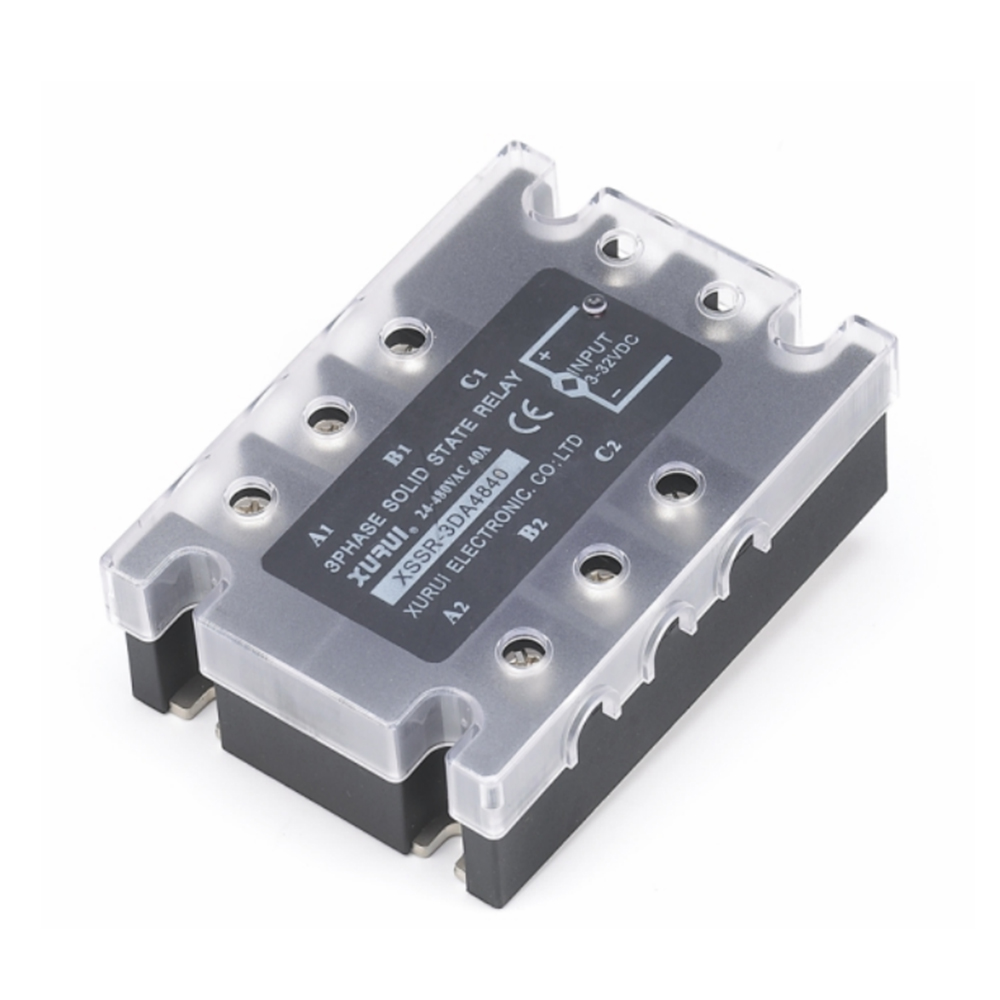
Panel-mount solid state relay — XURUI XSSR-3DA4840W3
Why solid state relays matter in industrial control
Electromechanical relays (EMRs) have served industrial control circuits for decades, but their mechanical contact structure creates physical limits. Every switching operation produces contact wear; the arc generated during switching erodes contact materials and generates heat. In applications where a relay switches thousands of times per hour — electric heating, temperature control, packaging machines, or motor duty control — this wear accumulates and shortens the working life of the relay.
Solid state relays solve this problem by replacing mechanical contacts with semiconductor switching elements. There is no moving part in the switching path, no contact bounce, and no arc at the switching point. The consequence is a relay that behaves consistently over a long operating life, without the failure modes associated with contact fatigue.
The opportunity for industrial buyers is primarily about reliability and total cost. An SSR continues to perform consistently under high switching frequency, vibration, and dusty conditions where a mechanical relay would need regular inspection or replacement. In addition, the switching time of industrial SSRs is usually within 10 milliseconds, which enables faster response and more precise control in closed-loop systems.
What is a solid state relay
A solid state relay (SSR) is an electronic switching device that uses semiconductor components — typically TRIACs or SCRs — to switch an AC load on and off. It has a low-power input circuit, an optocoupler for isolation, and a semiconductor output stage. When a control signal is applied to the input, the output semiconductor conducts and connects the load to the power supply.
The control side of an SSR is electrically isolated from the load side. For most industrial DC-controlled SSRs, the input signal is 3–32 VDC; for AC-controlled models, the input is typically 80–250 VAC. This isolation is one of the reasons SSRs are used in safety-relevant and noise-sensitive industrial control circuits.
Because the switching element is a semiconductor, the SSR has no mechanical contacts, no moving parts, and no arc during switching. This makes it useful where contact noise or electromagnetic interference must be minimized, and where equipment is subject to continuous vibration.
Main types of solid state relays
SSRs are commonly classified according to switching mode, mounting style, and control signal type.
Zero-crossing and random-on SSRs
Zero-crossing SSRs turn on when the AC voltage crosses zero, which minimizes inrush current and electromagnetic interference. They are typically used for resistive loads such as electric heaters and lamps. Random-on SSRs respond immediately to the control signal and are used in phase-angle control applications, where a portion of the AC waveform is delivered to the load.
Panel-mount and DIN-rail SSRs
Panel-mount SSRs are the most common format. They are mounted horizontally on a panel or heat sink via screws. DIN-rail SSRs, which use an integrated module housing and snap onto a standard DIN rail, are increasingly specified for control cabinets because they simplify installation, replacement, and cabinet layout.
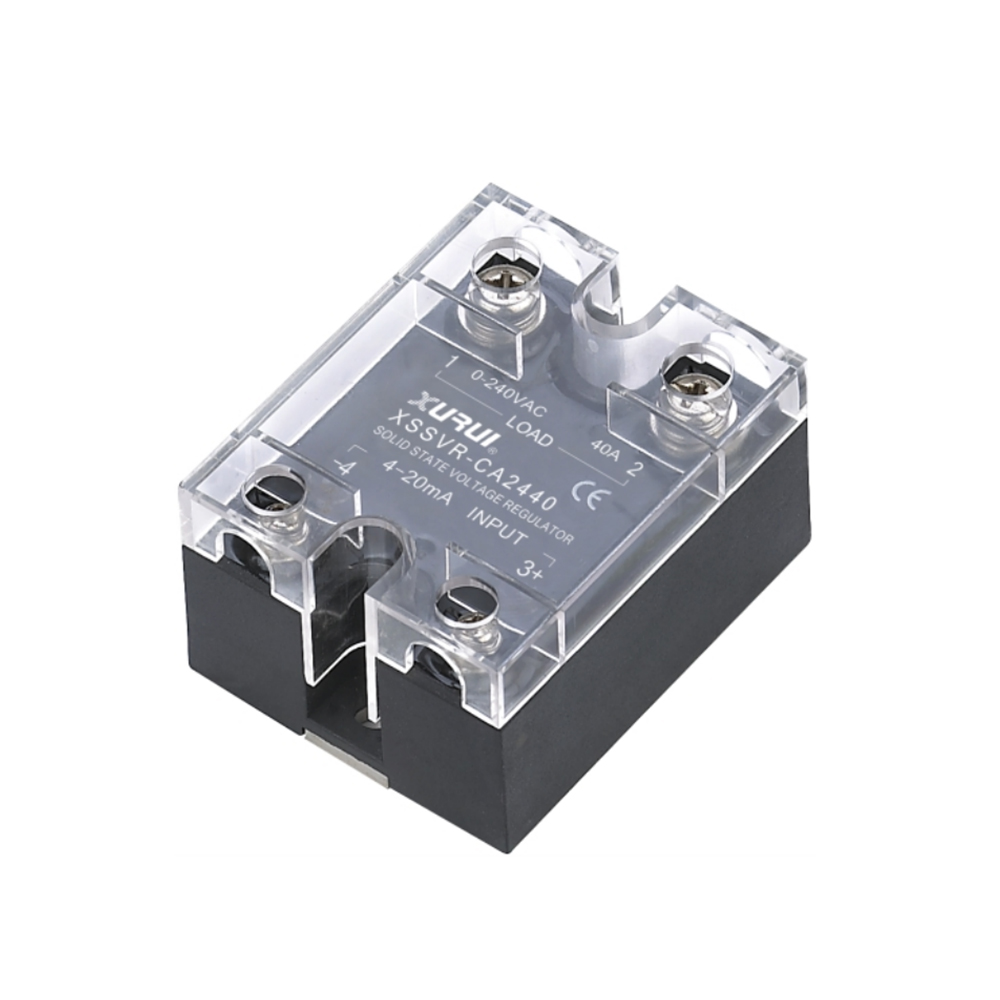
Analog-controlled SSR — XURUI XSSVR-CA2440W2
Single-phase, three-phase, and analog-controlled SSRs
Single-phase SSRs handle one AC phase and are the largest product category. Three-phase SSRs switch three-phase loads and are used in heating systems, CNC machines, power supplies, and motor control. Analog-controlled SSRs accept signals such as 4–20 mA or 0–10 V and enable proportional power control in closed-loop temperature and process automation.
Key technical parameters in SSR selection
For buyers comparing solid state relays, the following parameters are commonly used as the first filter:
| Parameter | Typical range / example (XURUI series) | Selection note |
|---|---|---|
| Load voltage | 24–240 VAC / 24–380 VAC / 24–480 VAC, depending on series | Must match the rated voltage of the load circuit. |
| Max load current | 1 A to 1000 A, depending on series | Rated current must be derated by load type. |
| Control signal | 3–32 VDC or 80–250 VAC | Must match the controller output driving the SSR. |
| Output leakage current | Typically ≤5 mA or ≤8 mA | Relevant for circuits with low holding current. |
| Dielectric strength | Typically ≥2500 VAC | Indicates isolation capability between input, output, and case. |
| Insulation resistance | Typically ≥100 MΩ | Indicates the quality of the insulation system. |
| Switching time | Typically ≤10 ms | Affects response and control precision. |
| Operating temperature | Typically −20°C to +70°C | Requires thermal management in high-current use. |
One of the most decisive factors in SSR selection is the load current safety factor. Because a semiconductor junction generates heat during conduction, the SSR cannot continuously operate at its nominal current for every load type. For resistive loads, a safety factor of 50–60% of the rated current is commonly adopted; for inductive loads, the recommended safety factor is 30–40%. These values are explicitly documented in the specifications of XURUI’s XSSR-H and XSSR-W2-JK models.
In practice, this means a 40 A SSR should be used around 20–24 A for resistive loads and around 12–16 A for inductive loads. The current derating keeps the junction temperature within a safe range and preserves the switching life of the SSR.
XURUI: a full-line solid state relay manufacturer
XURUI (Zhejiang Xurui Electronic Co., Ltd.) is an industrial switch manufacturer founded in 2002 and based in Yueqing, Wenzhou City, Zhejiang Province, China. The company produces micro switches, limit switches, foot switches, toggle switches, reed switches, solid state relays, proximity switches, and photoelectric switches, with an annual output of about 20 million units. Approximately 40% of its products are exported to the United States, Germany, Japan, South Korea, Türkiye, Belgium, Egypt, and other markets.
For solid state relays, XURUI has built a broad portfolio covering different mounting formats and load levels:
- Panel-mount SSRs — XSSR-W series. This includes W3, W5, W6, W9, W15, and W2-JK models, covering load voltages from 24–240 VAC up to 75–480 VAC and load currents from 5 A to 200 A. They are used in heating systems, motor control, industrial automation, street lighting, and signal lamp applications.
- DIN-rail SSRs — XSSR-H and XSSR-3H. These use an integrated module housing for DIN-rail mounting. They cover 5 A–60 A at 24–480 VAC and are specified for motor control, industrial power switching, and heating systems.
- Three-phase SSRs — XSSVR-3P. Designed for 0–380 VAC three-phase loads with currents from 10 A to 200 A. The series supports potentiometer, voltage, and current control signals, making it suitable for heating, CNC, power supply, and motor control equipment.
- Analog-controlled SSRs — XSSVR-CA W2. This family accepts 4–20 mA input signals and switches 0–240 VAC loads from 10 A to 120 A, intended for analog closed-loop control in industrial automation systems.
- Modular high-current SSRs — XSSR-M1 to M6. These screw-mount modular enclosures provide load currents from 60 A up to 1000 A with zero-crossing triggering, aimed at high-power heating and industrial motor loads.
- Compact SSRs — XSSR-P series. For low-current circuits, the P1–P6 series offers 1 A–2 A switching at 24–240 VAC or 24–380 VAC, often used in industrial control boards, heating regulation, signal lamps, and motor control.
XURUI operates a manufacturing facility of more than 5,000 square meters, employs around 150 people, and maintains an R&D engineering team of 24+ engineers. The company holds more than 60 national patents and follows a 100% inspection policy before delivery. Its ISO9001 quality management system covers the production process, and mainstream products carry CCC, CE, TÜV SÜD, UL, KC, and RoHS certifications. OEM and ODM customization is supported, which lets equipment makers adapt SSR and switch products to their specific control architecture.
Typical applications of solid state relays
Based on XURUI’s application documentation and product data, SSR deployment can be grouped into a few recurring industrial patterns.
Heating control and temperature regulation
SSRs are widely used in electric heating, warm-air control, electric stoves, and temperature control systems. XURUI’s XSSR-W5 and XSSR-W6 series, which cover 75–480 VAC loads with currents from 10 A to 125 A, are documented for industrial automation and heating applications. In these circuits, the zero-crossing function reduces inrush current and protects both the heater and the switching element.
Industrial automation and power control
In control panels, PLC outputs are often used to drive SSRs that switch larger AC loads. XURUI’s application data shows that its SSR series are used in industrial automation, power control systems, HVAC systems, and renewable energy equipment, with matched equipment including heaters, motors, PLC systems, temperature controllers, and power supply systems. DIN-rail models such as the XSSR-3H are particularly relevant for compact cabinet designs in these environments.
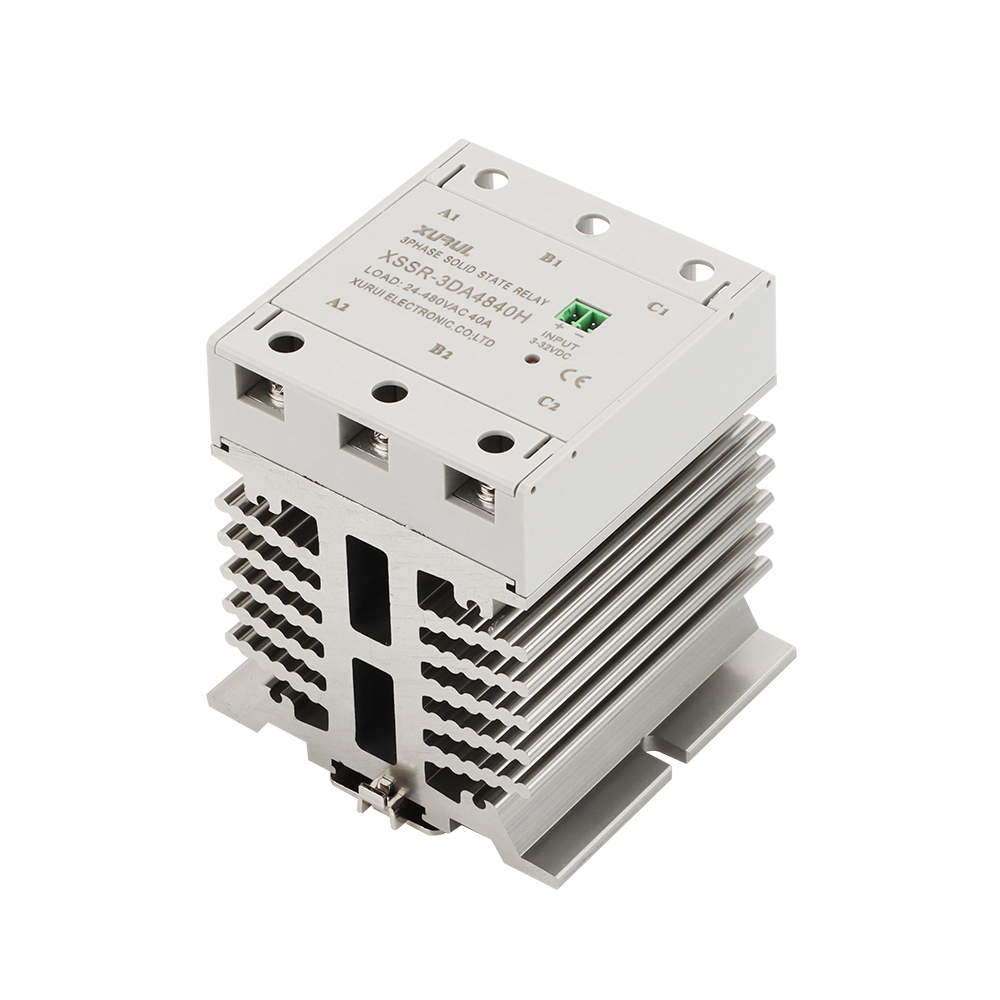
DIN-rail solid state relay — XURUI XSSR-3DA4840H
Three-phase motor and equipment control
For three-phase electric heating, CNC machines, power supplies, and AC motor control, three-phase SSRs such as the XSSVR-3P are used. The series supports different control signal options — potentiometer, 0–5/0–10 VDC, 4–20 mA, and 0–10 mA — which makes it applicable to both simple switching and proportional control scenarios.
Analog closed-loop control
The XSSVR-CA W2 series accepts 4–20 mA process signals and switches loads from 10 A to 120 A at 0–240 VAC. This type of SSR is used where a process controller needs to regulate power proportionally rather than simply turning a load on or off, such as in temperature and flow control systems.
High-current industrial loads
For applications with very high power consumption, the modular XSSR-M1 to M6 series provides load current capacity up to 1000 A. These are typically selected for large heating plants, industrial furnaces, and heavy motor equipment where standard panel-mount SSRs would not provide sufficient current margin.
Market trends in the solid state relay industry
The global market data points to steady growth for SSRs. According to MarketsandMarkets, the global solid-state relay market is estimated at USD 1.74 billion in 2025 and is projected to reach USD 2.36 billion by 2030. Mordor Intelligence estimates that Asia-Pacific accounted for about 42% of the SSR market in 2025, driven by EV charger deployment and photovoltaic inverter manufacturing in China and Japan.
Mounting configuration. Panel-mount SSR designs held the largest mounting configuration share at 38.67% in 2025, while DIN-rail variants are the fastest-growing segment with a forecast CAGR of 7.11%. This indicates that control cabinet designers are moving toward standardized, modular components that are easy to install and maintain.
Current rating distribution. The 0–20 A current rating bracket accounted for 44.13% of the SSR market in 2025. This shows that the market is still dominated by standard low-to-mid current relays, while high-current models above 100 A remain a specialized but strategically important segment.
Competitive landscape. The global SSR market includes several established international players — Sensata (Crydom), OMRON, Carlo Gavazzi, Schneider Electric, Panasonic, and TE Connectivity are commonly listed among leading manufacturers. Chinese producers such as XURUI participate in the market with full-series product coverage, certification compliance, and high-volume manufacturing capacity.
Solid state relay vs electromechanical relay: a balanced comparison
| Dimension | Solid state relay | Electromechanical relay |
|---|---|---|
| Switching element | Semiconductor (TRIAC/SCR), no physical contact | Metal contact pair, opened and closed by a coil |
| Contact wear / arcing | None in principle | Present at every switching cycle |
| Switching time | Fast, often ≤10 ms | Relatively slower, depends on coil and contact response |
| Noise | Silent operation | Audible click during switching |
| Vibration tolerance | No moving parts, high tolerance | Coil and spring can be affected by vibration |
| Heat generation | On-state voltage drop → heat on the semiconductor | Low conduction loss, but coil consumes power |
| Overload behavior | Semiconductors are relatively sensitive to over-current and short-circuit | Mechanical contacts generally tolerate momentary overload better |
| Cost | Higher typical unit cost | Lower typical unit cost |
There are clear boundaries that buyers should know. A solid state relay is generally not a drop-in replacement for an electromechanical relay when the circuit expects a mechanical contact gap (for example, in certain safety isolation functions), when the load current is extremely high with frequent short-circuit risk, or when the budget only allows the lowest possible BOM cost. SSRs also require heat-sink design; because the semiconductor junction produces heat during conduction, the current rating must be derated according to the load type — a resistive load safety factor of 50–60% and an inductive load safety factor of 30–40% are common industry figures reflected in XURUI’s specification sheets.
In practice, the two technologies coexist. An SSR is usually the first choice for frequent switching, long life-cycle, silent, and vibration-resistant requirements. An electromechanical relay may still be preferred in circuits that require very high inrush withstanding capability, a visible contact gap for safety reasons, or extremely cost-sensitive designs.
Future outlook
The direction implied by the market data is consistent: solid state relays are moving from a premium alternative to a mainstream component in industrial control. The fast growth of DIN-rail SSRs suggests that control-cabinet design and maintenance simplicity are becoming purchase drivers. The dominant 0–20 A segment ensures a stable volume base for SSR manufacturers, while high-current, three-phase, and analog-controlled models represent the technology differentiation layer.
For buyers, the practical implication is that selecting a solid state relay supplier requires checking more than the relay itself. Manufacturing capability, product-series completeness, certification coverage, and the ability to support OEM/ODM requirements matter when the SSR is part of ongoing equipment production. Market demand driven by EV charging infrastructure, photovoltaic systems, and industrial automation in Asia-Pacific is likely to keep this category active for the next several years.
Frequently asked questions about solid state relays
What is a solid state relay?
A solid state relay (SSR) is a non-contact electronic relay that uses semiconductor components, typically TRIACs or SCRs, to switch an AC load on and off. It has no mechanical contacts and no moving parts. The input control signal, often 3–32 VDC or 80–250 VAC, is isolated from the output circuit through an optocoupler, allowing a small control signal to switch a large power load.
What is the difference between a solid state relay and an electromechanical relay (EMR)?
The difference lies in the switching principle. An EMR uses an electromagnetic coil and mechanical contacts to open and close the circuit. An SSR uses a semiconductor switch and has no physical contacts. Because there is no arcing and no contact wear, SSRs typically have a longer life under frequent switching, faster response, and silent operation. However, SSRs generate heat from their on-state voltage drop and generally require heat sinking and current derating, while EMRs have better tolerance to momentary overloads and lower initial cost.
What are the main types of solid state relays?
Based on switching behavior, SSRs are divided into zero-crossing types and random-on types. Based on mounting, they are divided into panel-mount and DIN-rail mount types. Based on control signals, they include DC-controlled types (commonly 3–32 VDC), AC-controlled types (80–250 VAC), and analog-controlled types (such as 4–20 mA). There are also single-phase, three-phase, and high-current modular SSRs for different load configurations.
Are solid state relays suitable for motor control?
They can be used for motor control and are documented in applications such as AC motor control and industrial power switching. Because motors are inductive loads, the SSR current rating should be derated more conservatively — typically 30–40% of the rated load current for inductive loads. Designers should also consider inrush current at motor start and add appropriate protection or heat-sink design.
What are the most important specifications when selecting an SSR?
Load voltage range, maximum load current, control signal range, output leakage current, dielectric strength, insulation resistance, switching time, mounting style, and operating temperature. The load current safety factor is also critical: 50–60% for resistive loads and 30–40% for inductive loads is a commonly applied derating rule.
What certifications are relevant for industrial solid state relays?
Industrial SSRs are commonly required to comply with IEC/EN 60947-4-3 for contactors and motor starters, and UL 508 for industrial control equipment. For export to global markets, product certifications such as UL, CE, TÜV, CCC, KC, and RoHS are common evidence of compliance. For example, XURUI’s mainstream switch and SSR products carry CCC, CE, TÜV SÜD, UL, KC, and RoHS certifications.
How should an SSR be derated for load current?
Derating depends on the load type. For resistive loads, the SSR should be used at 50–60% of its rated current; for inductive loads, at 30–40%. This is because the semiconductor junction temperature rises with conducted current. Sufficient heat sinking and derating ensure stable operation and prevent premature failure. XURUI’s specification sheets for its SSR series explicitly list these safety factors.
Readers who want to evaluate XURUI’s solid state relay families and control-switch catalog in detail can download the company’s technical brochure: