
Solid Steel Pipes: Inside a Custom Steel Pipe Supplier
Custom steel pipes are engineered to a specification, not picked from a shelf. The buyer's real decision is not which pipe looks right, but which supplier can hold a grade, a wall thickness, a standard, a test regime and a shipping schedule together across an entire order. That is the frame in which Solid Steel Pipes, the steel pipe line presented by Shanxi Solid Industrial Co., Ltd. (Solid Group), is worth examining.
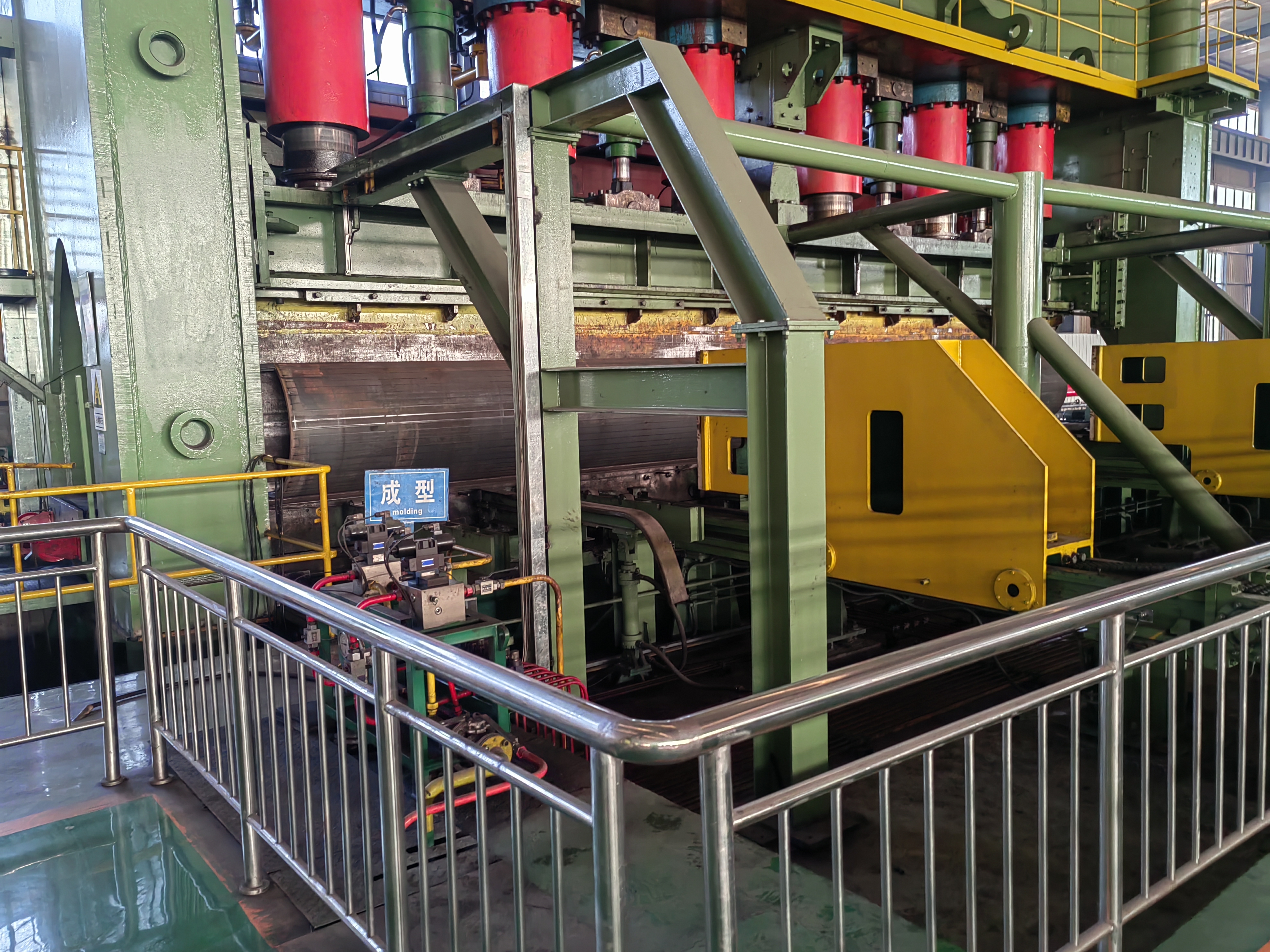
Production line at a Solid Group manufacturing facility. Image: Solid Group.
Solid Group is a Shanxi, China-based manufacturer and exporter of ductile iron pipes, ductile iron pipe fittings, steel pipes, steel pipe fittings, flanges, couplings, valves and related castings and forgings. The company was established in 2006 and reports more than 19 years of operating experience, 12 factories, 286 production lines, a 100,000 m² manufacturing facility, approximately 10,000 staff, roughly 1,000 technical personnel, and an annual production capacity of 300,000 tons.
For a buyer at the awareness and research stage, the useful question is narrower than "is this a large supplier?" It is: which parts of a steel pipe specification can this supplier actually control, and what evidence should I demand before I trust the rest? This analysis works through that question using company-reported facts and verifiable standards data, and it separates the two throughout.
Why Custom Steel Pipes Are a Supplier Problem, Not a Catalog Problem
A steel pipe specification is a chain of dependent choices. The medium, pressure, temperature, nominal diameter, wall thickness, material grade, connection method, corrosion environment, applicable standard and project drawing all constrain each other. Change the temperature and the material grade may change. Change the connection method and the end finish, flange pattern and fitting set change with it. Select a pipe, a fitting and a flange from three unrelated sources and the dimensional and documentation risk moves to the buyer.
This is where the category's economics sit. According to Fortune Business Insights, the global steel pipe market is projected to reach USD 109.72 billion by the end of 2026. Within that market, carbon steel pipes are reported to hold a 78.0% share in 2026, and seamless steel pipes held the largest technology segment share at over 66.0% in 2025. Those figures point to one conclusion for procurement: the volume of demand sits in carbon steel and in seamless product, and the differentiation sits in how precisely a supplier can deliver a specified variant of it.
The adjacent fittings market reinforces the same logic. The global pipe fittings market was valued at USD 70 billion in 2024 and is projected to reach USD 100 billion by 2030. Pipes and fittings are bought together, inspected together and installed together. A supplier that can cover both sides of the joint reduces the number of parties who can blame each other when a dimension is wrong.
Who Solid Group Is
Shanxi Solid Industrial Co., Ltd. was established in 2006 and is located in Shanxi, China, a province with resources of pig iron, coke, steel and other industrial raw materials. The company operates 12 factories and 286 production lines, with a manufacturing facility covering 100,000 m² and an annual production capacity of 300,000 tons. It employs approximately 10,000 staff, of whom around 1,000 are technical personnel forming the R&D team.
Its product range is broad rather than narrow: ductile iron pipes, ductile iron pipe fittings, flange adaptors, couplings, dismantling joints, valves, manhole covers, steel flanges, carbon steel pipe fittings, malleable iron pipe fittings, rubber O rings, fasteners, pumps, motor shells, and other castings and forgings. The company states that it manufactures according to standards including ISO2531, EN545, EN14525, ISO4422, ISO7005, DIN3352, BS5163, DIN3202, BS2494, BS4504 and EN124, along with other ISO, EN, BS, DIN, ANSI and AWWA standards.
Commercially, Solid Group is export-weighted. Export business accounts for 95% of total sales, with an annual export value of USD 130 million. Products have been exported to 109 countries and regions, and the company reports more than 20 years of export activity across Europe, the Middle East, South East Asia, Africa and South America.
Reading the numbers correctly: the capacity, headcount, plant count and export value above are company-reported figures from Solid Group's own materials. They describe scale as the company presents it. They do not constitute an independently audited capacity statement, a market share figure or a quality certification, and they should be treated as the starting point for due diligence rather than its conclusion.
The Product Portfolio: Four Pipe Families and a Fitting Chain
The Solid Steel Pipes range covers four distinct pipe families, each with its own dimensional envelope and standard set. The differences matter because they determine which projects a given family can serve.
Galvanized steel pipe is supplied in hot dip galvanized and pre-galvanized types, with carbon steel as the primary material. Outside diameter runs from 1/2" to 8" (20–219 mm), wall thickness from 0.8 mm to 2.75 mm, and length is normally 5.8 m or 6 m with random lengths customizable. Zinc coating is specified at 40–275 g/m².
Stainless steel pipe, including sanitary stainless steel pipe, is made of stainless steel with a size range of 1/2"–12" (DN15–DN200), wall thickness of 1.5–3 mm, and lengths of 6 m or 12 m or as requested. Company-listed standards are ASTM A554, A249, A269 and A270, with mirror or matt polishing as the surface treatment.
Seamless carbon steel pipe covers the line pipe, large diameter, structural, precision and mechanical steel pipe model series. Size range is 1/2"–18", wall thickness 0.8–78 mm, and length 1–12 m by customer requirement. Listed standards include ASTM A53, BS1387-1985, GB/T3091-2001, EN39 and BS1139, with A53 and A106 Grade B among the available material grades.
Welded carbon steel pipe is offered as ERW (electric resistance welded), LSAW (longitudinal submerged arc welded) and SSAW (spiral submerged arc welded) product. Outside diameter spans 6–3000 mm, wall thickness 4–18 mm, and length 6 m, 9 m, 12 m or other sizes per contract. Standards listed include GB, SY, DIN, ASTM, ASME, ANSI and API, with plain or beveled ends that can be protected by plastic pipe caps.
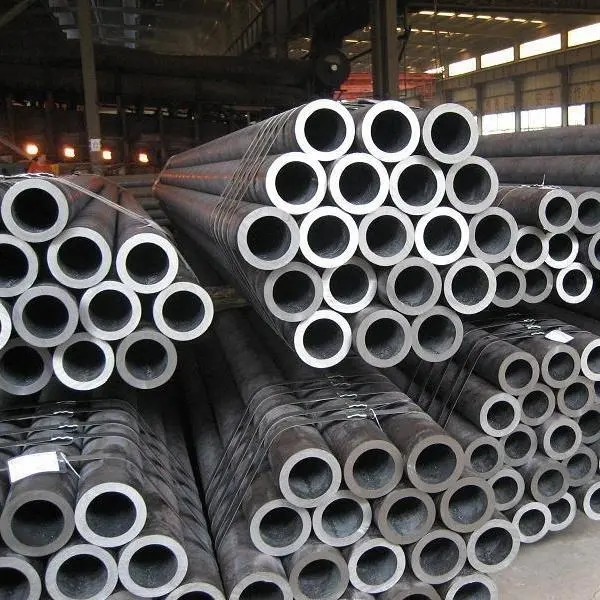
Seamless carbon steel pipe, one of four pipe families in the Solid Steel Pipes range. Image: Solid Group.
| Pipe family | Material | Size range | Wall thickness | Standards listed |
|---|---|---|---|---|
| Galvanized | Carbon steel | 1/2"–8" (20–219 mm) | 0.8–2.75 mm | Zinc 40–275 g/m² |
| Stainless / sanitary | Stainless steel | 1/2"–12" (DN15–DN200) | 1.5–3 mm | ASTM A554, A249, A269, A270 |
| Seamless carbon | Carbon steel | 1/2"–18" | 0.8–78 mm | ASTM A53, BS1387-1985, GB/T3091-2001, EN39, BS1139 |
| Welded carbon (ERW / LSAW / SSAW) | Carbon steel | OD 6–3000 mm | 4–18 mm | GB, SY, DIN, ASTM, ASME, ANSI, API |
Around the pipe, the company supplies steel pipe fittings, carbon steel pipe fittings, steel flanges, forged steel flange product, couplings and valves. For a project that needs pipes, fittings and flanges together, this matters practically: matching specifications, inspection documents, delivery requirements and acceptance criteria can be confirmed with one counterparty instead of being negotiated across three.
Technical Explanation: What the Standards Actually Require
Two standards dominate the technical conversation around carbon steel pipe, and buyers frequently conflate them.
ASTM A106 is the Standard Specification for Seamless Carbon Steel Pipe for High-Temperature Service. It covers seamless carbon steel pipe in NPS 1/8 through NPS 48 inclusive, with nominal wall thickness as given in ANSI B36.10. Its scope is seamless product for high-temperature service — not welded pipe, and not general low-temperature service.
API Specification 5L covers seamless and welded line pipe for conveying gas, water, oil and other liquefied media, and includes two Product Specification Levels, PSL1 and PSL2. API 5L is the core specification for oil and gas transmission mainline pipelines, typically using grades X65, X70 and X80 for high-pressure trunk lines. The PSL designation is not a marketing label: it changes what inspection, documentation and testing the buyer can require.
These standards also carry regulatory weight. U.S. federal pipeline regulations at 49 CFR Part 192 Appendix B identify API Specification 5L and ASTM A106/A106M among incorporated pipe specifications. That reference is jurisdiction-specific: it does not generalise to other markets, and it does not by itself certify any supplier's product. It does tell a buyer why the standard designation on a quotation is a compliance question rather than a formatting detail.
Trade classification is a parallel trap. HS 7304 covers seamless tubes, pipes and hollow profiles of iron or steel. HS 7305 covers non-seamless circular tubes and pipes with an external diameter exceeding 406.4 mm. HS 7306 covers other non-seamless tubes, pipes and hollow profiles, including specified welded products. Mixing these headings produces import statistics that look comparable but are not, because the product scopes differ. For a buyer comparing sourcing countries, validated subheadings are a precondition, not an afterthought.
Manufacturing, Customization and the Quality Model
Solid Group reports 12 factories and 286 production lines supporting a 300,000-ton annual capacity, with roughly 1,000 technical personnel behind product and process work. The company states that it supports customized sizes, materials, standards and markings per customer drawings and brand requirements, and that it maintains consistent quality, on-time delivery and full traceability for global OEM customers.
On quality control, the company describes a process-based inspection model rather than a final-gate model: inspectors check all orders during production and before shipment, and for some orders inspectors attend the loading process at port to confirm that the goods shipped match the goods approved. The stated warranty period is 12 months. The company also states that it holds a CE certificate for its steel pipeline products.
Commercially, the company reports that there is no specific MOQ, with order size handled case by case, and that payment can be structured as 100% T/T, 30% in advance with the balance before shipment, or letter of credit, with other terms open to discussion. It also reports experience operating project tenders in African, South American and Middle Eastern countries.
Application and Use Cases
The company positions its pipe output for building structures and energy pipelines, with fluid transportation for buildings and urban infrastructure as a primary project type. The stated functions are transporting fluids and providing structural support, and the stated operating modes include horizontal, vertical, slope and air transport.
The published working-condition envelope is a useful screening tool. Most steel pipes in the range are described as suitable for temperatures from −30 °C to 120 °C, and the stated special requirement is to keep away from strong acid and strong alkali media and from temperatures exceeding 120 °C. Steel pipe fittings are named as the matched equipment.
Read against the product families, this produces a practical map. Galvanized carbon steel suits architectural and infrastructure work where external corrosion protection is the driver. Stainless and sanitary stainless steel pipe suits sanitary piping scenarios within architecture and infrastructure. Seamless carbon steel suits line, structural, precision and mechanical duties. Welded ERW, LSAW and SSAW product covers large-diameter work up to 3000 mm outside diameter. In every case the stated temperature and chemical limits apply, and applications outside them sit outside the described envelope.
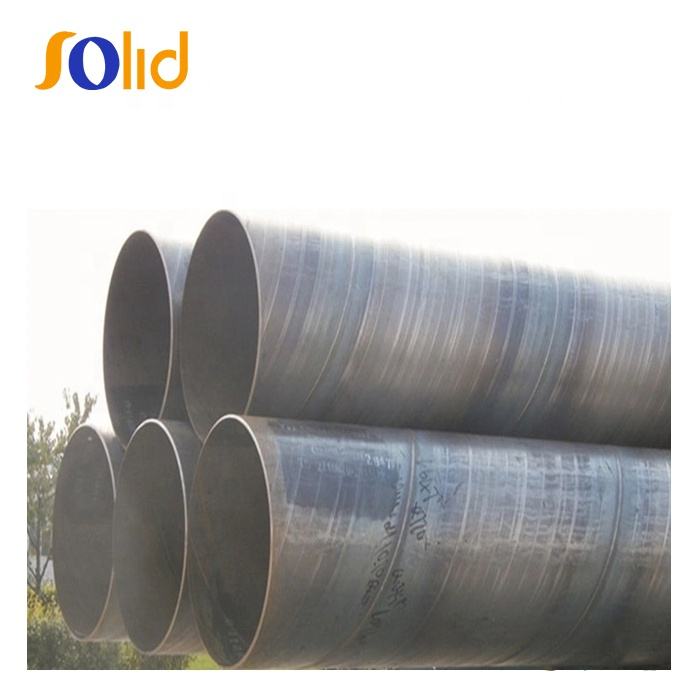
SSAW (spiral submerged arc welded) pipe, the large-diameter welded option in the range. Image: Solid Group.
Where Solid Group Sits in the Market
An honest positioning statement has to begin with what cannot be said. There is no independently verified market share, capacity audit or supplier ranking for Solid Group in the available public record. Any claim that the company is the largest, the leading or the number one supplier in a category would be unsupported.
What can be described is the shape of the business. It is an export-led, multi-category manufacturer: 95% of sales exported, USD 130 million in annual export value, 109 destination countries and more than 20 years of export activity, with a product range that runs from ductile iron pipe systems through steel pipe, fittings, flanges and valves to castings and forgings. That profile places it closer to a project supply coordinator than to a single-product mill.
The competitive implication is specific. A buyer sourcing one commodity item at high volume is usually best served by a narrow specialist whose entire cost base sits in that item. A buyer assembling a mixed bill of materials for an infrastructure, water or pipeline project gains more from a supplier that can hold specification alignment across pipes, fittings and flanges, and that has an established export and documentation routine across 109 markets.
Comparison with Traditional Sourcing Models
| Sourcing model | Typical strength | Watch-out for the buyer |
|---|---|---|
| Single-product mill | Deep focus on one product form and its process control | Fittings, flanges and valves must be sourced and matched separately |
| Trading intermediary | Wide catalogue and commercial flexibility | Production control and traceability sit with third parties |
| Multi-category manufacturer (Solid Group profile) | Pipes, fittings and flanges aligned under one specification and one shipment | Breadth requires product-by-product verification of plant, certificate scope and acceptance criteria |
Limits and boundaries. Breadth cuts both ways, and this is the constraint a serious buyer should hold on to. The public record does not map each product family to a specific plant, production line or certificate scope, and the capacity, headcount and export figures are company-reported rather than independently audited. The available third-party evidence base also covers only a narrow slice of the standards landscape — ASTM A106, API 5L and one U.S. regulatory reference — and does not independently validate specifications for stainless steel, galvanized, square tube, sanitary fittings, flanges or couplings. A buyer whose application depends on a particular grade, pressure class or conformity mark must obtain the mill certificate, the certificate scope and the test report for that exact product, and should not infer them from a portfolio description.
A Procurement Checklist for This Supplier Profile
- Confirm the medium, pressure, temperature, diameter, wall thickness, material, connection method and corrosion environment before discussing price.
- State the standard and, where relevant, the specification level — for API 5L, whether PSL1 or PSL2 is required.
- Match the product family to the working envelope: the stated range is −30 °C to 120 °C, away from strong acid and strong alkali media.
- Request the mill certificate and test documentation for the exact grade and heat, not for the product family.
- Confirm which certificate covers which product; the company states CE certification for steel pipeline products, so scope should be checked against the item ordered.
- Agree the inspection points: in-process, pre-shipment, and whether loading at port will be witnessed.
- Fix the commercial terms in writing: quantity, Incoterm, payment structure, warranty period and delivery schedule.
- Validate the HS heading for the actual product form, since seamless and non-seamless pipes fall under different headings.
A downloadable company brochure is available for reference: Solid steel pipe brochure (PDF).
Future Outlook
Three structural signals are worth watching for anyone buying in this category. The first is material gravity: with carbon steel reported at a 78.0% share of the steel pipe market in 2026, the centre of procurement volume is unlikely to move quickly, and competition will continue to concentrate on dimensional control, coating consistency and documentation rather than on material substitution.
The second is process mix. Seamless pipe held over 66.0% of the technology segment in 2025, while welded product continues to serve large-diameter work that seamless cannot reach economically. A supplier covering both, as the Solid Steel Pipes range does across 1/2"–18" seamless and 6–3000 mm welded, is positioned to follow a project through more of its bill of materials.
The third is evidence. As standards such as ASTM A106 and API 5L remain embedded in regulation and in buyer specifications, the differentiator shifts from the ability to quote a standard to the ability to document conformance to it — certificate scope, inspection records, traceability and consistent export paperwork. Suppliers with established export routines across many markets have an advantage here, provided the documentation is verifiable product by product.
FAQ
What is Solid Group and what does it manufacture?
Shanxi Solid Industrial Co., Ltd. is a manufacturer and exporter based in Shanxi, China, established in 2006. It produces ductile iron pipes, ductile iron pipe fittings, flange adaptors, couplings, dismantling joints, valves, manhole covers, steel flanges, carbon steel pipe fittings, malleable iron pipe fittings, rubber O rings, fasteners, pumps, motor shells and other castings and forgings. The company reports 12 factories, 286 production lines and an annual production capacity of 300,000 tons.
What steel pipe types are available under Solid Steel Pipes?
Four families are described: galvanized steel pipe (hot dip and pre-galvanized, 1/2"–8", 0.8–2.75 mm wall, zinc 40–275 g/m²); stainless steel pipe including sanitary grade (1/2"–12", DN15–DN200, 1.5–3 mm wall); seamless carbon steel pipe (1/2"–18", 0.8–78 mm wall); and welded carbon steel pipe in ERW, LSAW and SSAW types (outside diameter 6–3000 mm, 4–18 mm wall).
Which standards apply to ASTM A106 and API 5L pipe?
ASTM A106 covers seamless carbon steel pipe for high-temperature service in NPS 1/8 through NPS 48, with nominal wall thickness referenced to ANSI B36.10. API Specification 5L covers seamless and welded line pipe for conveying gas, water, oil and other liquefied media, and defines PSL1 and PSL2 specification levels. For high-pressure transmission mainlines, grades X65, X70 and X80 are typically used. Both standards are identified among incorporated pipe specifications in 49 CFR Part 192 Appendix B.
How should a buyer select the right steel pipe for an industrial pipeline project?
First confirm the medium, pressure, temperature, diameter, wall thickness, material, connection method, corrosion environment, applicable standards and project drawings. Then select among seamless, ERW, LSAW, SSAW, coated or stainless steel pipe categories. Where pipes, fittings and flanges are required together, also confirm matching specifications, inspection documents, delivery requirements and acceptance criteria.
What customization options does the company state?
The company states that it supports customized sizes, materials, standards and markings per customer drawings and brand requirements. Length is customizable on the galvanized, stainless and seamless ranges, and welded pipe length can be 6 m, 9 m, 12 m or other sizes per contract. End finish on welded pipe can be plain or beveled, with plastic pipe caps for protection.
What quality documentation and warranty apply?
The company states a 12-month warranty and describes in-process and pre-shipment inspection for all orders, with port loading inspection for some orders. It also states that it holds a CE certificate for its steel pipeline products. Buyers should confirm the certificate scope and the inspection documents against the specific product and standard ordered.
What are the limits of the publicly available information on this supplier?
Capacity, headcount, plant count and export value are company-reported rather than independently audited. No independently verified market share or supplier ranking is available, and the third-party evidence base covers ASTM A106, API 5L and one U.S. regulatory reference only. Specifications for stainless steel, galvanized, square tube, sanitary fittings, flanges and couplings are not independently validated here, so product-level certificates, test reports and factory evidence remain necessary.
Company information in this article is drawn from Solid Group's published materials; standards and market figures are attributed to ASTM International, API references, U.S. federal pipeline regulations, UN Comtrade classification tables and Fortune Business Insights market research.
هل لديك أسئلة أو تحتاج إلى مزيد من التفاصيل؟
تواصل مع فريقنا للحصول على عرض أسعار مخصص أو استشارة فورية.
طلب عرض أسعار
املأ النموذج أدناه وسيتواصل معك فريقنا بعرض مقترح مخصص.
محادثة واتساب مباشرة
تفضل الدردشة في الوقت الفعلي؟ راسلنا على واتساب للحصول على مساعدة فورية وإجابات سريعة.
- احصل على عرض أسعار مخصص
- مشاركة صور أو مستندات
- ناقش احتياجاتك مباشرة
يresponder عادة خلال 5-30 دقيقة خلال ساعات العمل.