
Solid Surface Bathtub Buying Scenarios: Standard, Custom, Outdoor
Solid Surface Bathtub Buying Scenarios: Standard, Custom, Outdoor
A solid surface bathtub is rarely one purchase decision. A hotel buyer ordering a catalogue model is confirming a specification, a price band and a lead time. A designer ordering a custom color is adding a sampling and approval cycle that has to finish before production starts. A project team asking about outdoor placement is testing whether the material fits the site at all. The confirmation items overlap — surface care, warranty, drain inclusion and packing apply in every case — but the order in which they must be closed does not. Treating the three scenarios as one checklist is how a project ends up with a bathtub that matches the drawing but not the location.
Three purchase scenarios, one decision matrix
The matrix below separates what actually changes between a standard specification, a custom color order and an outdoor placement brief. The rows are the items that decide whether an order runs cleanly; the reasoning behind each column is developed in the sections that follow.
| Confirmation item | Standard specification | Custom color order | Outdoor placement |
|---|---|---|---|
| Product type | Catalogue model, dimensions and edge profile confirmed; solid surface versus transparent resin settled first | Same as standard, plus a named color reference | Same as standard, plus written confirmation that the site falls inside the documented use |
| Color | 21 standard colors | Custom colors available; a custom color sample usually takes 7 days | Color does not change UV behavior |
| Suitability | Indoor installation | Indoor installation | Not recommended; UV exposure may cause yellowing over time |
| Installation | Level floor, drainpipe through the clearance under the tub, even base support | Same sequence | Same sequence, but the position sits outside the stated indoor use |
| Surface care | Soft cloth and neutral cleaner; fine sandpaper for minor scratches | Same, with no abrasive or strong acid/alkali cleaners | Sanding may help restore appearance after yellowing; prevention is the primary control |
| Warranty | 5 years | 5 years | 5-year product warranty; confirm in writing how an outdoor position is treated |
| Drain and packing | Drain included; standard packaging is a plywood crate | Confirm both on the purchase order | Confirm both on the purchase order |
| Price basis | Thin-edge models usually USD 510–600; models with a 25 mm edge usually USD 600–750; large round models quoted separately | Settled in the quotation for that order | Settled in the quotation for that order |
| Time | Regular production about 30 days; sample orders 7–15 days; new mould about 25 days plus 7 days for first-sample confirmation | Add the custom color sample step ahead of the production run | Schedule risk shifts to the site decision, not the factory |
| Main risk | Quotation referencing the wrong material family or model | Approval drift between sample and production | Yellowing and aging from ultraviolet exposure |
The figures above come from JINGZUN solid surface bathtub documentation and are model- and configuration-dependent. They describe product capability and commercial terms for this product line, not a market-wide price or performance standard.
Scenario 1 — Standard specification: lock the model, the material family and the price band
In a standard specification order, the buyer's job is to close four items before a deposit: the model, the material family, the edge profile and the price band those three produce. Everything else — drain, packing, warranty, care routine — is then a confirmation rather than a discovery.
The material family is the item most often blurred in a quotation. A solid surface bathtub is a one-piece, cast and cured product made from aluminum powder and resin, with a homogeneous body: the material inside and outside is the same, which is what makes sanding repair possible. A transparent resin bathtub is a different product, cast in high-transparency resin for a see-through effect. They share a factory and a packaging method, but they do not share hardness, color range, price or production time. Solid surface is documented at approximately 55 HBa, with 21 standard colors, thin-edge models usually at USD 510–600 and 25 mm edge models usually at USD 600–750, and regular production of about 30 days. Transparent resin is documented at 40 HBa, with 14 standard colors, standard models at USD 750–970 and regular production of about 35 days. A quote written for one is not a quote for the other.
Model confirmation should be by number and dimension, not by the family photo in a catalogue. The published solid surface range lists freestanding models such as JZ8608, JZ8628 and JZ8610, and each carries its own footprint and rim treatment. Edge profile matters twice: a thin edge and a 25 mm edge sit in different price bands, and the edge is the part of the tub a guest touches first.
Time should be planned backwards from the installation date. With regular production at about 30 days, sample orders at 7–15 days and new mould development at about 25 days plus 7 days for first-sample confirmation, the model confirmation date — not the purchase order date — is where the programme actually starts.
The supplier behind this product line, Huizhou Jingzun Sanitary Ware Co., Ltd. (JINGZUN), is a Huizhou-based sanitary ware manufacturer founded in 2007 that produces solid surface and transparent resin bathtubs and basins for overseas markets. Its published figures — a 12,000 m² plant, around 100 employees and a 3-engineer R&D team — describe a mid-sized specialist factory rather than a multi-category brand, which is the relevant context when reading its documentation on lead times and customization.
Scenario 2 — Custom color: the order changes from selection to approval
With a custom color, the deliverable stops being a color name and becomes an approved physical sample. The 21 standard colors are selectable from a chart; anything outside that range moves the order into a sampling cycle, and a custom color sample usually takes 7 days.
That 7-day sample is not decoration on the schedule. It sits ahead of the production run, so a custom color order needs the approval date fixed before a delivery date can be believed. Three practical points follow. First, approve the sample under the lighting the project will actually use, because a resin color read under factory light and read under warm hotel lighting are two different judgments. Second, keep the approved sample as the reference document and state in the order what happens if production differs from it. Third, treat color approval as a separate sign-off from specification approval; combining them is how a color change quietly alters a model number.
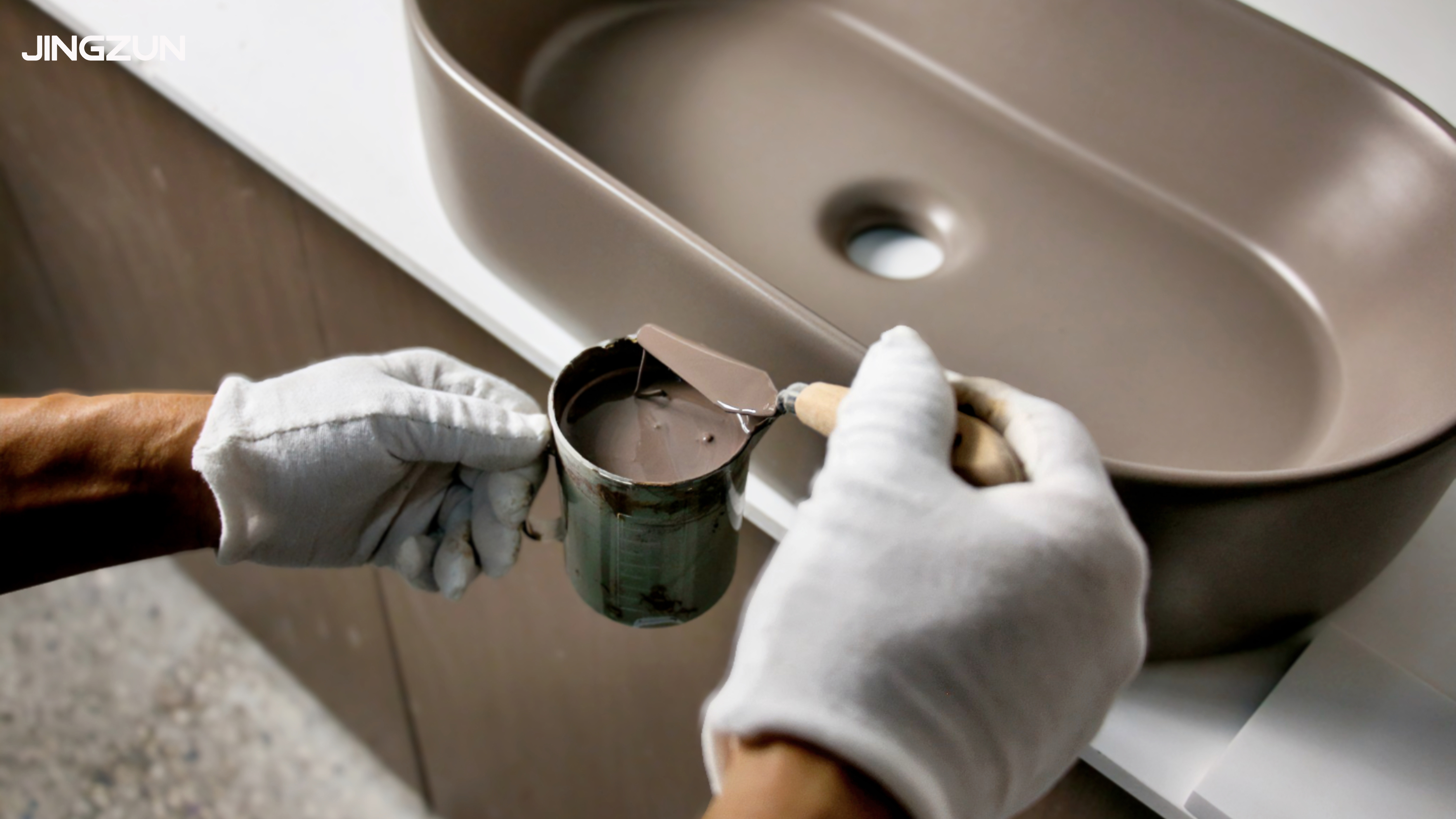
The reason buyers accept the extra step is consistency. In multi-room buildings, a batch-to-batch color match matters more than a single striking piece, and the comparison material published for this product line makes the point directly: natural stone varies from piece to piece, and a later restock can reintroduce a mismatch that the original order had resolved. A mixed and cured resin color can be reproduced from a formula. That is a genuine advantage for hotel and villa projects — with a boundary. A custom color changes appearance control; it changes nothing about ultraviolet behavior, installation sequence or the indoor positioning of the material.
Scenario 3 — Outdoor placement: an indoor product facing an outdoor brief
Outdoor use is not recommended for these solid surface bathtubs, and indoor installation is the documented recommendation. The stated reason is specific rather than cautious: prolonged direct sunlight can cause yellowing over time, and surface oxidation from extended light exposure is listed as a cause of surface yellowing.
The transparent resin line follows the same logic, with an explicit instruction to avoid direct sunlight and outdoor use because long-term UV exposure can cause discoloration and aging. Two product lines, one conclusion: the material is designed for indoor bathing spaces.
What this means for a brief is straightforward. A terrace, a pool deck, a semi-open courtyard or a sunroom without UV control sits outside the stated recommendation, and the documentation makes no exception for shaded or covered outdoor positions. If a project genuinely requires an outdoor tub, get written confirmation for that specific site rather than inferring approval from the presence of a pergola. Sanding may help restore appearance if yellowing or surface changes occur, but sanding is a remedy applied after the change — it is not permission to place the tub in sunlight.
The decision rule follows: where outdoor placement is fixed by the design, treat it as a product-selection problem rather than a finish problem. Changing where the tub sits costs a drawing revision. Changing the tub after installation costs a crane, a wall and a schedule.
Installation and maintenance: one sequence, different stakes
The installation steps are the same across all three scenarios, which is precisely why the outdoor case deserves separate attention — the sequence does not change when the site does.
Check that the floor is level before installation. Route the drainpipe through the clearance underneath the bathtub; no additional floor channel is needed. Position the tub, level it, connect the drainpipe and test the seal so drainage works without leaks. Ensure the base is evenly supported: a concentrated load under the tub is the documented cause of cracking, and the rim should not be struck with heavy objects during handling.
Routine cleaning uses a soft cloth and a neutral cleaner. Steel wool and strong acidic or alkaline cleaners are excluded, and that applies to custom colors as much as standard ones — an aggressive cleaner can mark a surface long before normal wear would. For an outdoor-intent project, note that the care instructions assume indoor conditions; relocating the unit outdoors moves it outside both the cleaning assumptions and the yellowing expectation at the same time.
One accessory point: the drain is included as standard, but a bath mixer tap is matched equipment rather than an included item. Mixers and overflow sets belong on the specification sheet next to the model number, not in a separate conversation after the tub has shipped.
Risk checks: scratches, yellowing and sanding as part of surface care
Two surface risks dominate this material: scratches and yellowing. Both are surface-layer issues on a homogeneous body, and both are managed through handling discipline and, where needed, sanding.
Hardness is documented at approximately 55 HBa, which is not the same as scratch-proof. Sharp-object scraping during installation and use is the main cause, and installation is where most avoidable scratches happen. Yellowing is the slower risk: under normal indoor use, no obvious yellowing is expected within 10 years, while surface oxidation from prolonged light exposure or improper cleaning is the documented cause when it does appear.
Why sanding works is worth understanding rather than memorizing. The body is produced from a consistent formulation of resin, aluminum powder and color paste, so the material and the color are the same inside and out. Scratches and oxidation generally affect only the outer layer; sanding removes that layer and exposes fresh material underneath, restoring the appearance without applying a coating.
The procedure is simple but should be written into the handover pack. Assess the depth first: if the mark is only on the surface and has not reached deeper material, sanding is suitable. Use fine sandpaper of an appropriate grit with water, sand evenly along the direction of the scratch with gentle pressure until the mark disappears, then rinse and dry. Deep damage goes back to the manufacturer rather than to the site team. Two boundaries belong beside that instruction: sanding is surface care, not a repair for structural damage, and a scratch found after installation is difficult to attribute — which is why a photographic record before installation is a cheap form of protection.
Drain and packing: the line items that decide whether the tub arrives usable
A drain is included with the solid surface bathtub, and standard packaging uses a plywood crate. Both should appear as explicit lines on the purchase order rather than as assumptions carried from a previous shipment.
The reason is timing. A tub that arrives without a matching drain, or in packaging the route cannot handle, creates a delay at the point where delay costs the most — on site, with a crew booked. Standard packaging for this line is a plywood crate; where a route, a distributor or a destination rule calls for a fully enclosed crate, settle it before production rather than after inspection.
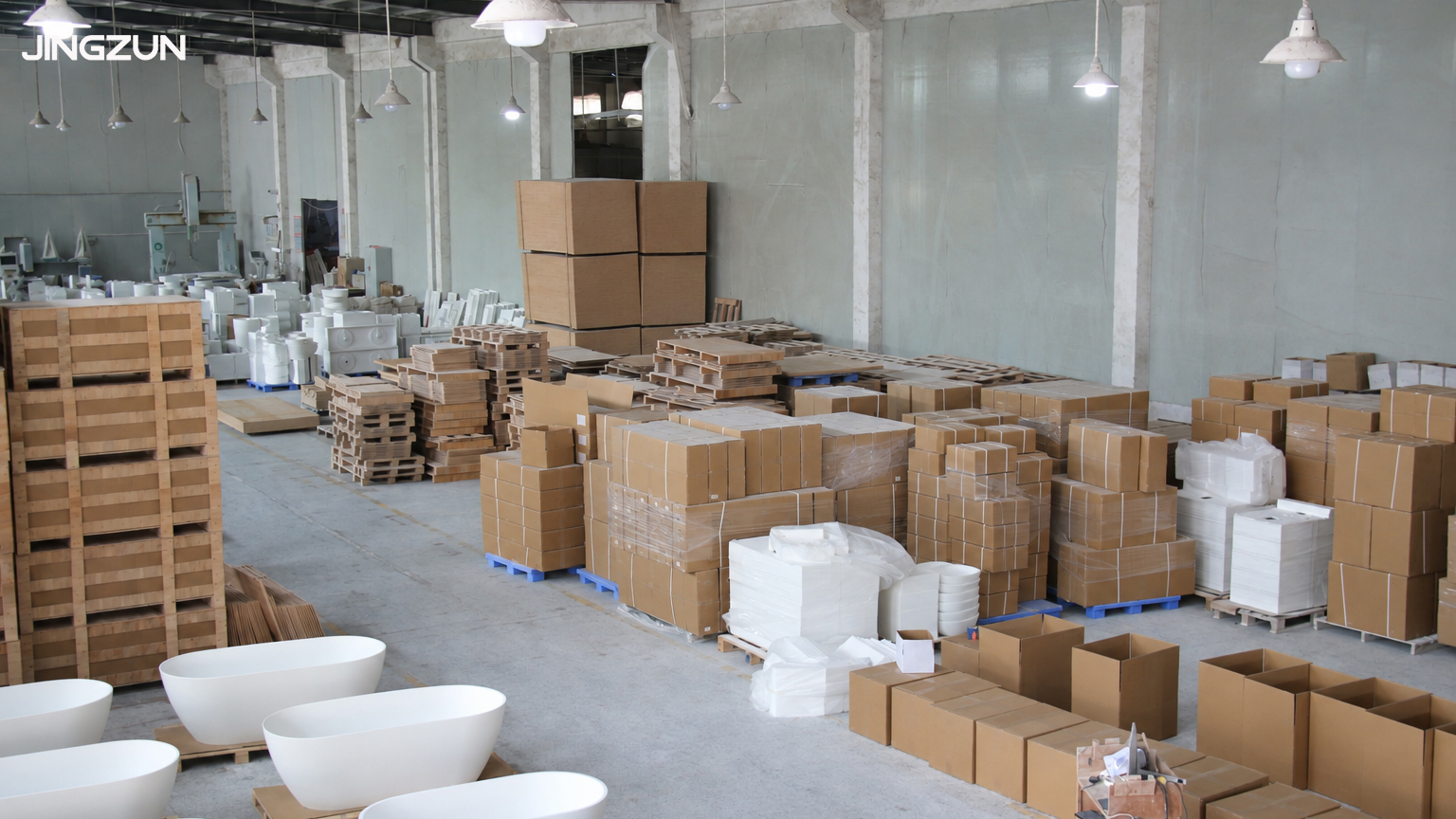
Ask the forwarder how the crate will be declared under the destination country's wood-packaging requirements, and keep that answer separate from the supplier's packaging specification — they are two different documents that are often treated as one. For capacity planning, the company reports a monthly bathtub manufacturing capacity of 20×40HQ, roughly 780 pieces; that is a company-reported figure that supports a planning conversation and is not an audited output.
Export standards and certification: a separate verification step
Certification is not a sales claim to be accepted at quotation stage; it is a document check that runs in parallel with the commercial negotiation and should be closed before the purchase order is released. The distinction matters because a certificate question answered verbally and a certificate question answered with a scope document look identical in an email thread and completely different at customs or at a project handover.
What verified looks like is specific: a certificate number, the issuing body, the standard or test method the report refers to, the product and model scope covered, the validity date, and a declaration of conformity that names the product. For European work, BS EN 14516 — the standard for baths for domestic use addressing cleanability and durability, published by BSI — is the kind of reference a buyer asks to see evidence against. The useful question is which report covers this model and who issued it.
Company materials for this product line reference UV and temperature-change testing and CE, cUPC and ICC-ES claims. In the material reviewed, certificate numbers, issuing bodies, product scope and validity dates were not available, and different company profiles list different combinations of marks. Those claims should therefore be treated as claims pending documentation, not as confirmed market access. It is also worth keeping the vocabulary straight: CE is a conformity marking tied to an applicable directive and a declaration of conformity, not a performance score, so the declaration and the underlying test report are the documents that answer the question.
Customs classification belongs in the same step. Confirm the code with a broker rather than copying one from a catalogue — a mineral-filled resin bath and an acrylic bath are not necessarily classified alike, and the difference affects duty. Finally, keep certification separate from price negotiation: bundling the two allows a documentation gap to be quietly absorbed into a discount, which is the opposite of what a project needs.
How solid surface compares with the alternatives still on the shortlist
Buyers usually compare solid surface against acrylic, ceramic, natural marble and cast iron for different reasons, and the comparison only helps if the claims are attributed and tested under comparable conditions. The figures below come from JINGZUN's published comparison material for this product line; they are supplier statements to be used for framing questions, not independent laboratory results.
Against acrylic, the structural difference is the process: acrylic is a thermoformed sheet, while solid surface is one-piece moulded and sandable. The company's comparison states roughly 60% higher surface hardness, about twice the service life, and acrylic yellowing within 3–5 years against 8–10 years of appearance stability for solid surface. Against ceramic, the difference is form: kiln-fired ceramic is limited in size and brittle, while solid surface can be produced to a drawing and refinished on site — though ceramic remains cheaper for standardized public and economy-hotel work, and that is a legitimate reason to choose it.
Against natural marble, the difference is repeatability. The comparison gives marble a water absorption of roughly 0.2–0.5% and a need for periodic sealing, against near-zero absorption for solid surface, plus the color-variation issue that matters in multi-room buildings. Marble's uniqueness is the counter-argument, and for a private villa it may be the right one. Against cast iron, the difference is weight and repair: a comparable cast iron tub weighs around 200–300 kg against roughly 100–150 kg for solid surface in the same comparison, and a chipped enamel surface cannot be repaired the way a sanded solid surface can.
The fit boundary belongs in the same paragraph as the advantages. This material is positioned for indoor installation, it costs more than acrylic at entry, and its repair model assumes somebody on site can actually sand a surface. Where those three conditions do not hold, the comparison stops being flattering.
Market context: why freestanding demand changes the confirmation list
Grand View Research, in a report dated July 2026, estimates the global bathtub market at USD 13.36 billion in 2026 and projects USD 20.74 billion by 2034, with freestanding bathtubs the fastest-growing segment at a 7.2% CAGR through 2034, driven largely by luxury bathroom renovation.
The interpretation for buyers is narrow but useful. Freestanding is the segment where shape, rim and color carry the design argument, so a growing freestanding segment is also a growing custom color segment — which is exactly where the sampling and approval step described earlier becomes a scheduling constraint rather than an optional extra. What does not change with demand is the material's indoor positioning, the certification requirement, or the fact that a larger supplier pool makes verification more valuable rather than less. The figures cover the whole bathtub market rather than solid surface alone, and they are commercial research estimates with published methodology — a demand indicator, not a specification.
A short pre-order checklist
- Model number, dimensions and edge profile confirmed against a drawing, not a catalogue photo.
- Material family stated in writing: solid surface or transparent resin, with the hardness, color count and price band that follow from it.
- Color route chosen: a standard color from the 21-color range, or a custom color with a 7-day sample and a retained approved reference.
- Site position confirmed as indoor; any outdoor or semi-outdoor placement escalated to written confirmation before the order.
- Installation conditions checked: level floor, drainpipe routed through the under-tub clearance, even base support.
- Warranty term (5 years) and its scope confirmed in writing, including how an outdoor position would be treated.
- Drain inclusion and plywood crate packaging written on the purchase order; wood-packaging declaration checked with the forwarder.
- Certification evidence requested as documents — certificate number, issuing body, standard, model scope, validity, declaration of conformity.
- Customs classification confirmed with a broker.
- Sanding procedure and responsibility assigned in the handover pack, with a photographic record taken before installation.
Frequently asked questions
What is a solid surface bathtub made of, and why can scratches be sanded out?
A solid surface bathtub is a one-piece, cast and cured product made from aluminum powder and resin. The material is homogeneous throughout the body, so the inside and outside share the same composition and color. Because scratches and surface oxidation generally affect only the outer layer, sanding removes that layer and exposes fresh material, restoring the appearance without an added coating.
How many colors are available, and how long does a custom color take?
There are 21 standard colors for solid surface bathtubs, and custom colors are available. A custom color sample usually takes 7 days. Because the sample is approved before the production run, a custom color order should plan the approval date ahead of the production date rather than alongside it.
Can a solid surface bathtub be installed outdoors?
Outdoor use is not recommended. Prolonged direct sunlight may cause yellowing over time through surface oxidation, and indoor installation is the documented recommendation. The transparent resin line carries the same guidance: avoid direct sunlight and outdoor use, because long-term UV exposure can cause discoloration and aging.
What warranty applies, and are a drain and wooden packaging included?
Solid surface bathtubs come with a 5-year warranty. A drain is included as standard, and standard packaging uses a plywood crate. Where a route or destination requires a different crate configuration, that should be confirmed on the purchase order before production.
How should the bathtub be installed and maintained?
Check that the floor is level, route the drainpipe through the clearance underneath the bathtub, position and level the unit, then connect the drainpipe and test the seal. Ensure the base is evenly supported to avoid cracking from a concentrated load, and avoid striking the rim with heavy objects. Clean with a soft cloth and a neutral cleaner; do not use steel wool or strong acidic or alkaline cleaners. Minor scratches or surface yellowing can be treated by sanding evenly with fine sandpaper and water, while deep damage should go back to the manufacturer.
What certification evidence should a buyer request before ordering?
Request certificate copies, the issuing body, the standard or test method referenced, the product and model scope covered, validity dates, and a declaration of conformity naming the product. Company materials reference UV and temperature-change testing and CE, cUPC and ICC-ES claims, but certificate numbers and scope details were not available in those materials, so they should be treated as claims pending documentation. Customs classification should be confirmed separately with a broker.
The company's product catalogue is available for public download: Jingzun product catalogue (PDF). Manufacturer details are published at jingzunbath.com.
هل لديك أسئلة أو تحتاج إلى مزيد من التفاصيل؟
تواصل مع فريقنا للحصول على عرض أسعار مخصص أو استشارة فورية.
طلب عرض أسعار
املأ النموذج أدناه وسيتواصل معك فريقنا بعرض مقترح مخصص.
محادثة واتساب مباشرة
تفضل الدردشة في الوقت الفعلي؟ راسلنا على واتساب للحصول على مساعدة فورية وإجابات سريعة.
- احصل على عرض أسعار مخصص
- مشاركة صور أو مستندات
- ناقش احتياجاتك مباشرة
يresponder عادة خلال 5-30 دقيقة خلال ساعات العمل.