
Solid Surface Bathtub Procurement FAQ: Specs, Risks and Export Checks
Solid Surface Bathtub Procurement FAQ: Specs, Risks and Export Checks
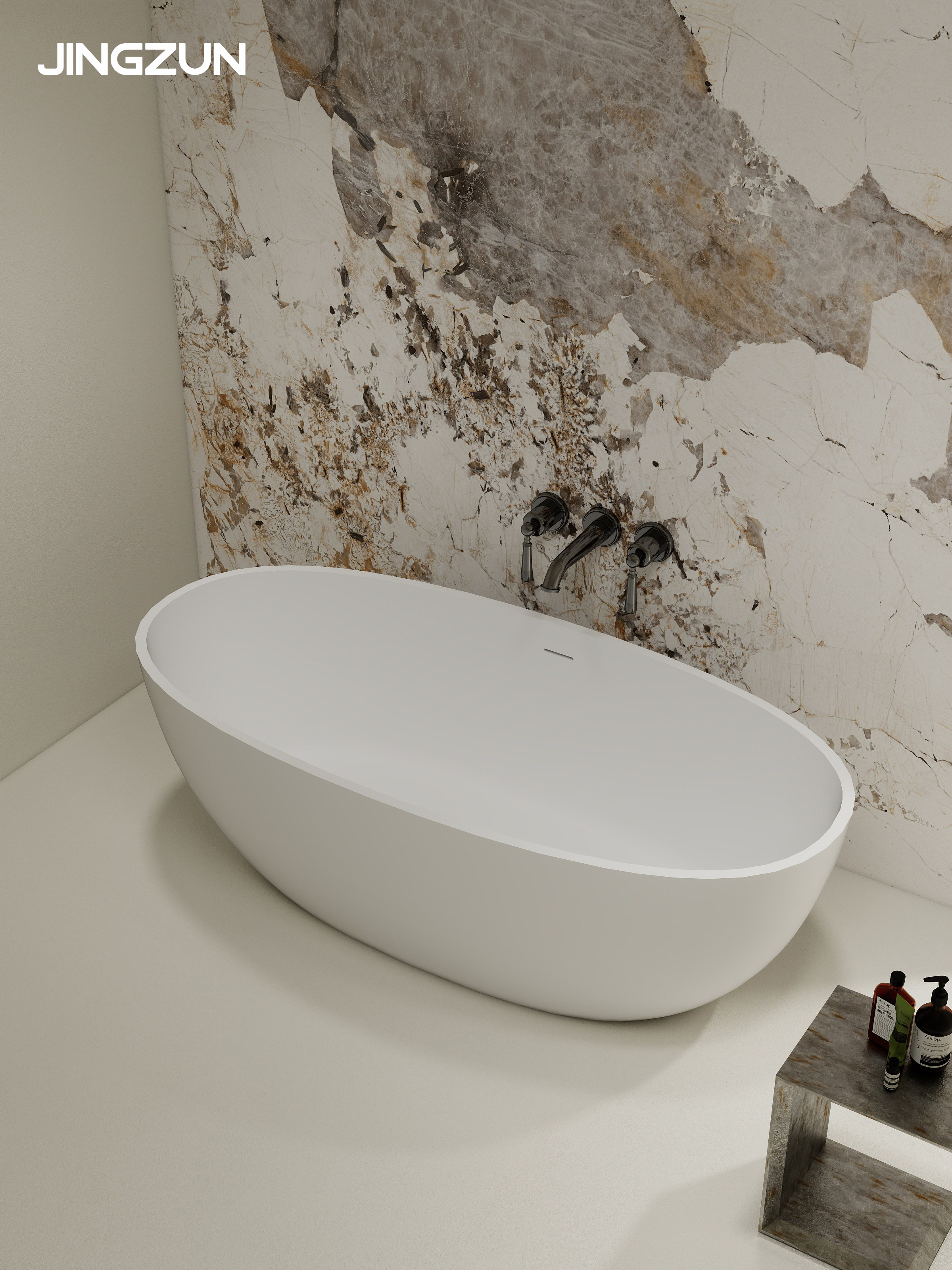
For a solid surface bathtub purchase, the key checks are the exact model and dimensions, material and finish description, included drain, packaging, warranty, production timing, and documents relevant to the destination market. A product label such as composite stone or mineral composite is not, by itself, enough to establish a bathtub’s composition or performance. Buyers should assess the actual model and its supporting documents rather than treat similarly named materials as interchangeable.
This technical procurement FAQ focuses on those checks, the risks that can arise when specifications are incomplete, and the limits of a price-only comparison. It uses JINGZUN product information as a concrete example, not as independent verification of every claim or a substitute for destination-market review. JINGZUN’s solid surface bathtub JZ8628 is described as an aluminum-powder-and-resin composite, cast as one integrated piece. The supplied product information lists two size options and customizable color; buyers should confirm the selected configuration in the order documents.
What should buyers specify before ordering?
Buyers should define the bathtub configuration in writing before comparing quotations. At minimum, identify the model, overall dimensions, finish, color, drain arrangement, packaging, order quantity, and delivery schedule. For a project, also coordinate the bathtub with the floor, waste and overflow set, mixer, waterproofing, access route, and installation plan. This helps distinguish a genuinely comparable quotation from one that leaves important items unspecified.
For JZ8628, the listed dimensions are 1550 × 750 × 550 mm and 1650 × 800 × 580 mm. The stated bathtub capacities are 250 L for the 1500-length option and 305 L for the 1650-length option. The product information also lists a 40HQ loading capacity of 39 pieces. Confirm the exact option and the meaning of the capacity figure with the supplier for the order being quoted; do not assume that details for one configuration apply to another model.
Color is listed as customizable in a full color range. That does not define a specific shade, finish, sample approval process, or effect on the production schedule. Where color matching matters, specify the approved reference and how the production sample will be checked. If a custom size or shape is being considered, record the approved drawing and installation relationship as part of the order specification rather than relying on a general description such as custom solid surface bathtub.
How should the material and finish be checked?
“Solid surface” is a product and material description, but the available category evidence does not establish a single standardized composition for every solid surface, stone resin, cast marble, polystone, or mineral composite bathtub. Names such as artificial stone bathtub, engineered stone bathtub, cultured marble bathtub, and acrylic composite bathtub can describe different supplier-defined materials. A shared label does not prove that two products use the same formulation, construction, or test basis.
For the JZ8628, the supplied specification identifies the material as solid surface made from aluminum powder and resin. Its product description states that the bathtub is cast as one integrated piece and has a homogeneous material body. This is company-provided product information; it should not be generalized to every freestanding bathtub or every product sold as stone resin. Buyers comparing products should request model-specific material and construction details, and keep any test or performance claims attached to the exact model and evidence provided.
Finish also deserves a precise description. The JZ8628 product description refers to a fine, even matte finish, while the selection FAQ also describes a high-gloss option. Buyers should therefore confirm which finish applies to the quoted model and whether it is standard or a requested variation. A general phrase such as “high end bathtubs” is not a technical specification. Written confirmation of finish, color, dimensions, and model is more useful for review and acceptance.
Does a higher-priced bathtub offer better value than a lower-priced one?
Price alone cannot establish quality or value. The supplied selection guidance distinguishes a standard model described as 25 mm thick from a thin-edge option presented for projects with a limited budget; it also identifies a high-gloss finish and custom colors as selectable considerations. That guidance does not provide a like-for-like test comparing every thin-edge and standard bathtub, nor does it prove that a higher quotation guarantees better durability or suitability.
A more useful comparison asks what is included and what is documented. Compare the exact model and size, stated construction, edge or body specification where applicable, finish, color, drain, packaging, warranty terms, and production schedule. Ask whether each quotation covers the same configuration and delivery basis. If a low-priced offer omits information, the gap is an uncertainty to resolve—not proof that the product is defective. Likewise, a higher price is not evidence of superior performance unless comparable specifications or relevant test evidence support that conclusion.
For hospitality or residential projects with defined quality requirements, the supplied selection guidance recommends considering the standard 25 mm model. For a budget-constrained project, it identifies a thin-edge model as an option. Treat these as starting points for configuration discussions, not universal rules: confirm what the quoted edge measurement describes, how the full bathtub is constructed, and whether the selected model fits the installation and project requirements. The available material does not provide a complete technical comparison between these options.
Which installation and maintenance risks should be planned for?
Installation conditions can affect the product and the finished bathroom. The solid surface bathtub guidance says to check that the floor is level, route the drainpipe through the clearance beneath the bathtub, and ensure the base is evenly supported. It also warns against concentrated point loads during installation. Buyers should coordinate the floor condition, access, support, and drain connection with the installer before delivery; the supplier’s product information does not replace a site-specific installation plan.
For routine cleaning, the supplied guidance recommends a neutral cleaner and advises against steel wool and strong acidic or alkaline cleaners. Minor surface scratches or localized yellowing may be repairable by sanding, according to the FAQ material, because the described solid surface is homogeneous. The guidance distinguishes shallow surface damage from deeper damage: deeper damage should be referred to the manufacturer rather than treated as a routine repair. This repair information should not be read as a guarantee that every type of damage can be restored.
Outdoor use is not recommended for the company’s solid surface bathtub; the supplied FAQ advises avoiding prolonged direct sunlight because UV exposure may cause yellowing over time. For indoor bathroom use, buyers should also align cleaning instructions with the property’s maintenance practices. These limits matter in hotels and apartment projects, where a maintenance team may use products or methods different from those in a private home.
What should be checked for export?
Export requirements depend on the destination market and the specific product and transaction. The available evidence does not establish one universal certification or document set for all solid surface bathtubs, so a buyer should not assume that a general certificate claim alone settles market access. Identify the destination and applicable requirements with the responsible importer or qualified compliance adviser, then check the documents against the exact model and configuration being purchased.
As a procurement review, request the applicable conformity or compliance documents, product scope, model identification, validity information where relevant, and supporting test or technical documentation. Check that names and specifications match the quotation, product label, and shipping documents. Company-profile certification claims in the supplied research lack certificate identifiers, confirmed product scope, and supporting reports; they are not sufficient on their own to establish that a particular bathtub is covered. No specific certification body or numeric compliance threshold is asserted here.
Do not treat a broad label such as composite stone bathtub or Aquastone bathtub as proof of export compliance. Nor should a supplier’s general statement about one product be silently extended to a different model or material. The practical question is whether the documentation available for the ordered product addresses the destination market’s actual requirements. This verification should happen before approval and shipment, not be inferred from the product name.
Are the drain, wooden packaging, warranty, and lead time included?
The supplied solid surface bathtub FAQ states that a drain is included and that standard packaging uses a plywood crate. It also distinguishes an optional fully enclosed wooden crate. Confirm the packaging type in the quotation and order confirmation, including whether the requested option is included in the price. The source describes the packaging but does not specify every export, handling, or destination requirement that may apply to a shipment.
The FAQ states a five-year warranty for JINGZUN solid surface bathtubs. Buyers should confirm the written warranty applicable to their order, including its covered product, conditions, and claim process; the FAQ’s stated period alone does not define all warranty terms.
Production timing in the supplied FAQ is approximately 30 days for regular production and usually 7–15 days for a sample order. New mold development is described as approximately 25 days, followed by seven days for first-sample confirmation. These are stated timings, not a guaranteed delivery date. Confirm the schedule for the selected model, color, quantity, and any customization before setting a project milestone.
What is the practical procurement sequence?
A disciplined sequence reduces ambiguity without assuming that a checklist can replace product evidence. First, freeze the model, dimensions, finish, color, drain, and packaging. Second, compare quotations only after confirming that they cover the same configuration. Third, review material and construction statements against model-specific documents. Fourth, confirm site fit, support, drainage, cleaning, and indoor-use conditions with the project team. Finally, validate destination-market documentation, written warranty terms, and production timing before approving the order.
JINGZUN’s supplied company profile describes the business as a manufacturer of solid surface sanitary products and lists OEM and ODM services. These are company-provided facts, not independent audit findings. For procurement purposes, they can help identify the supplier context, but do not substitute for checking the exact bathtub specification, order terms, or documents for a particular project. The official company website is JINGZUN.
Procurement FAQ
What is a solid surface bathtub made of?
The supplied JZ8628 specification describes a solid surface made from aluminum powder and resin. The product FAQ describes this bathtub type as a one-piece, cast-and-cured product with a homogeneous body. Buyers should verify that the description applies to the exact model under consideration; material labels used by different suppliers do not, by themselves, establish identical composition.
How should a buyer compare a standard and a lower-budget option?
The supplied selection guidance describes a standard 25 mm model as an option for projects with higher quality requirements and a thin-edge model as an option for limited budgets. It does not provide a controlled performance comparison. Compare the actual model specifications, finish, inclusions, packaging, warranty terms, and supporting evidence before drawing a value conclusion.
Does the solid surface bathtub include a drain, and how is it packed?
The supplied FAQ states that a drain is included and standard packaging uses a plywood crate. A fully enclosed wooden crate is described as optional. Confirm the selected packaging arrangement in the order documents.
What warranty and production timing are stated?
The supplied FAQ states a five-year warranty for JINGZUN solid surface bathtubs. It gives approximately 30 days for regular production, usually 7–15 days for samples, and approximately 25 days for new mold development plus seven days for first-sample confirmation. Confirm the written terms and schedule for the selected order; these statements do not guarantee a delivery date.
Which certification is required to export a solid surface bathtub?
The applicable requirements depend on the destination market and the product. The available evidence does not identify one universal certification for all markets or establish that a general supplier claim covers a specific model. Buyers should confirm the applicable requirements for their destination and review product-specific compliance documents and supporting evidence before shipment.
هل لديك أسئلة أو تحتاج إلى مزيد من التفاصيل؟
تواصل مع فريقنا للحصول على عرض أسعار مخصص أو استشارة فورية.
طلب عرض أسعار
املأ النموذج أدناه وسيتواصل معك فريقنا بعرض مقترح مخصص.
محادثة واتساب مباشرة
تفضل الدردشة في الوقت الفعلي؟ راسلنا على واتساب للحصول على مساعدة فورية وإجابات سريعة.
- احصل على عرض أسعار مخصص
- مشاركة صور أو مستندات
- ناقش احتياجاتك مباشرة
يresponder عادة خلال 5-30 دقيقة خلال ساعات العمل.