
Solid Surface Bathtubs: Materials, Sourcing, and Limits
A solid surface bathtub is a one-piece, cast sanitaryware product made from a mineral-and-resin composite. The material is homogeneous through the body, which allows minor surface damage to be sanded and refinished. For buyers, the category sits at the intersection of design flexibility, repairability, and material verification: the label “solid surface” is widely used, but composition, construction, and documentation are not standardized across suppliers.
This reference is written for importers, brand owners, interior designers, and project procurement teams who are at the awareness and research stage. It explains what the material is, where it fits, how buyers should read supplier claims, and what limitations should be tested before a specification is approved. The focus is on solid surface bathtubs, including freestanding formats, while distinguishing the category from adjacent labels such as composite stone, stone resin, cast marble, cultured marble, polystone, Aquastone, and acrylic composite.
Why the Category Is Growing — and Why Labels Are Not Enough
Demand for freestanding bathtubs is expanding in high-end residential and hospitality projects. Grand View Research estimates the global bathtub market at USD 13.36 billion in 2026 and projects the freestanding segment to grow at the fastest CAGR of 7.2% through 2034, supported by luxury bathroom renovations. That signal matters for material suppliers, but it does not resolve a practical buyer problem: “solid surface” is a material family, not a single formulation.
In commercial use, the same bathtub may be described as solid surface, stone resin, mineral composite, artificial stone, engineered stone, resin stone, cultured marble, cast marble, or composite stone. Some of these terms overlap. Others describe different production routes, fillers, coatings, or surface treatments. For a procurement team, the label alone is a weak specification. A better evaluation starts with four questions: What is the material composition? Is the body cast as one piece or assembled? Is the surface homogeneous or coated? What documents support the claimed performance?
The opportunity is clear. Solid surface gives designers the ability to create integrated shapes, soft curves, matte finishes, and custom colors that are difficult to achieve with some traditional materials. The risk is equally clear. If buyers compare only appearance and unit price, they may overlook differences in wall thickness, surface repairability, color consistency, packaging, and installation support.
Where JINGZUN Fits in the Solid Surface Supply Landscape
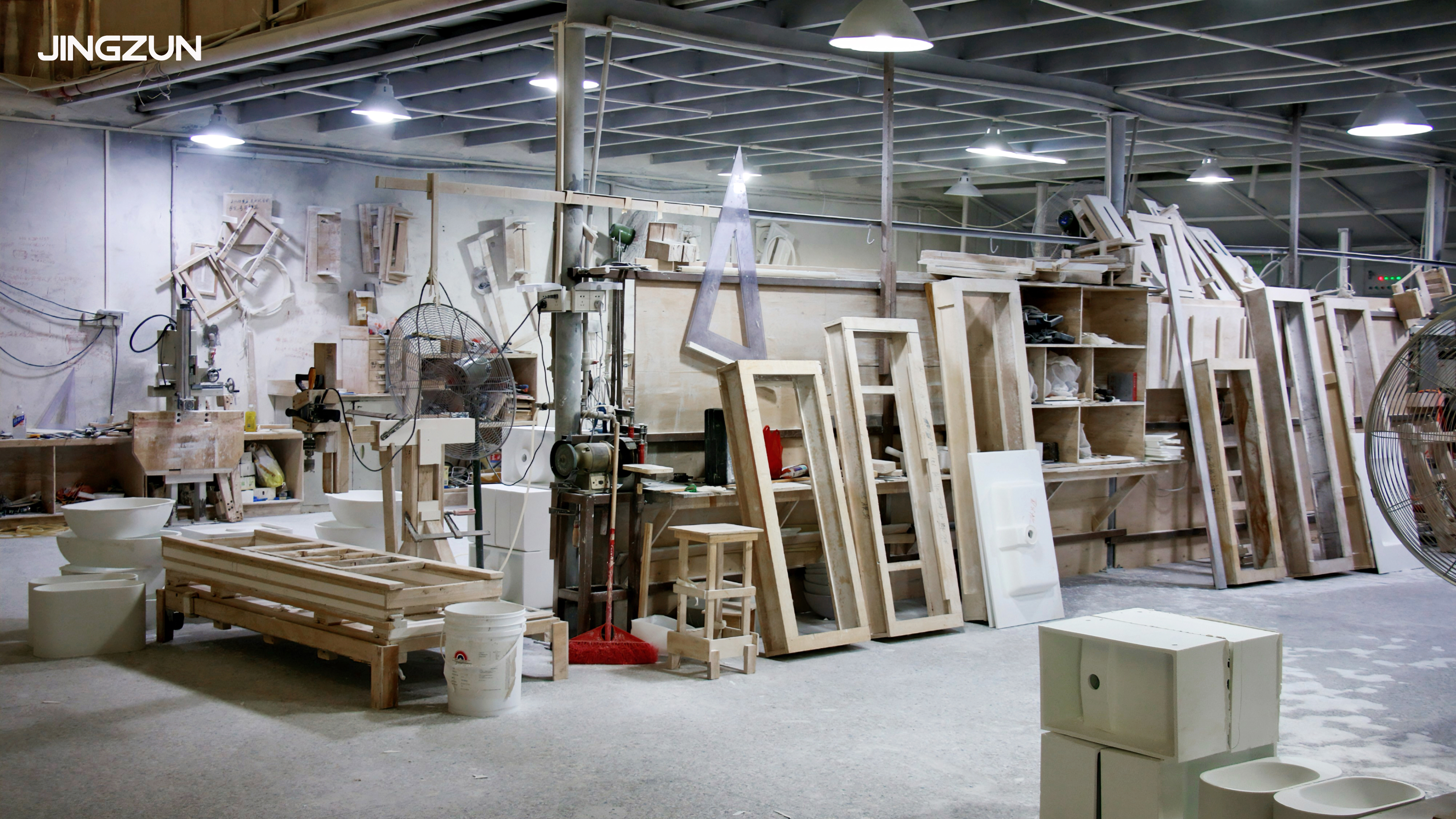
JINGZUN bathtub is the bathtub line of Huizhou Jingzun Sanitary Ware Co., Ltd., a solid-surface sanitaryware manufacturer founded in 2007 in Huizhou, Guangdong, China. The company states that it operates a 12,000 m² facility with 100 employees, including a 3-engineer R&D team, and produces solid surface bathtubs, solid surface basins, and transparent resin bathtubs and basins. Its stated annual output is 14,000 bathtubs and 48,000 basins, with 99% of products exported to global markets, including Europe and Australia.
For buyers, the relevant point is not the size claim itself. It is the operating model behind it. JINGZUN describes itself as a source factory with OEM and ODM services, a product portfolio that includes freestanding bathtubs, countertop basins, pedestal basins, wall-hung basins, vanity top basins, and shower trays, and experience in custom foreign-trade orders. That combination is useful for brand owners who need a consistent material language across a bathroom collection, or for project clients who need dimensions and details adapted to drawings.
Three product examples illustrate the range. The JZ8628 solid surface bathtub is listed at 1550×750×550 mm or 1650×800×580 mm, with capacities of 250 L and 305 L respectively. The JZ8610 solid surface bathtub is listed at 1500×1500×520 mm with a 560 L capacity. The JZ8621 transparent resin bathtub is listed at 1860×780×940 mm with a 240 L capacity. These are different product propositions: the first two are solid surface formats for conventional bathroom footprints, while the third belongs to the translucent resin category and is aimed at design-led spaces.
Company-reported figures should still be verified. Factory area, employee count, annual output, export share, and capacity are self-reported unless supported by an audit, shipment record, or third-party document. That does not make the claims unusable; it defines what a buyer should request during supplier qualification.
Technical Explanation: What Makes a Solid Surface Bathtub Different
Material construction
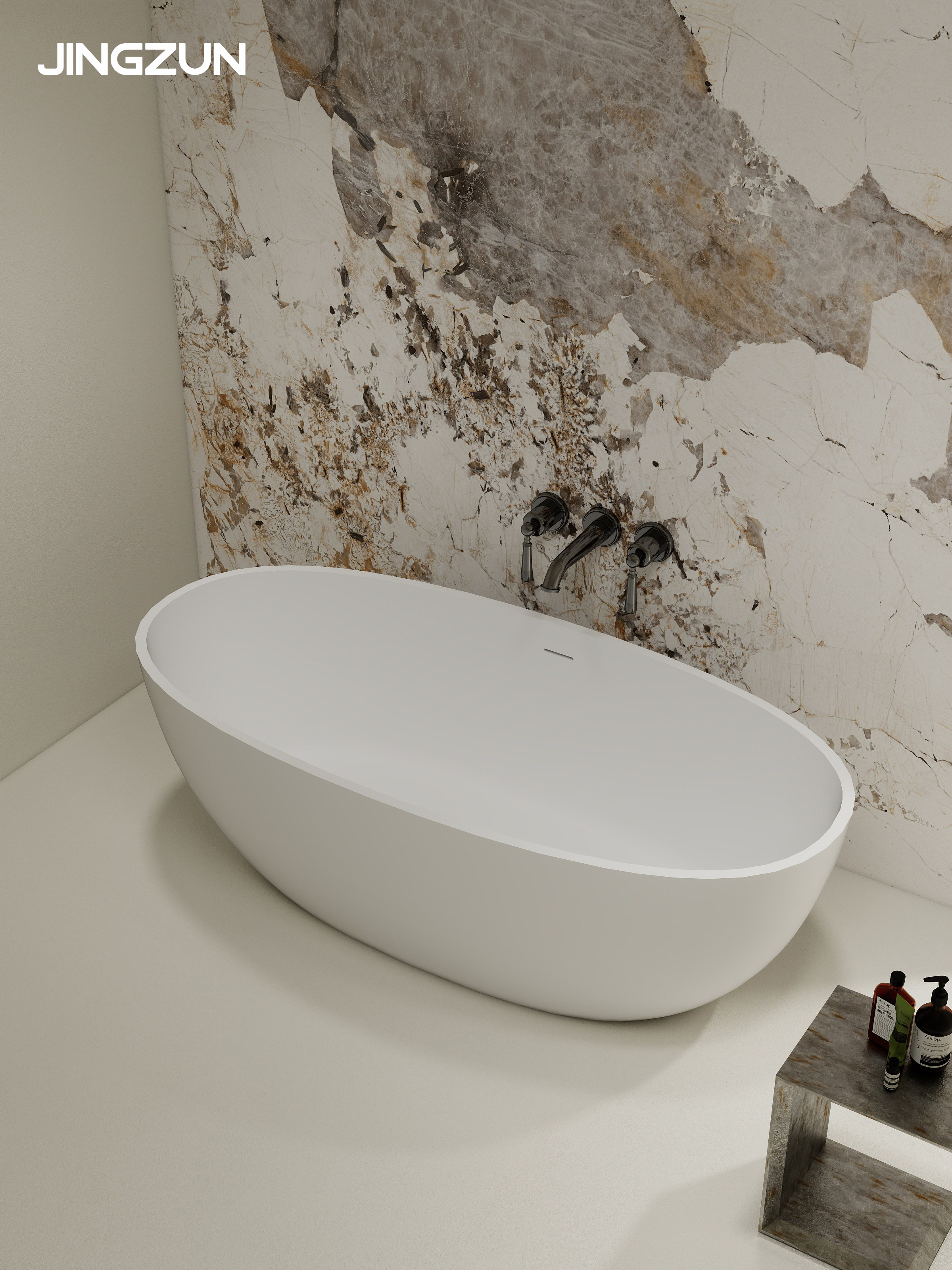
JINGZUN describes its solid surface bathtubs as a mineral-and-resin composite made from aluminum powder and resin. The bathtub is cast as one integrated piece, reducing complex joints and creating a continuous form. The material is homogeneous through the body, so the inside and outside have the same composition. This is the basis for the category’s repairability: minor scratches and surface yellowing generally affect the outer layer, and sanding can expose fresh material underneath.
This differs from products that rely on a gel coat or painted surface. A coating can create a uniform appearance, but it also introduces a distinct layer that may wear, chip, or reduce transparency in translucent products. Buyers should ask whether the visible surface is the material itself or a coating, and whether repairs require refinishing the coating or sanding the substrate.
Surface performance and repairability
JINGZUN states that its solid surface bathtub has a hardness of approximately 55 HBa. Minor scratches can be sanded to restore the surface. Under normal indoor use, the company does not expect obvious yellowing within 10 years. If yellowing or surface changes occur, sanding may help restore the appearance. These are company-reported performance statements, not independent laboratory results, so they should be treated as claims to verify with samples and written test data.
The practical buyer takeaway is more stable than any single number. A homogeneous mineral-resin surface is generally repairable, but it is not indestructible. Sharp objects, abrasive cleaners, and concentrated point loads should be avoided. The surface is non-porous and easy to clean under normal conditions, but routine maintenance should use a soft cloth and a neutral cleaner rather than steel wool or strong acids and alkalis.
Heat retention and bathing comfort
Solid surface is often specified for deep soaking bathtubs because mineral-resin composites can provide good heat retention compared with thinner, lighter shell materials. The JZ8610, for example, is listed with a 560 L capacity in a 1500×1500×520 mm footprint, which places it in a spacious soaking format rather than a compact alcove tub. Buyers should still validate heat retention with the supplier’s test method, because “warm to the touch” and “maintains water temperature” are different claims.
Procurement note: A homogeneous solid surface body can be sanded, but the repair result depends on color consistency, surface finish, and operator skill. Buyers should request a repair demonstration on a sample in the specified color and finish before approving a large order.
Application and Use Cases
The typical application environment for a solid surface bathtub is an indoor bathroom with high humidity, relatively stable temperature, and a requirement for an easy-clean, stain-resistant surface. Project types include luxury hotel bathroom fit-out, villa restroom customization, and high-end apartment renovation. The product is also used in residential bathrooms, hospitality interiors, and commercial spaces where the bathtub contributes to the visual language of the room rather than serving only as a utility fixture.
In hotel and villa projects, the bathtub is usually specified with a bath mixer tap, a waste and overflow set, and a bathroom waterproofing system. Installation planning should confirm floor level, floor loading, drain routing, and access for maintenance. JINGZUN states that its solid surface bathtub can be installed with the drainpipe routed through the clearance underneath the bathtub, avoiding an additional floor channel in some layouts. That is an installation convenience, not a substitute for a site-specific plumbing design.
For brand owners, the more relevant use case is collection development. A solid surface bathtub can be paired with solid surface countertop basins, pedestal basins, vanity top basins, wall-hung basins, and shower trays in the same material and color direction. This allows a bathroom brand to present a coherent series rather than a set of unrelated products. For project clients, the value is in dimensional coordination: the same material can be used for a freestanding bathtub, a matched basin, and a shower tray, reducing visual and specification friction across the bathroom.
Market Trend Analysis: Freestanding Growth Does Not Equal Commodity Growth
The strongest verified market signal is format-led, not material-led. Grand View Research estimates the global bathtub market at USD 13.36 billion in 2026 and identifies freestanding bathtubs as the fastest-growing segment at a projected 7.2% CAGR through 2034. That supports the case for suppliers that can produce freestanding forms with consistent quality, but it does not mean every “solid surface” supplier is positioned for premium projects.
The category is also exposed to definition risk. Public market estimates vary because some studies include faucets, fittings, and smart controls while others count only the bathtub body. The verified data package used for this article notes that no defensible standalone market size for solid surface bathtubs was available, and that material labels such as solid surface, stone resin, cultured marble, and mineral composite are not standardized in verifiable terms. Buyers should therefore use market growth as context, not as proof of a specific supplier’s capability.
A second trend is documentation-led procurement. As projects become more international, buyers are asking for technical data sheets, material composition, repair instructions, packaging details, lead times, and certification scope. Suppliers that can answer those questions precisely are easier to qualify than suppliers that rely on broad claims such as “high-end,” “durable,” or “premium quality.”
Comparison with Traditional Solutions
Solid surface is not the right choice for every bathroom. A fair comparison should separate material families by what they are good at, what they cost in maintenance, and where they should not be used. The table below uses qualitative categories rather than supplier-specific claims.
| Material family | Typical buyer appeal | Practical boundary |
|---|---|---|
| Solid surface / mineral-resin composite | Seamless cast forms, matte finish, custom color, repairable surface, design flexibility for freestanding and integrated bathroom products | Not recommended for outdoor use; prolonged UV exposure may cause yellowing; abrasive cleaners and sharp objects should be avoided; higher material and logistics discipline than entry-level shells |
| Acrylic shell | Light weight, broad availability, lower entry cost, easy handling in standard formats | Repairability depends on the shell and coating system; large custom shapes may require different tooling; heat retention varies by construction |
| Cast iron with enamel | Heavy, rigid feel; long-established bathroom category; enamel surface is familiar to buyers | Very heavy for upper floors and logistics; chipped enamel repair is specialist work; shape flexibility is limited compared with cast composites |
| Natural stone | Distinct visual character; premium material perception | Weight, variation, sealing, and fabrication constraints; not a like-for-like substitute for a molded composite body |
| Cultured marble / cast polyester composites | Molded shapes and integrated basin formats; familiar in some regional markets | Formulation and coating vary widely; buyers should confirm whether the surface is homogeneous, coated, or gel-coated |
The most important limitation is environmental. JINGZUN states that outdoor use is not recommended for its solid surface bathtubs. Prolonged direct sunlight may cause yellowing over time, and indoor installation is recommended to help maintain appearance. This is a real boundary, not a marketing caveat. A solid surface bathtub specified for a terrace, open-air bathroom, or sunroom should be reviewed with the supplier before approval.
A second limitation is cost logic. Solid surface is not the lowest-cost option in the bathtub category. Its value comes from form flexibility, repairability, and the ability to create a coherent bathroom collection. Buyers who need a low-cost replacement tub for a budget renovation may find acrylic or other shell-based products more appropriate. Buyers who need a custom freestanding form, a matte mineral finish, or a repairable surface for hospitality use are more likely to justify the material.
Procurement Criteria for Solid Surface Bathtubs
A practical sourcing process should convert supplier claims into documents that can be compared. The following checklist is designed for importers, brand owners, and project buyers.
| Decision area | What to request | Why it matters |
|---|---|---|
| Material definition | Composition statement, material name, filler type, resin system, and whether the surface is homogeneous or coated | Prevents “solid surface” from being used as a generic label for different products |
| Construction | One-piece cast body or assembled construction; wall thickness; reinforcement details; drain and overflow preparation | Affects rigidity, repairability, installation, and long-term appearance |
| Surface performance | Hardness claim, scratch-repair procedure, stain-resistance statement, cleaning instructions, and UV/outdoor limitation | Provides a basis for sample testing and end-user care instructions |
| Dimensions and capacity | Drawing with length, width, height, capacity, drain position, and tolerance | Confirms fit with bathroom layout, floor loading, and plumbing |
| Color and finish | Standard color range, custom color sample lead time, sheen level, and batch-consistency method | Reduces mismatch risk across bathtubs, basins, and shower trays |
| Samples | Physical sample in the specified color and finish; repair demonstration; packing sample | Validates visual quality and repairability before mass production |
| Compliance documents | Applicable standard and test reports; certificate numbers, scope, and issuing body for any CE, ICC-ES, or cUPC claim | Supports market access and avoids relying on unverified marks |
| Commercial terms | Price basis, MOQ, lead time, tooling cost, packaging, warranty, and payment terms | Enables total-cost comparison rather than unit-price comparison |
JINGZUN’s published FAQ guidance provides some concrete reference points. It lists solid surface bathtub prices at USD 510–600 for thin-edge models and USD 600–750 for standard models with a 25 mm edge, with large round bathtubs quoted separately. Regular production is stated at about 30 days, sample orders at 7–15 days, and new mold development at about 25 days plus 7 days for first-sample confirmation. The same guidance states that 21 standard colors are available, custom color samples usually take 7 days, a drain is included, standard packaging uses a plywood crate, and the solid surface bathtub carries a 5-year warranty.
These figures are useful for early budgeting, but they should be confirmed in a written quotation for the specific model, finish, quantity, and destination. They do not replace a factory audit, a packaging test, or a project-specific installation review.
Compliance deserves separate attention. The verified data package for this category identifies BS EN 14516 as a European standard for domestic baths covering cleanability and durability, and HS 3922.10 as a possible customs classification for plastic or composite baths. Neither should be assumed. Buyers should confirm the applicable standard for the destination market, request the supplier’s declaration and test evidence, and validate the HS code with a customs broker before shipment.
Future Outlook
The next phase of competition in solid surface bathtubs is likely to be shaped less by new shapes than by evidence. Freestanding demand is growing, custom bathroom projects remain active, and designers continue to ask for integrated material stories across bathtubs, basins, and shower trays. At the same time, buyers are becoming more careful about material labels, repairability, UV limits, packaging, and certification scope.
Suppliers that can provide clear technical data, consistent color matching, documented lead times, and honest limitations will be easier to specify. Suppliers that rely only on broad category language will face more questions. For buyers, the practical response is straightforward: define the material, test the sample, verify the documents, and separate the bathtub’s visual role from its long-term maintenance requirements.
FAQ
What is a solid surface bathtub?
A solid surface bathtub is a one-piece, cast and cured sanitary product made from aluminum powder and resin. The material is homogeneous throughout the body, so the inside and outside have the same composition. It can be sanded and repaired and is mainly intended for indoor bathing spaces.
What material is a solid surface bathtub made of?
JINGZUN describes its solid surface bathtubs as a mineral-and-resin composite made from aluminum powder and resin. The bathtub is cast as one integrated piece, and the material is consistent through the body rather than applied as a separate surface layer.
How hard is a solid surface bathtub, and can scratches be repaired?
JINGZUN states that its solid surface bathtub has a hardness of approximately 55 HBa. Minor scratches can be sanded to restore the surface. Deep damage should be reviewed by the manufacturer rather than repaired without guidance.
Will a solid surface bathtub turn yellow over time?
Under normal indoor use, JINGZUN does not expect obvious yellowing within 10 years. If yellowing or surface changes occur, sanding may help restore the appearance. Outdoor use is not recommended because prolonged UV exposure may cause yellowing over time.
What colors are available, and can a custom color be requested?
JINGZUN offers 21 standard colors for solid surface bathtubs. Custom colors are available, and a custom color sample usually takes 7 days.
What is the price and production lead time?
JINGZUN’s published guidance lists thin-edge solid surface bathtubs at USD 510–600 and standard models with a 25 mm edge at USD 600–750. Large round bathtubs are quoted separately. Regular production takes about 30 days, sample orders usually take 7–15 days, and new mold development takes about 25 days plus 7 days for first-sample confirmation.
Does the solid surface bathtub include a drain and packaging?
A drain is included with the solid surface bathtub. Standard packaging uses a plywood crate.
What warranty is provided?
JINGZUN states that its solid surface bathtubs come with a 5-year warranty.
Can a solid surface bathtub be used outdoors?
Outdoor use is not recommended. Prolonged direct sunlight may cause yellowing over time, and indoor installation is recommended to help maintain the bathtub’s appearance.
Reference document: JINGZUN product catalogue (PDF).
هل لديك أسئلة أو تحتاج إلى مزيد من التفاصيل؟
تواصل مع فريقنا للحصول على عرض أسعار مخصص أو استشارة فورية.
طلب عرض أسعار
املأ النموذج أدناه وسيتواصل معك فريقنا بعرض مقترح مخصص.
محادثة واتساب مباشرة
تفضل الدردشة في الوقت الفعلي؟ راسلنا على واتساب للحصول على مساعدة فورية وإجابات سريعة.
- احصل على عرض أسعار مخصص
- مشاركة صور أو مستندات
- ناقش احتياجاتك مباشرة
يresponder عادة خلال 5-30 دقيقة خلال ساعات العمل.