
Sourcing Collar Stays: What MOQ Specs Reveal About Capacity
In garment accessories, a published minimum order quantity is not a sales target. It is a manufacturing fingerprint — the residue of material purchasing batches, die and mould economics, and the process steps a factory has chosen to keep in-house.
Order specifications are among the most reliable public evidence of how a shirt packaging supplier is actually tooled. A unit price can be quoted by an office with no machinery behind it. A minimum order quantity is harder to fake, because it exposes the production route that sits underneath the quotation. When one supplier catalogue lists 1,000 pieces for a stainless steel collar stay, 10,000 pieces for a metal pin, and 100,000 pieces for a moulded clip, those three numbers are not arbitrary. They describe three different ways of making things.
Wuxi Mingyu Garment Accessories Factory, a shirt packing accessories manufacturer founded in 2004 in E'hu Town, Xishan District, Wuxi, Jiangsu, China, publishes exactly this kind of ladder across its Shirt Packaging Accessories range. That range covers collar stays, collar bands, collar butterflies, collar support inserts, cardboard, tissue paper, belly bands, hang tags, plastic bags and clips. Reading the ladder component by component is a practical screening exercise for importers, brand owners, garment manufacturers and procurement managers who are comparing suppliers at the research and evaluation stage.
Why Order Specs Outrank Price Sheets
A quotation answers one question: what does a piece cost. A minimum order quantity answers several at once. It indicates whether the supplier owns tooling or books capacity from someone else. It indicates whether raw material is bought in contract volumes rather than in small lots. It indicates whether the component is punched, die-cut, folded or moulded, because each of those routes has a different economic break-even point.
For a buyer building a first supplier shortlist, the MOQ ladder produces three immediate signals:
- Tooling ownership. A component produced with a dedicated die or mould carries a setup cost that must be absorbed across a batch, which pushes the minimum up.
- Batch planning discipline. A stated minimum implies a production calendar, not one-off runs squeezed between orders.
- Process boundaries. When different components land at 1,000, 10,000 and 100,000 pieces, the supplier is describing where one manufacturing method stops and another begins.
The caveat matters as much as the signal. MOQ alone does not prove throughput, on-time delivery or material compliance. It should be read alongside capacity figures, lead time, inspection regime and export documentation — which is why the same catalogue that publishes the minimums also publishes what sits behind them.
The Three-Tier MOQ Ladder in Shirt Packaging Accessories
Mingyu's published component minimums fall into three clear tiers. The table below reproduces the specifications as listed, so that the numbers can be read against the material and process route rather than in isolation.
| Component | Material and key specification | Published MOQ |
|---|---|---|
| Metal collar stay | Stainless steel; four common sizes 55.9 × 9 × 0.8 mm, 63.5 × 9 × 0.8 mm, 69.9 × 9 × 0.8 mm, 76.2 × 9 × 0.8 mm; silver, blue, black, gold, rose gold; laser-engraved logo | 1,000 pcs |
| Metal pin (Shirt Pin) | Stainless steel / brass; common size 26 × 0.6 mm; thickness 0.6 mm or 0.65 mm; silver | 10,000 pcs |
| Plastic collar band | White PET; 48.1 × 4 cm × 0.35 mm; rectangle | 10,000 pcs |
| Collar stay (plastic) | White PVC; 6.35 cm × 1 cm × 0.75 mm; rectangle; customizable logo | 10,000 pcs |
| Collar support insert | Light blue PVC; 22.7 cm × 18.5 cm × 0.35 mm; cuboid | 10,000 pcs |
| Paper collar band | Specialty tenacity paper; 47.2 cm × 3.8 cm, 1.4 cm × 15 holes; 1 mm | 10,000 pcs |
| Paper butterfly | 400 g single white paper; 15 cm × 3 cm; butterfly shape; customizable logo | 10,000 pcs |
| Shirt packaging cardboard | 100% natural wood pulp paper; 21 × 35.2 cm; 500 gsm | 10,000 pcs |
| Shirt tissue paper | Tissue paper; 36 cm × 40 cm; 17 gsm | 10,000 pcs |
| Hang tag (apparel tag) | 100% natural wood pulp paper; 4 cm × 7 cm; 500 gsm | 10,000 pcs |
| Poly bag | PP; 35 cm × 26 cm; single side 0.035 mm; transparent | 10,000 pcs |
| Gift box | Paper cardboard wrapped with 120–150 g art paper; 22 cm × 35 cm; 2–3 mm | 10,000 pcs |
| Shirt clip (moulded clip family) | PS / metal; 3.3 cm or 3.7 cm × 0.8 cm × 1.2 mm; X shape; customizable logo | 100,000 pcs |
Note: the paper belly band in the same portfolio is listed at 58 × 10 cm, 0.25 mm, with a 10,000-piece minimum and a stated usage for pajama packing rather than shirt packing. Component-level minimums differ from the programme-level figure of 1,000 sets described later in this article.
Tier 1 — 1,000 pieces: cut, finished and engraved
The stainless steel collar stay is the only component in the published range with a four-figure minimum. That is consistent with a route that starts from standard metal stock in fixed sizes and applies finishing rather than forming: four common lengths between 55.9 mm and 76.2 mm, a common 0.8 mm thickness, five colour finishes, and logo applied by laser engraving. No mould is created for the part itself, so the economic batch is governed by cutting and engraving setup rather than by a tool that must be amortised.
Tier 2 — 10,000 pieces: punched, die-cut and folded
The largest group sits at 10,000 pieces, and it is dominated by flat goods converted from sheet or roll: white PET collar bands at 48.1 × 4 cm, PVC collar stays at 6.35 cm × 1 cm, specialty tenacity paper collar bands at 47.2 × 3.8 cm with a 1.4 cm × 15-hole pattern, 400 gsm paper butterflies, 500 gsm cardboard at 21 × 35.2 cm, 17 gsm tissue paper, 500 gsm hang tags, 0.035 mm PP bags, three-layer gift boxes and the 26 × 0.6 mm metal pin. These components share a characteristic: they are produced by cutting, punching, creasing or folding equipment, where a 10,000-piece batch covers material purchasing and die setup but does not require a bespoke mould for every part.
Tier 3 — 100,000 pieces: the moulded clip gate
The clip family sits alone at 100,000 pieces. Its published specification — PS or metal, 3.3 cm or 3.7 cm × 0.8 cm × 1.2 mm, X shape — points to a moulded or stamped-and-assembled part rather than a flat converted one. A minimum two orders of magnitude above the paper and PVC lines is consistent with a part whose cost structure depends on long, uninterrupted production runs, and where the batch gate protects both the tooling investment and the consistency of small dimensional tolerances.
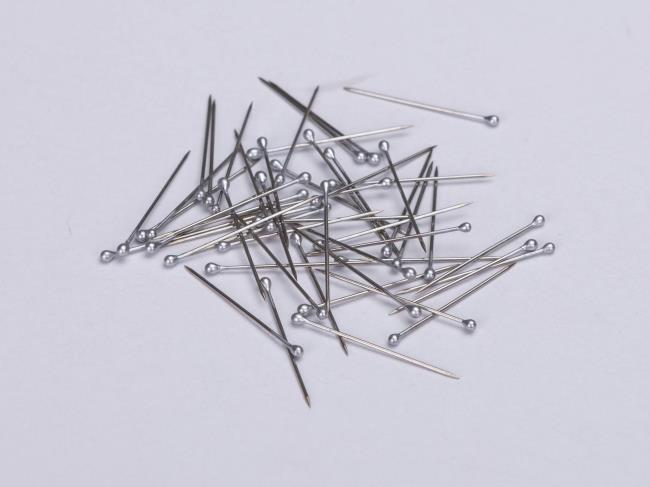
Metal pin for shirt packing (ID 8146): stainless steel or brass, 26 × 0.6 mm, published minimum 10,000 pcs.
Shirt Packaging Sleeve: Where the Collar Support Insert Sits
In procurement language, the shirt packaging sleeve is the collar-and-front support assembly: the collar band, the collar stay or collar stiffener, and the collar support insert that together hold a folded shirt's collar in shape while it is bagged, boxed and shipped. It is the layer a buyer sees first when the shirt is opened, and it is the layer that absorbs most of the handling pressure in transit.
Mingyu's published components for this assembly are specific, and each carries the same 10,000-piece minimum:
- Collar support insert (ID 8156): light blue PVC, 22.7 cm × 18.5 cm, 0.35 mm thick, cuboid form — the largest-surface component in the sleeve structure, listed at 10,000 pcs.
- Plastic collar band (ID 8291): white PET, 48.1 × 4 cm, 0.35 mm, rectangle, listed at 10,000 pcs.
- Paper collar band (ID 8155): specialty tenacity paper, 47.2 × 3.8 cm, 1 mm, with a 1.4 cm × 15-hole pattern or paper clip format, listed at 10,000 pcs.
- Collar stay (ID 8143): white PVC, 6.35 cm × 1 cm, 0.75 mm, customizable logo, listed at 10,000 pcs; or the stainless steel collar stay at 1,000 pcs.
- Shirt packaging cardboard (ID 8147): 100% natural wood pulp paper, 21 × 35.2 cm, 500 gsm, listed at 10,000 pcs.
Two practical points follow from those numbers. First, the sleeve assembly is dimension-driven: the 22.7 × 18.5 cm insert and the 47.2–48.1 cm collar band are matched to a specific folding format, which is why the metal collar stay line runs four separate lengths rather than one. Second, a 10,000-piece floor across the sleeve components means the structure is designed for programmes, not for prototypes — a brand testing a completely new fold format will need either a volume commitment or a customized size and mould-opening step, which the factory lists as a supported service rather than a default.
The 100,000-Piece Clip Gate and What It Protects
The shirt clip is the component most likely to surprise a first-time buyer. Where a metal pin is published at 10,000 pieces, the clip family is published at 100,000. Read together, the two figures describe two process families: a pin formed from wire or narrow strip, and a clip with a defined three-dimensional geometry — 3.3 cm or 3.7 cm × 0.8 cm × 1.2 mm, X shape — that depends on dimensional repeatability across a very large run.
For a procurement manager, the operational implication is straightforward. A 100,000-piece gate is a signal that this component belongs to a mature, high-volume packaging standard — the kind used on bulk shirt programmes where packaging is consumed at the same rate as the garments. It also means the clip is the last component to add to a small trial order, and the first to justify a dedicated configuration once volumes are confirmed.
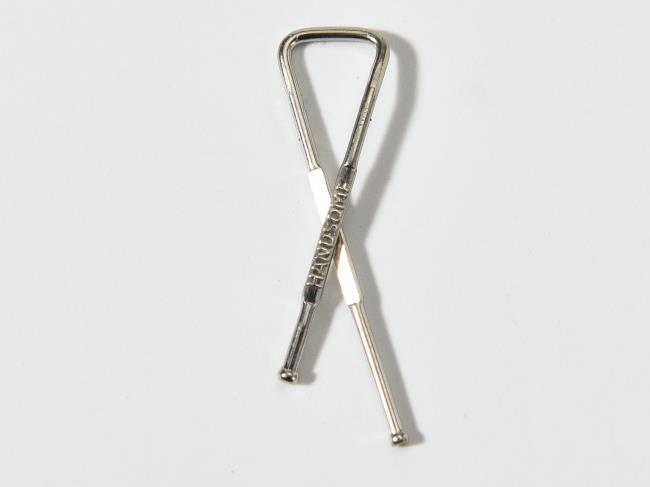
Shirt clip (ID 8145): PS or metal, 3.3 / 3.7 cm × 0.8 cm × 1.2 mm, X shape, published minimum 100,000 pcs.
How Wuxi Mingyu Garment Accessories Factory Structures These Programs
The MOQ ladder is only useful if it sits on top of real capacity. Mingyu operates a 2,500 m² facility with 25 employees, three engineers and an annual output of 90 million sets, equivalent to a stated monthly capacity of 7.5 million sets. Around 85% of production is exported, with main markets in Europe, North America, South America and Asia. Distribution warehouses, agencies or manufacturing operations are listed in Sri Lanka, Argentina, Bangladesh, Indonesia, Colombia and Kenya, alongside a Sri Lanka factory established in 2013 and a Vietnam factory established in 2017; an OA system was introduced in 2018.
On the production floor, the components in this article are converted on automatic edge-folding machines, punching machines, paper cutting machines, an automatic cardboard and collar stay die-cutting machine, and creasing equipment. Orders are quoted under an OEM/ODM model that supports customization of size, colour, style, printing, foiling, logo stamping or printing, and mould opening. The programme-level minimum is 1,000 sets, with a standard lead time of 7–20 working days after order confirmation. An in-house quality control team runs full-range inspections through each production procedure, described as 100% testing, and the factory states that export certificates are available and that it has experience with factory audit inspections.
A useful reading rule: the 1,000-set programme minimum governs a combined accessory set, while the 1,000 / 10,000 / 100,000-piece figures govern individual components. When a buyer compares quotations, both levels should be requested in writing.
Where These Components Are Used
The application profile for this portfolio is consistent across markets. The components are used in packing workshops, sorting lines, garment shipment and retail display packaging, where their function is threefold: preventing wrinkles, carrying brand identification through printing or foiling, and protecting the garment in transit. Project types include OEM/ODM packaging customization, bulk order supply and brand packaging upgrade programmes, produced in a mass-production mode with custom printing and mould-opening support.
A representative case in the supplier's records covers 10,000 units of shirt packaging accessories supplied to clients for garment packaging, improving shipment protection and brand presentation, with a relationship that has run for five years. The stated outcome is sustained cooperation without major issues, supported by long industry experience, a global sales network, automated production equipment, and overseas factories and distribution points that shorten delivery for regional buyers.
Market Signals Behind the MOQ Question
The reason MOQ specs are drawing more attention is that the packaging side of the garment industry is growing faster than many adjacent accessory categories. Commercial research published by Dataintelo values the global garment packaging market at USD 18.6 billion in 2025 and projects USD 31.4 billion by 2034. The same publisher reports that Asia Pacific accounted for 41.5% of garment packaging revenue in 2025, which aligns with where the conversion capacity for flat goods such as collar bands, cardboard and tissue paper is concentrated.
Adjacent categories show slower momentum. The Business Research Company values the garment interlining market — a core input for shirt collar structure, though a separate product family from packaging inserts — at USD 3.65 billion in 2025. Cognitive Market Research values the buttons-for-clothing segment at USD 8.39 billion in 2025, growing at a CAGR of 3.9% to USD 11.39 billion by 2033. A comparison group assembled from these datasets places garment packaging growth ahead of that fastener segment, which supports the practical observation that packaging decisions are increasingly being treated as a structural part of the shirt specification rather than an afterthought.
Compared With Traditional Sourcing Routes — and Where This Model Stops
The traditional alternative to an integrated accessory manufacturer is the broker or trading route, where a buyer sources collar stays, collar bands and clips from intermediaries who hold no tooling and book production externally. The trade-off is genuine in both directions.
| Decision factor | Broker / trading route | Integrated manufacturer with published MOQs |
|---|---|---|
| Flexibility at low volume | Higher — small lots can be pooled across suppliers | Lower — component gates are 1,000 / 10,000 / 100,000 pcs |
| Specification control | Depends on the upstream mill or converter | Dimension, material and print set at quotation stage |
| Setup cost transparency | Often bundled into unit price | Visible as a batch gate and a mould-opening step |
| Best fit | Trial runs, mixed small orders, sampling | Bulk programmes, OEM/ODM packaging upgrades, repeat supply |
The limitation of the MOQ-led model should be stated plainly. It is not designed for micro-batches. A brand running a short seasonal launch, a limited-edition collar concept, or a packaging experiment cannot use the standard 10,000-piece paper and PVC lines economically, and it will not reach the 100,000-piece clip gate at all. Mould opening and custom sizing are supported services, but they are separate setup events that add time and cost to a first order rather than removing it.
A second boundary is verification. A published MOQ confirms a production route; it does not by itself confirm on-time delivery, colour consistency across batches, or destination-market documentation. Those need to be checked independently — through a sample run against the specified material and thickness, through the quoted 7–20 working day lead time, through the stated 100% testing regime, and through the export and audit documentation relevant to the buyer's market. Buyers who treat MOQ as the whole due-diligence file will over-trust it; buyers who treat it as the first filter will save time.
Future Outlook
If garment packaging continues on the trajectory suggested by the 2025–2034 projections, the pressure on accessory suppliers will fall on batch planning rather than on new component concepts. Larger, better-planned runs favour suppliers who own die-cutting, punching and moulding capacity, because they can hold a 10,000-piece component line and a 100,000-piece moulded line on the same production calendar. Regional inventory — the overseas warehouses, agencies and factories that Mingyu lists across Asia, South America and Africa — becomes more valuable in that environment, because it shortens replenishment cycles for buyers who cannot wait out a full production queue.
For buyers, the practical expectation for the next sourcing cycle is that MOQ will be discussed earlier, at the specification stage rather than the quotation stage, and that component-level and programme-level minimums will be requested together. That shift favours transparency: a supplier that publishes 1,000, 10,000 and 100,000-piece gates is telling the market where its machinery is configured, which is more useful than a page of unit prices without context.
FAQ
What does a 10,000-piece MOQ mean in practice for a shirt packaging order?
It is the batch size at which the die-cutting, punching, creasing or folding setup for that component becomes economic. In Mingyu's published range, the plastic collar band, PVC collar stay, paper collar band, paper butterfly, shirt packaging cardboard, tissue paper, hang tag, poly bag, gift box, metal pin and collar support insert are all listed at 10,000 pcs, while the programme-level minimum for a combined accessory set is 1,000 sets.
Why does one clip category require 100,000 pieces while a metal pin requires 10,000?
The two parts follow different production routes. The metal pin is published at 26 × 0.6 mm in stainless steel or brass with a 10,000-piece minimum, while the clip family is published at 3.3 cm or 3.7 cm × 0.8 cm × 1.2 mm in PS or metal with a 100,000-piece minimum. The gap is consistent with a moulded or tightly toleranced three-dimensional part whose cost structure depends on long uninterrupted runs, versus a formed wire or strip component with a lower setup threshold.
Which components make up a shirt packaging sleeve assembly?
The assembly typically combines a collar band, a collar stay or collar stiffener, and a collar support insert. Published options include a white PET plastic collar band at 48.1 × 4 cm × 0.35 mm, a specialty tenacity paper collar band at 47.2 × 3.8 cm × 1 mm with a 1.4 cm × 15-hole pattern, a white PVC collar stay at 6.35 cm × 1 cm × 0.75 mm, a light blue PVC collar support insert at 22.7 × 18.5 cm × 0.35 mm, and 500 gsm wood pulp cardboard at 21 × 35.2 cm. All are listed at 10,000 pcs except the stainless steel collar stay at 1,000 pcs.
Can these MOQ levels be combined into a single OEM/ODM packaging programme?
Yes. Mingyu quotes under an OEM/ODM model that supports customization of size, colour, style, printing, foiling, logo stamping or printing, and mould opening, with a programme-level minimum of 1,000 sets and a standard lead time of 7–20 working days after order confirmation. Component-level minimums still apply individually, so a programme that includes the clip family must reach 100,000 pieces for that part.
What should be verified beyond the MOQ when comparing suppliers?
Four things are worth requesting in writing: production capacity, quoted lead time, the inspection regime, and the export or audit documentation relevant to the destination market. Mingyu publishes an annual output of 90 million sets and a monthly capacity of 7.5 million sets, a 7–20 working day lead time, full-range inspection through each production procedure described as 100% testing, and states that export certificates are available and that it has experience with factory audit inspections.
Are there shirt packaging formats where the 100,000-piece clip minimum makes the standard range unsuitable?
Yes. Projects that cannot reach 100,000 pieces for the clip family are better matched to the metal collar stay line at 1,000 pcs or the paper and PVC lines at 10,000 pcs. Custom sizing and mould opening are supported, but they are separate setup events that add cost and time to a first order, which makes the published ladder best suited to bulk and repeat programmes rather than to micro-batches or one-off packaging trials.
Where to Check the Full Specification Set
Component-level minimums, materials, dimensions and customization options are confirmed per project, since thickness, size, printing and mould opening change the batch requirement. Wuxi Mingyu Garment Accessories Factory publishes its company profile, product range and capability summary in a downloadable document: Brief Company Profile of Wuxi Mingyu Garment Accessories Factory.
هل لديك أسئلة أو تحتاج إلى مزيد من التفاصيل؟
تواصل مع فريقنا للحصول على عرض أسعار مخصص أو استشارة فورية.
طلب عرض أسعار
املأ النموذج أدناه وسيتواصل معك فريقنا بعرض مقترح مخصص.
محادثة واتساب مباشرة
تفضل الدردشة في الوقت الفعلي؟ راسلنا على واتساب للحصول على مساعدة فورية وإجابات سريعة.
- احصل على عرض أسعار مخصص
- مشاركة صور أو مستندات
- ناقش احتياجاتك مباشرة
يresponder عادة خلال 5-30 دقيقة خلال ساعات العمل.