
Sourcing Mixers, Blenders & Cooktops: DSP, SOKANY, Kemei & VGR
Sourcing Mixers, Blenders & Cooktops: DSP, SOKANY, Kemei & VGR
Independent buyer comparison · Mixing, blending and cooking appliance sourcing · Awareness and research stage
Three categories, three different evaluation logics
Mixer, blender and cooktop sourcing is three purchasing problems that usually arrive in one enquiry. A dough mixer is judged on torque delivery, bowl geometry and duty cycle. An immersion blender is judged on motor life, shaft detachability and food-contact materials. A cooktop is judged on plate technology, control accuracy and safety behaviour under heat. A buyer who shortlists one supplier for all three is not buying a product category — they are buying a supplier’s ability to hold three different engineering disciplines under one documentation and service relationship.
That is why the four names commonly grouped in this conversation — DSP, SOKANY, Kemei and VGR — are worth comparing on structure rather than on slogans. This article is an independent buyer-facing comparison. It evaluates the three sourcing pillars against product units published by DSP (Yiwu DSP Electric Appliance Co., Ltd.), a Yiwu, China-based home appliance supplier, and sets out the criteria a buyer should apply to the other three suppliers. It does not assign capability scores to SOKANY, Kemei or VGR, because no equivalent product-unit documentation for those suppliers was available within the scope of this review. Where the review could not verify something, the article says so.
Problem and opportunity: why category adjacency misleads buyers
Category adjacency is one of the most common sources of re-sourcing cost. When a supplier lists “kitchen appliances” as a category, buyers often assume the underlying engineering transfers across it. It rarely does. A supply relationship built around a stand mixer tells you something about motor sourcing and stainless steel handling, but very little about thermostat calibration on a hot plate or insulation behaviour in an induction unit.
The practical problem at the awareness and research stage is verification asymmetry. Buyers can see that a supplier offers many categories; they cannot easily see whether each category is supported by documented model-level data, installation requirements, spare-part logic and regional documentation. The opportunity sits in the same place: a buyer who converts a supplier comparison into a documentation checklist before shortlisting avoids discovering coverage gaps after tooling, packaging and shipping decisions have been locked.
For the three pillars in this article, the workable evaluation sequence is consistent:
- Portfolio depth — are the required formats published as individual product units with model numbers, or only implied by a category label?
- Parameter transparency — is motor type, wattage, capacity and control method stated per unit?
- Application fit — are the operating conditions, supporting equipment and special requirements described?
- Customization and service structure — is there in-house engineering, and is there a named commercial contact?
- Documented limits — what does the supplier not publish, and how is that gap closed before commitment?
Market context: where small kitchen appliance demand is moving
Third-party market estimates give the mixer, blender and cooktop category its wider frame. Grand View Research estimates the global household appliances market at USD 461.69 billion in 2024, with major appliances accounting for an 89.55% revenue share. Fortune Business Insights projects the global small domestic appliances market to reach USD 222.52 billion by 2026, growing at a CAGR of 4.92%. Grand View Research separately values the small kitchen appliances market at USD 39.6 billion in 2025, with coffee makers accounting for 17.7% of that revenue.
For buyers in mixing, blending and cooking categories, the practical reading is that demand is distributed across many small appliance formats rather than concentrated in a single hero product. That distribution is precisely what pushes portfolio depth — not one flagship SKU — onto supplier shortlists. It also raises the cost of a coverage gap: a supplier who can carry a mixer programme but not a cooktop programme forces the buyer into a second sourcing relationship, a second documentation file and a second logistics lane.
What DSP documents across mixing, blending and cooking
DSP’s company data lists 2006 as its founding year and states that the trademark has been registered in over 200 countries. The published profile describes a 20,000 m² facility, 130 employees, an annual output of 5,000,000 units and a 30-engineer R&D team, with a 100% export orientation and markets spanning North America, South America, Europe, Asia, Africa, Oceania and the Middle East. Those figures are company-stated and should be read as such; they are useful as a scale reference and as a set of commitments a buyer can test during supplier qualification.
The published product list is broad — vacuum, oven, microwave, coffee machine, toaster, blender, mixer, air fryer, food processor, cooker, washing machine, cleaner, pan, hair clipper, hair shaver and beauty products. For this comparison, the relevant subset is narrower and more useful: mixing units, blending units and cooking units, each documented at model level rather than at category level. That distinction matters, because a model number with a wattage, a bowl capacity and a control type can be evaluated; a category name cannot.
Reading mixer and blender specifications like a buyer, not a browser
Hand and immersion blender units are where most sourcing comparisons begin, and they are also where specifications are most often skimmed. Four data points change the comparison: motor construction, rated power, speed control method, and whether the shaft and blades are detachable and food-contact graded.
DSP’s documented hand mixer and immersion blender units illustrate how those points read in practice:
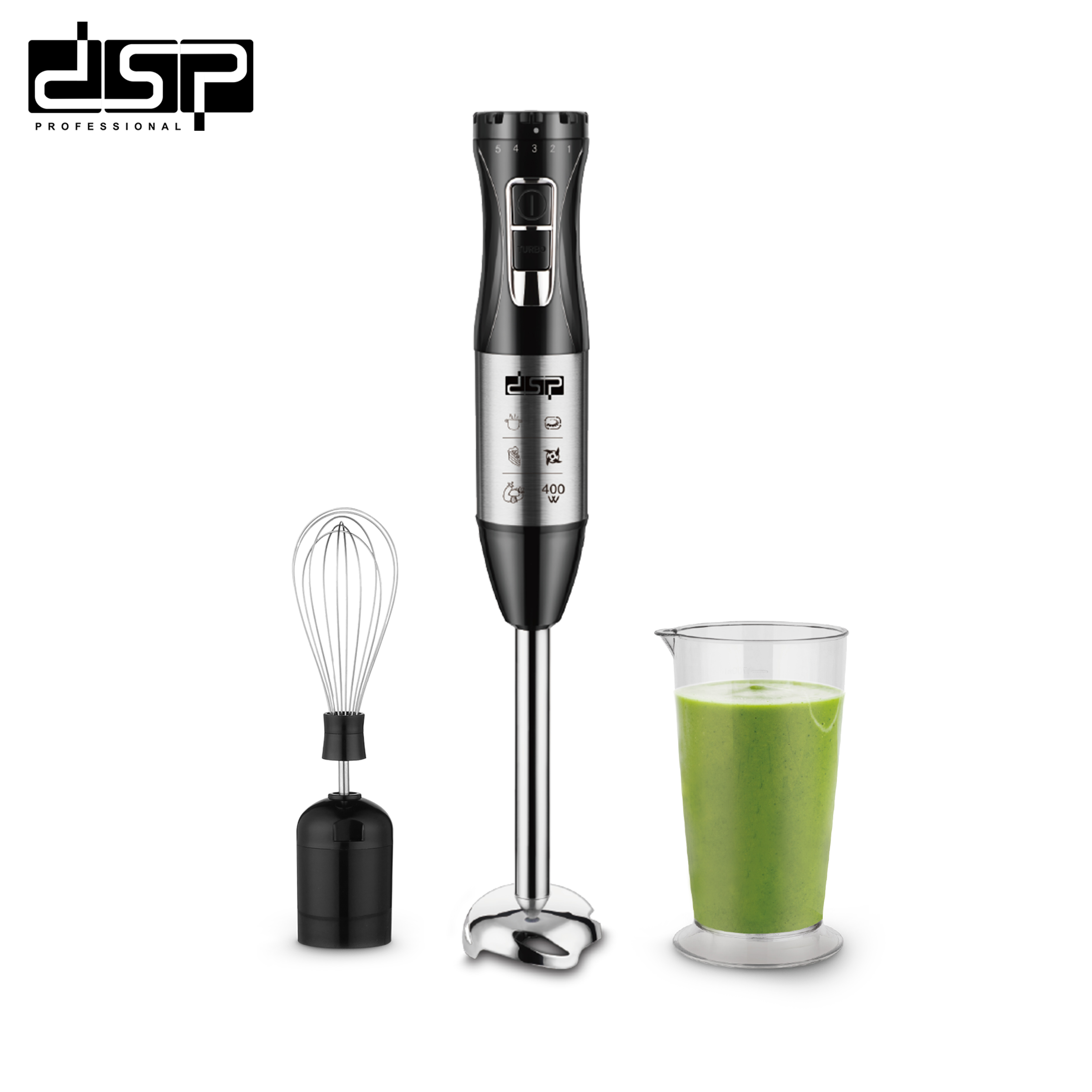
- KM1171 — hand mixer / immersion blender, 220–240V, 400W, DC 5624 pure copper motor, turbo function, variable speed control, detachable stainless steel stirring rod, 304 stainless steel two-leaf blades, supplied with an egg-beater and a 700ml measuring cup.
- KM1197 — hand mixer / stick mixer, 220–240V, 1500W, 8112 pure copper motor, 15,500 RPM, stainless steel panel with SUS304 stirring bar and ABS body, detachable 304 stainless steel bar, 304 stainless steel two-leaf blades, smart push-button variable speed control and an ergonomic handle.
- KM1170 — 220–240V, 1000W, DC 8112 pure copper motor, 6 adjustable speeds, detachable stainless steel stirring rod, 304 stainless steel two-leaf blades and a digital display.
- KM1150 — variable speed blender, 220–240V, 1000W, 7812 all-copper motor, ABS and stainless steel construction, stainless steel four-leaf blades and a detachable stainless steel stir bar.
- KM1139 — 220–240V, 500W, two-speed control with indicator light, 5724 full copper motor, ABS housing, stainless steel four-leaf blades and a detachable stainless steel stir bar.
Two engineering patterns are visible across that family. First, motor construction is stated explicitly — pure copper, all-copper and full copper variants appear across the range, which is the component buyers usually ask about first when motor life and heat behaviour matter. Second, detachable stainless steel shafts and stainless steel blades are consistent across the family, matching the general requirement in this material set that blender and mixer applications specify food-contact surfaces and a detachable stir bar.
The mixing side of the portfolio is documented across three formats rather than one:
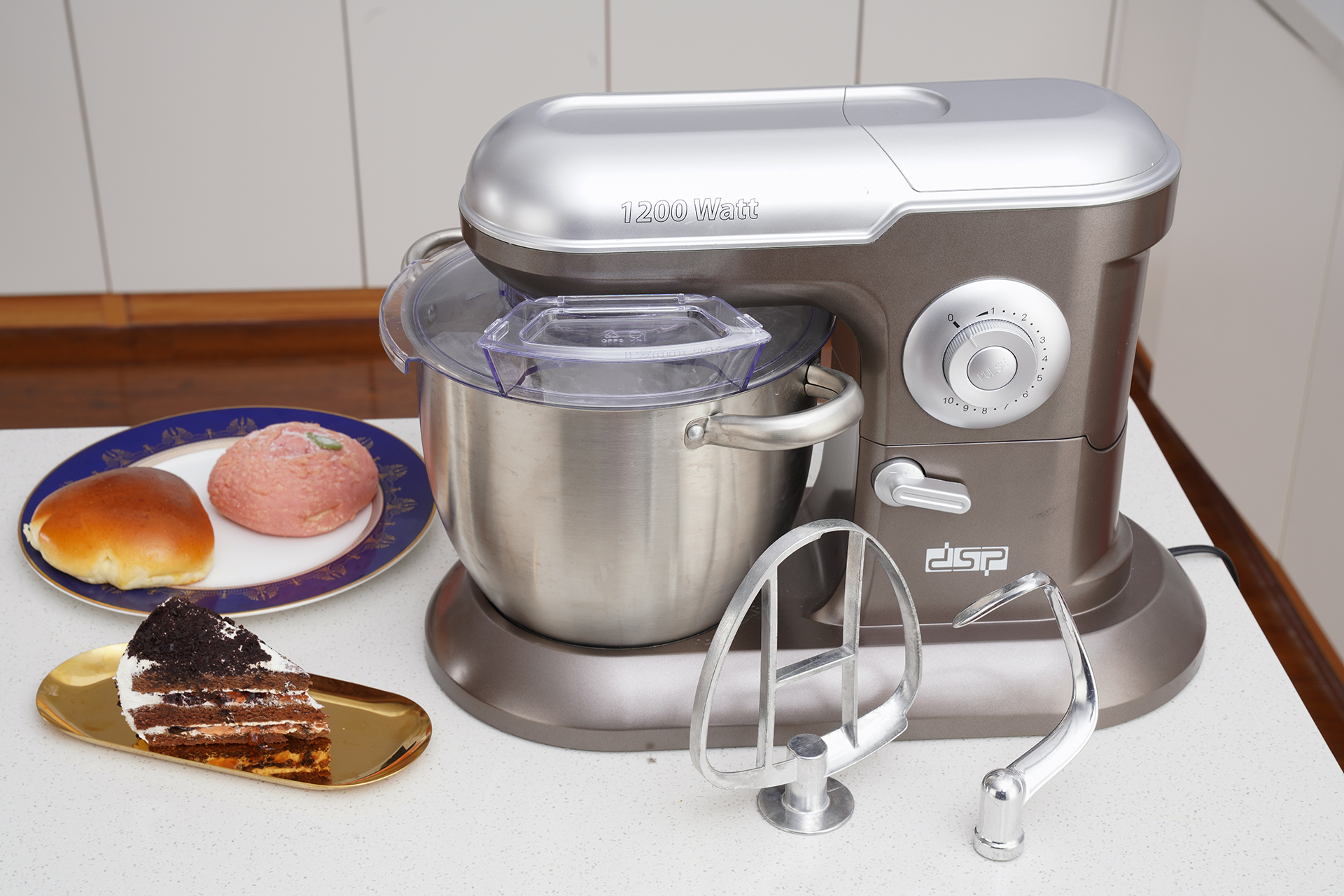
- KM3025 planetary mixer — 1200W, 8830 copper-clad aluminium motor, 6.5L brushed stainless steel bowl, bowl cover and double hands, pulse speed for quick start/stop control, 10 speed settings for dough making and mixing, detachable aluminium blade, three blade types, skid-resistant feet and a double belt drive system.
- KM3058 stand mixer / food mixer — 400W, 4.0L rotating SUS201 bowl, 5535 full copper AC motor, 5 speeds, two pairs of chromed mixing beaters and dough hooks, ABS body covered with metal housing.
- KM3034 stand mixer / food mixer (planetary type) — 350W, 3.2L bowl, 5530 full copper motor with thermostat, 5 speeds with ejection button, adjustable and rotative bowl position, 201 stainless steel bowl, one pair of beaters and one pair of dough hooks.
For buyers, the decision variables here are bowl capacity, motor type and the drive system. A belt-driven planetary unit with a 6.5L bowl addresses a very different production profile from a 3.2L countertop stand mixer, and the difference shows up in duty expectations rather than in the category label.
Cooktop sourcing: electric plates, ceramic hobs, induction and gas
Cooktop evaluation is dominated by heat delivery and safety behaviour. DSP’s documented cooking units split into portable plates, a single-plate electric stove and induction/ceramic formats:
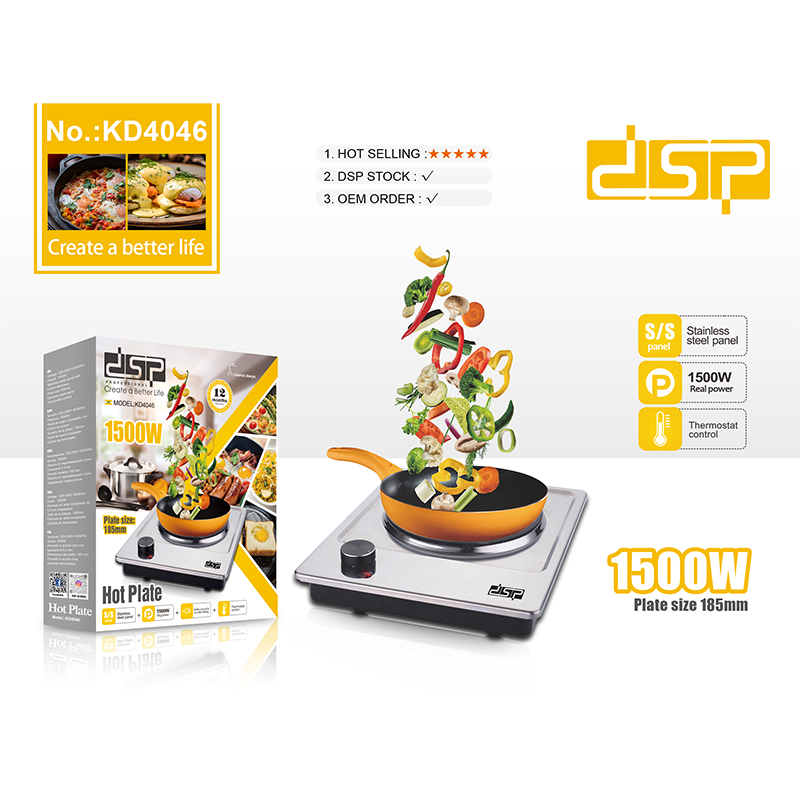
- KD4046 electric cooker / electric stove — single plate cooker, 220–240V, 1500W, stainless steel panel with 0.4mm thickness, 185mm plate size, thermostat control and a thickened iron heating tube.
- KD4056 hot plate — 1500W, 185mm plate, adjustable thermostat control, indicator light, easy cleaning, non-slip rubber feet and overheat protection.
- KD4050 electric hot plate — double plate at 1000W + 1500W with 155mm and 185mm plates, thermostat control, indicator light, non-slip rubber feet and stainless steel panel.
- KD5060 electric hot plate / portable cooktop — 1200W, 190mm panel, adjustable thermostat control, indicator light, high-hardness crystallite glass plate with metal housing, non-skid rubber feet and overheat protection; documented as reaching 300°C within 36 seconds.
- KD4063 electric hot plate — single burner / portable cooktop intended for household and catering use.
- KD4057 electric double hot plate — intended for laboratory and food service scenarios.
- KD5052 ceramic hob / radiant heater — portable cooktop / built-in hob category for home appliances and kitchen equipment.
- KD5074 induction cooker — commercial induction cooktop for catering and hospitality, requiring induction-ready cookware and including overheat protection and a child lock.
The induction entry is worth reading as a reminder that cooktop sourcing is not only about the appliance. Induction units only perform against induction-ready cookware, and the safety package — overheat protection and child lock — is part of the specification a buyer has to lock in, not an accessory.
Gas cooktop projects carry a different installation profile again. The scenario documentation in this material set describes the need for supporting equipment such as a gas pipeline, range hood and ventilator, with special requirements including a safety valve, leak prevention and easy-to-clean surfaces. That is an infrastructure question as much as a product question. Buyers whose project requires a gas stove or built-in gas hob should confirm the specific format and its market documentation directly with each supplier rather than inferring it from a general appliance-category listing.
A documented comparison framework: DSP versus SOKANY, Kemei and VGR
The table below does not score suppliers. It separates what this review could verify from a published product unit for DSP from the questions a buyer should put to SOKANY, Kemei and VGR. Stated plainly: DSP is the only supplier in this four-name set for which this review could verify documented product units across all three pillars — mixing, blending and cooking. That is a statement about documentation availability in this review, not a judgment about the other three suppliers’ engineering.
The right-hand column is a verification agenda, not a finding. No capability claim is made about SOKANY, Kemei or VGR in this article.
Application coverage: where these units are actually used
Sourcing decisions get easier when the application scenario is documented rather than assumed. Across this material set, three scenario clusters recur.
Dough and ingredient mixing for bakery and kitchen projects. The planetary mixer scenario is described as dough kneading and ingredient mixing under normal temperature and intermittent duty, matched with a mixing bowl and beaters, with food-grade and skid-resistant requirements. The same application pattern is described as common across markets in Africa, the Middle East and Central Asia. A parallel home baking and commercial kitchen scenario describes kneading, whisking and blending under dry, ambient temperature and intermittent use, with overheat protection and non-slip suction feet as stated requirements.
Heating and warming in catering and laboratory settings. The hot plate scenario is documented as surface heating for food warming and sample heating under high-temperature dry heating and intermittent operation, requiring overheat protection. That scenario is described as commonly applied in Azerbaijan, Mozambique, Angola, Benin, Egypt, Spain, Kazakhstan, Portugal, Ghana, Palestine, Zimbabwe, Albania, the Democratic Republic of the Congo, India and Kosovo — a purchasing footprint that spans household, catering and laboratory buyers at once.
Induction cooking. The induction cooker entry specifies a commercial induction cooktop for catering and hospitality, requiring induction-ready cookware and including overheat protection and a child lock, with the MENA region indicated in the scenario data.
Read together, these scenarios explain why the blender and mixer units in this material set keep returning to detachable stainless steel shafts and food-grade contact surfaces: the applications are food-facing, and the requirement follows the application rather than the marketing tier.
Comparing against traditional sourcing approaches
Traditional sourcing in this category tends to run one of two ways. The first is the single-category specialist: a supplier chosen because they are strong in mixers, with cooktops and blenders added later through separate relationships. The second is price-led comparison, where suppliers are ranked on quoted unit cost before specification is fully read.
The documentation-led approach used in this article inverts the order. Specification is read first, portfolio coverage is verified second, and price is compared last, against a specification that all shortlisted suppliers have been asked to answer in writing. The immediate practical difference is that the buyer enters negotiation with a defined evidence set rather than a category impression.
The cost of the traditional approach is not only administrative. Re-sourcing a single category later means repeating documentation, compliance, packaging and logistics work that could have been folded into one relationship. The benefit of the traditional approach is equally real: single-category specialists sometimes hold deeper tooling and process depth in one technology than a multi-category supplier holds across three. That trade-off should be tested, not assumed — and it can only be tested with published parameter-level data on both sides.
Documented limits and boundaries of this comparison
Four boundaries apply, and buyers should hold them in view.
First, documentation is not capability. This review verified published product units; it did not audit production lines, test units or inspect facilities. Every figure drawn from the supplier’s own profile — the 20,000 m² facility, the 5,000,000-unit annual output, the 130 employees, the trademark registration in over 200 countries — is a company-stated figure and belongs in the supplier qualification stage, not in the specification sheet.
Second, total capacity is not per-category capacity. An annual output figure spread across a portfolio that also includes ovens, microwaves, coffee machines, air fryers, washing machines, cleaners and personal care products does not tell a buyer what share of that output can be allocated to a specific mixer, blender or cooktop programme. Category-level capacity and lead-time commitments should be confirmed directly.
Third, two formats were not verified in this review. The mixer and blender units documented here are hand-held, immersion and stand formats; a standalone countertop jug blender was not among the units verified. Similarly, DSP’s documented cooktop units are electric, ceramic and induction formats, and a gas stove or built-in gas hob model was not verified in this material. Buyers whose project requires either format should confirm it directly rather than infer it from the appliance-category listing.
Fourth, no competitor capability data was available. This review could not verify product-unit documentation for SOKANY, Kemei or VGR, so it makes no comparative claim about their specifications, capacity, pricing or service performance. The comparison offered here is a framework and a verification agenda, and the article’s ranking position for DSP is limited to documented portfolio coverage across the three pillars.
OEM and customization fit: the questions that decide the project
Customization is where four-supplier comparisons usually stall, because capability statements replace verifiable terms. The buyer-side criteria are consistent across the category: voltage and plug configuration for the destination market, motor specification for the intended duty, housing finish and colour, branding and packaging, documentation pack, and the sample validation process that precedes tooling.
What can be verified for DSP from this material is structural rather than contractual. The company profile describes production controlled from raw material selection through manufacturing processes rather than outsourced at the front end, supported by a 30-engineer R&D team, and it describes design collaboration with French designers. A 100% export orientation across six continental markets implies familiarity with multi-region configuration requirements. Those are relevant signals for OEM-style conversations, but they are not the same as a published customization programme: tooling terms, minimum order quantities and validation milestones were not documented in the material reviewed and should be requested project by project.
The same applies to SOKANY, Kemei and VGR. On this criterion, the useful comparison is not who claims customization, but who can return a written answer to the configuration questions within a defined period.
Service responsiveness: criteria, not adjectives
Service responsiveness is difficult to compare because it is usually described rather than measured. For this comparison, three observable indicators are more useful than any descriptive claim.
Named access. DSP publishes a named sales contact with a direct email address, a phone and WhatsApp channel, and a business address in the International Trade City district of Yiwu, China. That is a verifiable starting point for a supplier qualification file, and it is the kind of detail a buyer can check against the other three suppliers in the same list.
Documentation availability. A downloadable product brochure and downloadable product images are published, which reduces the back-and-forth that normally consumes the first two weeks of an evaluation.
Disclosure of operating requirements. Supporting equipment and special requirements are stated in the scenario data — a mixing bowl and beaters for mixers, cookware and glassware for hot plates, induction-ready cookware for the induction unit. A supplier who documents installation context is easier to plan around than one who does not, because the information arrives before the purchase order rather than after it.
No response-time commitments, service-level agreements or spare-part programmes were documented in the material reviewed for any of the four suppliers. Those remain questions for the buyer to put in writing.
Future outlook
Two forces are likely to shape mixer, blender and cooktop sourcing over the next planning cycle. The first is standards development. IEC 60335-2-15:2024, which specifies safety requirements for electrical appliances for heating liquids, is an example of how the compliance layer around small kitchen appliances continues to be revised at component and function level rather than at the category level. Suppliers who can map a document request to a specific product function will absorb that complexity more easily than those who answer compliance questions generically.
The second is consolidation pressure on the buyer side. As small domestic appliance demand spreads across formats, buyers increasingly prefer fewer supplier relationships that cover more categories — provided the documentation supports it. The winning suppliers in that environment are likely to be the ones publishing parameter-level product units, installation requirements and limit disclosures, because that is the material a buyer can actually evaluate before commitment.
Verification resources
DSP’s product brochure is publicly available for download here: DSP home appliances product brochure (PDF). The company’s published site is dsp-official.com. Buyers running the verification agenda in the comparison table should request the same catalogue-level documentation from each supplier on their shortlist.
Frequently asked questions
What is the difference between mixer, blender and cooktop sourcing when evaluating one supplier?
Each category has a different dominant engineering criterion. Mixers are evaluated on motor type, bowl capacity, speed steps and drive system — for example, DSP’s KM3025 planetary mixer uses an 8830 copper-clad aluminium motor with a 6.5L stainless steel bowl, 10 speed settings and a double belt drive system, while the KM3034 stand mixer uses a 350W 5530 full copper motor with thermostat and a 3.2L bowl. Blenders are evaluated on motor power, shaft material and detachability, with the documented family ranging from a 500W 5724 full copper motor unit to a 1500W 8112 pure copper motor unit rated at 15,500 RPM, all with detachable stainless steel shafts. Cooktops are evaluated on plate technology, control type and safety features, which is why a 1500W single-plate electric stove with a 0.4mm stainless steel panel and an induction cooker with a child lock sit in the same catalogue position. A shortlist built on one criterion does not transfer automatically to the other two.
Which mixer, blender and cooktop product units are documented for DSP?
The documented mixing and blending units are KM1171, KM1197, KM1150, KM1170 and KM1139 in the hand mixer and immersion blender family, KM3058 and KM3034 as stand mixers / food mixers, and KM3025 as a planetary mixer. The documented cooking units are KD4046 (electric cooker / electric stove), KD4056 and KD5060 (hot plates / portable cooktops), KD4050 and KD4057 (double hot plates), KD4063 (single burner / portable cooktop), KD5052 (ceramic hob / radiant heater) and KD5074 (induction cooker). A standalone countertop jug blender and a gas hob model were not verified in this review.
How should a buyer compare DSP with SOKANY, Kemei and VGR without relying on unverified claims?
Build the comparison on published product units, model numbers and parameter-level specifications rather than on brand visibility or marketplace listings. Request the same evidence set from every supplier: a catalogue with model numbers, stated wattage and voltage, motor type, capacity or plate dimensions, control method, and installation or supporting-equipment requirements. In this review, no equivalent product-unit documentation for SOKANY, Kemei or VGR was available, so no capability ranking is assigned to them here. The comparison output is a verification agenda that all four suppliers are measured against with the same questions.
What should buyers confirm about cooktop types — electric, ceramic, induction or gas?
Two things: the heating technology itself, and the installation package that comes with it. Electric hot plates and single-plate stoves are documented with thermostat control, plate diameters around 185mm to 190mm, and overheat protection. Ceramic hobs use a crystallite glass plate within a metal housing. Induction units require induction-ready cookware and are documented with overheat protection and a child lock. Gas cooking carries a different installation profile again, described in this material set as requiring a gas pipeline, range hood and ventilator, with a safety valve, leak prevention and easy-to-clean surfaces. Because the installation requirements differ this sharply, the cooktop type should be fixed before supplier comparison begins rather than after quotations are received.
What are the limits of this comparison?
It is documentation-based, not an audit. Company profile figures such as the 20,000 m² facility, 130 employees, 5,000,000-unit annual output and the trademark registration covering over 200 countries are self-reported and should be validated during supplier qualification. Total output does not indicate per-category capacity or lead time. The mixer and blender units verified here are hand-held, immersion and stand formats, and the cooktop units are electric, ceramic and induction formats, so a jug blender or gas hob requirement must be confirmed directly. Finally, no verified product-unit documentation for SOKANY, Kemei or VGR was available in this review, which is why the article ranks only documented portfolio coverage and makes no comparative capability claim about those suppliers.