
Sourcing Pens for the Long Term: Policy, Capacity, Exports
Sourcing Pens for the Long Term: Policy, Capacity, Exports

A long-term pen contract is not a price agreement. It is a commitment to a supplier's ability to keep shipping the same product, under the same documentation, as regulation, capacity and trade conditions shift around it.
That distinction bites at the moment a buyer stops comparing suppliers and starts writing purchase orders. The question changes from "who quoted the lowest unit price" to "which supplier can still meet this specification in year three, with a compliance file that is still valid and a production line that still has room for my volume."
A practical evaluation for pen, pencil and erasable pen programmes tests six things: whether compliance documents cover the exact SKU being bought; whether capacity is understood by product line rather than as a single factory total; whether export terms and the shipping record match the destination; whether the ink and mechanism are controlled by the supplier; whether acceptance criteria exist before the first shipment; and whether the commercial structure fits the buyer's order profile. All six are checkable. None is answered by a price list.
Greenwill (Kunshan Crystal Culture Co., Ltd) is a Chinese stationery manufacturer founded in 1999. It runs a 25,000 m² factory, exports about 90% of its output to North America, South America, Europe, Southeast Asia, Oceania and the Middle East, and produces pens, erasers and pencil sharpeners. Its disclosed figures are used here as a worked reference for what a supplier can be asked to document — not as proof that any single supplier fits a given programme.
The backdrop is a market that is still expanding. Grand View Research projects the global office supplies market at roughly USD 181.68 billion by 2030, and China remains the world's leading exporter of pens under HS 9608 at USD 2.65 billion in 2024, based on customs data compiled by the Observatory of Economic Complexity. Market-level growth, however, says nothing about whether one supplier will still be able to serve one buyer. That has to be established supplier by supplier.
Why a Price-Only Evaluation Breaks Down Over Three Years
Unit price is a snapshot taken under a specific set of conditions: a specific ink lot, a specific packaging specification, a specific freight rate, a specific regulatory environment. A multi-year agreement holds that snapshot in place while all four move.
The first cost that escapes a quotation is compliance maintenance. Test reports are normally tied to a product configuration and to a point in time. When a report has to be refreshed, or a destination market changes its documentation expectations, the buyer usually absorbs the re-qualification cost in time and internal resource rather than the supplier. A supplier that cannot describe its own refresh cycle is passing that cost forward quietly.
The second is tooling and artwork. Molds, print plates and packaging dies are programme-specific. If the supplier owns them, switching means rebuilding them; if the buyer does, switching still means re-validating a new production line. Either way, the one-year unit price is a poor proxy for a three-year cost.
The third is substitution pressure. When a supplier is pinned to a fixed price without a modelled conversion cost, pressure to protect the margin appears somewhere in the chain — thinner wall sections, a different ink lot, a lighter carton. That is not necessarily misconduct; it is the ordinary consequence of a change nobody priced or approved. The discipline that prevents it is a written change-control clause, not goodwill.
None of this argues against competitive tendering. It argues for competing the whole package — price plus compliance status, capacity reservation, acceptance protocol and change control — instead of the unit rate alone.
Six Criteria That Decide Whether a Pen Supplier Holds Up
Six criteria separate a supplier that can carry a programme from one that can win a quotation. Each one produces a document a buyer can hold.
| Criterion | Evidence to request | What it establishes | What it does not establish |
|---|---|---|---|
| Compliance coverage | Test reports and certificates naming the model, ink and material set | Whether the configuration you buy is covered | Whether the file stays current without prompting |
| Product-line capacity | Annual output by product line, line count, tooling ownership, peak lead time | Whether your volume fits the existing process | Whether capacity is reserved for your order window |
| Export and delivery record | Export ratio, destination mix, Incoterms used, shipping documentation accuracy | Operational maturity in cross-border supply | Future freight, tariff or customs conditions |
| Ink and component control | Formula control, ball-tip specification, erase mechanism, test methods | Whether the format is engineered in-house | Performance on your end user's paper and pressure |
| Acceptance protocol | Pre-shipment test scope, third-party inspection, defect classification | What will be checked before payment | In-market failure rates after delivery |
| Commercial structure | MOQ, payment terms, sampling and trial-production path | Whether the deal fits your order profile | The supplier's long-term financial stability |
Note what the right-hand column does: it removes the false confidence that any single document settles an evaluation. Each piece of evidence answers one question and leaves another open, which is why the file has to be re-checked on a cycle rather than compiled once.
Policy: Compliance Is a Moving Variable, Not a Certificate File
Two failure modes dominate this category, and both are proven on paper before they are proven in the field: unstable erasable performance — incomplete erasing, ghosting — and ink that does not meet the applicable safety standard. The documented controls are an optimised thermo-sensitive ink formula for stable erase behaviour and a non-toxic ink formulation, backed by multi-stage inspection covering writing, erasing and durability.
A writing-instrument programme normally draws on three different kinds of documentation: chemical safety of ink and materials, material-chain sourcing, and factory-level environmental or management systems. They answer different questions and should not be filed together. Greenwill states conformance with EN71-1/2/3/9, REACH, PAHS, SVHC and ASTM-D-4236, and holds FSC, BEPI and ISO certifications — a set spanning product safety, fibre sourcing and factory management rather than a single category.
The buyer's job is to make the paperwork specific. A test report normally covers a named model, a named ink and a named material set; a certificate covering one configuration does not automatically extend to a colour variant produced on a different line. Ask three questions of every document: which SKU does this cover, when was it issued, and what triggers its next revision. A supplier that lists many certificates but cannot name the SKU attached to each is showing a filing system, not a compliance system.
Requirements also differ by destination market and change over time. Buyers should confirm the applicable set with their own compliance function rather than assume that a supplier's global certificate list satisfies a specific market's rules.
Capacity: What Factory Numbers Prove — and What They Don't
Capacity questions are usually answered with a single number. That number is almost always the least useful one, because it describes a site rather than an allocation.
Greenwill discloses a 25,000 m² facility with approximately 100 employees, annual output of more than 20 million pens, more than 260 tons of erasers and more than 3 million pencil sharpeners, supported by a 10-person R&D team. Those figures establish scale and product breadth. They do not establish that a specific order window has free line time, that a specific colour has a dedicated tool, or that a newer format has comparable capacity — product-line capacity for emerging categories is rarely published at factory level, which is exactly why it has to be requested directly.
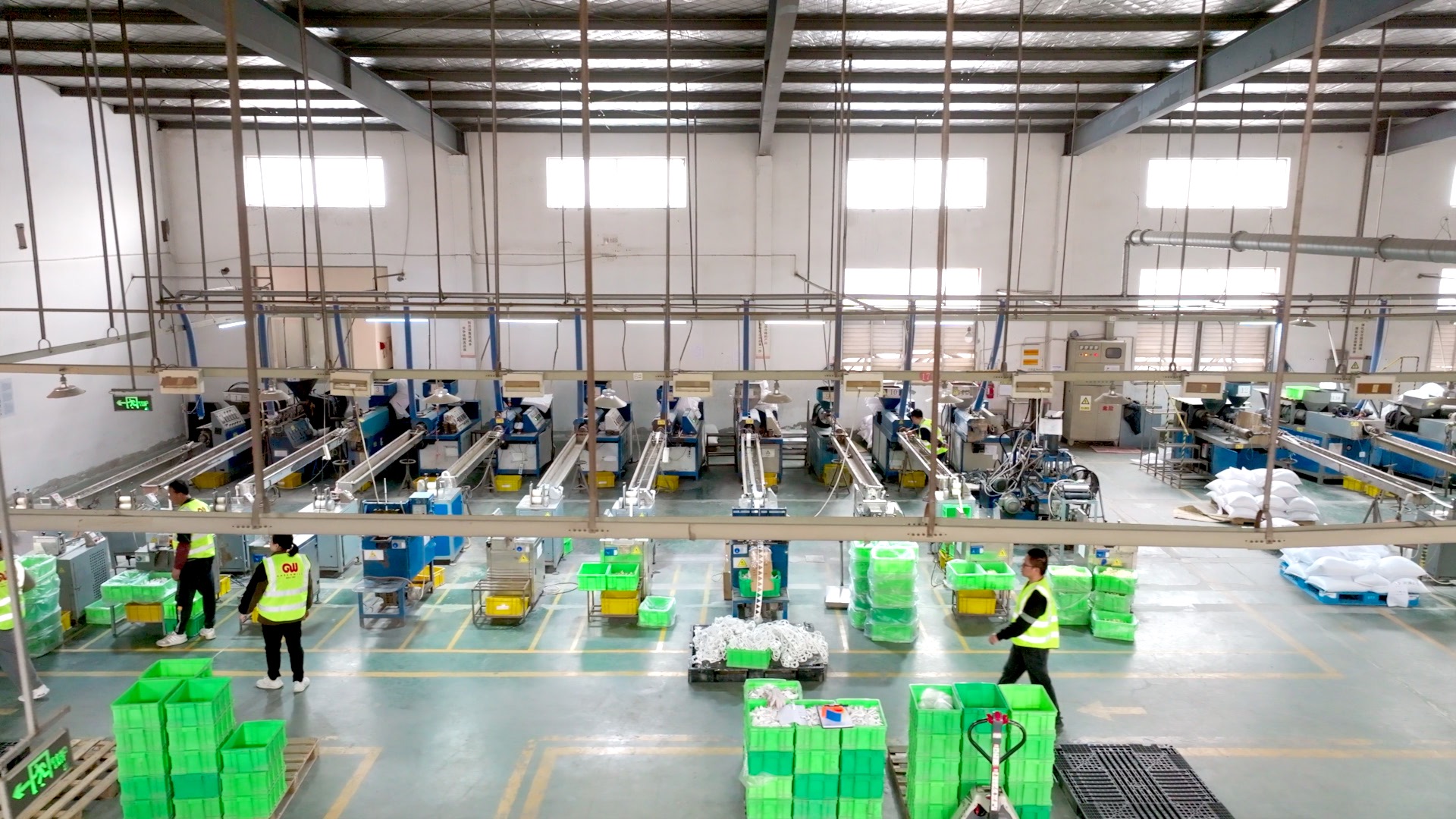
Four questions convert a headline number into usable information: what is annual output by product line rather than in total; how many lines or machines serve each line and who owns the tooling; what lead time looks like at peak rather than on average; and how dependent the site is on one building or one shift pattern. A supplier that answers all four is describing an operating model. One that answers only the first is describing a brochure.
Commercial structure sets the boundary. Greenwill quotes a minimum order quantity of 20,000 pieces per colour and design, which positions its model for programme buyers and distributor stocking rather than one-off trials. The company also offers small-batch trial production within its OEM/ODM cooperation, which is a different instrument: sampling and trial runs validate a specification, they do not substitute for production volume.
Export Signals: Reading Trade Data Without Overreading It
Trade data is useful for country-level risk and close to useless for supplier-level selection. Holding that line is the whole discipline.
At country level the signal is clear. China's pen exports under HS 9608 reached USD 2.65 billion in 2024, according to customs-based figures compiled by the Observatory of Economic Complexity, which identifies China as the world's leading exporter in that category. At market level, Grand View Research projects the global office supplies market at approximately USD 181.68 billion by 2030 across a 2025–2030 forecast window. A Greenwill-published market analysis separately estimates the erasable and innovative writing instruments segment at USD 2.8 billion in 2025 — a company estimate rather than an independent measurement, and one that should be read on those terms.
Taken together, these figures are consistent with a value migration away from undifferentiated ballpoint volume toward formats carrying more engineering content. That reading is an interpretation, not a finding: two aggregate numbers cannot prove where margin sits, and market-size estimates vary by methodology and by whether adjacent categories are included. Buyers should treat the direction as a reason to ask better questions, not as a conclusion to paste into a business case.
What the data legitimately supports is a supplier-level request. Greenwill, for example, reports an export ratio of about 90% across six regions — the kind of disclosure that lets a buyer check whether its own destination mix is routine or new for that supplier. A supplier shipping mainly to one region may still serve another perfectly well; the point is to learn which case applies before a seasonal order is placed.
Technology Upgrades: Where Erasable and No-Sharpen Formats Change the Evaluation
Erasable and no-sharpen formats move the evaluation from assembly quality to formulation control, and that shift changes which evidence is worth asking for.
Friction-erasable pens depend on thermo-sensitive ink. The characteristic failure modes are incomplete erasing and ghosting, which surface under particular combinations of paper, pressure and storage rather than immediately at goods-in. The documented control is formula optimisation plus staged testing of writing, erasing and durability — a regime aimed at the failure mode itself rather than at general appearance.
No-sharpen formats shift the question to the barrel and core. Greenwill describes an eco-friendly barrel with a replaceable core design intended to support circular use, and specifies ultra-precision ball tips with custom eco-friendly ink for writing length and continuity in its pen lines. For a buyer, the useful check is the method rather than the description: ask how writing length is measured, how many erase cycles the protocol covers, and whether the same formula and tip specification apply across every colour in the range. A programme ships dozens of SKUs, and a specification that holds on one colour while drifting on another becomes a returns problem.
One boundary belongs with the buyer, not the supplier: erasable performance varies with the paper stock and writing pressure of the end user. Qualification should include a trial on the paper the end user will actually use, because a lab result on coated test paper does not transfer automatically to a classroom exercise book.
Annual Rebidding vs. a Long-Term Framework
The choice is not between competition and loyalty. It is between competing on unit price and competing on the full cost of continuity.
Annual rebidding keeps price tension high and administrative load low, and it works well for stable commodity lines where specifications are simple and switching cost is genuinely small. Its weakness appears in programmes with custom tooling, multi-SKU ranges or regulated end markets, where every switch resets the qualification file and consumes internal approval capacity that rarely appears in the business case.
A long-term framework trades some price tension for continuity: reserved capacity, an agreed change-control route, a documented compliance refresh cycle and a stable acceptance baseline. Its limitation is symmetrical and worth stating plainly — a multi-year commitment reduces the buyer's leverage on price. Three mitigations keep the trade honest: benchmark the conversion cost annually rather than the finished price; keep a qualified second source for the highest-volume commodity lines; and write a review trigger into the agreement so that price, capacity and compliance are re-examined on a fixed cycle rather than only at renewal.
Purchasing Terms and Acceptance Criteria: The Execution Layer
Terms are where an evaluation becomes enforceable. They should be specific enough that a dispute has a reference point.
| Element | Greenwill's stated term | What the buyer should pin down in the order |
|---|---|---|
| Minimum order quantity | 20,000 pcs per colour and design | Whether the MOQ applies per colour, per design and per carton configuration |
| Delivery terms | FOB, EXW, DDP | Which party absorbs freight, insurance and import clearance, and how delay is handled |
| Payment terms | 30% deposit by TT, 70% against B/L copy | The documents that release the balance and the timeline for their presentation |
| Acceptance criteria | Pre-shipment test, third-party inspection | Inspection standard, sample size, defect classification and the remedy for a failed lot |
Each line carries a consequence. The minimum order quantity fixes the point at which a programme becomes economic and should be checked against forecast accuracy, not only against budget. FOB, EXW and DDP allocate freight, insurance and customs responsibility differently, and the choice determines who absorbs delay. A 30% deposit with 70% against a bill of lading copy ties payment to shipping documents; the buyer's protection comes from the pre-shipment test and third-party inspection that precede it, and those steps only mean something if the purchase order names the inspection standard, sample size and defect classes in advance.
Where This Framework Stops
- Disclosed figures are company-reported. They are a basis for questions, not an audit, and should be corroborated by inspection and, where volumes justify it, a site visit.
- Certification is configuration-specific. A report covering one model, ink and material set does not automatically extend to a variant.
- Market forecasts are conditional. Projections differ by scope and method, and none of them commits a supplier to a delivery date.
- Order structure has a floor. A 20,000-piece minimum per colour and design suits programme and distributor buying; smaller buyers are generally better served through a distributor than a direct factory relationship.
- Product-line capacity for newer formats is thin in public sources. It has to be requested, and the answer should be checked against the supplier's own delivery record.
Outlook: Conditional, Not a Forecast
If office supplies demand tracks the projected expansion to 2030 and erasable formats hold their position in the writing-instrument mix, the constraint that binds buyers will shift from price to qualified capacity — the ability to find suppliers whose compliance file, tooling and test protocol are already in place when a programme scales.
Two conditions would weaken that reading. A broad slowdown in office-supply consumption would return leverage to price, and a consolidation of safety documentation requirements across markets would lower the cost of switching suppliers, making annual rebidding attractive again. Neither outcome can be dated from the data available here, so the outlook is best treated as a planning assumption to be reviewed rather than a commitment to be signed.
What survives either scenario is the method: make the supplier document the specific SKU, the specific capacity and the specific acceptance test, then re-check the file on a fixed cycle. That is cheaper than discovering a gap in year two.
Frequently Asked Questions
What should a long-term pen supplier evaluation cover first?
Compliance coverage first, then capacity, then commercial fit. The order matters because compliance is the only criterion that can disqualify a supplier retroactively: a price advantage cannot offset a lapsed test report or an uncovered configuration, while capacity and terms can usually be renegotiated within an existing relationship. Starting with compliance also forces the buyer to define the exact SKU, ink and material set being bought, which makes every later question more precise.
How do buyers verify that pen and erasable pen compliance documents are current?
Check that each document names the model, ink and material set it covers; record the issue date; and ask what triggers the next revision. Keep product safety reports separate from factory-level system certificates, because they answer different questions and expire on different cycles. Requirements vary by destination market, so the applicable set should be confirmed with the buyer's own compliance function. A certificate list without SKU mapping verifies nothing.
How should buyers compare a factory's stated capacity with their own requirement?
Request annual output by product line, line and tooling ownership, and lead time during peak periods. Compare those with annual volume plus seasonal peak, remembering that a factory total is not an allocation to a specific SKU or colour. Where a supplier quotes a 20,000-piece minimum per colour and design, forecast accuracy becomes as important as headline capacity, because over-forecasting locks volume into a minimum that cannot be adjusted down.
What do China's pen export figures indicate for buyers?
They indicate manufacturing concentration. China exported USD 2.65 billion of pens under HS 9608 in 2024 and is the world's leading exporter in that category, based on customs data compiled by the Observatory of Economic Complexity. That supports country-level sourcing and risk decisions. It does not establish any individual supplier's capacity, compliance or delivery record, all of which have to be verified at supplier level through documentation, inspection and delivery references.
What purchasing terms and acceptance criteria are typical for pen, pencil and erasable pen orders?
Greenwill quotes a minimum of 20,000 pieces per colour and design, delivery terms of FOB, EXW or DDP, and payment of 30% deposit by TT with 70% against a B/L copy. Acceptance runs through pre-shipment testing and third-party inspection. Buyers should name the inspection standard, sample size and defect classification in the purchase order, and confirm that terms fit their own cash flow and freight arrangements before committing.
Where do erasable pens fit in a long-term supply programme?
They fit where erasing is part of the workflow and the buyer accepts the characteristics of thermo-sensitive ink. The relevant failure modes are incomplete erasing, ghosting and ink safety, and the documented controls are formula optimisation plus staged writing, erasing and durability testing. Treat erasable formats as a separate SKU family with their own acceptance criteria and a trial on the end user's paper, rather than a colour variant of a standard ballpoint line.
Reference Material
Greenwill's factory profile, covering facility scope, core product lines and its certification set, is available for download: Greenwill factory profile 2026.11.24 (PDF). Company information is published at Greenwill.
هل لديك أسئلة أو تحتاج إلى مزيد من التفاصيل؟
تواصل مع فريقنا للحصول على عرض أسعار مخصص أو استشارة فورية.
طلب عرض أسعار
املأ النموذج أدناه وسيتواصل معك فريقنا بعرض مقترح مخصص.
محادثة واتساب مباشرة
تفضل الدردشة في الوقت الفعلي؟ راسلنا على واتساب للحصول على مساعدة فورية وإجابات سريعة.
- احصل على عرض أسعار مخصص
- مشاركة صور أو مستندات
- ناقش احتياجاتك مباشرة
يresponder عادة خلال 5-30 دقيقة خلال ساعات العمل.