
Sourcing Tool Sets, Hex Keys and Staple Guns: A Technical FAQ
HTNXT · Independent Industry Reference
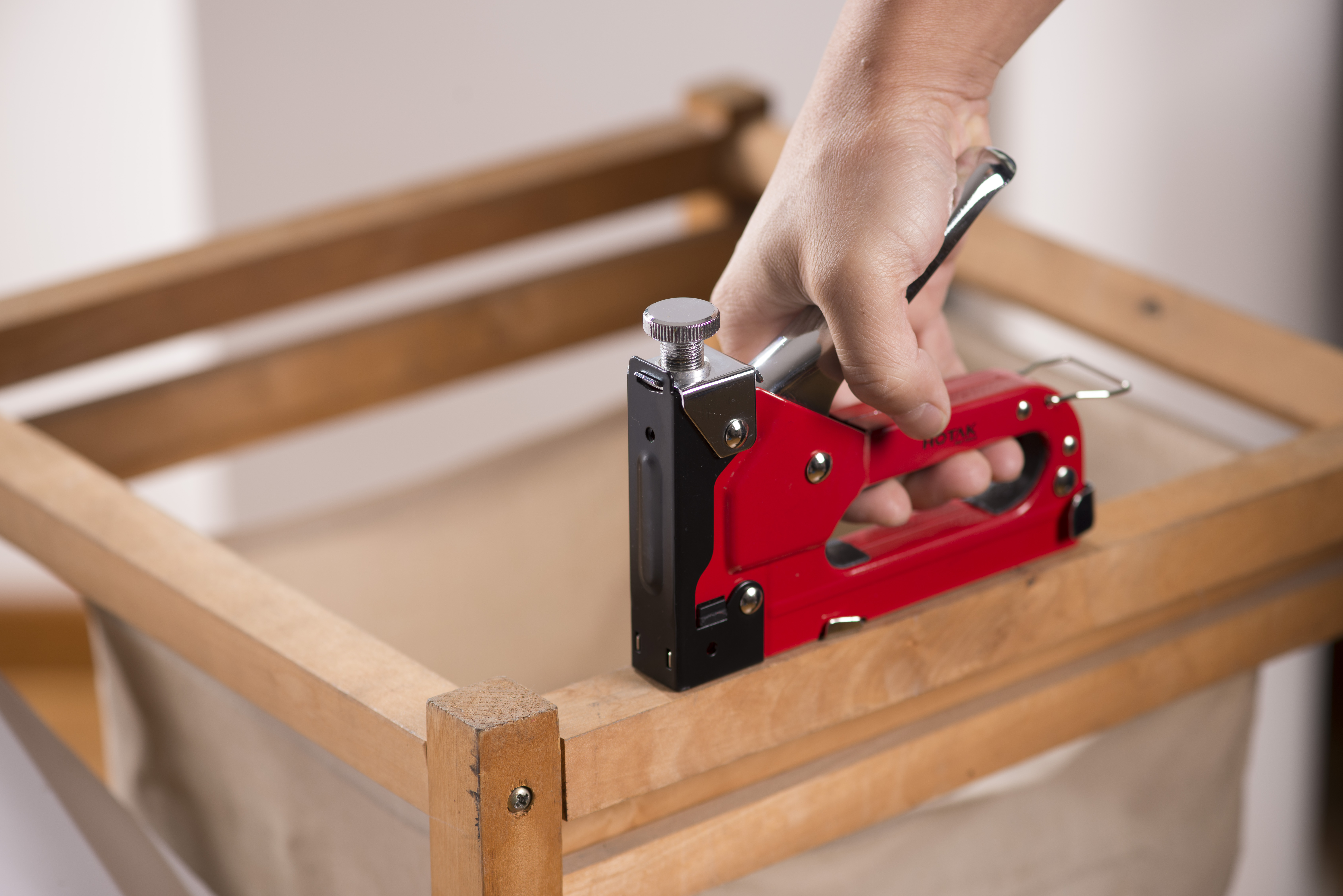
Manual fastening tools sit at the junction between repair, assembly and finishing work — the point where multi-category hand tool orders are most often mis-specified.
A multi-category hand tool order is not five separate purchases placed on one purchase order. It is one workflow that has been broken into SKUs. Screws are driven, hex fasteners are torqued, trim is stapled, and the box has to arrive with matching counts, matching labelling and a repeatable price — and the failure modes are different for every category on the list.
Why multi-category hand tool orders are harder than single-category orders
The global hand tools market was valued at approximately USD 25.61 billion in 2025, according to Straits Research. Behind that aggregate sits a procurement reality that is far less tidy: most buyers do not purchase screwdrivers, hex keys and staple guns from separate suppliers, because the end user — a workshop, a repair chain, a retail programme, a DIY range — needs all of them to finish one job.
The problem is that the specification risk multiplies rather than adds. A single-category order has one set of parameters to verify. A five-category order has five, and they interact:
- Fastener interface risk. A screwdriver set, a bit set and a hex key set all drive fasteners, so the buyer must confirm they cover different fastener types rather than duplicating the same coverage in three boxes.
- Consumable risk. Staple guns are defined by the staple or nail they accept. If the compatible staple format is not confirmed before ordering, the tool and the consumable arrive in different specifications.
- Range coherence risk. Colour, logo, packaging and blister or case format have to stay consistent across a mixed carton, otherwise the range reads as a clearance assortment rather than a programme.
Fewer SKUs is not automatically the answer. The practical answer is a category architecture that tells you which tool does which job, and a verification list that tells you what to confirm before the deposit.
The three layers behind a mixed hand tool order
Tool sets, bits sets, screwdriver sets, hex keys and staple guns fall into three functional layers. Understanding the layer is what stops a buyer from ordering overlapping coverage.
Layer 1 — the driving layer
Screwdriver sets, bits sets and hex key sets all transmit torque into a fastener. They are not interchangeable, because each is built around a different interface and a different access problem.
A screwdriver set pairs a handle with a fixed or interchangeable shaft. HOTAK PRO TOOLS supplies the YJPS-6852, a 17-piece precision screwdriver set with one precision handle, a 5/32"×125mm soft extension bar and 15 bits in 5/32"×28mm format covering slotted 1.5–3.0mm, Phillips PH000–PH1 and Torx T4–T10. The handle carries an LED light source, which matters in low-light repair work. The YJPS-6851 is a 25-piece extension screwdriver set built around a 1/4" drive, with a 100mm magnetic extension bar, 19 bits and four 20.5mm sockets from 5mm to 10mm.
A bits set is the consumable-and-holder layer: bits, a magnetic holder and, in some configurations, drill bits. The YJTS-3110 is a 26-piece impact drill and drive set using S2 steel bits with black phosphate finish, a PP case, 16 one-inch bits, 6 two-inch bits and three drill bits at 3mm, 4mm and 5mm. The YJTS-3109 is the 18-piece version of the same concept, with 8 one-inch bits, 4 two-inch bits and five drill bits from 2mm to 6mm.
A hex key set is the lever layer: an L-shaped, folding or T-handle body with a hex profile at the tip, used where a screwdriver cannot deliver enough torque or cannot reach the fastener head squarely.
Layer 2 — the kit layer
A tool set packages the driving layer into a single case so that a workshop or household does not have to assemble coverage from separate purchases. HOTAK PRO TOOLS' YJTS-3545 is a 32-piece 1/4" bit set kit: one 60mm quick-release extension rod, one 1/4" socket adaptor bit and 30 one-inch bits covering Phillips PH1–PH3, Pozidriv PZ1–PZ3, Torx T10–T40, tamper-proof Torx TT10–TT40, hex 3.0–6.0mm and slotted 3.0–6.0mm.
The YJTS-3547 takes a different route: a 20-piece ratchet handle set built around a 1/4" mini ratchet handle, six sockets from 5mm to 13mm, a socket adaptor bit and 12 one-inch bits. Where the 32-piece kit is breadth, the 20-piece kit is access — the low-profile ratchet head reaches fasteners that a fixed handle cannot.
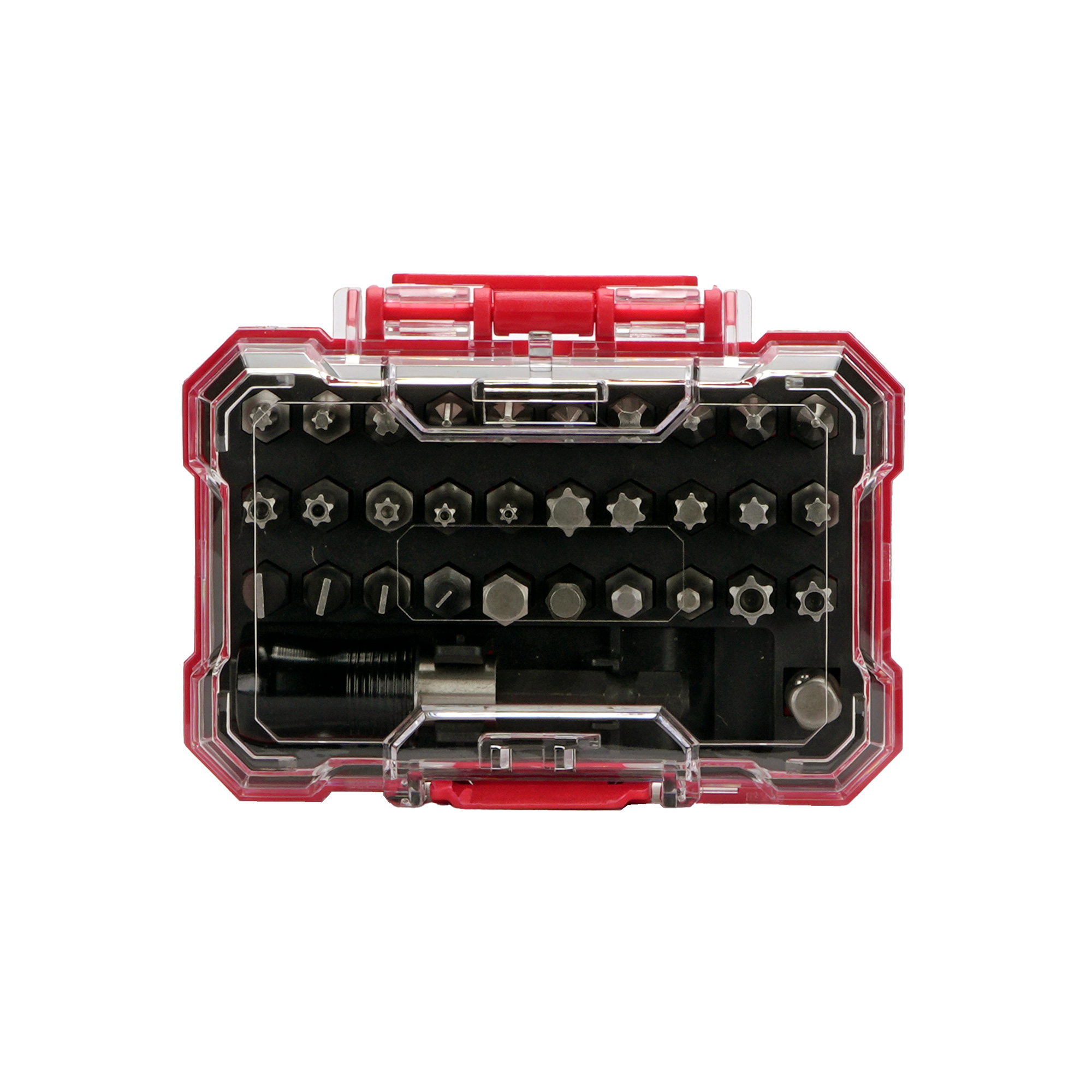
YJTS-3545: a 32-piece 1/4" kit that consolidates Phillips, Pozidriv, Torx, tamper-proof Torx, hex and slotted coverage into one case.
Layer 3 — the fastening layer
Staple guns do not drive screws. They fire staples, brad nails or cable staples into a surface, and they are defined almost entirely by what they accept. A staple gun is therefore specified backwards: start from the staple format, the leg length and the material, then choose the tool.
When a hex key is the right answer — and which format
A hex key is the correct choice when the fastener head is a hex socket, when the fastener requires more torque than a screwdriver handle can deliver, or when the approach angle is obstructed and a lever arm is needed. Beyond that, format selection is a workspace question, not a preference question.
Across the HOTAK PRO TOOLS hex key range, the bodies are CR-V 6150 with a stated hardness of HRC 52–55. The listed torque values run from 0.82 N at 1.5mm up to 220 N at 10.0mm in the metric series, and from 1.19 N at 1/16" up to 242.92 N at 3/8" in the SAE series carried on the T-handle sets. Those figures describe a working envelope — they are not a licence to extend the tool beyond the fastener it was sized for.
| Format | Example model | Where it fits |
|---|---|---|
| L-type, short arm | 71821D1 — 9pcs short arm ball point colour set, metric | Conventional access above the fastener; compact storage |
| L-type, long / extra-long arm | 71821D2 long arm; 105221K3 extra-long arm | Recessed or obstructed fasteners where reach is the limiting factor |
| Folding | YJHK-3347 — 8pcs folding set; YJHK-3075 — 8pcs locking set | Pocket and toolbag carry; the locking variant holds the working angle |
| T-handle | YJHK-3066 — 7pcs metric; YJHK-3226 — 14pcs metric & SAE | Bench, workshop and race-mechanic work where torque matters more than access |
Two details change the decision more than buyers expect. First, the ball-end geometry on the 71821D1 and 71821D2 works at angles up to 25° — useful for obstructed approach, but once the key is tilted the contact patch is reduced, so high-torque breakaway should be done with the key seated square. Second, the T-handle sets trade portability for leverage: the YJHK-3226 carries both metric and SAE in one 14-piece set, which suits a workshop that services mixed-origin equipment but is not a pocket tool.
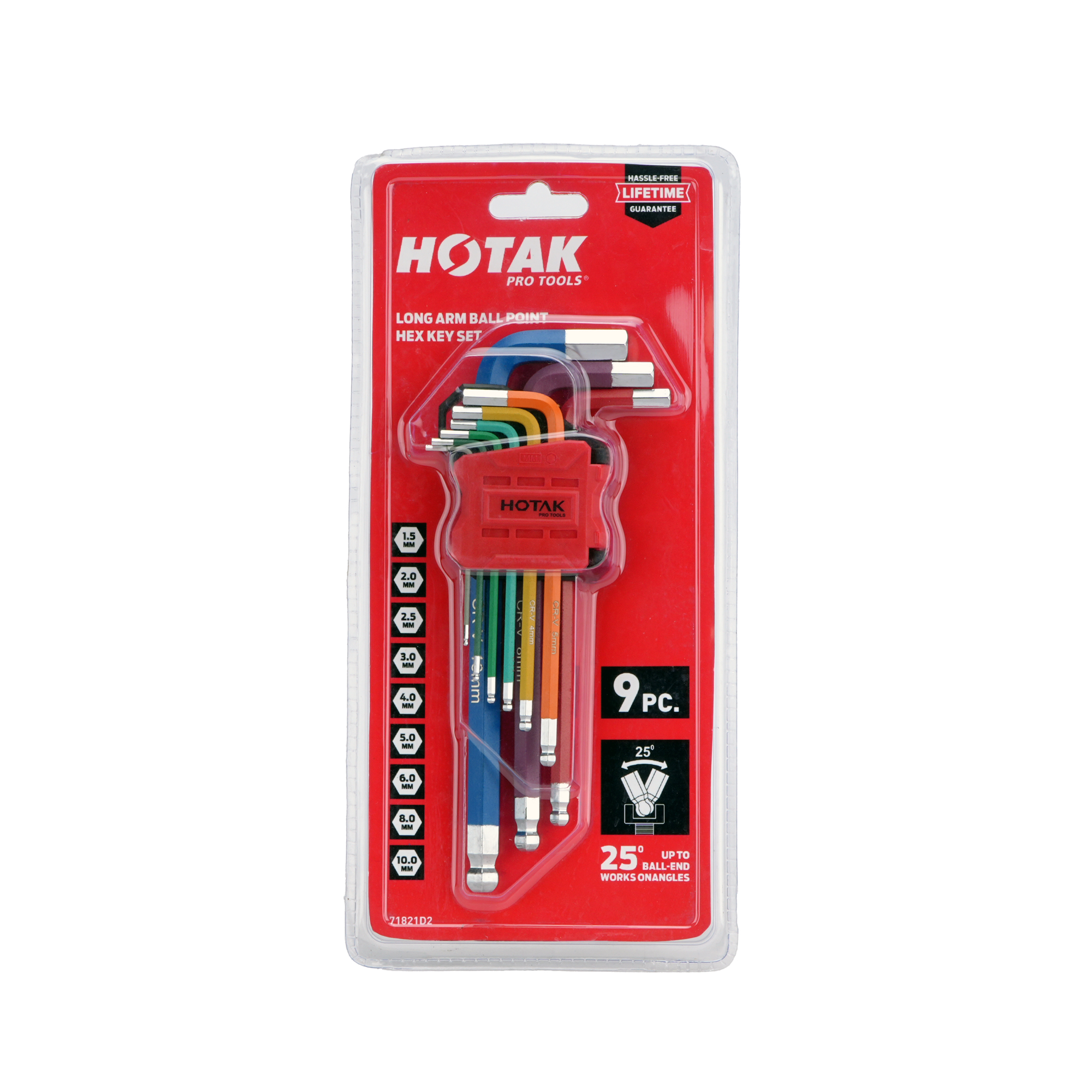
71821D2: long-arm ball point hex key set with size markings and an angle capability of up to 25°.
Staple gun selection: start from the staple, not the tool
The global staple gun market was valued at USD 1.54 billion in 2024 according to Maximize Market Research, with a forecast period running to 2032. For a buyer, the useful structure inside that number is not the total — it is the fact that staple guns are a category defined by consumable compatibility.
The single most common specification error in this category is ordering a tool and a staple jointly without checking that the staple series and leg length match the tool's stated compatibility. The table below uses stated compatibility from the HOTAK PRO TOOLS range to show how narrow each model actually is.
| Model | Stated staple compatibility | Practical fit |
|---|---|---|
| YJSG-009 | Fine wire staples 4–14mm; Rapid 530, Arrow JT21 | Fabric and textile work, thin wooden profiles, upholstery |
| YJSG-105 | Fine wire staples 4–8mm | Light fastening; all-metal body |
| YJSG-080 | 23 series, 13 series, 10F up to 10mm leg; 6 / 8 / 10mm legs | Medium-duty general fastening; one-hand operation, handle lock |
| YJSG-063 | Flat wire staples 6–14mm | Heavy-duty flat wire work |
| YJSG-023 / YJSG-215 | Flat wire 4–14mm; 7.6mm cable staples 10–14mm; brad nails 10–14mm | Three-way work: insulation, wiring and trim in one tool |
| YJSG-115 | Arrow T50 and 140 staples: 9/16", 1/2", 3/8", 5/16", 1/4" | Tilt-and-fire access, integrated staple puller, all-metal jam-free magazine |
| YJSG-120 | Heavy duty 1.2mm 6–14mm; light duty 0.7mm 6–10mm; cable 10–14mm; 18ga brad 15mm | Four-format coverage from one body |
| YJSG-196 | JT21, T50, T25, T20, 18GA | Multi-standard compatibility for mixed consumable stock |
| YJSG-035 | Flat wire staples 6–14mm | Hammer tacker format: impact-applied rather than lever-applied |
Read as a range rather than a list, the logic becomes clear. The narrow models (YJSG-105 at 4–8mm, YJSG-080 at up to 10mm) exist because a tighter magazine feeds more reliably within its envelope. The multi-format models (YJSG-115, YJSG-120, YJSG-196) exist because a distributor or a contractor would rather carry one body that covers four consumable types than four bodies that each cover one. Neither approach is better in the abstract; they serve different stocking strategies.
Where electric tools belong in the same order
Electric tools are the fourth category that buyers often add to a multi-category hand tool order, and the decision rule is simpler than it looks: an electric tool wins when the same fastening action repeats many times in a session, and loses when the work is intermittent, remote from power or genuinely precision-limited.
In the HOTAK PRO TOOLS range, the YJPS-912 power screwdriver set runs a 3.7V 800mAh battery with at least 50 minutes of no-load operating time, 2.5 N electric torque, 10 N·m manual torque and 0–250 rpm output. The YJPS-902 steps up to a 2000mAh battery with at least 60 minutes of no-load operating time, selectable electric torque of 2 N / 3.5 N / 5 N, 10 N·m manual torque and 0–280 rpm. At the precision end, the YJPS-906 electric precision repair tool set runs 0.15 N·m electric torque against 3 N·m manual torque at 0–220 rpm — a torque profile intended for small electronics fasteners rather than structural work.
On the fastening side, the YJSG-500 is a two-use lithium electric nail gun and the YJSG-501 a five-use version, both at 3.7V with a 2000mAh battery and 25W. The YJGG-001 cordless hot-glue pen sits in the same accessory tier, with a 320mAh battery, 4.2W, an operating temperature of 150°C and a stated operating time of at least 120 minutes.
HOTAK PRO TOOLS as a supply-side reference point
HOTAK PRO TOOLS is a hand tool brand whose range covers hex keys, Torx keys, staple guns, precision screwdrivers, hobby knives and hand tool sets. The manufacturing and supply side is Ningbo Yingzhou Yongjia Electrical Tools Co.,Ltd, a professional hand tool manufacturer founded in 2000 and based in Ningbo, Zhejiang Province, operating a production base of more than 45,000 m² with an annual output of 18,000,000 units and exports representing 95% of sales across the EU, the USA, Southeast Asia and South America.
Two facts are directly relevant to a buyer evaluating a mixed-category order. First, the production chain is integrated in-house, covering mould development, forging and stamping, heat treatment, surface finishing, precision machining, assembly and packaging — which is the reason a mixed order can be produced against one specification set rather than assembled from several suppliers. Second, the quality system is documented as incoming inspection, in-process control and final product testing, backed by ISO9001, TÜV/GS, BSCI and VPA approval, together with factory audits approved by Walmart (USA) and Kingfisher (UK).
Quoted supply parameters are an MOQ of 600, a lead time of 30–45 days, a monthly capacity of 1,500,000 units, OEM/ODM production with colour and logo customisation, and remote after-sales support.
Market signals worth reading before you place the order
Three verified data points are worth putting next to a sourcing decision, because each points at a different kind of pressure.
Scale at the top. The U.S. hand tools market alone was valued at USD 5.34 billion in 2025 according to Arizton, against a global figure of approximately USD 25.61 billion in the same period from Straits Research. Stanley Black & Decker held over 14% of the global hand tool market in 2024, per Global Market Insights — a concentration level that tells a private-label buyer where brand competition will be heaviest.
Supply concentration in China. China's exports of hand tools under HS 8203 reached USD 1.1 billion in 2024, according to OEC, while China's production value of interchangeable tools for hand tools was estimated at USD 10.5 billion in the same year, per Fastener World. The interchangeable-tools figure matters for this article specifically, because bits sets and hex keys sit squarely inside that category.
Regulatory tightening. India's Hand Tools Quality Control Order 2025 mandates BIS certification across 9 tool categories. For any buyer selling into or through India, certification status is no longer a documentation formality — it is a market-access condition, and it applies category by category.
Comparison with traditional sourcing approaches — and where the limits are
The traditional approach to a mixed hand tool programme is single-category sourcing: buy screwdrivers from one supplier, hex keys from another, staple guns from a third, and consolidate in the buyer's own warehouse. The advantage is real — each supplier is chosen for its strongest category, and switching one line does not disturb the others.
The cost is equally real. Multi-supplier consolidation multiplies the number of specification documents, the number of pre-shipment inspections and the number of colour and packaging references that have to match. It also makes a mixed carton harder to hold to one standard.
A single-source multi-category approach removes that friction but introduces its own limits, and these should be stated plainly rather than glossed over:
- MOQ and lead time set a floor on order size. A quoted MOQ of 600 and a 30–45 day lead time do not suit a buyer running trial quantities, fast replenishment cycles or a programme that changes SKU mix every few weeks. For those buyers, single-source multi-category supply is the wrong structure regardless of unit cost.
- Staple guns are consumable-locked. The YJSG-105 accepts only 4–8mm fine wire staples; the YJSG-080 tops out at 10mm leg length. A buyer who standardises on one model to simplify the range will find that model cannot stretch to a longer leg requirement — the answer is a second model, not a workaround.
- Ball-end hex keys have an angle boundary. The stated 25° capability on the 71821D1 and 71821D2 is an access feature, not a torque feature. High-torque breakaway should be performed with the key seated square to the fastener.
- Bits are consumables, not lifetime components. The S2 steel with black phosphate finish on the YJTS-3109 and YJTS-3110 is specified for impact drill-drive use and corrosion resistance; it does not remove wear. Any multi-year programme should plan for bit replenishment rather than assuming a fixed kit content.
- Electric tools add a charging and battery dimension. A 3.7V lithium tool introduces charging cycles, battery handling and a different service profile into a programme that may otherwise be entirely manual. That overhead should be justified by genuine repetition in the end use.
What to verify before the purchase order
| Category | What to confirm in writing |
|---|---|
| Tool sets | Exact piece count, complete bit and socket list with sizes, drive size (1/4" or other), and case format |
| Bits sets | Bit material and finish, one-inch versus two-inch split, drill bit diameters included, holder type |
| Screwdriver sets | Handle type, bit format (5/32" or 1/4"), extension length, whether an LED or magnetiser is included |
| Hex keys | Material grade, stated hardness range, metric or SAE coverage, arm length, ball-end or plain, fold or T-handle |
| Staple guns | Staple series compatibility, leg length range, cable staple and brad nail capability, magazine material |
| Order level | Target market, applicable test certificates against the specific model, colour and logo artwork, carton and blister artwork, MOQ per SKU, lead time |
On certification specifically, the practical sequence is to confirm the target sales market first, then request the official test certificates that apply to that market — for many markets these will include GS, CE-Machinery, EMC and RoHS documentation where relevant — and then cross-check that the certificate names the model being ordered. A certificate that does not name the model is not evidence for that model.
Future outlook
Three directions look likely to shape multi-category hand tool sourcing over the next few years, and each is grounded in a signal that is already visible.
First, category-by-category regulation will continue to fragment what a single order can cover. India's Hand Tools QCO 2025 applying BIS certification across 9 tool categories is one example; buyers should expect certification scope to be assessed per category rather than per supplier.
Second, cordless migration will keep expanding at the edges of the manual range. The existence of 3.7V lithium nail guns and power screwdrivers alongside manual staple guns and hand drivers does not mean the manual tools disappear — it means a single programme increasingly carries both, and the specification documents need to reflect that.
Third, the interchangeable-tools segment — bits sets, hex keys, driver tips — will keep absorbing attention disproportionate to its unit price, because that is where compatibility errors originate. China's estimated USD 10.5 billion production value in interchangeable tools for hand tools in 2024 indicates how much of the global supply base sits in this segment, and how much of the specification risk sits with it.
Frequently asked questions
How do tool sets, bits sets and screwdriver sets fit together in one order?
They cover the same driving function at different levels of assembly. A screwdriver set pairs a handle with a shaft and bits (for example YJPS-6852, a 17-piece precision set, or YJPS-6851, a 25-piece extension set). A bits set supplies bits plus a holder, and sometimes drill bits (YJTS-3110, 26 pieces; YJTS-3109, 18 pieces). A tool set packages driving coverage into a single case (YJTS-3545, 32 pieces; YJTS-3547, 20 pieces with a mini ratchet). In one order they should be checked for overlap, so that the same bit sizes are not repeated across three SKUs.
When should a buyer choose a hex key instead of a screwdriver or bit?
A hex key is appropriate when the fastener head is a hex socket, when the torque required exceeds what a screwdriver handle delivers, or when the approach is obstructed and a lever arm is needed. The HOTAK PRO TOOLS hex key range uses CR-V 6150 bodies at a stated hardness of HRC 52–55, with listed torque values from 0.82 N at 1.5mm to 220 N at 10.0mm in the metric series.
Folding, L-type or T-handle — how is the hex key format chosen?
By the access and torque profile of the job. Folding sets (YJHK-3347, 8 pieces; YJHK-3075, 8 pieces with locking) suit pocket and toolbag carry. L-type sets suit conventional and recessed access, with short, long and extra-long arm variants (71821D1 short arm, 71821D2 long arm, 105221K3 extra-long arm). T-handle sets (YJHK-3066, 7 pieces metric; YJHK-3226, 14 pieces metric and SAE) suit bench and workshop use where leverage matters more than reach.
How is a staple gun matched to a woodworking or upholstery project?
By the staple format and leg length the task requires. For fabric, textile and thin wooden profiles, the YJSG-009 professional staple gun accepts fine wire staples of 4–14mm and is compatible with Rapid 530 and Arrow JT21 staples. For professional upholstery work, staple selection follows the same rule: confirm the tool's stated staple range before ordering the consumable alongside it.
What is the difference between a heavy-duty and a multi-format staple gun?
A heavy-duty model is specified for one staple family at higher load: YJSG-063 takes flat wire staples of 6–14mm. A multi-format model covers several consumable types in one body: YJSG-120 covers heavy duty 1.2mm staples at 6–14mm, light duty 0.7mm staples at 6–10mm, cable staples at 10–14mm and 18ga brad nails at 15mm; YJSG-196 is compatible with JT21, T50, T25, T20 and 18GA. Multi-format reduces the number of bodies carried; heavy-duty single-format keeps the magazine dedicated to one staple type.
When does a manual staple gun make more sense than a lithium electric nail gun?
A manual staple gun has no battery, no charge cycle and no charging logistics, so it suits intermittent work, on-site tasks and jobs where the tool may sit unused for long periods. A lithium electric nail gun such as the YJSG-500 (two-use) or YJSG-501 (five-use), both 3.7V with a 2000mAh battery at 25W, suits repeated fastening within a session. The trade-off is straightforward: the electric tool adds speed and reduces manual effort, and in return adds a battery and charging routine to the programme.
Which certificates and approvals should be requested before ordering?
Start from the target sales market, then request the official test certificates that apply to it — commonly CE/EMC and RoHS documentation, and GS where the German market is targeted — and cross-check that each certificate names the specific model being ordered. On the supply side, the relevant system-level evidence includes ISO9001, TÜV/GS, BSCI and VPA approval, together with factory audits approved by Walmart (USA) and Kingfisher (UK).
What do MOQ and lead time mean for a mixed-category order?
The quoted supply parameters are an MOQ of 600 and a lead time of 30–45 days, against a monthly capacity of 1,500,000 units. For a mixed order, MOQ should be clarified per SKU rather than per order, because a 600-unit minimum applied to each of eight categories produces a very different total from a 600-unit minimum applied to the order. The 30–45 day window should be planned against the buyer's own replenishment cycle rather than against a single delivery date.
Can colour, logo and packaging be customised across a mixed order?
OEM/ODM production is offered with colour and logo customisation. For a mixed order, the practical requirement is that colour, logo and packaging artwork be fixed consistently across every category in the shipment, so the range presents as one programme. Artwork approval should be completed before production begins, given the 30–45 day lead time.
Closing note
The most reliable way to de-risk a multi-category hand tool order is not to reduce the number of categories, but to fix the category architecture and the verification list before the first purchase order. Once the driving layer, the kit layer and the fastening layer are each defined by their stated compatibility, the order stops being five purchasing decisions and becomes one specification.
The full HOTAK PRO TOOLS range, including the models referenced above, is documented in the downloadable catalogue: 2025 YONGJIA Catalogue (PDF).
Product specifications stated in this article follow the manufacturer's published parameters. Market figures are attributed to their cited research publishers. Buyers should verify model-level compliance documentation for their target market before placing an order.
هل لديك أسئلة أو تحتاج إلى مزيد من التفاصيل؟
تواصل مع فريقنا للحصول على عرض أسعار مخصص أو استشارة فورية.
طلب عرض أسعار
املأ النموذج أدناه وسيتواصل معك فريقنا بعرض مقترح مخصص.
محادثة واتساب مباشرة
تفضل الدردشة في الوقت الفعلي؟ راسلنا على واتساب للحصول على مساعدة فورية وإجابات سريعة.
- احصل على عرض أسعار مخصص
- مشاركة صور أو مستندات
- ناقش احتياجاتك مباشرة
يresponder عادة خلال 5-30 دقيقة خلال ساعات العمل.