
Sourcing Workwear: Matching Men's Basics to Field and Office
Corporate workwear rarely fails because the garments are badly made. It fails because one specification is asked to cover two different jobs — a climate-controlled office and a working field environment — and ends up serving neither.
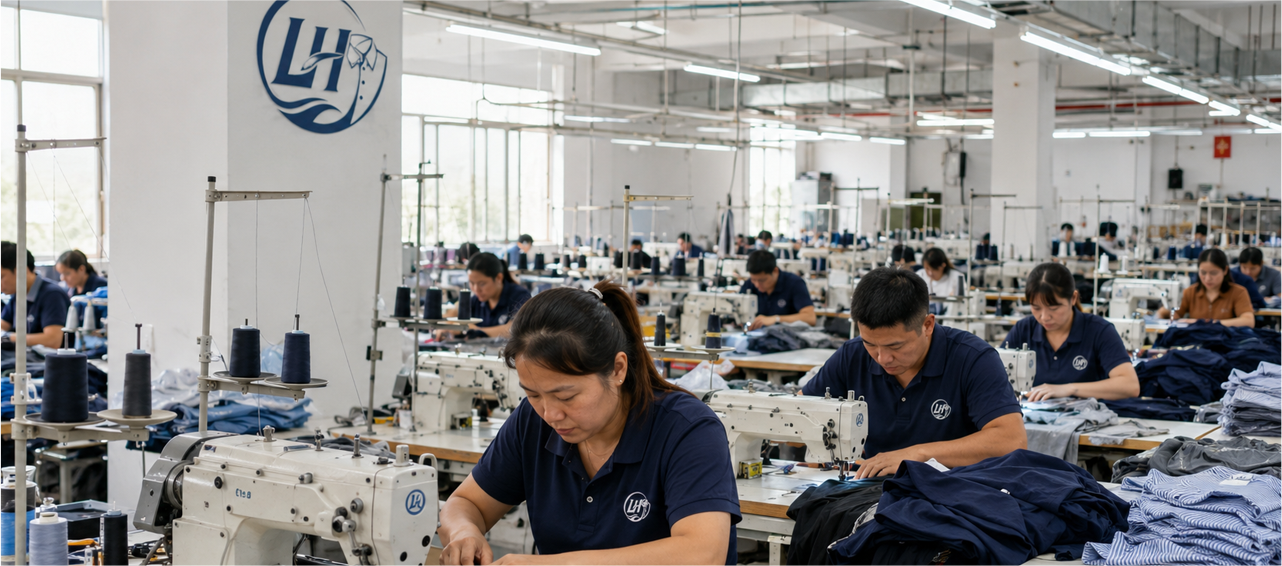
Production line at the Lihongwear facility, where men basic apparel for corporate and field workwear programmes is sewn, checked and packed.
Most corporate apparel programmes start from a familiar block: one polo or shirt, one fleece, one trouser, issued across every department. The purchasing logic is simple — one order, one size curve, one laundry cycle. The operational logic is not. A receptionist, a warehouse picker and a site inspector place different mechanical demands on the same fabric, and the difference shows up after thirty wears rather than on the sample hanger. Matching men basic apparel to job function is therefore a sourcing decision: it determines which fabrics, weights and embellishment surfaces a buyer should specify before the purchase order is issued.
Why one specification for the whole workforce underperforms
The failure mode is predictable. A garment selected for a client-facing reception area is usually chosen on appearance — a smooth face, a stable colour, and a surface that accepts embroidery or a heat-transfer logo cleanly. That same garment is then issued to a warehouse team that needs stretch, warmth and abrasion resistance. Within a few laundering cycles the two requirements pull apart: the appearance-first version loses shape under physical work, while the durability-first version looks out of place in front of customers.
Export-oriented programmes add a second variable. Fabrics used in these orders are expected to suit four-season daily wear, to be washed repeatedly, to hold colour in high-temperature and humid climates, and to remain serviceable after long-term warehousing before they are ever issued to staff.
Separating the workforce into two or three functional groups — office, mixed commuting, and field or warehouse — lets a buyer use fewer fabric types more precisely. The front-of-house look stays consistent, the physical roles get fabric that survives them, and the replacement rate caused by forcing one garment into both roles falls. The rest of this guide maps specific men basic apparel from the Lihongwear range to those groups, using the published fabric and weight specifications.
A function-first matching framework
The table below maps work environments to garment roles using specifications published for the Lihongwear product range. It is a starting point for a sourcing brief, not a substitute for a wear trial with the actual team.
| Work environment | Garment role | Product range | Published weight and material evidence |
|---|---|---|---|
| Climate-controlled office, client-facing | Lightweight, logo-ready base layer | T-Shirts: 08 Series, 0606 Series, 0829 Series, Comfort Stretch Cotton Series, Roma Cotton Series | 170g / 230g / 220g / 170g; sizes M-4XL or M-3XL; Comfort-Stretch Cotton (100% polyester), Breathable Cotton (100% combed cotton), Sorona (63.6% cotton / 36.4% polyester), Starry Sky Cotton (87% nylon / 13% spandex) |
| Office with commuting and light movement | Slim, no-iron long sleeve layer | Long Sleeve Shirts: 1701 Series, 1801 Series | 280g high-elastic tech blend; 79.7% polyester + 20.3% spandex four-way stretch; sizes M-4XL |
| Warehouse, logistics, cool indoor space | Mid-weight thermal layer | Hoodies & Sweatshirts: 1901 Series | 360g hoodie; Mountain Cotton (63.5% cotton, 36.5% polyester; lining 100% polyester); sizes M-3XL |
| Outdoor field work, spring and autumn | Outer layer for active work | 1901 Series hoodie worn alone | Double-layer composite for heat retention; breathable; resistant to pilling and sagging |
| Outdoor field work, winter | Inner insulation layer | 1901 Series hoodie under outerwear | Fleece lining retains heat and limits the cold feeling when the wearer sweats |
| Multi-site programmes in hot, humid markets | Washable replenishment stock | Men's Basic Apparel: 1901 Series, 1801 Series, 1701 Series | Four-season daily wear; repeated washing; adapted to high-temperature and humid overseas climates; suitable for long-term warehousing |
The weights above are the published fabric weights for each series: 170g to 230g across the T-shirt range, 280g for the 1701 and 1801 long sleeve range, and 360g for the 1901 hoodie. A single programme can therefore cover three distinct thermal bands without introducing a new supplier.
Reading the specifications: what 280g and 360g actually change
The 1701 and 1801 Series: 280g high-elastic long sleeve shirts
The 1701 and 1801 Series long sleeve shirts are built on a 280g high-elastic tech blend — 79.7% polyester and 20.3% spandex — supplied in sizes M to 4XL. On paper the blend reads as unremarkable. In a workwear programme the spandex content is the functional headline, because four-way stretch is what allows a garment to be cut slim without restricting reach, kneeling or overhead work. The specification states that the fabric holds its shape after repeated stretching and shows no shedding or snagging.
Three further properties matter for corporate use. The smooth face drapes without wrinkles and is specified as requiring no ironing, which removes a daily preparation step for staff and a pressing cost for the buyer. The fabric is lightweight and opaque, so it works as a standalone shirt in mild conditions or as a base layer under a jacket. And it is described as quick-drying and breathable, positioned for daily commutes and light exercise without causing sweating.
The same family includes a 280g High-Elastic Smooth Polyester option (18 Series, 100% polyester thin sweatshirt) for buyers who prefer a firmer, smoother face and a slightly crisper drape than the stretch blend delivers.
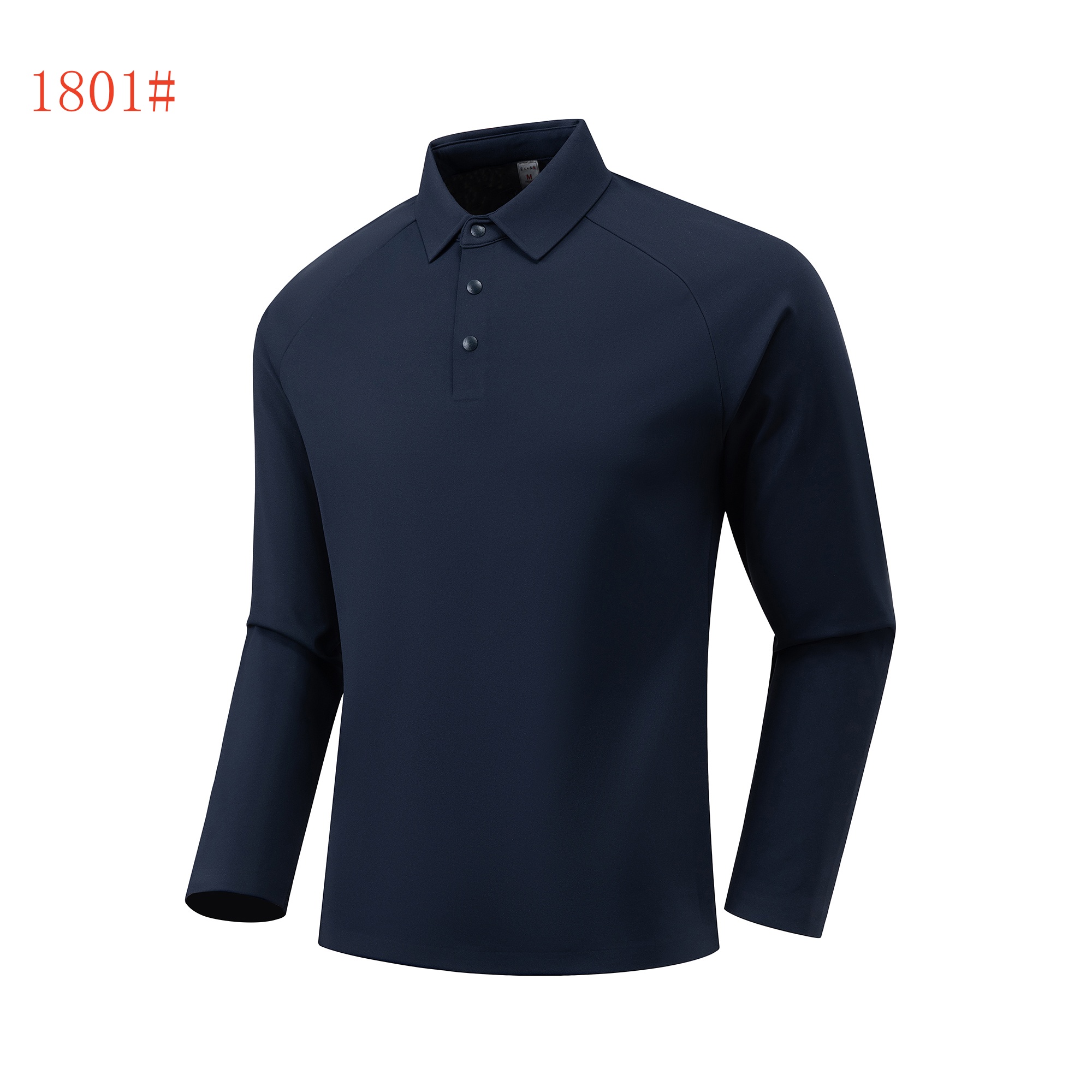
1801 Series long sleeve shirt in navy — a 280g four-way stretch garment (79.7% polyester / 20.3% spandex) suited to office, reception and commuting roles.
Two boundaries are worth stating early. The 1701 and 1801 range is positioned for spring and summer and for light layering; it is not a winter outer layer. And because the fabric is offered across a range of stock colours, a programme that needs an exact corporate shade should plan for Pantone colour dyeing rather than assume an existing stock colour will match.
The 1901 Series: 360g hoodie in Mountain Cotton
The 1901 Series hoodie is a 360g garment in Mountain Cotton — 63.5% cotton and 36.5% polyester, with a 100% polyester lining — available in sizes M to 3XL. The construction is a double-layer composite, which is the source of its insulation: the hoodie can be worn alone in spring and autumn or used as an inner layer in winter, covering both outdoor and commuting use cases in a single style.
The details matter for staff who wear the garment for a full shift. The cotton base is soft and non-irritating against the skin, while the fleece lining is specified to retain heat and to prevent the wearer feeling cold when sweating — a common complaint with unlined fleece. The garment is described as stiff and durable, resisting pilling and sagging after multiple washes, and the loose fit is cut to accommodate larger body types, including European and American sizing. Breathability is stated for mountaineering, hiking and everyday wear.
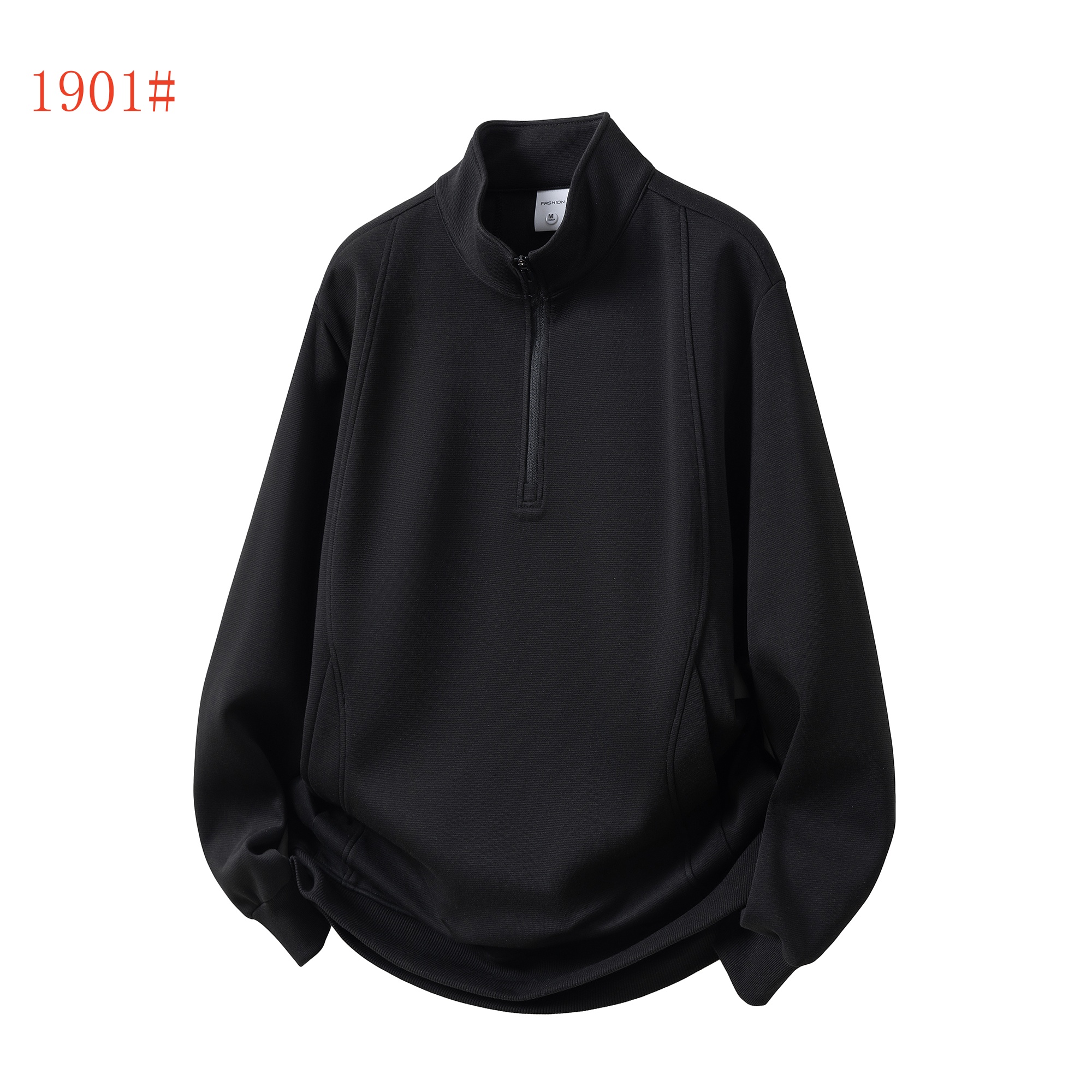
1901 Series 360g hoodie in black — the mid-weight fleece layer specified for warehouse, logistics and outdoor field roles.
Heavier fleece also means more bulk under a tailored jacket and slower drying after washing, and the hoodie's published size range stops at 3XL. For a mixed workforce that needs both formal presentation and 4XL-and-above coverage, the practical answer is to treat the hoodie as a field and warehouse garment and leave client-facing roles to the lighter layers.
How Lihongwear supports a two-track corporate programme
Lihongwear is the trading name of Guangzhou Lihong Apparel Trade Co., Ltd., a Guangzhou-based manufacturer and exporter of men basic apparel — T-shirts, shirts, polo shirts, hoodies, jackets and pants — operating out of Tianhe District, Guangzhou. The company runs a 5,000 m² production plant with more than 150 employees and an in-house pattern-making team with over ten years of experience in export menswear, and reports an annual output of 500,000 pieces.
For corporate buyers, the operation is organised around two supply routes rather than one. The first is ready stock: more than 200,000 pieces held across 50-plus styles in sizes XS to 5XL, shipped within three days, with no minimum order and support for arbitrary mixed wholesale. The second is custom production: orders starting from 200 pieces per style, with a lead time of 15 to 25 days from sample confirmation and a monthly capacity of 45,000 knitted and woven garments.
Customisation covers fabric weight, garment size, garment colour, front and back printing, embroidery logos, hangtags, wash labels and full-set packaging. Decoration methods include screen printing, digital direct injection (DTG), embroidery and heat transfer. On the T-shirt range, the ultra-smooth face of the Comfort Stretch fabric is specified as suitable for high-resolution screen printing, silicone heat-transfer logos, subtle embroidery and reflective safety branding. Full private-label trims — custom inner neck taping, woven brand tags, printed wash care labels, custom hangtags and custom polybag packaging — are available for buyers building their own identity into the uniform.
Quality control runs as a six-stage full-process inspection covering raw materials, processes and finished products, executed to international AQL standards. Fabrics are supported by CTI test reports, every shipment undergoes 100% manual inspection, and third-party on-site inspection can be arranged. In-stock and custom services share the same standardised quality process.
Each order is handled by a dedicated order follower, with replies within two hours on business days, production progress synchronised through video and photographs, and defective goods handled for return or exchange within seven days of receipt.
The supplier's case record covers cross-border e-commerce sellers, overseas clothing wholesalers, local fashion brands and foreign trade sourcing agents, with relationships running five to ten years. Order patterns range from spot replenishment of thousands of pieces to custom repeat orders of tens of thousands. The stated outcomes are shorter new-product launch cycles from stock, differentiated products built on independent patterns, and lower after-sales return rates from standardised quality control.
Mapping garments to roles and work environments
The mapping below combines the garment specifications with the applications listed for this product family: online store sales, offline supermarket retail, brand exclusive series and corporate workwear, across the cross-border e-commerce, clothing wholesale, trendy private customisation, corporate group workwear and offline retail industries.
| Role group | Matched garment | Functional reason | Delivery option |
|---|---|---|---|
| Reception, admin and client-facing office | 170g-230g T-shirt, or 280g 1701 / 1801 long sleeve shirt | Wrinkle-resistant drape, clean surface for logos, comfortable for seated work | Custom inner neck taping, woven brand tags, printed wash care labels, embroidery or heat-transfer logos |
| Sales and account teams | 280g 1701 / 1801 long sleeve shirt | Four-way stretch allows movement; smooth face needs no ironing between visits | Screen-printed or embroidered logos, custom hangtags, brand packaging bags |
| Warehouse and logistics | 360g 1901 Series hoodie | Heat retention in cool storage areas; resists pilling and sagging under repeated washing | Screen printing, embroidery or heat transfer for department-level marks |
| Outdoor field crews, transitional weather | 360g 1901 Series hoodie worn alone | Warm without an outer jacket; loose fit accommodating larger body types | Embroidered or heat-transfer company marks, custom hangtags and wash labels |
| Cold-season field teams | 1901 Series hoodie as inner layer | Insulation without restricting movement | As above, with gift colour box packaging for staff distribution |
| Brand-exclusive series and promotional uniforms | Blank T-shirt base and slim inner layer | Blank base accepts printing and embroidery; doubles as brand image workwear | Full private-label trims: hangtags, wash labels, packaging bags, gift colour boxes |
Programmes are usually completed with matched accessories rather than garments alone. Custom hangtags, wash labels, brand packaging bags and gift colour boxes are listed as the supporting items for these product lines, and they typically carry the brand identity that a plain navy or grey base layer cannot.
Market context: why scenario-level sourcing is gaining ground
Three published data points help explain why buyers increasingly specify workwear by scenario rather than by category. Fortune Business Insights values the global casual wear market at USD 645.22 billion in 2025 and projects growth to USD 906.32 billion by 2034. Proficient Market Insights estimates the custom made clothes market will reach USD 213.1 billion by 2035, with a CAGR of 10.5% from 2026. HTF Market Intelligence estimates the private label apparel market at USD 81.2 billion in 2024, growing to USD 147.5 billion by 2033.
Fabric-level expectations are moving in the same direction. Heavyweight hoodies in the 350-420 GSM band have become the baseline standard for premium casual and streetwear ranges, a band the 360g 1901 hoodie sits inside — one reason mid-weight fleece now appears in corporate and warehouse programmes rather than only in retail lines. On the compliance side, OEKO-TEX reports issuing over 50,000 certificates between 2023 and 2024, an increase of 22%, an indicator of how much weight chemical-safety documentation now carries in textile sourcing decisions.
Market size estimates for custom apparel vary widely depending on definition. Published figures include USD 54.97 billion (Proficient Market Insights) and USD 48.6 billion (Dataintelo) for the broader custom-made clothing market, and USD 2.3 billion for the printing-only segment (Credence Research). Buyers should treat any single number as a definition-dependent estimate rather than a fixed market value.
Boundaries, compliance and what these garments are not
Workwear specifications in the European Union are framed by EN ISO 13688:2022, the general performance and safety requirement standard for protective and work-related apparel. Buyers should be clear about where casual and corporate basic apparel sits within that framework.
Lihongwear's men basic apparel is corporate and casual clothing. It is not certified protective equipment and is not marketed as such. Programmes with flame-retardant, cut-resistant, chemical-protective or certified high-visibility requirements must be fulfilled through certified PPE supply channels. The reflective branding option on the Comfort Stretch T-shirt surface is a decorative brand application; it does not convert a T-shirt into certified high-visibility clothing.
Within the casual and corporate scope, the stated scenario requirements for these product lines are fabric free of formaldehyde, no carcinogenic dyes, and colour fastness to standard, supported by CTI test reports for fabrics. Buyers operating a documented compliance file should request the fabric test reports and third-party inspection records attached to their specific order rather than relying on general statements.
- Lead time. Spot goods ship within three days; custom orders take 15 to 25 days from sample confirmation. A programme specifying a custom colour and logo must build the longer window into its rollout schedule.
- Minimum order quantity. Spot replenishment has no minimum; custom orders start from 200 pieces per style. Small teams are usually better served by stock garments plus applied trims than by a full custom run.
- Size coverage. Published ranges differ by style: M-4XL for the T-shirt and long sleeve ranges, M-3XL for the 360g hoodie, and XS-5XL across the wider men basic apparel catalogue. Mixed workforces should confirm the size curve per style before ordering.
- Colour. Custom Pantone colour dyeing is available for enterprise-level production orders, so smaller runs depend on the colours held in stock.
Comparing sourcing approaches
Corporate buyers generally choose between four sourcing patterns. Each carries a real constraint, including the hybrid model described in this guide.
| Approach | What it does well | Where it constrains the buyer |
|---|---|---|
| Single-spec uniform from retail wholesale | Simple, low commitment, immediate availability | One fabric for every role; limited logo and trim customisation |
| Fully custom programme in one style | Consistent brand identity; exact fabric, colour and trims | Custom orders start from 200 pieces per style and take 15 to 25 days from sample confirmation; less suitable for very small teams |
| Ready-stock replenishment only | No minimum order, arbitrary mixed wholesale, shipment within three days | Restricted to stocked colours and sizes; no private-label trims |
| Stock plus custom hybrid | Covers turnover items and identity items in one relationship; over 200,000 pieces of standing stock alongside 45,000-piece monthly custom capacity | Requires the buyer to forecast replenishment and carry two size curves; still subject to the 200-piece custom minimum |
The hybrid route is not automatically the right answer. For a single-site office team of under 200 people, either a small stock order with applied trims or a focused custom run will usually be simpler to administer than a two-track programme.
Outlook
Two shifts are likely to shape corporate workwear sourcing over the next few years. First, the boundary between workwear and casualwear continues to soften: mid-weight fleece in the 350-420 GSM band, once a retail streetwear standard, is now a normal specification in warehouse and field programmes. Second, buyers increasingly request documentation — fabric test reports, inspection records and named standards — as part of the quotation rather than after it.
For suppliers, that puts pressure on two fronts at once: flexibility for small trial orders and consistency for repeat orders. The two-track model Lihongwear operates — more than 200,000 pieces of standing stock alongside 45,000 pieces of monthly custom capacity, with custom orders from 200 pieces — is one response to that pressure. Buyers evaluating any supplier in this category should test both tracks, stock and custom, before committing a multi-site programme to a single route.
FAQ
Which men's basic apparel items fit office roles, and which fit field or warehouse roles?
Office and client-facing roles are served by the lighter layers: the 170g-230g T-shirt range (08 Series, 0606 Series, 0829 Series, Comfort Stretch Cotton Series, Roma Cotton Series) or the 280g high-elastic long sleeve shirts in the 1701 and 1801 Series, which drape without wrinkles and accept embroidery or heat-transfer logos. Field, warehouse and outdoor roles are better matched to the 360g 1901 hoodie, a double-layer composite garment designed for heat retention that can be worn alone in spring and autumn or as an inner layer in winter.
Can a corporate workwear programme combine ready stock with customised garments?
Yes, and the two routes serve different needs. Stock items cover turnover and new-hire replacement: over 200,000 pieces are held across 50-plus styles, with no minimum order, support for mixed wholesale and shipment within three days. Customised production covers identity items such as colour-specific or logo-embroidered garments, with orders starting from 200 pieces per style and a lead time of 15 to 25 days from sample confirmation.
What can be customised on a corporate workwear order?
The published customisation scope covers fabric weight, garment size, garment colour, front and back printing, embroidery logos, hangtags, wash labels and full-set packaging. Decoration methods include screen printing, digital direct injection (DTG), embroidery and heat transfer. Private-label trims — inner neck taping, woven brand tags, printed wash care labels, custom hangtags and polybag packaging — are also available.
What are the practical constraints on a corporate order?
Four are worth planning around. Minimum order quantity: none for stock, 200 pieces per style for custom. Lead time: three days for stock, 15 to 25 days for custom after sample confirmation. Size coverage: M-4XL for the T-shirt and long sleeve ranges, M-3XL for the 360g hoodie, and XS-5XL across the wider catalogue. Colour: Pantone dyeing is available for enterprise-level production orders, so smaller runs depend on stock shades.
How does a buyer choose between the 280g long sleeve shirt and the 360g hoodie?
The decision is driven by environment rather than preference. The 280g long sleeve (79.7% polyester / 20.3% spandex, four-way stretch, sizes M-4XL) is positioned for spring and summer wear, commuting and light movement, with a smooth face that requires no ironing. The 360g hoodie (63.5% cotton / 36.5% polyester with 100% polyester lining, sizes M-3XL) is warmer and more structured, suited to cool warehouses and outdoor work in transitional weather.
Are these garments suitable for safety-critical or certified protective work?
No. The range is corporate and casual apparel, not certified protective equipment. In the EU, work-related apparel requirements are framed by EN ISO 13688:2022, and programmes requiring flame, cut, chemical or certified high-visibility protection must be fulfilled through certified PPE supply. Reflective branding applied to the Comfort Stretch T-shirt surface is a decorative brand application and does not confer high-visibility certification.
A product catalogue covering the ranges referenced in this guide — 08 Series, 0606 Series, 0829 Series, Comfort Stretch Cotton Series, Roma Cotton Series, the 1701 and 1801 Series long sleeve shirts, and the 1901 Series hoodie — is available for download: Lihongwear product catalogue (PDF). Company information is published at lihongwear.com.