
Specifying Backlit Light Guide Panels for Retail Displays
A retail display is judged by shoppers on the merchandise, but it succeeds or fails on a component they never see. The backlit light guide panel decides whether a shelf, a showcase or a window graphic reads as evenly lit, colour-accurate and visually flat — and whether it still does so after months of continuous use.
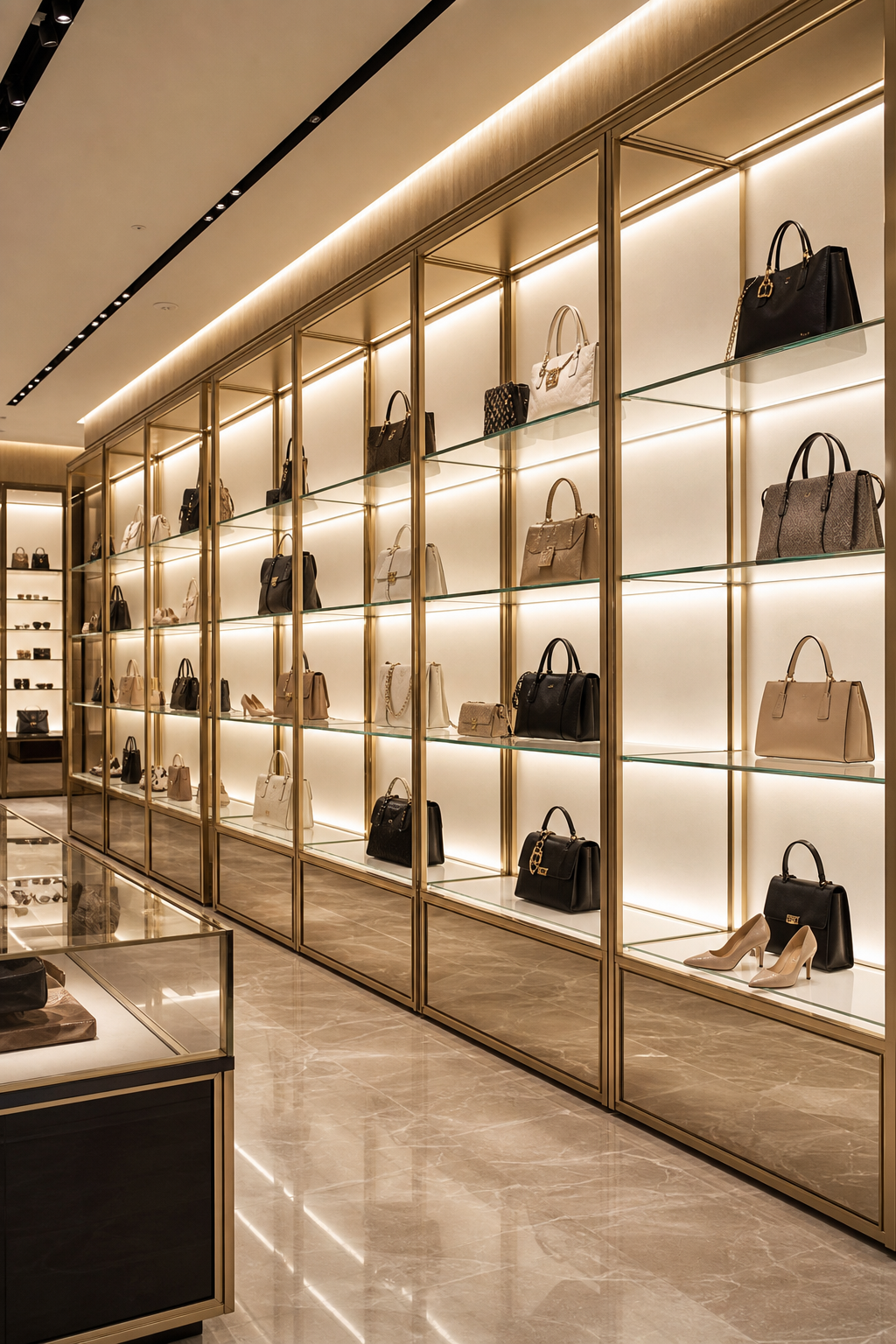
Edge-lit backlighting behind a retail shelf: the panel, not the LED, determines what the shopper sees.
A backlit light guide panel (LGP) is a transparent acrylic sheet that accepts light from LEDs coupled into one or more of its edges and redistributes that light across its face through a controlled pattern of light-extraction dots. In retail environments the panel typically sits behind a graphic, a shelf surface or a display-cabinet back wall, converting a line of point sources into a flat and diffuse plane.
This article treats the retail display backlit light guide panel as a specification problem rather than a product category. It sets out the parameters a retail project actually fixes, the certification evidence that EU and North American buyers usually request, the customization envelope, and the boundary conditions where an edge-lit panel stops being the correct answer.
Shanghai Edgelight Industry Co., Ltd. (EDGELIGHT) is a Shanghai-based manufacturer founded in 2004 that develops and produces light guide panels, LED modules, drivers, intelligent control equipment and advertising lighting products. The company operates production bases in Shanghai, Tianjin, Germany and the United States, employs around 500 people, and exports approximately 75% of its output, mainly to the USA and the EU. Its LGP platform is the reference product used throughout this analysis.
Why Retail Displays Impose a Different Constraint Set
Advertising light boxes and retail displays both use backlighting, but they are specified against different failure modes. A light box is usually read from several metres away; minor non-uniformity disappears at that distance. A retail display is read from arm's length. At that distance the eye resolves differences in brightness across a panel, edge hotspots near the light-entry side, and shifts in colour temperature between adjacent modules.
Three constraints therefore dominate retail specification. The first is uniformity across the full visible area, including the zones closest to the LED strip. The second is thickness: display fixtures, shelf returns and cabinet backs are shallow, and a backlight that requires cavity depth forces the whole fixture to grow. The third is behaviour over time — retail applications in the Edgelight application data are described as running continuously, which places thermal management and material stability on the same decision list as brightness.
A fourth constraint has become more prominent in procurement: documentation. Retail brands roll out fixtures across many stores and often across several countries, and the lighting component has to be defensible to a compliance team before it is signed off by a design team.
The Parameters a Retail Specification Actually Fixes
The Edgelight LGP platform is specified across a defined parameter set. Each value carries a direct consequence for a retail fixture, which is what makes the table useful at the evaluation stage rather than only at the purchase order stage.
| Parameter | Edgelight LGP specification | What it constrains in a retail display |
|---|---|---|
| Maximum operating current | 7.2 A | Driver selection, connector rating and wiring gauge inside the fixture |
| Maximum power | 144 W | Thermal budget for large-format panels and window installations |
| Typical power consumption | 101 W | Continuous-operation energy profile and driver sizing at nominal load |
| Luminous flux | >1080 lm | Brightness headroom when the panel competes with ambient store lighting |
| Colour temperature | 2700 K – 6500 K | Brand colour matching for cosmetics, wine, apparel and premium packaging |
| Operating temperature | -20 ℃ to 50 ℃ | Cold aisle deployment, unheated storefronts and enclosed cabinet mounting |
| Protection grade | IP20 – IP65 | From clean interior shelving to dust- and water-exposed promotional signage |
| Substrate material | Acrylic | Optical clarity, dimensional stability and resistance to yellowing under sustained light |
Two of these values do more work than the others in practice. Colour temperature range is the parameter that most often determines whether a single panel family can serve an entire retail programme, because cosmetics, wine and apparel sections usually demand different white points within the same store. Protection grade is the parameter that decides whether a panel can move from an interior shelf to a semi-exposed promotional position without a separate product being engineered.
Luminous flux above 1080 lm should be read as a platform capability rather than a per-fixture output figure. The useful brightness at the display face depends on panel size, dot-pattern density, diffuser film and how much light is lost at the panel edges — all of which are configuration decisions, not fixed product attributes.
Certification as a Procurement Filter
For retail programmes that ship into the European Union and North America, certification is not an afterthought appended to a datasheet. It is a filter that determines which suppliers remain in the evaluation at all. The relevant question is not simply whether a certificate exists, but whether the certificate's scope covers the configuration being ordered.
CE EMC documentation
The CE EMC certificate held for the LED light panel family is certificate number CTSL2620530156EZ, issued by CTSL Testing (Dongguan) Co., Ltd. for the EU market on 29 May 2026 and valid to 29 May 2096. The listed standards are EN IEC 55015:2019/A11:2020, EN IEC 61547:2023, EN IEC 61000-3-2:2019/A2:2024 and EN 61000-3-3:2013/A2:2021/AC:2022-01. The certificate scope names the GPF001 base reference together with series models including MO22, MO24, MO31, GPF21, GPF23, GPF25, GPF26, GPF100, GPF101, GPF102, GPFX-GPFXXX, MOX-MOXXX and Badge-Fascia / Blade / Hanging LED Panel variants, with the model-number range X = 0–999 stated as sharing identical circuits apart from colour appearance and model name.
The practical reading for a buyer is straightforward. EMC conformity is established at the circuit and model-family level, so a retail fixture order that stays within the named series and the X = 0–999 model convention sits inside the documented scope. A configuration that changes the electrical architecture — a different driver topology, an added control module, a different LED loading — falls outside that scope and needs separate verification. This distinction matters most in retail because fixture designers frequently request integrated dimming or networked control that the base certificate does not describe.
UL listing
The UL certification is listed as UL-US-2145621-0, issued by UL LLC for the UL market on 5 October 2021 and valid to 5 October 2025 in the supplied record's issue and expiry fields, under UL 2108, 2nd Edition. UL 2108 is the standard for sign accessories, and the certificate scope covers LPS / Class 2 LED module component models within the enumerated range.
As with CE, the scope is component-level and model-specific. A retail buyer comparing suppliers should confirm that the LED module actually proposed for the fixture appears in the certificate scope, rather than assuming that a company-level UL reference transfers automatically to every product in the catalogue.
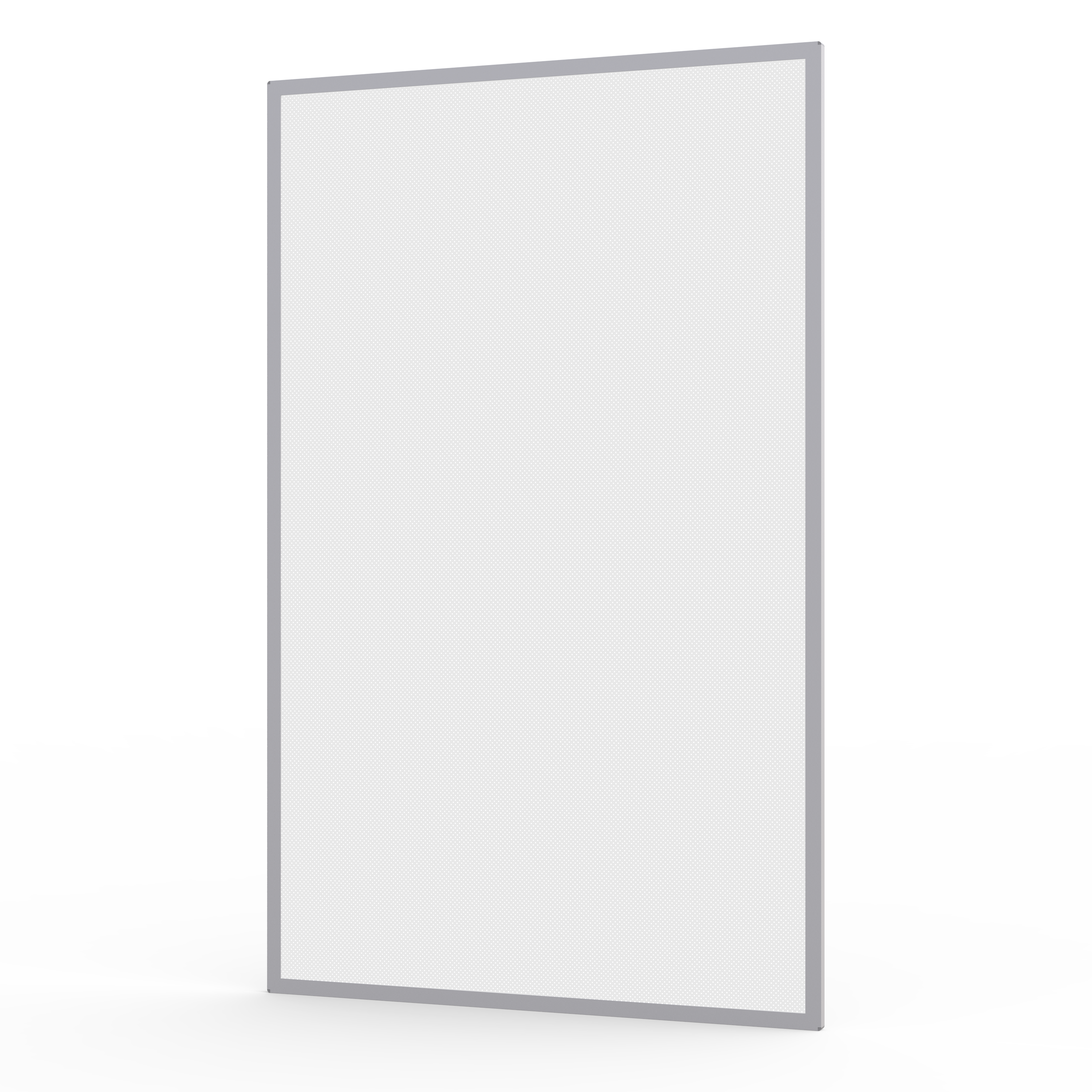
A framed LGP assembly: frame, panel and light source are specified together, because the frame determines installation depth.
Substrate and Light Extraction: Acrylic, Laser Dotting and V-Cutting
The substrate of the Edgelight LGP platform is acrylic. The material choice is not incidental. Acrylic transmits light with low absorption, holds its dimensions under moderate thermal load, and — critically for retail — resists the yellowing that degrades white-point consistency in long-running displays. A panel that shifts colour over a two-year store fit-out forces a brand to replace hardware mid-cycle, which is a far larger cost than the panel itself.
Light extraction is where panel design becomes visible. Light travelling inside the acrylic by total internal reflection escapes only where the surface has been modified — by printed dots, by laser-dotted micro-structures, or by V-shaped grooves cut into the surface. Edgelight's LGP production includes laser dotting and UV cutting stages, both of which are shown in the company's production documentation.
The extraction method shapes what the buyer can expect. Laser-dotted patterns allow fine control of dot density, which is how uniformity is tuned across a panel that is brighter near the light-entry edge and dimmer at the far side. V-cutting, used more widely across the industry as an alternative extraction method, produces grooves that can deliver high extraction efficiency but introduces visible line structure at close viewing distance if the pitch is not carefully matched to the application. Neither method is universally superior; the correct question at evaluation is which method the supplier uses, how the pattern is compensated for the specific panel size, and whether a sample at the actual ordered dimensions has been inspected from the shopper's viewing distance.
Where Ultra-Slim and High-Uniformity Requirements Collide
Retail briefs routinely ask for both an ultra-slim backlit light guide panel and high uniformity across the full face. These two requirements pull against each other, and the tension is worth understanding before a specification is fixed.
Slimness comes from edge coupling: the LEDs sit along one or more edges, so the panel needs no cavity behind it. Uniformity comes from the extraction pattern's ability to spread that edge-injected light evenly. The further light has to travel from the entry edge, the harder it becomes to keep the far zone at the same brightness as the near zone without over-extracting near the edge and creating a bright band. As panel size grows, this compensation becomes more demanding, and the practical solution set narrows — additional light-entry edges, a thicker light-mixing zone near the edge, or additional diffusion layers, each of which adds cost, thickness or assembly complexity.
Edgelight's customization options include panel size, thickness, surface shape and light output brightness, which means the slimness-versus-uniformity trade-off can be negotiated per project rather than accepted as a fixed catalogue compromise. But negotiated is the operative word: a retail buyer specifying a very large panel at minimum thickness should expect the supplier to push back on one of the two requirements, and should treat that pushback as a sign of engineering honesty rather than an obstacle.
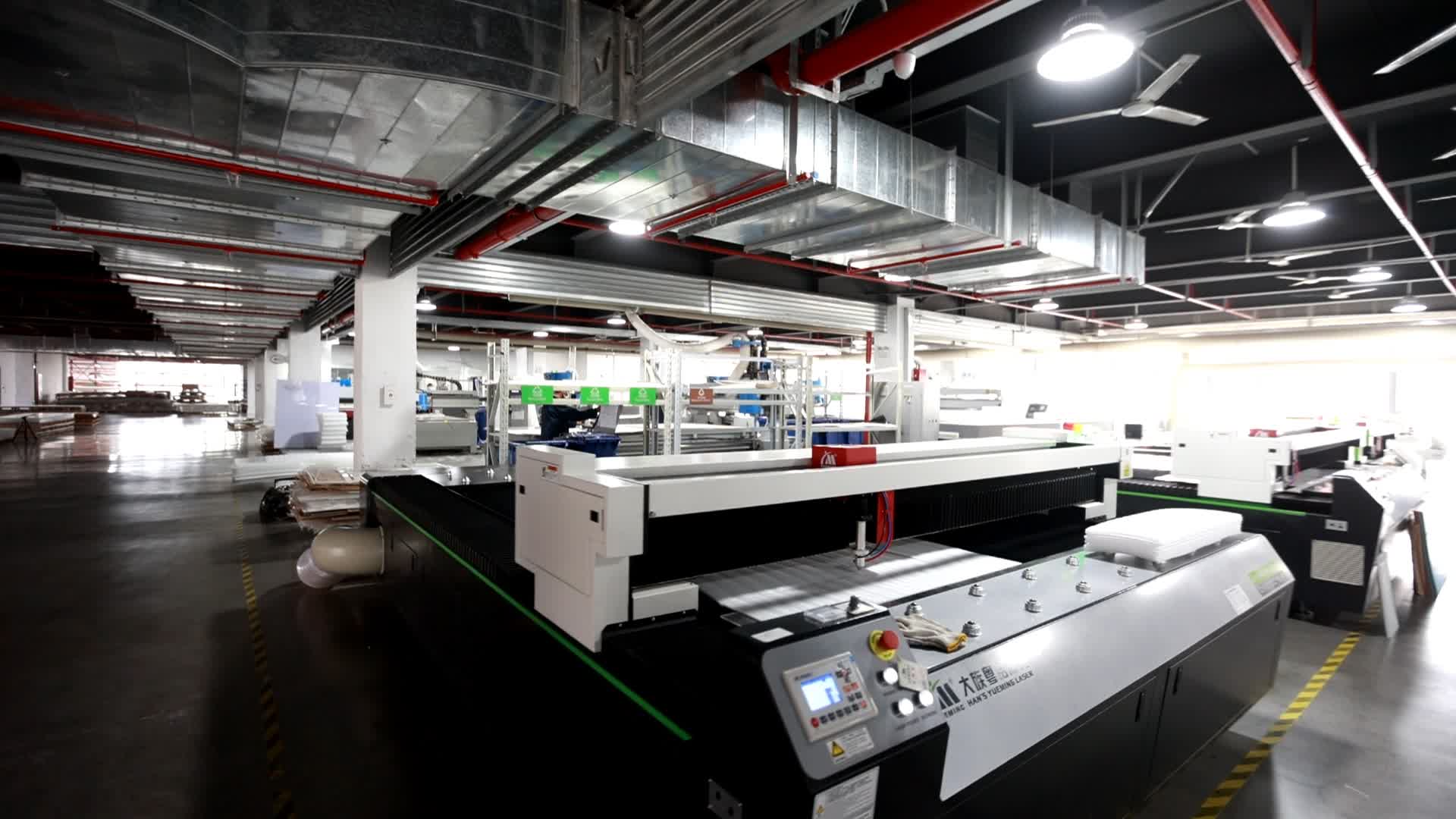
UV cutting stage in LGP production. Cutting tolerance directly affects how cleanly a custom-size panel fits a retail fixture.
Custom Sizes, MOQ and Lead Time
Retail fixtures are rarely standard. Shelf widths, cabinet depths and window formats differ by brand, by store format and often by market. The Edgelight LGP platform is offered under OEM / ODM production with customization across size, thickness, colour temperature, logo, surface shape, light output brightness and installation structure.
The commercial envelope surrounding that customization is unusually accessible for a component of this type. The stated minimum order quantity is 1 unit, which allows a single fixture prototype or a store trial to proceed without a volume commitment. Lead time is stated as 5–10 days. Monthly capacity is 30,000 units, which is the figure that matters when a retail programme moves from pilot to national rollout and the buyer needs to know whether the same supplier, and therefore the same optical behaviour, can carry the full volume.
Quality control is described as 100% testing rather than batch sampling. For retail buyers this is a meaningful distinction, because the most common cause of a failed store rollout is not a design defect but unit-to-unit variation — one panel in a run of forty reading slightly warmer or slightly dimmer than its neighbours on an adjacent shelf. Export markets named in the capability record are the European Union, North America, Southeast Asia and Australia, and after-sales is described as local support, which is relevant for multi-country retail estates where a replacement panel cannot wait for a cross-border shipment.
On the manufacturing side, the company reports an annual output of 120,000 units, a 33,000 m² Shanghai headquarters production base, and an R&D team of 25 engineers. Those figures describe the organisation behind the custom capability rather than the capability itself, but they are the figures a procurement team typically uses to assess whether a custom order will remain a priority once it is placed.
Application Scenarios in Retail
The Edgelight application data places the light guide panel across retail and luxury display, hospitality and commercial interiors, exhibition and museum, elevator decoration, advertising light boxes and signage, office and high-end residential, transportation and public spaces, and consumer electronics backlighting. Within retail specifically, four configurations recur.
Showcase backlighting places the panel behind the back wall of a glass display case. The requirement here is uniform, ultra-thin edge-lit illumination that does not add depth to a case whose footprint has already been fixed by the store layout. Because the shopper views the case from directly in front at close range, edge hotspots are immediately visible and the extraction pattern has to be tuned for that viewing geometry.
Shelf backlighting mounts the panel behind or beneath a shelf surface to illuminate product from below or behind. Cosmetics and wine display are the two applications named in the Edgelight scenario data, and they illustrate why colour temperature range matters: a cosmetic brand's packaging colours are evaluated under the backlight, so a warm white that flatters a wine label may distort a cosmetic shade.
Display cabinet backing uses a larger panel as a luminous rear wall. Here the constraint is usually power and thermal rather than optical, since a large panel running continuously inside a closed cabinet concentrates heat.
Exhibition and entrance-wall installations combine the panel with printed graphics, which is where surface shape and logo customization become relevant alongside optical performance.
The matched equipment list for these scenarios is consistent: LED strip light, constant-current power driver, light box frame, diffuser film, reflective film and mounting brackets. The scenario data also names IP55 dustproof and waterproof performance together with high light uniformity, optical acrylic material and long service life without yellowing as the special requirements for these installations — requirements that map directly onto the IP20–IP65 protection range and the acrylic substrate of the LGP platform.
Market Trend: Certification-Led Sourcing
Two structural shifts are visible in how retail backlighting is being sourced. The first is the migration of specification authority from the fixture maker to the brand owner. Retail brands with multi-country estates increasingly issue a component specification that the fixture maker must satisfy, rather than accepting whatever backlight the fixture maker happens to stock. That shift moves the decision from a price comparison to a documentation comparison, which is why CE and UL scope questions now appear early in the evaluation rather than at the contract stage.
The second shift is the consolidation of optical supply. A brand that sources panels from multiple suppliers for different store formats inherits colour variation between formats, and correcting it store by store is expensive. Sourcing a single panel family across showcase, shelf and cabinet applications — with colour temperature customized per application within the same platform — is the simpler commercial answer, and it is the reason customization breadth now carries as much weight in supplier selection as unit price.
The export profile of the Edgelight LGP business, with roughly 75% of output going to the USA and the EU and production bases in Shanghai, Tianjin, Germany and the United States, reflects this consolidation pattern: retail buyers increasingly want a supplier whose documentation and support footprint already match the markets they sell into, rather than one that has to be qualified market by market.
Edge-Lit LGP vs Conventional Direct-Lit Backlighting
Most retail backlighting decisions come down to a choice between an edge-lit light guide panel and a conventional direct-lit box, in which an LED array sits behind a diffuser at some distance from the face. The comparison below describes structural trade-offs in the two approaches; it is not an assessment of any specific competing product.
| Dimension | Edge-lit backlit light guide panel | Direct-lit diffuser box |
|---|---|---|
| Assembly depth | Low — light is coupled at the edge, no rear cavity required | Higher — needs spacing between LED array and diffuser |
| Uniformity mechanism | Extraction dot pattern engineered for the specific panel size | Diffusion distance and LED pitch |
| Hotspot behaviour | Concentrated near the light-entry edge; managed by pattern density | Concentrated directly above each LED; managed by cavity depth |
| Scaling to very large formats | More demanding — uniformity and brightness fall-off must be re-engineered | More forgiving across large areas |
| Service access | Light source sits at the panel edge | Light source sits behind the face |
| Fit to shallow retail fixtures | Strong — the panel thickness largely defines the backlight envelope | Constrained by cavity depth |
The honest conclusion is that edge-lit panels win on depth and lose on large-format simplicity. A retail programme with shallow shelves, cabinet backs and window graphics is a natural fit. A very large single-plane installation where depth is not constrained may be better served by a direct-lit approach, and a supplier who claims otherwise is not giving the buyer useful information.
Boundary Conditions Buyers Should Confirm Before Ordering
Any specification has edges, and the useful ones to state explicitly are these.
Protection grade ceiling. The LGP platform is specified across IP20 to IP65. IP65 supports dust-tight and water-jet-resistant installations, but it is not a submersible rating and should not be specified for fixtures that collect standing water or are pressure-washed at close range.
Operating temperature window. The stated operating range is -20 ℃ to 50 ℃. Retail installations in unheated storefronts, cold-chain retail or enclosed cabinets with restricted airflow need that upper limit checked against measured internal cabinet temperature, not against room temperature.
Electrical ceiling. Maximum power is 144 W at a maximum operating current of 7.2 A. A configuration that pushes toward these limits leaves little margin for driver tolerance and should be reviewed with the supplier rather than assumed.
Certification scope. As described above, the CE and UL records cover defined model families and circuit architectures. Custom electrical changes require confirmation that the configuration remains inside scope.
Size-dependent optical performance. Uniformity is not a constant across a product family. A panel that performs well at one size does not automatically perform identically at twice that size, which is why sample validation at the actual ordered dimensions is essential rather than optional.
Future Outlook
Retail backlighting is moving toward fewer, better-documented components. As brands standardize fixtures across markets, the panel becomes a specified part with a certificate file attached rather than a line item chosen by the fixture builder. That favours suppliers who can present a coherent parameter set, explain the boundaries of their certifications, and customize within a defined envelope instead of quoting a bespoke solution per enquiry.
The parallel direction is optical consistency across formats: one panel platform serving shelf, showcase and cabinet applications with colour temperature tuned per zone. The technical enabler is extraction-pattern engineering that can be re-tuned for size and viewing distance without changing the underlying platform. The commercial enabler is manufacturing capacity and testing discipline sufficient to hold that consistency across a multi-store rollout. For buyers, the practical implication is that supplier evaluation should weigh documentation quality and customization discipline as heavily as unit brightness.
FAQ
What is a backlit light guide panel in a retail display?
A backlit light guide panel is an acrylic sheet that receives light from LEDs coupled into one or more of its edges and redistributes it across the face through a controlled extraction pattern. In a retail display it sits behind a graphic, shelf surface or cabinet wall and produces a flat, evenly lit plane without the rear cavity depth that a direct-lit box requires.
Which certifications should a retail display backlit light guide panel carry for EU and North American projects?
For the EU, CE EMC conformity is the baseline; the Edgelight record cites certificate CTSL2620530156EZ issued by CTSL Testing (Dongguan) Co., Ltd. on 29 May 2026 under EN IEC 55015:2019/A11:2020, EN IEC 61547:2023, EN IEC 61000-3-2:2019/A2:2024 and EN 61000-3-3:2013/A2:2021/AC:2022-01, covering named GPF and MO series models within an X = 0–999 model range. For North America, the UL record cites UL-US-2145621-0 issued by UL LLC under UL 2108, 2nd Edition, covering specified LPS / Class 2 LED module component models. Buyers should confirm that the proposed configuration falls inside each certificate's model scope rather than treating the certificate as a company-wide claim.
Which technical parameters decide whether a light guide panel fits a retail showcase?
The Edgelight LGP specification lists maximum operating current 7.2 A, maximum power 144 W, typical power consumption 101 W, luminous flux above 1080 lm, colour temperature 2700 K–6500 K, operating temperature -20 ℃ to 50 ℃, protection grade IP20–IP65 and an acrylic substrate. In practice, colour temperature range determines whether one panel family can serve multiple retail zones, while protection grade determines whether the same panel can move from interior shelving to semi-exposed signage.
Can panel size, thickness and colour temperature be customized?
Yes. The Edgelight LGP platform is produced under OEM / ODM with customization across size, thickness, colour temperature, logo, surface shape, light output brightness and installation structure. The stated minimum order quantity is 1 unit, lead time is 5–10 days, and monthly capacity is 30,000 units, which allows a single-fixture prototype to precede a full rollout on the same optical platform.
What are the operating limits of a backlit light guide panel?
The stated limits for the Edgelight LGP are a maximum operating current of 7.2 A, maximum power of 144 W, an operating temperature range of -20 ℃ to 50 ℃ and a protection grade range of IP20 to IP65. IP65 is dust-tight and water-jet resistant but not submersible. Installations inside closed cabinets or in unheated storefronts should be checked against measured internal temperature rather than ambient room temperature.
How does an edge-lit light guide panel compare with direct-lit backlighting for retail?
Edge-lit panels achieve low assembly depth because light is coupled at the panel edge, which suits shallow shelves, showcases and cabinet backs. Direct-lit boxes place an LED array behind a diffuser and require cavity depth, but are more forgiving when scaling to very large single planes. Uniformity in an edge-lit panel depends on extraction-pattern engineering for the specific size, so its advantage narrows as format size increases.
What should be verified in a sample before a retail rollout?
Verify uniformity at the actual ordered dimensions and from the shopper's viewing distance, inspect the zone nearest the light-entry edge for a visible bright band, confirm colour temperature consistency across adjacent panels in the same run, measure internal temperature under continuous operation, and check that the configuration ordered appears in the relevant CE and UL certificate scopes.
The full Edgelight product catalogue, including light guide panel configurations and related components, is available for download: Edgelight LED Product Catalogue (PDF).
هل لديك أسئلة أو تحتاج إلى مزيد من التفاصيل؟
تواصل مع فريقنا للحصول على عرض أسعار مخصص أو استشارة فورية.
طلب عرض أسعار
املأ النموذج أدناه وسيتواصل معك فريقنا بعرض مقترح مخصص.
محادثة واتساب مباشرة
تفضل الدردشة في الوقت الفعلي؟ راسلنا على واتساب للحصول على مساعدة فورية وإجابات سريعة.
- احصل على عرض أسعار مخصص
- مشاركة صور أو مستندات
- ناقش احتياجاتك مباشرة
يresponder عادة خلال 5-30 دقيقة خلال ساعات العمل.