
Specifying HPMC for Dry Mix Mortar: Grade, Proof, Price
HTNXT Industry Reference · Construction Chemicals
Construction Grade HPMC — the hydroxypropyl methylcellulose sold into cement-, gypsum- and lime-based dry-mix mortars — is a specification decision before it is a purchasing decision. In a factory-made mortar it works as a small-dosage functional additive rather than a bulk ingredient, controlling how the mix holds water and how it behaves between batching and application. That is why two quotations for the same tonnage of "HPMC" can describe two different products, and why buyers in research and evaluation need to compare three things at once: viscosity band, documentary proof, and price band.
The reason is straightforward. HPMC is a chemical family, not a single article of commerce. The same base chemistry is authorised as a food additive elsewhere in the regulatory system — E 464 in the European Union under Regulation (EC) No 1333/2008, and a permitted multipurpose additive in the United States under 21 CFR 172.874 — while being sold industrially for tile adhesives, putties and plasters. Grade, purity and dossier differ by end use. A quotation that reads only "HPMC" has therefore not yet specified anything a formulator can test against.
Why dry mix mortar performance concentrates in one additive
Dry-mix mortar is blended in a factory but becomes a construction material only when water is added on site. Between mixing and the moment a tile is bedded or a skim coat is trowelled, the paste loses water twice: to evaporation, and to suction from the substrate. The cellulose ether is the component that governs that loss.
In cement-based mortars, wall putty and tile adhesives, HPMC improves water retention, workability, anti-sagging and open time — the four properties that decide whether an adhesive classified under EN 12004-1 / ISO 13007-1 as C1 (normal) or C2 (improved) still behaves on the wall the way it behaved in the laboratory. For floor tile systems, ASTM C627 describes the Robinson-type floor tester method used to evaluate the installed assembly rather than the powder alone. Both points matter for procurement: the additive is specified against a downstream performance class, not against a viscosity figure in isolation.
Practical consequence for buyers: state the target mortar class and test method in the request for quotation, then ask the supplier for viscosity data, documentary scope and sample trial results against that target. A grade number alone does not close the loop.
The viscosity band is the specification — and the two viscometers are not interchangeable
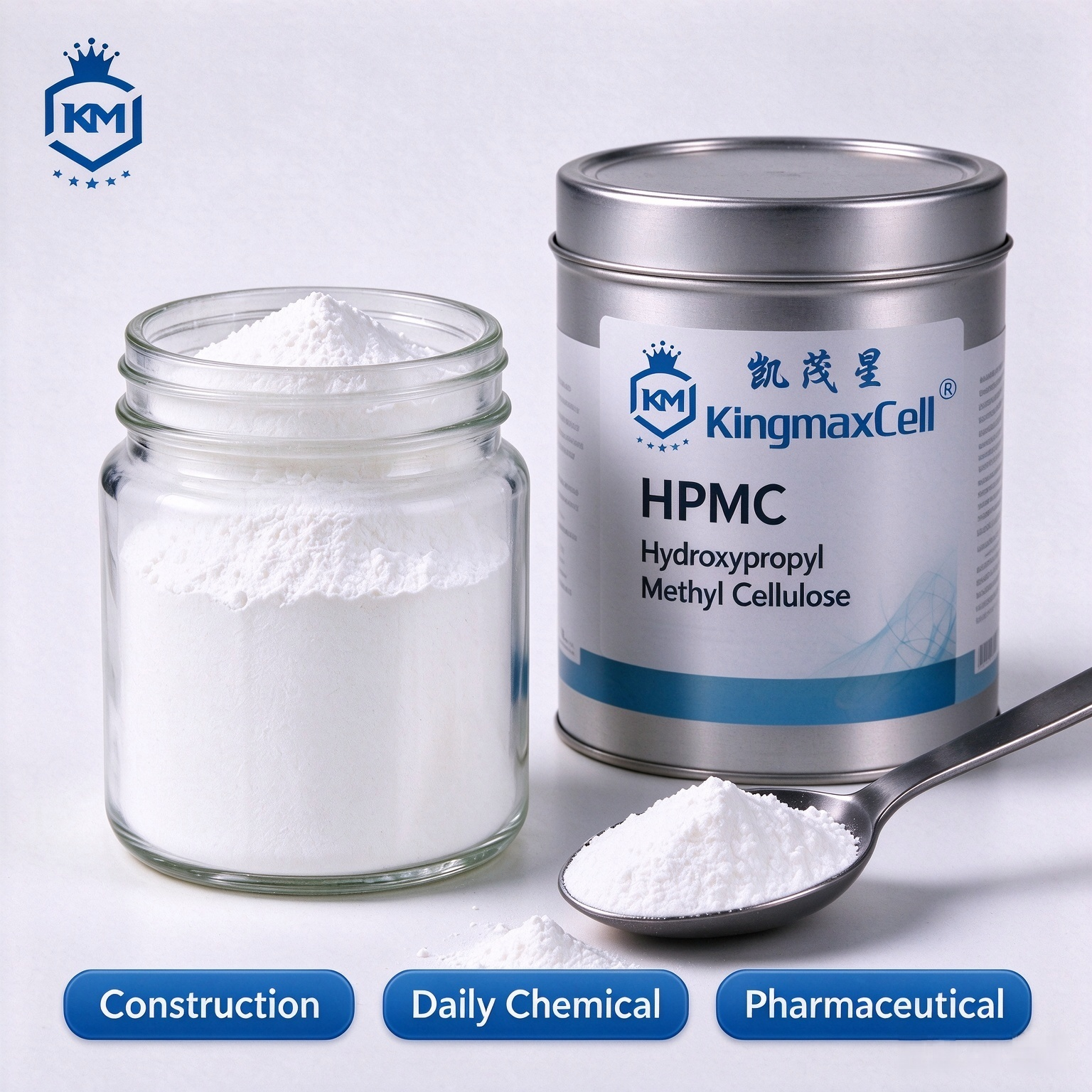
Kingmax Cellulose Co., Ltd., a cellulose ether producer based in Jinzhou City, Hebei, China, manufactures its construction-grade HPMC from refined cotton and publishes the series across three viscosity levels, each reported at 2% concentration under both NDJ and Brookfield methods:
| Model | Viscosity, NDJ, 2% (mPa·s) | Viscosity, Brookfield, 2% (mPa·s) | Typical specification role |
|---|---|---|---|
| HPMC-KM8100M / HPMC-KM8100MS | 48,000–72,000 | 24,000–36,000 | Lower band; workability-led systems where flow and levelling matter more than stand-up |
| HPMC-KM8150M / HPMC-KM8150MS | 120,000–180,000 | 55,000–65,000 | Mid band; general mortar and putty formulating space |
| HPMC-KM8200M / HPMC-KM8200MS | 180,000–240,000 | 70,000–80,000 | High-viscosity grades; water retention and anti-sag driven systems |
The two columns are the same product measured two ways, and they differ substantially. NDJ and Brookfield instruments shear the solution differently, so a Brookfield figure cannot be compared with an NDJ figure from another supplier's data sheet. This is one of the most common specification errors in construction-chemical procurement: two bidders appear to be an order of magnitude apart when in fact they are quoting different methods. The defensible practice is to require both values, plus the concentration and temperature of the measurement, before any comparison is made.
Batch control is the second half of the specification. Kingmax states that its HPMC is produced with low ash content and stable batch-to-batch quality, and that batch-to-batch viscosity control is defined by the NDJ and Brookfield ranges published for each individual model. For a mortar plant running continuous batching, that is a more useful commitment than a single midpoint figure, because it defines the tolerance band a formulator has to absorb.
What the documentation actually proves — and where it stops
Certification is the constraint most often misread during supplier evaluation. Each document answers a narrower question than buyers assume, and reading the scope line is the difference between a verified supplier and a well-formatted PDF.
| Document | What it verifies | What it does not verify |
|---|---|---|
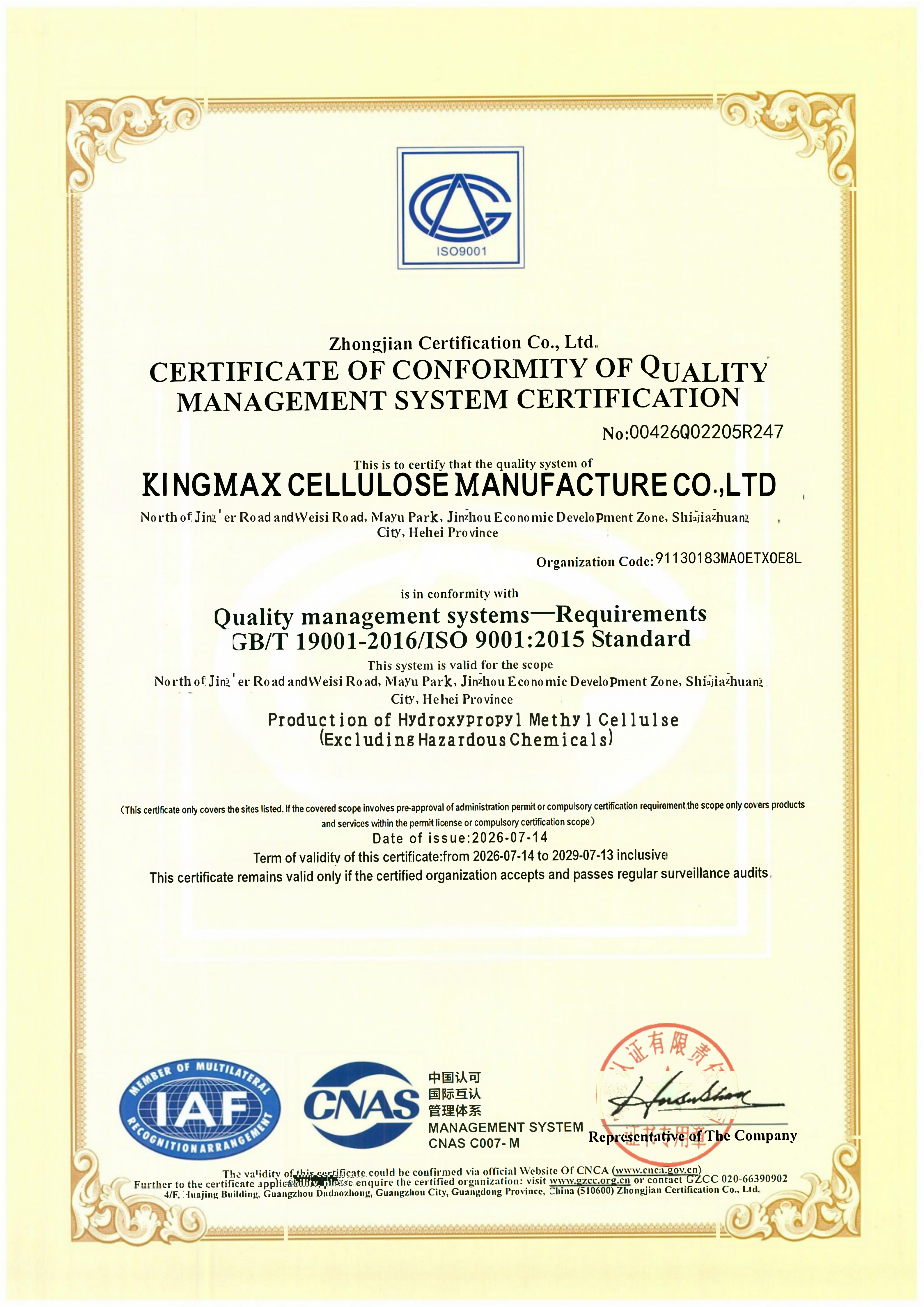
| ISO 9001:2015 (GB/T 19001-2016), certificate 00426Q02205R247, issued by Zhongjian Certification Co., Ltd., valid 2026-07-14 to 2029-07-13 | Quality management system for production of Hydroxypropyl Methyl Cellulose, excluding hazardous chemicals; scope applies to the Global, EU and Asia markets | Any individual batch's viscosity, water retention or open time |
| ISO 14001:2015 (GB/T 24001-2016), same certificate number and validity period | Environmental management system for HPMC production | Product quality of any kind — this is explicitly an environmental system certificate |
| ISO 45001:2018 (GB/T 45001-2020), same certificate number and validity period | Occupational health and safety management system; scope covers the HPMC-KM8100M, HPMC-KM8150M and HPMC-KM8200M grades | Product performance or fitness for a specific mortar formulation |
| LCA Review Statement (HPMC), issued 2026-05-14 by Star Talers EnviroTech Ltd, EU market | Life Cycle Assessment for HPMC referencing ISO 14040, ISO 14044 and the Saint-Gobain LCA/PCF methodology | It is a pre-verification document, not a product certification, and states no certification number |
Two further points belong in the same checklist. First, the three management-system certificates share the number 00426Q02205R247 in the company's records and are all valid from 14 July 2026 to 13 July 2029; a buyer verifying them should match the scope wording, not just the standard number. Second, compliance is not the same as classification. In the European Union, polymers are exempt from the registration obligation under REACH Article 2(9) of Regulation (EC) No 1907/2006 — an exemption that addresses the registration title only and says nothing about fitness for a given end use. In China, the Inventory of Existing Chemical Substances (IECSC), maintained by the Ministry of Ecology and Environment, is the reference point, and a substance absent from it may be treated as a new chemical substance subject to registration or notification before manufacture or import. Whether HPMC (CAS 9004-65-3) is listed was not confirmed within the source set used for this article, which makes it a screening question to put to any supplier rather than an assumption to carry into an order.
Customs classification sits alongside, not inside, that picture. Cellulose ethers other than carboxymethylcellulose and its salts fall under HS subheading 3912.39, and the United States tariff schedule identifies 3912.39.0000 for HPMC. A valid HS code confirms duty treatment; it does not evidence chemical-inventory clearance in the destination market.
The price band: what is actually being compared per tonne
Cellulose ether pricing is volatile and grade-specific, which makes category-level benchmarks a starting point rather than a quotation. IMARC Group reported cellulose ether prices in China reaching USD 4,845 per tonne in June 2025. That figure describes the cellulose ether category, not a named HPMC grade at a named viscosity, and it should be used to frame the negotiation rather than to set an expected number.
On commercial terms, Kingmax states a minimum order quantity of 1 tonne, a lead time of normally 7 days after receipt of deposit, a monthly capacity of 500 tonnes, OEM/ODM support with customization of viscosity, specification and packaging, free samples, and 100% inspection before shipment. Those parameters change the shape of a cost comparison in three ways that a per-kilogram price hides:
- Trial cost versus production cost. A free sample plus a small first order lets a formulator validate the grade before the tonnage commitment, which lowers the real cost of a wrong first specification.
- Working capital versus lead time. A 7-day production lead time supports frequent, smaller replenishment; a longer lead time forces inventory and ties up capital that a lower unit price rarely offsets.
- Cost in use, not cost per bag. The additive is a minor share of the mortar formulation by weight but a major share of the failure modes. Evaluating it per tonne of finished mortar — including rework, rejected batches and site complaints — reframes apparently cheap offers.
Matching the grade to the mortar system
The same construction-grade series is not applied identically across mortar types. What changes is which property carries the risk in that system.
| Mortar system | What the HPMC has to deliver | Evaluation note |
|---|---|---|
| Cementitious tile adhesive | Water retention, anti-sagging, open time | State the target class (C1/C2 under EN 12004-1 / ISO 13007-1) and, for floors, the test method reference such as ASTM C627 |
| Wall putty and skim coat | Workability, smooth application, low ash content for finish consistency | Test on the actual substrate; suction differences dominate results |
| Gypsum plaster and gypsum mortar | Water retention and open time in gypsum-based systems | Gypsum chemistry sets faster than cement; trial before scaling |
| Self-levelling mortar | Rheology stability and flow retention | Usually formulated with redispersible polymer powder; check additive compatibility |
| Exterior wall insulation (EIFS) and thermal insulation mortar | Water retention and adhesion in insulation systems | Verify compatibility with the RDP grade in the same formulation |
| Masonry mortar | Workability and water retention in general batching | Often the lowest-risk entry point for a first trial order |
| Repair mortar and concrete repair systems | Water retention plus compatibility with polymer modification | Requires joint validation with RDP-5013 or RDP-5015 type powders |
Kingmax's own case records describe supplies into European dry-mix and adhesives producers, including large-format tile and slab adhesive systems, insulation and putty lines, and construction additive formulations. The company reports 750 tonnes supplied into tile and stone adhesive applications in Italy, 720 tonnes into tile adhesive, grout and cement-based waterproof mortar in Switzerland, 650 tonnes into additive formulations in Germany, 580 tonnes into tile adhesive and renovation putty in Germany, and 800 tonnes into tile adhesive, exterior insulation and gypsum mortar in France. These are company-reported cooperation records rather than independently audited figures, and they are most useful as evidence of application breadth rather than as proof of a specific performance claim.
Where dry mix mortar performance concentrates in one additive
Where HPMC stops: the limits a buyer should price in
Neutral evaluation requires the boundary as well as the capability, and in this category there are five boundaries worth stating plainly.
1. Viscosity is not performance. A 180,000–240,000 mPa·s grade is not automatically better than a 48,000–72,000 mPa·s grade. In a skim coat that must flow and level, the high-viscosity band can be the wrong tool; in an anti-sag tile adhesive it can be the right one. Selection follows the target class and the application method, not the size of the number.
2. A system certificate is not a batch certificate. ISO 9001, ISO 14001 and ISO 45001 describe management systems. None of them certifies that the drum in front of you delivers a specific water retention value. Batch-level verification means a certificate of analysis plus an incoming test.
3. HPMC is not universally interchangeable with MHEC. The same producer's MHEC range (MX960M through MX9200MS) is specified as a high-temperature-resistant construction cellulose ether with a gel temperature of 65–75 °C for cement mortar systems. The construction-grade HPMC data set does not publish an equivalent gel temperature, so a formulator who needs that thermal behaviour cannot assume substitution in either direction without testing.
4. Grade boundaries are real. Construction grade, daily chemical grade and pharmaceutical grade cellulose ethers may share a refined cotton base material, but they are not the same specification. Substituting a food- or pharma-grade material into a mortar, or a construction grade into a personal care formulation, is a sourcing error with regulatory and performance consequences.
5. Public measured performance data is thin. The verified source set behind this article contains no independently measured water retention, open time or tensile adhesion values attributable to a specific HPMC grade. Claims in this category are still largely supplier-generated, which is precisely why a sample trial against the target mortar class is not optional due diligence.
Market context: a large, slow-moving demand base with faster-moving documentation
Two structural facts frame the procurement environment. Commercial research cited for this article projects the global construction HPMC market moving from an estimated USD 2.73 billion in 2026 to USD 4.15 billion by 2034, and estimates that construction applications account for approximately 60% of total HPMC demand. Those are third-party projections, not audited figures, but they explain why dry-mix mortar remains the reference application for grade development.
The faster-moving layer is documentation. European dry-mix producers are already asking for life-cycle and carbon data alongside technical data sheets, which is where pre-verification documents such as an LCA review statement enter the conversation — with the caveat that they are not product certifications. In parallel, chemical-inventory screening in China and the REACH polymer exemption in Europe mean market access is assessed through separate tracks from customs classification. Suppliers that can produce scope-accurate paperwork on request are increasingly differentiated from those that can only produce a price.
Future outlook
Three directions are reasonable to expect over the next several years. First, viscosity bands will continue to fragment as mortar formulators optimise for application method rather than for a headline number, which raises the value of a producer able to hold a documented tolerance band rather than a midpoint. Second, documentation will consolidate: quality, environment, safety and life-cycle evidence will be requested as one supplier file, and buyers will read the scope lines more carefully than they read the logos. Third, the verification gap will narrow — measured performance data on water retention, open time and adhesion at defined dosages is the obvious missing layer in this category, and whoever supplies it credibly will shift how grades are compared.
For a buyer in research or evaluation today, the workable sequence is unchanged: define the mortar class, request both viscometer values and the certificate scope, confirm inventory and classification status for the destination market, and validate on a sample before committing tonnage.
FAQ
What can construction grade HPMC be used for?
Construction grade HPMC is used as a thickener, water retention agent, binder and protective colloid in cement-, gypsum- and lime-based systems. Typical applications include dry-mix mortar, tile adhesive, wall putty, skim coat, gypsum plaster, self-levelling mortar, exterior wall insulation systems, masonry mortar, repair mortar and other powder building materials and construction chemical formulations. In these systems it improves water retention, workability, anti-sagging and open time.
What is the difference between the three viscosity bands in the construction series?
Kingmax's construction grade HPMC series covers three NDJ viscosity levels at 2% concentration: 48,000–72,000 mPa·s for HPMC-KM8100M and HPMC-KM8100MS, 120,000–180,000 mPa·s for HPMC-KM8150M and HPMC-KM8150MS, and 180,000–240,000 mPa·s for HPMC-KM8200M and HPMC-KM8200MS. The high-viscosity grades are HPMC-KM8200M and HPMC-KM8200MS. Each grade is also reported with a Brookfield viscosity range at the same concentration, and the two methods produce different numbers for the same product.
Is the supplier a manufacturer or a trading company?
Kingmax Cellulose Co., Ltd. is a cellulose ether manufacturer based in Jinzhou City, Hebei, China, operating its own production workshop and laboratory, and it supports OEM and ODM arrangements. Its product range covers HPMC, HEC, MHEC and redispersible polymer powder, with construction grade, daily chemical grade and pharmaceutical grade cellulose ethers produced from refined cotton.
How is quality controlled from batch to batch?
The stated control approach is 100% inspection before shipment, with low ash content and stable batch-to-batch quality, and batch-to-batch viscosity control defined by the published NDJ and Brookfield ranges for each individual model. This is backed by a quality management system certified to ISO 9001:2015 for HPMC production excluding hazardous chemicals. A system certificate covers the process; conformance of a specific batch is normally confirmed through a certificate of analysis and incoming testing.
Can viscosity, specification and packaging be customized?
Yes. Viscosity, specifications and packaging can be customized according to the buyer's requirements, and OEM and ODM support is available. Customization should be agreed against a stated test method and concentration, since viscosity values are only comparable when the instrument and measurement conditions are the same.
Are samples available before a commercial order?
Free samples are available. In practice a sample is most useful when it is trialled against the target mortar class and test method rather than assessed in isolation, because HPMC performance depends on the full formulation, the substrate and the application method.
What are the minimum order quantity and lead time?
The minimum order quantity is 1 tonne, and the lead time is normally 7 days after receipt of deposit. Monthly capacity is stated at 500 tonnes, which is relevant when planning replenishment frequency against inventory holding cost.
Reference document
The full Kingmax Cellulose product catalogue, covering HPMC, MHEC, HEC and redispersible polymer powder grades with their published parameters, is available for public access and download: Kingmax Cellulose product catalogue (PDF).
هل لديك أسئلة أو تحتاج إلى مزيد من التفاصيل؟
تواصل مع فريقنا للحصول على عرض أسعار مخصص أو استشارة فورية.
طلب عرض أسعار
املأ النموذج أدناه وسيتواصل معك فريقنا بعرض مقترح مخصص.
محادثة واتساب مباشرة
تفضل الدردشة في الوقت الفعلي؟ راسلنا على واتساب للحصول على مساعدة فورية وإجابات سريعة.
- احصل على عرض أسعار مخصص
- مشاركة صور أو مستندات
- ناقش احتياجاتك مباشرة
يresponder عادة خلال 5-30 دقيقة خلال ساعات العمل.