
Specifying Porcelain for Transit Hubs vs. Luxury Hotels
Two commercial buildings can sit in the same city and be finished in the same 60x120cm porcelain format, yet require materially different surface performance. A railway station concourse and a five-star hotel lobby are both labelled high-traffic in tender documents, but the traffic they receive behaves differently: different load types, different slip exposure, different cleaning regimes, and very different consequences when a tile fails.
Surface tolerance is the practical term for how much abrasion, moisture, point load and cleaning chemistry a floor is expected to absorb across its service life. Vitrified porcelain with water absorption below 0.5%, Mohs hardness of 6–7 and a PEI 4 / PEI 5 abrasion rating can serve both building types. What changes between a transit hub and a luxury hotel is which of those properties act as gate criteria — and which remain design preferences.
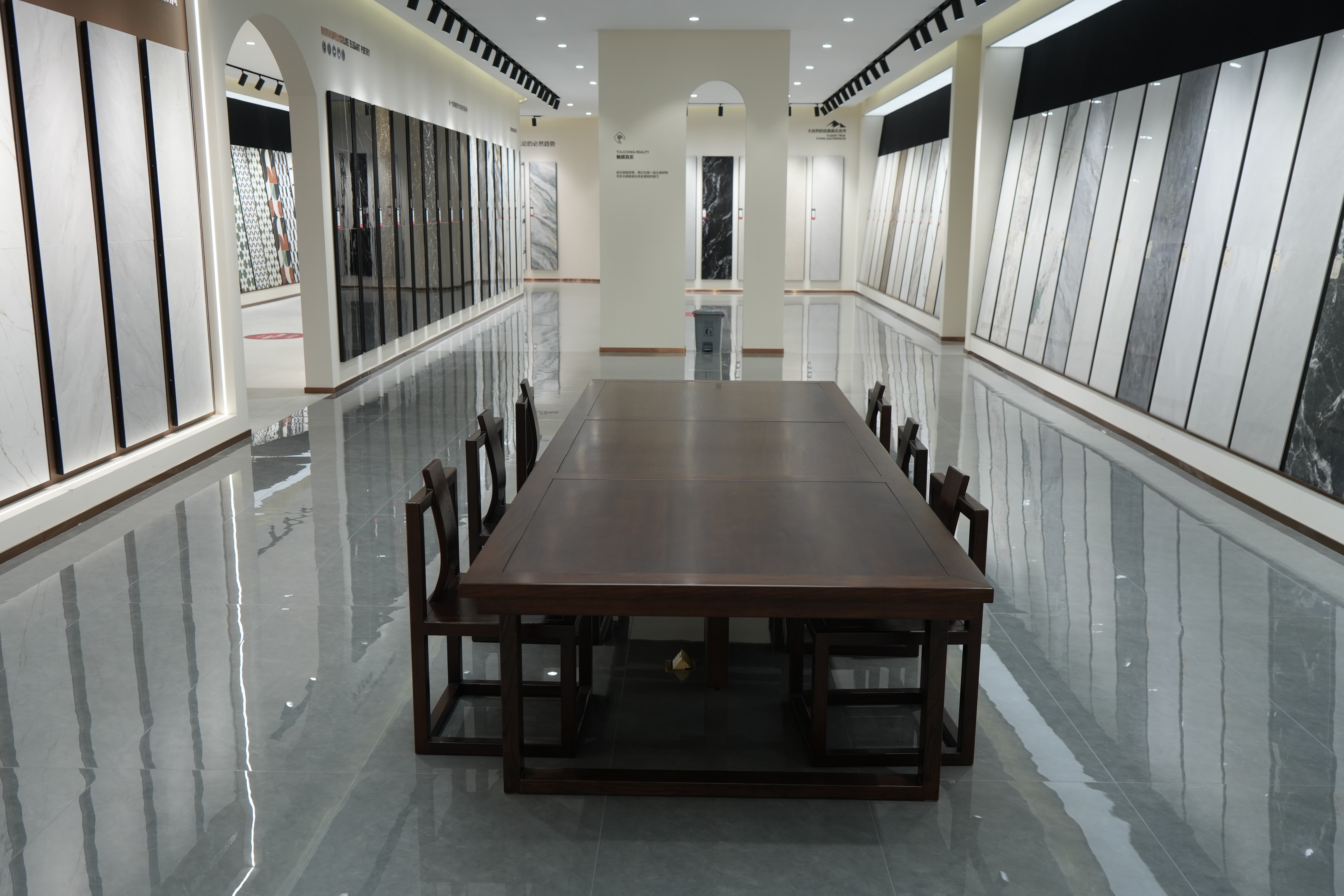
Large-format porcelain in a continuous interior floor application. Format size reduces joint count but raises the importance of substrate flatness and tile calibration.
Why the traffic profile, not the design brief, sets the specification
The most common specification error in commercial projects is not choosing the wrong tile. It is choosing a defensible tile for an incorrect traffic assumption, then discovering the gap during the first maintenance cycle.
Transit hubs concentrate wear. Passenger footfall is continuous rather than tied to business hours, wheeled loads are routine, cleaning is mechanised, and entrances carry in water, grit and, in cold-climate markets, residues from de-icing agents. Under those conditions the surface must survive freeze-thaw cycling as well as abrasion. Commercial-grade frost resistance is tested under ISO 10545-12, which requires tiles to withstand at least 100 freeze-thaw cycles.
Luxury hospitality concentrates expectation rather than load. Foot traffic is lower, but visual tolerances are far tighter: reflections running across a lobby floor, vein continuity across a 60x120cm layout, joint alignment under directional lighting, and the ability to replace a damaged zone years later without an obvious patch.
Both applications nevertheless share the same base operating envelope. Commercial porcelain applications in this segment are specified for high traffic, frost and freeze-thaw, wet and slippery conditions, thermal shock and heavy surface load. The same envelope covers commercial fit-out, interior decoration, façade engineering and hotel renovation — which is why a shared base specification exists at all, and why the differences are narrower and more technical than buyers often assume.
The performance envelope of vitrified porcelain
Start with the definition, because the terminology is frequently misused. Under ISO 13006 / EN 14411, porcelain tiles for commercial use are classified in Group BIa when water absorption is ≤ 0.5%. That single threshold separates vitrified porcelain from lower-density ceramic bodies, and it drives most downstream behaviour: stain resistance, frost performance and dimensional stability under moisture.
The 60x120cm porcelain formats in the Travertine and Marble Series family are produced with the following specified parameters.
| Property | Specified value | What it governs on site |
|---|---|---|
| Water absorption | < 0.5% (Vitrified) | Moisture uptake, stain behaviour, suitability for wet and freeze-thaw conditions |
| Abrasion resistance | PEI 4 / PEI 5 | Surface wear under abrasive footfall and tracked-in grit |
| Mohs hardness | 6–7 | Resistance to scratching from grit, trolley wheels and dragged loads |
| Breaking strength | ≥ 1300 N | Performance under point and concentrated loads |
| Modulus of rupture | ≥ 35 MPa | Flexural behaviour under distributed load |
| Thickness range | 9.0–10.5 mm | Load distribution and installation system compatibility |
| Format and packing | 60x120cm, 2 pcs/box (1.44 m²/box) | Joint planning, handling, freight and storage planning |
| Body material | Porcelain clay | Density and dimensional stability of the fired body |
Read together, these values describe a tile that is dense, dimensionally stable and wear-resistant. Read separately, they answer different questions. Water absorption below 0.5% is a body-density statement; PEI 4 / PEI 5 is a surface-wear statement; Mohs 6–7 is a hardness statement. None of them is a slip-resistance statement, and conflating them is one of the most frequent technical errors in commercial tendering.
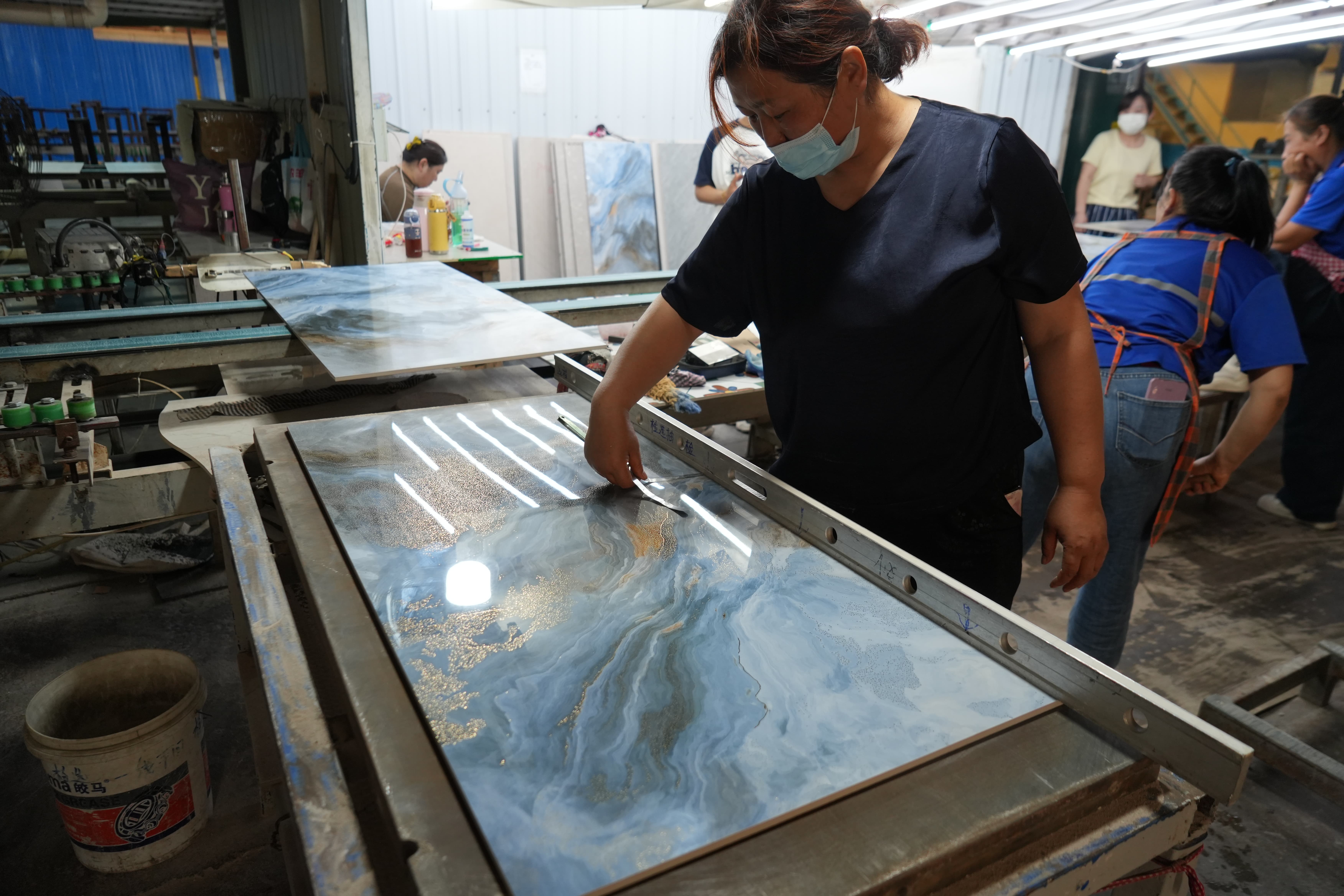
Flatness and sizing inspection during production. As format size increases, calibration tolerance becomes an installation-cost variable rather than a cosmetic detail.
Transit hubs: non-stop load, slip exposure and cleaning cycles
In airports, railway stations and comparable public infrastructure, the governing specification is usually safety rather than appearance. High-traffic public areas such as airports and railway stations require a slip resistance rating of R10 or R11 under DIN 51130. That requirement sits alongside the abrasion rating — it does not replace it.
Four performance questions dominate transit specifications:
- Abrasion under continuous traffic. Non-stop foot traffic across concourses and transfer corridors makes PEI 4 / PEI 5 the relevant floor, because the wear mechanism is sustained surface abrasion rather than impact.
- Slip exposure in wet zones. Entrance thresholds, external approaches and washroom interfaces are typically zoned to R10 or R11, while dry retail areas inside the same building may be specified differently.
- Frost and freeze-thaw. In Central Asian, Russian, Canadian and northern Chinese markets, exterior-adjacent zones and unconditioned areas must be assessed against ISO 10545-12 frost testing rather than assumed from the word “porcelain”.
- Chemical cleaning. Mechanised cleaning with acidic or alkaline agents is standard practice, which is why acid and alkali resistance is treated as a required property in commercial applications rather than an optional one.
Installation quality also carries more weight in transit projects than in most other buildings. Large-format installation depends on a coordinated system: subfloor preparation, a leveling system, tile spacers, diamond cutting tools, and appropriate adhesive and grout. Where porcelain is used as wall cladding or on façades, façade hanging systems become part of the specification. In a facility that cannot easily close a concourse for repair, the cost of a poorly prepared substrate is measured in operational disruption rather than in tiles.
Luxury hotels: continuity, finish quality and short maintenance windows
Hotels purchase the same physical performance but price appearance differently. The emphasis shifts from surviving traffic to holding a visual standard while traffic continues.
- Visual selection. Vein direction and pattern variation can be controlled during production through marble vein customisation, allowing a designer to specify a coherent vein flow across a 60x120cm layout instead of accepting an uncontrolled mix. This is a specification decision made at order stage, not a site-stage correction.
- Flatness and reflection lines. In lobby and ballroom floors, flatness is a visual property as much as a technical one, because slight lippage reads clearly under low-angle lighting.
- Maintenance behaviour. Water absorption below 0.5% and zero water penetration limit absorption-driven staining, which matters where spot cleaning is preferred over wet cleaning during guest hours. Reference programmes in this product family record easy-maintenance and stain-free outcomes as a design objective rather than an afterthought.
- Zoned slip requirements. Slip resistance is a zone-level decision in hospitality, not a building-level one. Bathroom and wet-area zones carry different requirements from lobbies, corridors and guest room floors.
- Future replacement. Two or three years after opening, a hotel may need a small quantity to match an existing floor. Batch tracking and reordering support are therefore procurement criteria, not service extras.
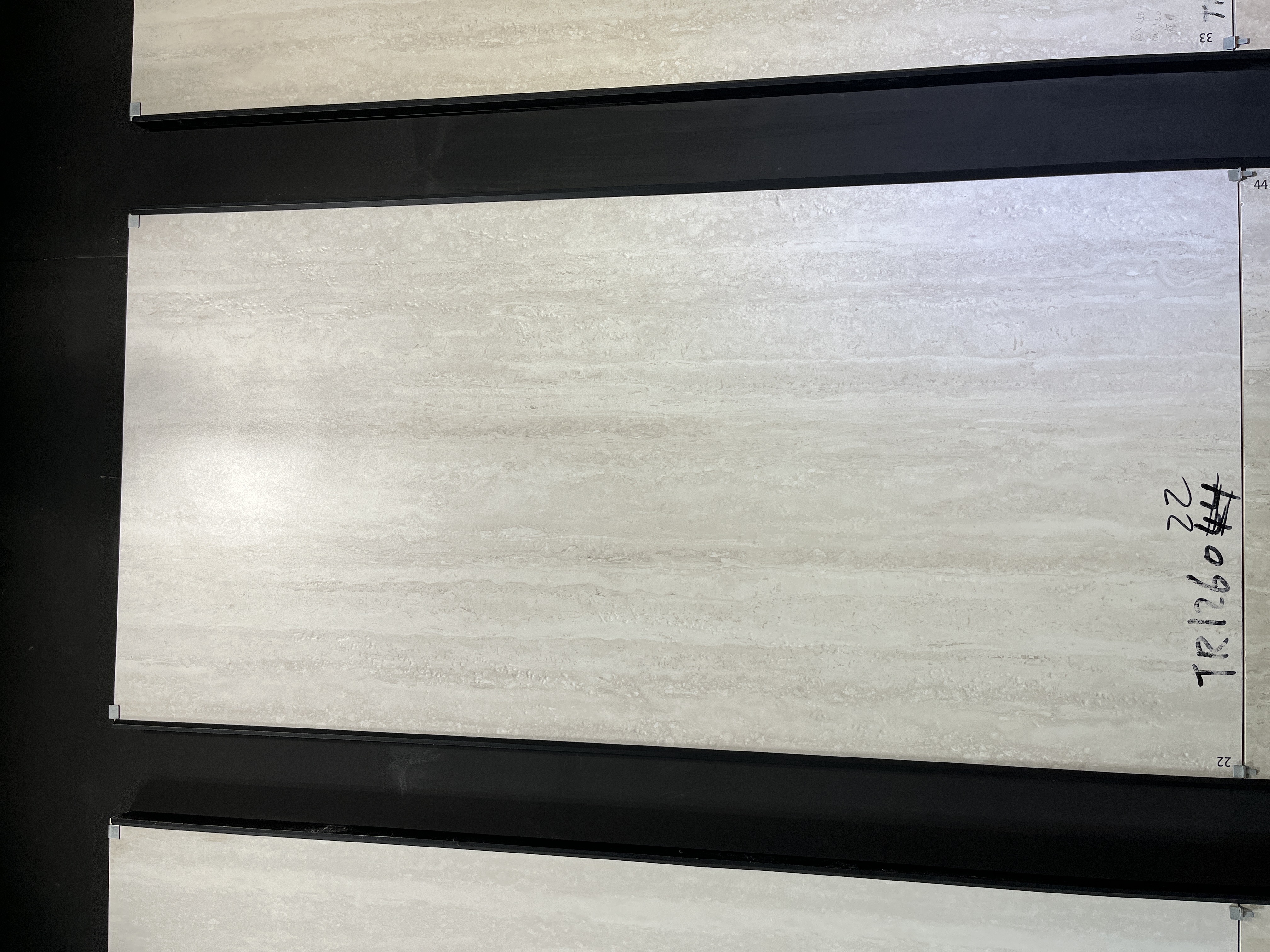
60x120cm Travertine porcelain. The same vitrified body — water absorption below 0.5%, Mohs 6–7, PEI 4 / PEI 5 — serves transit and hospitality specifications, but with different finish and slip-rating decisions attached.
Transit hub versus luxury hotel: where the specification actually diverges
| Specification driver | Transit hub | Luxury hotel |
|---|---|---|
| Dominant wear mechanism | Abrasion plus wheeled and point loads | Abrasion plus appearance retention |
| Typical slip requirement | R10 / R11 (DIN 51130) in public circulation areas | Zoned by area; wet zones specified separately |
| Frost exposure | High in cold-climate markets and unconditioned zones | Lower, but entrances and façades still cycle |
| Cleaning regime | Mechanised, chemical-intensive | Spot cleaning, appearance-first |
| Format priority | Large format to reduce joints; robust edges | Large format for design continuity and vein matching |
| Replacement tolerance | Low visual tolerance, high downtime cost | High visual tolerance, low downtime tolerance |
| Shared base specification | Water absorption < 0.5% (vitrified), PEI 4 / PEI 5, Mohs 6–7, breaking strength ≥ 1300 N, modulus of rupture ≥ 35 MPa | |
The practical conclusion for buyers is that the two building types should not be specified from two different product philosophies. They should be specified from one verified performance baseline, with the remaining decisions — finish, slip rating, format and visual control — applied by zone.
Where the two specifications converge: malls, offices and high-end residences
The transit-versus-hospitality comparison is useful precisely because most commercial projects sit between the two extremes.
Shopping mall flooring behaves like a transit environment in circulation corridors and food court zones, where footfall is continuous and cleaning is mechanised, but behaves like hospitality in feature areas and entrances. Office buildings place less abrasion demand on the floor but concentrate load under furniture legs, partitions and chair castors, which is where breaking strength and rupture modulus become relevant. High-end residences carry the lowest traffic of the three, yet the expectation of a maintenance-free surface is often higher, because replacement in an occupied home is disruptive.
One performance baseline covers all three when the base properties are held constant. The format matrix matters here: 60x120cm porcelain is the most commonly specified commercial format, while 75x150cm serves larger public interiors, and 80x80cm, 100x100cm and 60x60cm ceramic formats cover cost-optimised areas and secondary spaces. When the base properties are fixed first, format selection becomes a logistics and design decision rather than a performance gamble.
The boundaries: what PEI, Mohs and R-ratings do not cover
A credible specification also states its limits. Five boundaries matter in practice.
- Abrasion resistance and slip resistance are separate properties. A PEI 4 / PEI 5 tile is not automatically R11. The DIN 51130 classification depends on the surface finish, which is why anti-slip rating is handled as a production parameter rather than assumed from the abrasion figure.
- Breaking strength is a measured value under controlled test conditions. A breaking strength of ≥ 1300 N does not compensate for a deficient subfloor, insufficient adhesive coverage or substrate movement. The matched installation system — subfloor preparation, leveling, adhesive and grout — is part of the specification, not an accessory.
- Published parameters apply to specific formats. The values above describe the 60x120cm porcelain formats in the Travertine and Marble Series family (products 5624 and 4765). Other formats in the same manufacturer’s matrix are produced to their own parameter sets, and buyers should confirm per SKU rather than assume one datasheet covers the entire range.
- Low water absorption does not make grout stain-proof. It limits absorption-driven staining in the tile body. Grout joints remain a separately specified material with their own performance profile.
- Frost resistance is a tested property of a specific body. It follows ISO 10545-12 and should be evidenced by test documentation, not inferred from the general term “porcelain”.
There is also a commercial boundary. Production parameters such as a 1.2 million m² monthly capacity or a 7–10 day lead time describe standard output conditions. Phased infrastructure and hotel programmes still need scheduling against batch availability, particularly when a single project mixes several formats.
Turning the specification into a supply decision
For importers, contractors and specifiers, the specification only holds if the supplier can evidence it. A workable verification list includes: water absorption declared against ISO 13006 / EN 14411 Group BIa; abrasion rating stated as PEI; slip classification stated per DIN 51130 for the specific finish; frost test documentation for cold-climate delivery; declared thickness range and dimensional tolerance; a documented flatness and sizing inspection process; batch traceability; and a reordering pathway for later phases.
ZIBO ALL-KING CERAMICS CO., LTD is a porcelain tile manufacturer and direct exporter based in Zibo, China, founded in 2011 and operating a 60,000 m² facility with 320 employees, 25 engineers and an annual output of 12–16 million m². Roughly 70% of production is exported, with established commercial tile supply to markets including Australia, New Zealand, Russia, Belarus, South Korea, Vietnam, Malaysia, the Philippines, Peru, Panama, Colombia, Chile, Bolivia, Guatemala, Iraq, Ukraine and the UAE.
Several supply parameters are relevant to mixed commercial specifications. Production runs in OEM / ODM mode with customisation of size and thickness, surface finish, brand logo and packaging, marble vein variation, and anti-slip rating. Minimum order quantity is 400 m² per design, with trial orders accepted. Quality control combines 100% flatness and sizing auto-check with piece-by-piece visual inspection and random laboratory testing per batch. After-sales support covers damage compensation, online installation guidance, 24/7 technical consultation, and batch tracking and reordering support — the last of which directly addresses the hotel replacement problem described earlier.
Reference programmes in this product family include a 15,000 m² commercial supply covering hotel lobbies, shopping mall flooring, office building façades, high-end apartment bathrooms and an airport departure hall, recorded with 100% project acceptance and zero maintenance complaints. The stated performance drivers in those projects were low water absorption, high flatness, high wear resistance and controlled marble veining.
Market signals behind the specification shift
Demand data supports the direction of travel, though buyers should treat headline figures with care.
- China’s ceramic tile exports to the Philippines grew 77.5% year-on-year in March 2025, reaching USD 29.6 million (Cerambath Organisation / customs data).
- Uzbekistan imported USD 125 million of ceramic products in 2024, with China the largest supplier at USD 75.1 million (Observatory of Economic Complexity).
- The Russia ceramic tiles market was valued at USD 3.2 billion in 2024, with a projected path to USD 5.10 billion by 2032 (Verified Market Research).
- Southeast Asia’s ceramic tiles market was valued at approximately USD 11.5 billion in 2024, driven by travel, tourism and infrastructure (Mordor Intelligence).
Global market sizing is less settled. One widely cited figure puts the global ceramic and porcelain tiles market at USD 423.90 billion in 2024, projected to reach USD 845.80 billion by 2034 (Custom Market Insights), while other research houses publish materially different totals depending on whether ceramic or only porcelain is counted. That divergence is itself a procurement signal: global totals are useful for direction, but the reliable planning inputs remain regional import values, project pipelines and verified product data.
Future outlook
Three shifts are likely to shape commercial porcelain specification over the next planning cycle. First, performance criteria are moving earlier in the process: slip classification, frost testing and abrasion ratings increasingly appear in tender documents rather than in post-tender clarifications. Second, zoning is replacing building-level specifications, meaning a single project will mix finishes and slip ratings across areas while holding one verified body specification underneath. Third, traceability is becoming a procurement expectation rather than a courtesy, because phased infrastructure and hospitality assets need replacements that match earlier batches years after opening.
For manufacturers, that favours suppliers able to document parameters per SKU, support finish and anti-slip customisation at order stage, and maintain batch records. For buyers, it means the comparison question is no longer simply which tile looks right, but which documented performance envelope fits the traffic the building will actually receive.
FAQ
What water absorption level defines a porcelain tile suitable for commercial use?
Under ISO 13006 / EN 14411, commercial porcelain tiles are classified in Group BIa when water absorption is ≤ 0.5%. The 60x120cm porcelain formats in the Travertine and Marble Series family are produced with water absorption below 0.5% (vitrified body). This threshold is a body-density classification; it indicates limited moisture uptake, but it does not by itself describe slip resistance or abrasion behaviour.
Which porcelain tile ratings are used for airports and railway stations?
High-traffic public areas such as airports and railway stations typically require a slip resistance rating of R10 or R11 under DIN 51130. Abrasion resistance in the PEI 4 / PEI 5 range and Mohs hardness of 6–7 are also relevant because circulation areas receive continuous footfall and wheeled loads. In cold-climate locations, frost performance should additionally be evidenced against ISO 10545-12, which requires resistance to at least 100 freeze-thaw cycles.
Can the same porcelain tile be specified for a hotel lobby and a transit concourse?
Yes, at the base performance level. The same vitrified body — water absorption below 0.5%, PEI 4 / PEI 5, Mohs 6–7, breaking strength ≥ 1300 N and modulus of rupture ≥ 35 MPa — can serve both environments. What should differ is the finish and slip classification by zone, the visual selection criteria for hospitality areas, and the installation system used. Specifying one body and then zoning the finish and slip requirements is generally more controllable than specifying two unrelated products.
Does a high abrasion rating such as PEI 5 also guarantee slip resistance?
No. Abrasion resistance and slip resistance are separate properties measured under different standards. PEI ratings describe surface wear under abrasive traffic, while slip classification is defined under DIN 51130 (for example R10 or R11). Because slip performance depends largely on surface finish, anti-slip rating is typically handled as a production specification parameter rather than being inferred from the abrasion figure.
What should importers and contractors verify before ordering commercial porcelain tiles?
A practical verification list covers: water absorption declared against ISO 13006 / EN 14411 Group BIa; abrasion rating stated as PEI; slip classification stated per DIN 51130 for the specific finish supplied; frost test documentation where the project is in a freeze-thaw climate; declared thickness and dimensional tolerance; the flatness and sizing inspection process; batch traceability; and reordering terms for later project phases. For reference, production parameters such as 400 m² minimum order quantity per design, trial orders, and 7–10 day lead time describe standard conditions and should be confirmed against the formats and phases in a specific project.
Product and format documentation, including 60x120cm, 75x150cm, 80x80cm, 100x100cm and 60x60cm ranges, is available in the All-King Ceramics catalogue: All-King Ceramics Catalogue (PDF).