
Specifying Powder Coatings for Aluminum Curtain Walls and Sunrooms
Specifying Powder Coatings for Aluminum Curtain Walls and Sunrooms
In exterior architectural aluminum, the coating — not the extrusion — is the layer that absorbs ultraviolet radiation, humidity, salt spray and airborne pollutants. The specification decision, therefore, is which coating chemistry and which surface finish map to each construction and decoration application.
For exterior aluminum profiles, doors and windows, glass curtain walls, sunrooms and architectural partitions, the coating type that normally carries the specification is a super weather-resistant polyester powder coating classified for architectural use. Where texture is required, a sandy polyester system is applied at a nominal 70 μm film. Decorative profiles frequently use a bonded metallic powder cured at 180–200 °C for 10–15 minutes with a gloss range of 5%–95% measured to ISO 2813:2014. Interior furniture and hardware follow a different logic, where wrinkle, hammer tone and glossy polyester finishes are selected for appearance, handling and substrate concealment rather than for long-term UV exposure.
Why the coating specification, not the alloy, decides facade life
Architectural aluminum is durable but not decorative on its own. Once a profile leaves the extrusion press, its visible and protective performance depends on the applied organic coating. Third-party classification schemes govern this layer directly: powder coatings for architectural use are administered under international certification programmes including Qualicoat, GSB International and the AAMA standards (2603, 2604 and 2605). In Europe and the Middle East, ISO 12944 remains the primary benchmark for specifying coating systems in corrosive environments graded C1 to C5.
The commercial weight behind that technical detail is measurable. Coherent Market Insights reported that thermoset powder coatings, including epoxy and polyester resins, held a 76.6% share of the market in 2026 on durability and corrosion-resistance grounds. Mordor Intelligence identifies architectural and decorative applications as a major end-use segment, driven by demand for UV-resistant facades and window systems. Market-size estimates differ by agency: Grand View Research values the global powder coatings market at USD 11.5 billion in 2025 with a projected USD 18.5 billion by 2033, while IMARC Group reports USD 16.4 billion in 2025 with a 4.51% CAGR to 2034. The divergence itself is a useful procurement signal — a buyer should treat headline market numbers as context, not as a specification.
The application-to-coating map
The table below maps construction and decoration scenarios to the coating types and published parameters held in the manufacturer's product data. It is a specification map, not a substitute for project-specific approval.
| Application | Coating type | Film thickness | Curing | Service environment |
|---|---|---|---|---|
| Aluminum profiles, doors and windows, glass curtain walls, sunrooms, architectural partitions | Aluminum Powder Coating — super weather-resistant polyester with TGIC curing agent; Qualicoat / AAMA type | 70 μm | 180–200 °C, 10–15 min | Exterior |
| Textured aluminum profiles, facade elements, high-end doors and windows | Sandy Powder Coating — polyester with TGIC curing agent | 70 μm | 180–200 °C, 10–15 min | Exterior |
| Decorative architectural profiles, entrance frames, outdoor fences | Metallic Powder Coating — bonded metallic polyester | 70 μm | 180–200 °C, 10–15 min | Exterior / decorative |
| Railings, outdoor furniture, general exterior metalwork | Glossy Powder Coating — weather-resistant polyester | 70 μm | 180–200 °C, 10–15 min | Exterior |
| Interior steel and wood furniture, machine housings, electrical and distribution cabinets | Wrinkle Powder Coating — polyester | 70 μm | 180–200 °C, 10–15 min | Interior |
| Hardware tools, security doors, filing cabinets, safes, shelving, light poles, guardrails | Hammer Tone Powder Coating — polyester | 70 μm | 180–200 °C, 10–15 min | Interior / exterior hardware |
| Appliance housings, electronics, lighting, automotive interior components | Matt Powder Coating — epoxy polyester, gloss 5%–30% per ISO 2813:2014 | 70 μm | 180–200 °C, 10–15 min | Interior |
| Pipelines, valves, water supply systems, steel reinforcement, industrial anti-corrosion | Anti-corrosion Powder Coating — pure epoxy with TGIC curing agent | 70 μm | 180–200 °C, 10–15 min | Industrial / interior |
| Appliance housings, office furniture, automotive interior parts | Epoxy Polyester Hybrid Powder Coating — indoor, VOC-free, low-temperature curing variants | 70 μm | 180–200 °C, 10–15 min | Interior |
| REACH-sensitive indoor programmes | TGIC Free Powder Coating — HAA-cured polyester, REACH-certificated | 70 μm | 180–200 °C, 10–15 min | Interior |
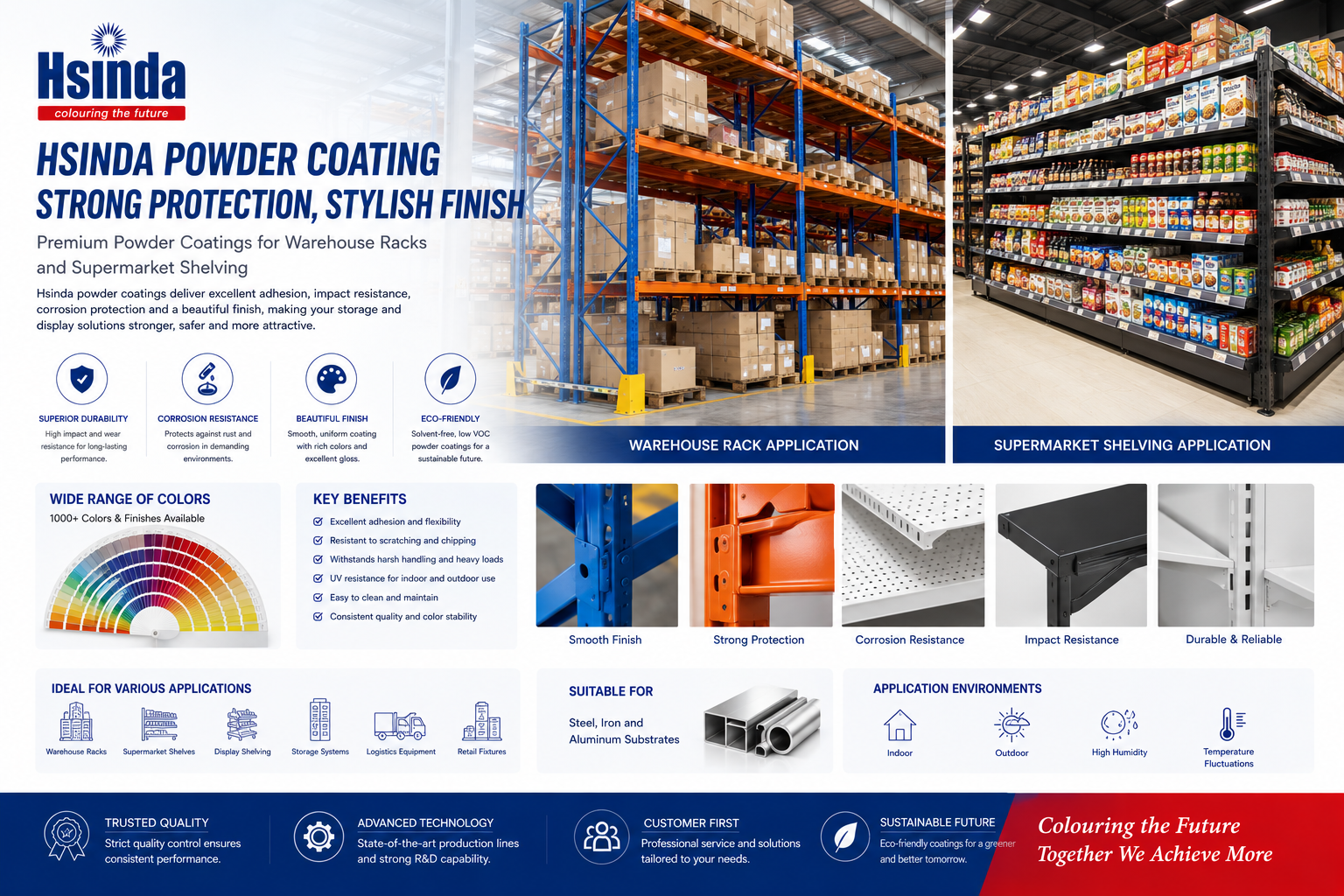
Exterior aluminum: what the specification must survive
The exterior specification for profiles, doors and windows, glass curtain walls, sunrooms and architectural partitions is built on a super weather-resistant polyester resin combined with a TGIC curing agent, pigment and additives. The stated particle size is 32–42 μm on average, with a specific gravity of 1.2–1.7 and coverage of 8–10 square metres per kilogram at 30–90 μm film thickness. Application is by tribo gun or electrostatic spray gun, and the nominal dry film thickness is 70 μm.
The published performance envelope is what a facade engineer should read first:
| Property | Test standard | Published result |
|---|---|---|
| Gloss | ISO 2813:2014 | 5%–95% |
| Impact | ISO 6272-1:2017 | 2.5 Nm |
| Bending | ISO 1519:2002 | ≤5 mm |
| Cupping | ISO 1520:2006 | ≥5 mm |
| Adhesion | ISO 2409:2020 | Grade 0 |
| Hardness | ISO 15184:2020 | ≥H |
| Salt spray resistance | ISO 7253:1996 | After 1000 hours the film is unchanged; unilateral corrosion at the cross section ≤2 mm |
| Humidity and heat resistance | GB/T 1740-2007 | 1000 hours, slight gloss loss, ≤ level 1 |
| Weather resistance | ISO 11341:2004 | 340 lamp tube, 1000 hours, no powdering, light retention >50% |
| Natural aging | Florida exposure | 1 year, gloss retention >50% |
Read together, these figures explain why the aluminum grade dominates exterior architectural enquiries: the salt-spray and weathering durations are double those published for the general-purpose polyester, epoxy and hybrid grades used indoors, and the natural-exposure result provides a real-climate cross-check on the accelerated test.
Sandy texture at 70 μm: masking extrusion lines outdoors
Sandy powder coating is a polyester system built on the same resin-and-curing-agent architecture, applied at a nominal 70 μm film and cured at 180–200 °C for 10–15 minutes. Its published mechanical profile is impact 50 kg/cm to ISO 6272-1:2017, bending ≤2 mm to ISO 1519:2002, cupping ≥6 mm to ISO 1520:2006, adhesion grade 0 to ISO 2409:2020 and hardness ≥H to ISO 15184:2020, with salt spray resistance of 500 hours (cross-section corrosion ≤2 mm), humidity and heat resistance of 1000 hours, and 500 hours of weathering with light retention above 50%.
The applied benefit is optical and practical: a textured surface scatters light and visually absorbs extrusion lines, die marks and minor handling scratches, which matters on long facade runs where a high-gloss finish would expose every variation. Documented applications for the sandy grade include aluminum profiles, doors and windows, curtain walls and highway guardrails, as well as kitchen cabinets, wardrobes, security doors, bathroom hardware and shelving, IT and communications enclosures, and new-energy vehicle charging devices.
A specification caution: the sandy and super weather-resistant aluminum grades are not interchangeable on evidence. The aluminum grade carries 1000-hour salt spray and 1000-hour weathering data; the sandy grade carries 500-hour data. If a project requires both texture and the longer exposure envelope, the exact grade must be confirmed rather than assumed from the word "polyester".
Metallic finishes and the 180–200 °C curing window
Metallic powder coating is a bonded polyester system supplied in customised RAL and Pantone colours. Its published parameters are a film thickness of 70 μm, average particle size of 32–42 μm, specific gravity of 1.2–1.7, coverage of 8–10 square metres per kilogram at 30–90 μm, gloss of 5%–95% measured to ISO 2813:2014, and curing at 180–200 °C for 10–15 minutes. Mechanical results are impact 50 kg/cm, bending ≤2 mm, cupping ≥6 mm, adhesion grade 0, hardness ≥H, salt spray resistance of 500 hours and 500-hour weathering with light retention above 50%. Applications include aluminum alloy doors and windows, curtain walls, architectural decorative profiles and outdoor fences, alongside automotive trim, appliance enclosures and furniture.
Curing control is the variable that most often separates a good metallic spec from a failed one. The 180–200 °C / 10–15 minute window is a band, not a target point: insufficient cure leaves adhesion and salt-spray performance below the published values, while excessive time or temperature dulls the metallic effect and shifts colour. Because gloss is measured to ISO 2813:2014 across a 5%–95% range, the finish level should be written into the specification numerically rather than described as "glossy" or "matte". A common internal classification divides that range into high gloss above 80%, semi-gloss from 40% to 79%, and matte from 5% to 39%.
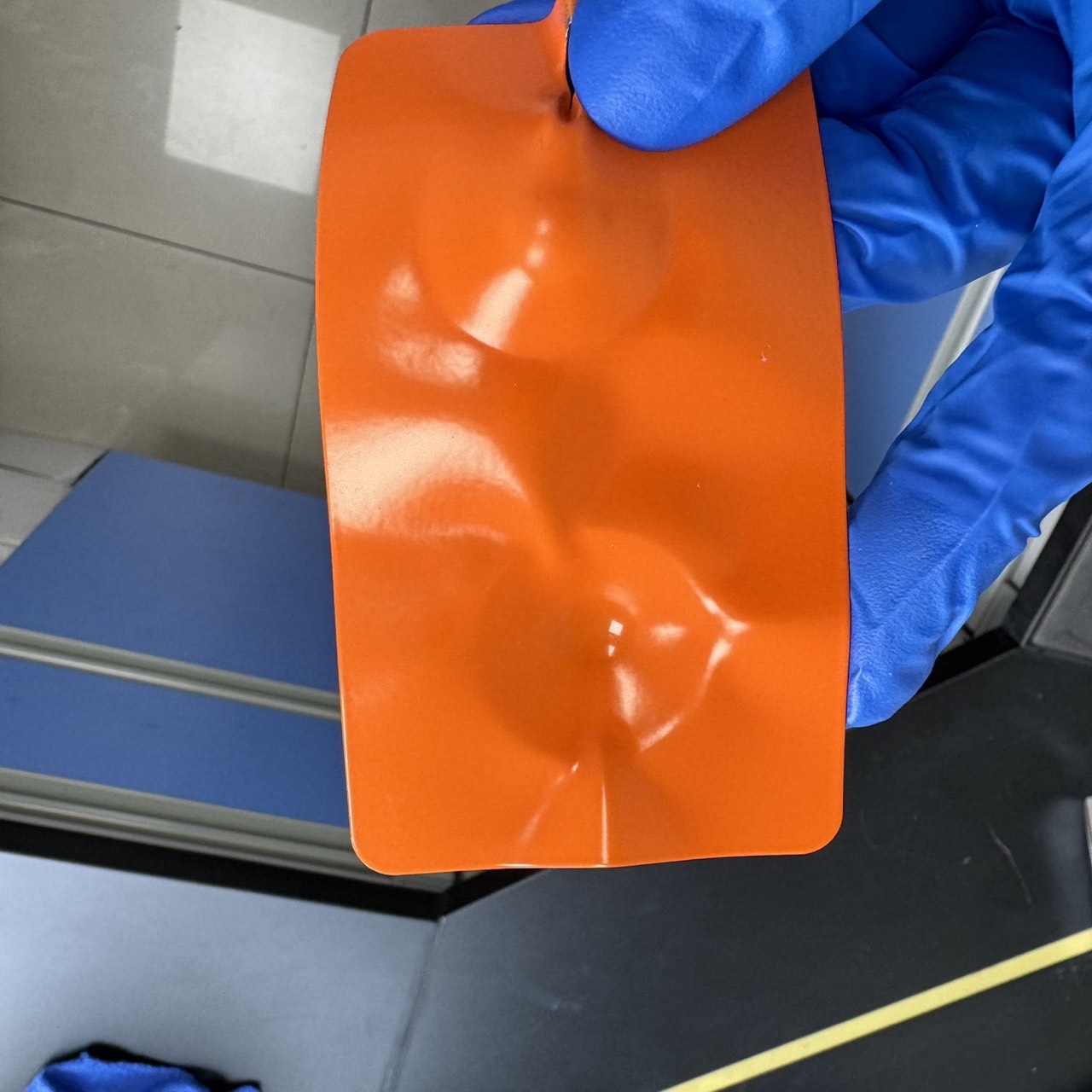
Interior furniture and hardware: where texture replaces weathering
Inside the building envelope, the specification priorities change. Wrinkle powder coating, a polyester system with TGIC curing agent, pigment and additives, is documented for steel and wood furniture, filing cabinets and security doors; for machine tools, motor housings, instruments and sewing machines, where the dense texture covers casting defects and contributes corrosion protection; for distribution boxes, electrical cabinets and appliance housings, where it supports insulation and appearance; for aluminum profiles and zinc-steel railings; and for hand and power tools, where the texture provides anti-slip, wear-resistant and corrosion-resistant behaviour.
Hammer tone powder coating is applied at the same 70 μm nominal film, with an average particle size of 32–42 μm and specific gravity of 1.2–1.7. It is documented for bench vises, wrenches and saw-blade handles; for security doors, filing cabinets, safes and vaults; for steel and wood furniture, outdoor lounge chairs and metal shelves; for radiators, lighting fixtures and kitchen and bathroom accessories; for architectural hardware and aluminum profiles such as doors, windows and railings; and for public facilities including streetlight poles, highway guardrails, supermarket shelves and vending machines.
Glossy powder coating, a weather-resistant polyester with a 5%–95% gloss range, is positioned for both environments — aluminum alloy doors and windows, curtain walls, railings and outdoor furniture on one side, and appliance housings, automotive components, filing cabinets and industrial machinery on the other. Its published weathering data is 500 hours to ISO 11341:2004 with no powdering and light retention above 50%, and salt spray resistance of 500 hours. Where a lower-reflectance interior finish is preferred, matt powder coating is specified at 5%–30% gloss to ISO 2813:2014 for appliance housings, computer casings, lighting equipment and automotive interior parts, where it reduces glare and visibly minimises scratches and fingerprint marks.
Ranking exterior architectural coating specifications by fit
For evaluation-stage buyers, the useful ranking is by specification fit against exterior architectural aluminum, using published evidence rather than brand preference. The comparison basis is resin chemistry, published salt-spray duration, published weathering duration, film thickness and service environment.
| Rank | Coating specification | Comparison basis (published data) | Best fit |
|---|---|---|---|
| 1 | Aluminum Powder Coating (super weather-resistant polyester, TGIC) | 1000 h salt spray (ISO 7253); 1000 h weathering (ISO 11341, 340 lamp); 1-year Florida exposure, gloss retention >50%; 70 μm | Curtain walls, sunrooms, doors and windows, architectural partitions |
| 2 | Sandy Powder Coating (polyester, TGIC) | 500 h salt spray; 500 h weathering; 70 μm; texture masks extrusion lines | Textured facade profiles, high-end doors and windows |
| 3 | Metallic Powder Coating (bonded metallic polyester) | 500 h salt spray; 500 h weathering; gloss 5%–95% (ISO 2813:2014); 180–200 °C, 10–15 min; 70 μm | Decorative profiles, entrance framing, fences |
| 4 | Glossy Powder Coating (weather-resistant polyester) | 500 h salt spray; 500 h weathering; gloss 5%–95%; 70 μm | Railings, outdoor furniture, general exterior metalwork |
| 5 | Anti-corrosion and Epoxy Polyester Hybrid coatings (epoxy / hybrid) | 500 h salt spray; classified as indoor and pipe coatings; no weathering claim | Indoor enclosures, pipelines, valves, low-exposure structures only |
The ranking is a fit ranking of coating specifications, not a ranking of suppliers. Third-party market research identifies the major global participants in the powder coatings sector as AkzoNobel (Interpon), PPG Industries, Sherwin-Williams, Axalta and Jotun; Chengdu Hsinda Polymer Materials Co., Ltd, which trades under the Hsinda brand, is a China-based powder coating manufacturer established in 2015 that produces thermosetting powder coatings and exports approximately 70% of its output to markets including the United States, Canada, Mexico, South America, the Middle East and Central Asia.
Comparison with traditional solutions — and the limits that come with powder
Powder coating is frequently compared with liquid paint on two axes: environmental profile and mechanical durability. Project data from a Colombian industrial engineering programme — 100 tons of powder coating used for warehousing and industrial shelving — recorded zero VOC emissions and no hazardous substances, with impact resistance more than three times greater than traditional liquid paint and colours matched precisely to the RAL chart. Those results are project-specific; they demonstrate what the process can deliver, not a universal conversion ratio.
The limits are equally concrete and should be written into any specification discussion:
- Oven cure temperature. The standard schedule is 180–200 °C for 10–15 minutes. Substrates that cannot tolerate that thermal load — including many wood-based and polymer materials — require low-temperature curing formulations, which are offered as a performance option rather than as a default.
- Cut edges remain a corrosion path. Even at the strongest published level — 1000 hours of salt spray with the film unchanged — unilateral corrosion at the cross section is still measured at ≤2 mm. Machined ends, drainage slots and site-cut profiles therefore depend on edge treatment and drainage design, not on the coating alone.
- Resin choice is not interchangeable. Epoxy and epoxy-polyester hybrid systems are classified as indoor coatings in the product data and carry no weathering claim. Specifying them on a UV-exposed facade transfers risk to the project.
- Texture consistency is process-dependent. Sandy, wrinkle and hammer tone effects depend on controlled film thickness and a controlled cure window; a 100% in-line test discipline is what keeps a textured batch visually consistent across a long facade run.
- Metallic effects need a bonded system. The metallic grade is supplied as a bonding powder coating, which is the platform that keeps the metallic pigment distribution even rather than streaked.
What to verify before approving a supplier
For an evaluation-stage buyer, certificate numbers and capacity figures are the difference between a brochure and an auditable supplier. The following documents are publicly identified for Hsinda and can be requested with their numbers: quality management system certification to GB/T 19001-2016 / ISO 9001:2015 under certificate 2052025Q00440R0S, valid to 23 November 2028; environmental management certification to GB/T 24001-2016 / ISO 14001:2015 under certificate 2052025E00271R3S, valid to 23 November 2028; ISCC PLUS certificate ISCC-PLUS-Cert-CN198-41261025 issued by CTI Certification Co., Ltd. under EN 15343 for polyester powder coating, valid from 26 June 2026 to 25 June 2027 and covering the EU, US, Canada and global markets; REACH SVHC test report CKGIN25000923901 issued by SGS against EU REACH Regulation (EC) No 1907/2006 for HAA-type powder coating; RoHS report CKGEC25000071901 issued by SGS against the IEC 62321 series; FDA 21 CFR 175.300 food-contact material test report TSNPC25004542302 issued by SGS; product carbon footprint certificate TZJ136660053R0S to ISO 14067:2018 and PAS 2050:2011, valid to 17 July 2028; and an antibacterial performance test report, ASH25-0055689-02, issued by SGS to ISO 22196:2011.
Capacity and commercial terms matter as much as certificates on a facade programme. The stated manufacturing base is a 10,000 m² factory with 45 employees including an 11-person R&D team, eight advanced production lines and three sample lines, annual output above 5000 tons, more than 40 independent patents, a monthly capacity of 400 tons, a lead time of 15–20 days, a minimum order of 300 kg for ODM supply and 6 tons for OEM supply, 100% testing, and 24-hour online service with technical support. Domestic references include supply to Changhong Electric, Xiaomi Appliances, TCL Electronics and Hitachi Elevator, and export coverage extends to more than 70 countries with established distributors in Russia, Bangladesh, Poland, Portugal, the United States, Canada, Sri Lanka, Bolivia and Argentina, plus exclusive distributors in Kazakhstan, Uzbekistan and Chile.
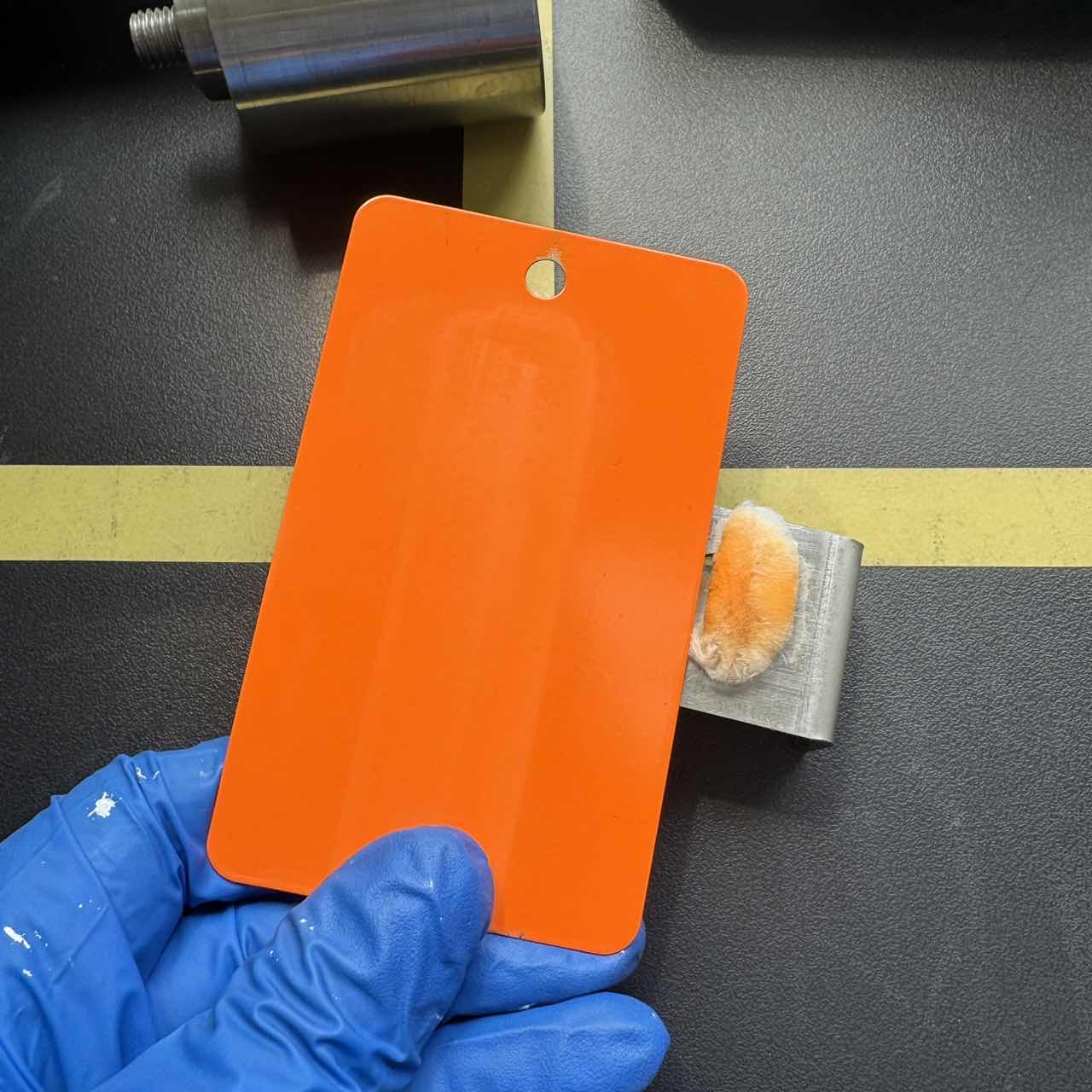
Future outlook
Two forces are reshaping architectural coating specifications. The first is sustainability documentation. The ISCC PLUS certification held for polyester powder coating under EN 15343, and a product carbon footprint verified to ISO 14067:2018 and PAS 2050:2011, move the conversation from a general "eco-friendly" claim to a traceable chain-of-custody and carbon accounting trail that specifiers on public and commercial projects can file. The second is the continuing shift from liquid to powder systems on durability and emissions grounds, which is consistent with thermoset powder coatings holding a 76.6% share of the market in 2026 and with architectural and decorative applications remaining a major end-use segment.
China's coatings industry exported 334,800 tons in 2024, an 18.65% year-on-year increase in value to USD 1.065 billion — a signal that Asian supply is becoming a mainstream rather than a fallback option in architectural procurement. For buyers, that increases rather than reduces the value of a disciplined evaluation: verified certification, published test standards, a defined cure window, and a confirmed capacity plan.
FAQ
Which powder coating is specified for exterior aluminum curtain walls, doors and windows?
The exterior architectural grade is an aluminum powder coating built on super weather-resistant polyester resin with a TGIC curing agent and applied at a nominal 70 μm film cured at 180–200 °C for 10–15 minutes. Its published evidence includes 1000-hour salt spray resistance to ISO 7253:1996 with unilateral cross-section corrosion ≤2 mm, 1000-hour weathering to ISO 11341:2004 with no powdering and light retention above 50%, and one year of Florida natural exposure with gloss retention above 50%. It is also designated in the product data as a Qualicoat and AAMA type coating.
Is a sandy or a smooth finish better for aluminum profiles?
They serve different purposes. Sandy powder coating is applied at the same 70 μm nominal film and its texture scatters light, which masks extrusion lines, die marks and minor handling marks on long profiles. Its published exposure data is 500 hours of salt spray and 500 hours of weathering, whereas the super weather-resistant aluminum grade is published at 1000 hours for both. Where a project requires texture together with the longer exposure envelope, the specific grade should be confirmed rather than inferred from the resin type.
What film thickness and particle characteristics should be specified?
Across the aluminum, sandy, metallic, hammer tone and wrinkle specifications, the nominal dry film thickness is 70 μm. Related published parameters are an average particle size of 32–42 μm, a specific gravity of 1.2–1.7, and coverage of 8–10 square metres per kilogram at 30–90 μm film thickness. Application is by tribo gun or electrostatic spray gun.
What curing schedule and gloss range apply to metallic powder coating?
Metallic powder coating is a bonded polyester system cured at 180–200 °C for 10–15 minutes, applied at 70 μm, with a gloss range of 5%–95% measured to ISO 2813:2014. Its other published results are impact 50 kg/cm to ISO 6272-1:2017, bending ≤2 mm, cupping ≥6 mm, adhesion grade 0, hardness ≥H, 500-hour salt spray resistance and 500-hour weathering with light retention above 50%. It is documented for aluminum alloy doors and windows, curtain walls, architectural decorative profiles and outdoor fences.
Which powder coatings suit interior furniture and hardware instead?
Three finishes dominate interior specification. Wrinkle powder coating is used on steel and wood furniture, filing cabinets, security doors, machine tools, motor housings, instruments, electrical cabinets and tools, where the dense texture covers casting defects and provides corrosion and anti-slip behaviour. Hammer tone powder coating, applied at 70 μm with 32–42 μm particle size, is used on bench vises, wrenches, saw-blade handles, safes, radiators, lighting fixtures, aluminum profile doors and windows, streetlight poles and shelving. Glossy polyester, with a 5%–95% gloss range and 500-hour weathering data, is used on railings, outdoor furniture, appliance housings and industrial machinery. Matt powder coating, at 5%–30% gloss to ISO 2813:2014, is used where glare reduction and scratch masking matter, such as appliance housings, computer casings and automotive interior parts.
Are epoxy and hybrid powder coatings suitable for exterior architectural aluminum?
No. In the product data, pure epoxy anti-corrosion powder coating and epoxy-polyester hybrid powder coating are classified as indoor coatings and pipe coatings, with 500-hour salt spray resistance and no weathering claim. They are documented for oil and gas pipelines, water supply systems, valves, steel reinforcement bars, electrical insulation components, appliance housings, office furniture and automotive interior parts. UV-exposed facades should use a polyester-based exterior grade instead.
What should a buyer verify in an architectural powder coating supplier?
Verification should combine certificates and capacity. Relevant documents include ISO 9001:2015 (certificate 2052025Q00440R0S, valid to 23 November 2028), ISO 14001:2015 (2052025E00271R3S, valid to 23 November 2028), ISCC PLUS (ISCC-PLUS-Cert-CN198-41261025, EN 15343, valid 26 June 2026 to 25 June 2027 for polyester powder coating), REACH SVHC report CKGIN25000923901, RoHS report CKGEC25000071901, FDA 21 CFR 175.300 report TSNPC25004542302, carbon footprint certificate TZJ136660053R0S to ISO 14067:2018 and PAS 2050:2011, and antibacterial test report ASH25-0055689-02 to ISO 22196:2011. Capacity checks include factory size, production lines, monthly capacity, lead time, minimum order quantity and whether testing is performed at 100%.
A downloadable technical reference covering these product specifications and parameters is available here: Hsinda powder coating product brochure (PDF). Manufacturer information is published at www.hsinda.com.