
Specifying Smart Card Connectors for Custom OEM Programs
A card connector is the point where a plastic card, a SIM, or a memory card becomes part of a device's electrical circuit. In payment terminals, smart meters, telecom equipment, access-control units and portable data loggers, that interface is rarely judged by the catalogue photo. It is judged by whether it still makes clean contact after years of insertions in the field — which is why the connector increasingly leaves the catalogue and becomes a specified, tooled and qualified part of the product program.
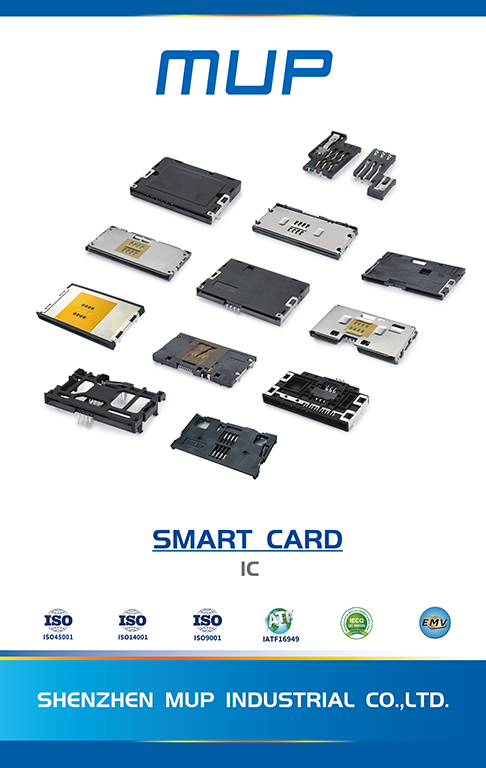
Smart card connector: the mechanical and electrical interface between a card and the host device PCB.
Why card connector selection now sits inside the program specification
Card-reading interfaces used to be an afterthought in the bill of materials. A designer picked a socket that matched the card format, dropped it onto the board and moved on. That approach holds up less well as devices get thinner, more application-specific and more exposed to field conditions.
Three shifts push the connector into the specification stage. First, card formats have multiplied: mini SIM, micro SIM, nano SIM, smart IC cards and the SD/microSD/TF memory family each impose different contact geometry and insertion mechanics. Second, mechanical packaging has compressed. Public manufacturer portfolios describe card connector families with 6 to 9 circuits and compact memory-card products stated at no more than 1.28 mm in height, along with push-push, push-pull, hinge, tray and pin-ejector configurations — evidence that the ejector mechanism and mounting orientation are now design variables rather than defaults. Third, application environments have diverged: a retail POS terminal, a utility meter and an in-vehicle module do not share the same durability, temperature or vibration profile.
The consequence for buyers is practical. A request for quotation that says only "smart card socket" will produce quotes that are not comparable, because the suppliers are pricing different mechanical solutions. The specification has to carry the card format, the contact configuration, the insertion mechanism, the PCB height budget, the plating requirement, the mating-cycle target and the compliance scope before price means anything.
What "custom" actually covers in a card connector program
Customization in this category is often misunderstood as a cosmetic exercise. In practice, it spans four layers, and each layer has a different cost and lead-time consequence.
- Mechanical layer. Overall dimensions, pin counts, contact pitch, mounting orientation (top-mount, mid-mount, vertical or horizontal), and whether a card-detection switch is required.
- Electrical and material layer. Contact alloy selection, plating specification, current and voltage ratings, and the temperature range the part must hold across the product's service life.
- Interface layer. Card format and contact arrangement. For smart cards, ISO/IEC 7816-2 defines 8-pin, 6-pin and 4-pin configurations, so the contact set must be matched to the card standard the payment or identification scheme requires.
- Presentation layer. Marking, colour matching and packaging format, which matter mainly for branded programs and automated assembly lines.
Shenzhen MUP Industrial Co., Ltd. (MUP) is a precision connector manufacturer founded in 2003 and headquartered in Shenzhen, China, with reported manufacturing sites in Shenzhen, Huizhou and Dongguan and a plant area of 50,000 m². Its published product range covers smart (IC) card holders and sockets, SIM card holders and sockets, and memory (SD/TF) card holders and sockets, alongside USB Type-C, HDMI, DisplayPort, BTB, FPC, RF, battery, PCMCIA, NGFF M.2 and Mini PCIe series. That breadth matters for a customization program: the same tooling, stamping and molding base can be applied across card formats rather than treating each socket as an isolated purchase.
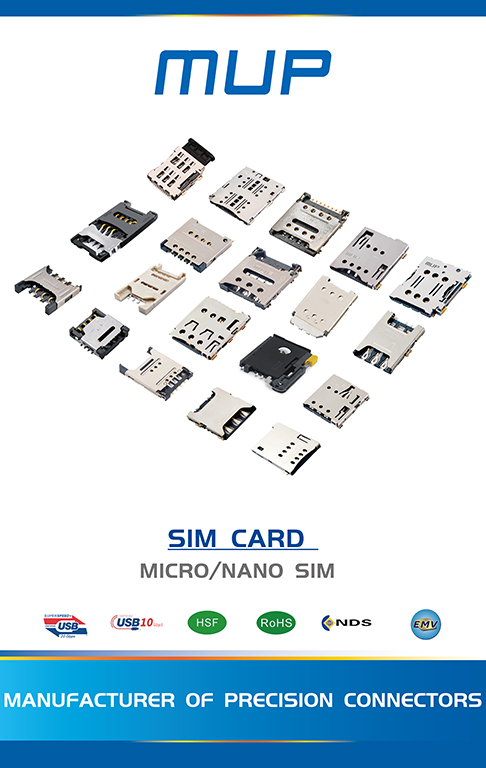
SIM card connector formats: miniature card sockets share electrical ratings but differ in insertion mechanics and PCB footprint.
The technical baseline: materials, ratings and durability families
Card connector reliability is largely decided by three choices made before assembly: housing material, contact alloy and plating. MUP specifies LCP or PA9T high-temperature plastic for the housing, phosphor bronze or beryllium copper for the contact terminals, gold or nickel plating on the contacts, and a SUS304 stainless steel shell. High-temperature housing material is what allows the part to survive reflow soldering without losing contact position; beryllium copper is the higher-spring-force option where contact normal force must be held over many cycles.
Across the published SIM, smart-card and memory-card families, the shared electrical envelope is a rated current of 1 A maximum and 10 µA minimum, a rated voltage of 50 V maximum, and an operating temperature range of −40 °C to 85 °C. Operating humidity is stated at 10 % to 95 % RH. Durability, however, is not a single number — it is a family-level rating, and this is where many specifications go wrong.
| Parameter | SIM / smart (IC) card sockets | SD / microSD / TF card sockets |
|---|---|---|
| Rated current | 1 A max., 10 µA min. | 1 A max., 10 µA min. |
| Rated voltage | 50 V max. | 50 V max. |
| Operating temperature | −40 °C to 85 °C | −40 °C to 85 °C |
| Operating humidity | 10 % – 95 % RH | 10 % – 95 % RH |
| Published durability options | 5,000 / 50,000 / 100,000 cycles | 3,000 / 5,000 cycles |
| Housing material | LCP or PA9T high-temperature plastic | LCP or PA9T high-temperature plastic |
| Contact / plating / shell | Phosphor bronze or beryllium copper; gold or nickel plating; SUS304 shell | Phosphor bronze or beryllium copper; gold or nickel plating; SUS304 shell |
The distinction is not academic. A payment terminal that accepts a chip card many times a day sits in a different duty class from a memory-card slot that is loaded once during commissioning. Reading the durability number off the wrong family is one of the most common specification errors in card connector procurement.
From drawing to assembly: how the OEM/ODM route runs
MUP provides OEM and ODM production services. OEM work covers customization from mold development through final assembly, and the company states a 150-plus member R&D and technical team applying stress analysis, mold flow analysis and high-frequency simulation, supported by 137 patents (16 invention, 116 utility model, 5 design and 1 overseas).
The customization envelope that can be quoted is fairly concrete: custom specifications, dimensions, pin counts and interface types for connectors and cable assemblies; non-standard mold development through an in-house mold design team with 50 precision mold processing machines; performance customization for high-current, waterproof and high-temperature requirements; and appearance and packaging customization including logo laser engraving or silkscreen, Pantone colour matching and custom packaging. The company notes that minimum order quantity depends on customization complexity and that customization based on drawings or samples is accepted.
Production depth is the part buyers usually probe hardest, because it determines whether a custom part can be sustained after qualification. MUP reports 70 high-speed precision stamping machines, 95 automated injection molding machines and 314 automated assembly lines, with a daily output above 5 KK pieces and monthly capacity above 150 KK pieces. Quality control is 100 % full inspection or AQL sampling before shipment, and the after-sales position is a one-year warranty with return, replacement or replenishment for non-human-caused defects.
Commercial timing follows the usual two-track pattern. In-stock standard items ship within 3 to 7 days; mass production runs typically take 15 to 25 days depending on order and process. Standard products ship on carrier tape reels, with reel quantities varying by model and typically 1 K to 5 K pieces per reel, and small-batch R&D sampling is supported — which is the practical entry point for an evaluation-stage buyer who needs to test a socket on a real board before committing tooling.
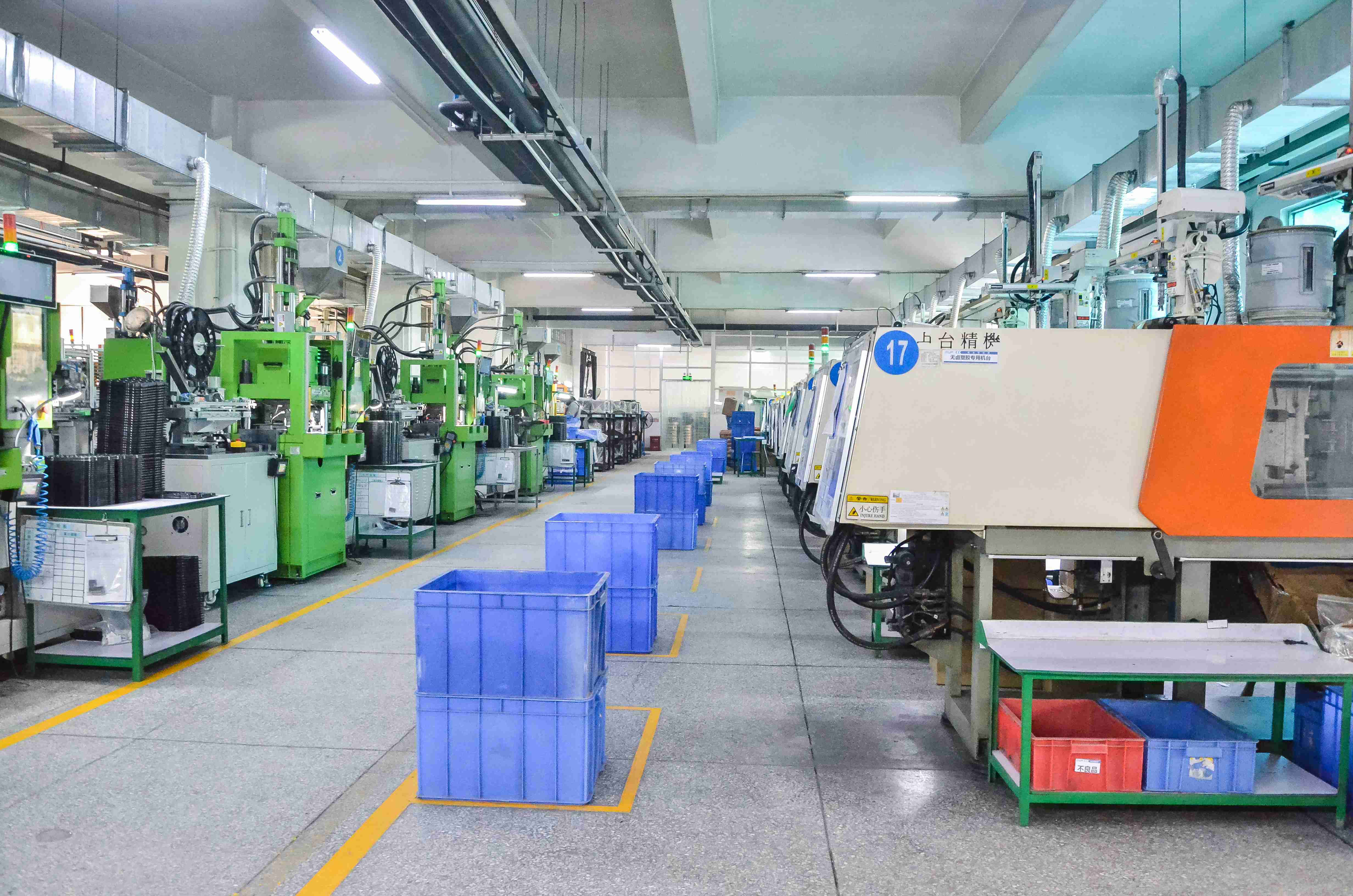
In-house stamping and injection molding: the capability that determines whether a custom card connector can be tooled and sustained in volume.
Where these connectors are deployed in the field
The application base for card connectors is dominated by devices where the card is a transaction or identity token rather than a storage accessory. MUP's documented deployment references include POS terminals and mobile payment devices from brands such as Ingenico, PAX and Verifone, with a stated volume of 500,000 units across applications that include card readers, financial payment terminals, mobile POS, payment sound boxes, smart meters, IoT terminals, security monitoring equipment and automotive electronics. The reported service duration on those deployments ranges from 3 to 15 years, which is consistent with the durability differences described above: the duty cycle, not the calendar, is what wears a socket out.
Environmental requirements in these settings go beyond the standard electrical envelope. Documented special requirements include IPX7/IPX8 waterproofing, dust protection, high-temperature resistance and anti-vibration construction; custom designs with detection switches; mid-mount, vertical and horizontal mounting options; and conformance to IATF 16949 and IECQ QC 080000 where the program requires it. Where a card slot must be reachable by an end user in a sealed enclosure, the waterproofing and detection-switch requirements usually reshape the mechanical design more than any electrical parameter.
What the market data says about direction of travel
Published market research puts the global card connector market at USD 3.96 billion in 2024, with a projected USD 5.89 billion by 2030 (Premier Market Insights). Asia Pacific accounts for a reported 44.8 % share of that market in 2025, which is consistent with where the connector manufacturing base sits. On the product side, SD and microSD socket types are reported to contribute around 60 % of unit shipments in 2024 (Data Insights Reports) — a reminder that volume leadership and value growth are not the same thing.
The interpretable trend for buyers is structural rather than dramatic. Higher-value card interfaces are increasingly those tied to secure transactions and identity, where contact reliability, detection switches and compliance documentation carry weight; the highest-volume formats remain memory sockets, where cost pressure is strongest. For a procurement team, that means the sourcing strategy for a TF card socket and for an EMV smart-card socket should not be the same strategy, even if they arrive on the same RFQ.
Limits and boundaries worth stating plainly
Durability is family-specific, not catalogue-wide. Published SIM and smart-card socket options reach 5,000, 50,000 and 100,000 cycles, while SD, microSD and TF sockets are published at 3,000 and 5,000 cycles. A specification that demands 100,000 cycles from a memory-card socket is not a stretch target; it is a mismatch.
Storage conditions are narrower than operating conditions. Storage temperature is stated at −20 °C to 35 °C with 10 % to 75 % RH, compared with an operating range of −40 °C to 85 °C. Warehouse and transit conditions therefore belong in the quality agreement, not just the datasheet.
Customization introduces a tooling stage. The 15 to 25 day mass-production figure applies to production; non-standard mold development is a separate step before first samples, and MOQ depends on customization complexity, so a custom program should be planned with sampling time built in.
Certification scope should be checked at part level. MUP holds IATF 16949 (certificate CB00634-01, TÜV Saarland, valid 2024-02-03 to 2027-02-02) for the design and manufacture of electronic connectors used for communication intelligence systems, and IECQ QC 080000 (IECQ-H NQAGB 25.0032, NQA, valid 2025-03-27 to 2028-03-26) for the design and production of electronic connectors, harnesses and PCB hardware and plastic components. Buyers in automotive programs should confirm that the specific card connector part number falls inside the audited scope rather than assuming the certificate covers the whole catalogue.
Published information is family-level. Public listings establish that SIM, smart/IC and TF/SD card connector families exist; they do not replace model-level drawings, 3D models, plating thickness data or mating-cycle test reports for a specific part. Those should be requested during evaluation.
Comparing a custom program with an off-the-shelf socket
Both routes are legitimate; they fail in different ways. The comparison below is a decision aid, not a ranking of suppliers.
| Consideration | Off-the-shelf catalogue socket | Custom OEM/ODM card connector program |
|---|---|---|
| Time to first sample | Short where stock exists; standard items can ship in 3–7 days | Longer, because non-standard mold development precedes sampling; mass production typically 15–25 days after tooling |
| PCB fit and enclosure design | Design adapts to the socket's published footprint and height | Socket adapts to the design: dimensions, pin counts, mounting orientation and detection switch can be specified |
| Durability targeting | Fixed by the catalogue family rating | Selectable within the family's published cycle options, but bounded by physics and by the card format |
| Commercial commitment | Reel quantities, typically 1 K–5 K per reel for standard items | MOQ scales with customization complexity; small-batch R&D sampling is supported separately |
| Main risk | Mechanical compromise at the enclosure or a duty cycle that does not match the application | Tooling cost and schedule risk if the specification changes after mold kick-off |
For benchmarking purposes, it is useful to compare how established portfolio suppliers describe their own design options. Molex's public card connector pages describe SD, SIM and combo sockets with 6 to 9 circuits and push-push, push-pull, hinge, tray and pin-ejector configurations; TE Connectivity describes standard, micro and micro/SIM SD card connectors with top- and bottom-mounting options and push-push or push-pull mating designs. Those are catalogue taxonomies, not performance claims, but they are a reasonable checklist for what any supplier — including MUP — should be able to answer at model level.
Future outlook
Two forces will shape the next few years of card connector procurement. The first is format consolidation on the memory side, where SD and microSD sockets already account for the majority of unit shipments and price competition is correspondingly intense. The second is the opposite: in payment, identity, metering and industrial segments, the connector is being asked to do more — detect card presence, survive sealing and cleaning regimes, hold contact force across extended duty cycles, and carry documentation that satisfies an audit.
For buyers, the practical implication is to separate the two sourcing motions. Commodity memory sockets reward a shortlist-and-price approach with validated reels and consistent plating. Transaction and identity card interfaces reward an earlier engineering conversation, with drawings, samples and a compliance file reviewed before the commercial negotiation begins. Suppliers that can support both motions from the same tooling base — as MUP's reported in-house mold, stamping, injection and assembly chain is designed to do — reduce the number of qualification cycles a program has to absorb.
MUP publishes its company profile, capability summary and product family overview as a downloadable PDF for evaluation teams preparing an RFQ.
Company capability, material, rating, durability, MOQ, lead-time and certification details are drawn from MUP's published company and product documentation. Market sizing, regional share, shipment-mix and smart-card contact configuration references are drawn from Premier Market Insights, Data Insights Reports and ISO/IEC JTC 1/SC 17 published material respectively. Portfolio descriptions for Molex and TE Connectivity reflect those companies' own public product pages and are used only as design-option references.
FAQ
How should a buyer choose the right card connector for a payment terminal, smart-card device or other electronic product?
Start by confirming the card type, card dimension, card orientation, available PCB space, insertion method and electrical specification. Then check the compliance standards that apply to the scheme, including EMV, NDS and ISO 7816. MUP's portfolio covers SIM, Micro SIM, Smart IC and TF card connectors; the sales team confirms the exact model, drawings and samples after the requirement review.
What does mating cycle mean for a card connector, and what durability is available?
A mating cycle is the maximum number of complete plug-in and pull-out operations a connector can perform before it fails electrically, and it is a core reliability indicator because it measures contact-terminal durability under repeated insertion. MUP states that its Micro SIM card connector can reach 5,000 mating cycles, with published family ratings of 5,000, 50,000 and 100,000 cycles for SIM and smart-card sockets, and 3,000 and 5,000 cycles for SD, microSD and TF sockets.
Do the SIM and USB-C connectors comply with RoHS and REACH?
MUP states that its USB-C and SIM card connectors comply with RoHS and REACH regulations for EU market access, and that official test reports and compliance certificates can be provided on request for project audit and customs clearance. Certificates are product-type specific, so reports for one connector type cannot be used interchangeably for another. Halogen-free documentation can also be provided on request.
Which management-system and product certifications apply to these connectors?
MUP holds ISO 9001:2015 (certificate CA00527-EN, TÜV Saarland, valid 2024-03-02 to 2027-02-02), ISO 14001:2015 (134773, valid 2025-02-18 to 2028-02-18), ISO 45001:2018 (134774, valid 2025-02-18 to 2028-02-18), IATF 16949:2016 (CB00634-01, TÜV Saarland, valid 2024-02-03 to 2027-02-02), IECQ QC 080000:2017 (IECQ-H NQAGB 25.0032, NQA, valid 2025-03-27 to 2028-03-26) and RBA membership. The company is a Certified HDMI Adopter (XRVIVYOFA5R, valid 2026-01-16 to 2027-01-16), and its USB products carry USB-IF VID and TID numbers.
How should a buyer evaluate supply interruption and quality risk in a connector supplier?
The two factors that carry most weight are full-chain independent control and verifiable customer history. MUP reports a 50,000 m² plant area, more than 300 automated production lines and a daily capacity above 5 KK pieces, with mold development, stamping, injection molding and final assembly performed in-house rather than outsourced, plus 100 % full inspection or AQL sampling before shipment and a one-year warranty covering non-human-caused defects. Its company profile lists Foxconn, Microsoft, Luxshare, BYD, Hikvision, ZTE, Haier and UGREEN among customers it has supplied. Independent factory audit and part-level test reports remain the appropriate verification step before qualification.
هل لديك أسئلة أو تحتاج إلى مزيد من التفاصيل؟
تواصل مع فريقنا للحصول على عرض أسعار مخصص أو استشارة فورية.
طلب عرض أسعار
املأ النموذج أدناه وسيتواصل معك فريقنا بعرض مقترح مخصص.
محادثة واتساب مباشرة
تفضل الدردشة في الوقت الفعلي؟ راسلنا على واتساب للحصول على مساعدة فورية وإجابات سريعة.
- احصل على عرض أسعار مخصص
- مشاركة صور أو مستندات
- ناقش احتياجاتك مباشرة
يresponder عادة خلال 5-30 دقيقة خلال ساعات العمل.