
Specifying Stainless Steel Press Fittings: Models and Materials
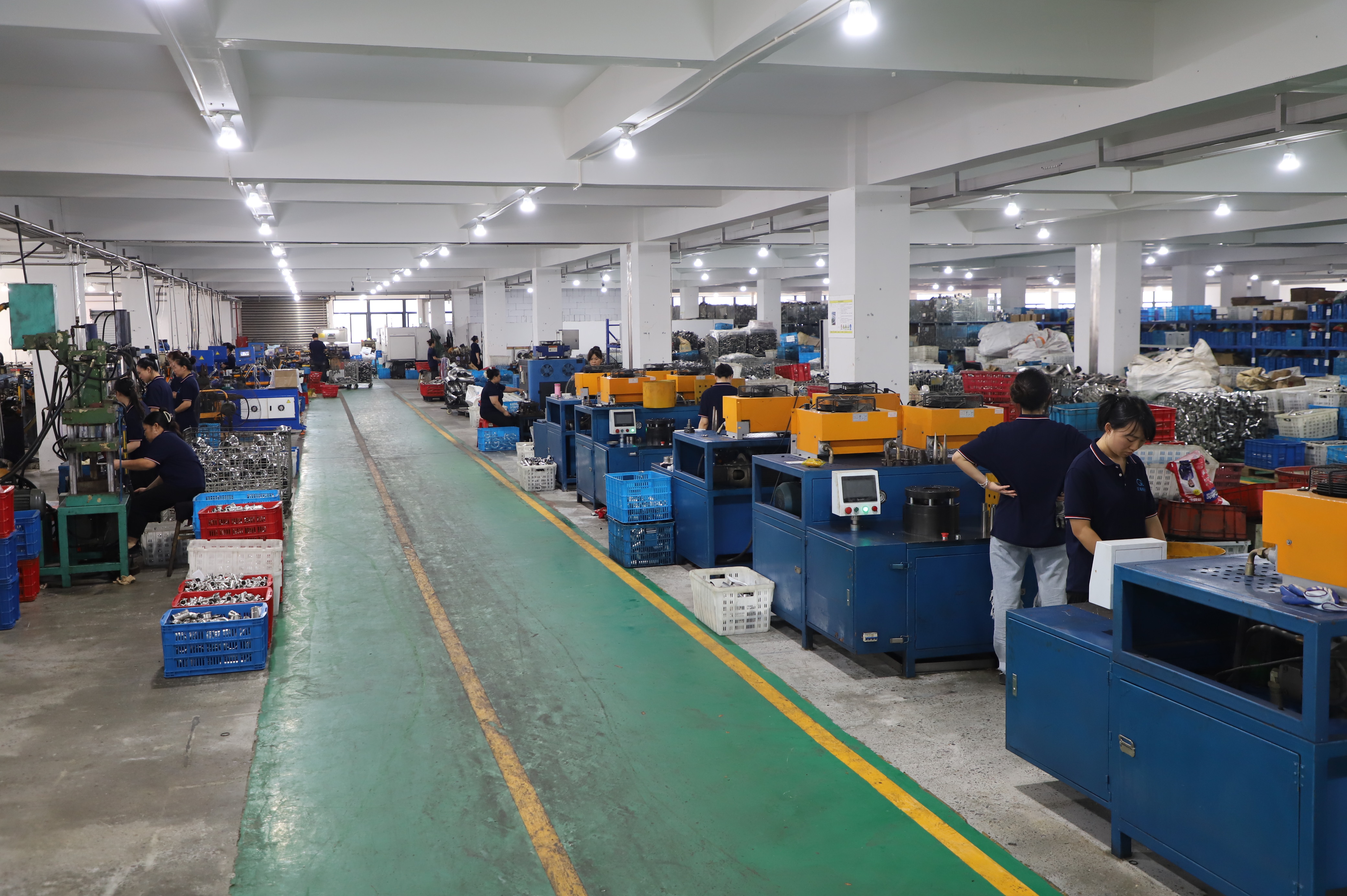
Stainless steel press fitting production environment. Fitting selection is a document decision before it becomes a site decision.
A stainless steel press fitting is a pipe connector that is joined to a stainless steel tube by cold radial compression with a matched press tool, without welding, threading or an open flame at the joint. That single characteristic explains much of the category's momentum: a connection is completed in seconds, and the joint is expected to stay sealed for the life of the building.
The market data points the same way. The global stainless steel press fitting market was valued at USD 3.8 billion in 2025 and is projected to reach USD 6.4 billion by 2034, a compound annual growth rate of 6.0% (Dataintelo, 2026). Independent research places the stainless steel sub-sector at approximately USD 1.03–1.30 billion in 2024 (Global Industry Reports). Growth of that scale changes the buying question. Fewer projects now ask whether press fittings belong in the specification; more ask which lines, which materials and which seals should appear on the shortlist.
The specification problem: three connection families in one package
A building services package can call for more than one fitting family at the same time. High-pressure and high-temperature branches, domestic water and gas distribution, and European-standard plumbing installations each pull the specification in a different direction. Treating them as one interchangeable item is where most procurement errors begin.
In practice, the errors rarely come from choosing the wrong supplier. They come from moving a model number from one project to another without re-checking five variables: connection type, dimensional and product standard, pressure and temperature envelope, base material grade, and sealing material. A GB Series double-press fitting and an EN Standard press fitting can look interchangeable on a drawing; what actually decides between them is the piping standard of the project, the market the project is delivered in, and the press tooling already on site.
The shortlist at a glance
Three product lines cover the practical range. The table below summarises the published specification of each line; the sections that follow explain what each parameter means for a buyer.
| Product line and types | Model / series | Connection and cited standard | Size, pressure and temperature | Material and sealing |
|---|---|---|---|---|
| Socket weld 90° elbow, socket weld full coupling, socket weld equal tee | Socket Weld Series | Socket weld (welded joint); manufactured to GB/T 14383-2021, compatible with ASME B16.11 | DN6–DN100 (NPS 1/8''–4''); Class 3000#, 6000#, 9000#; −20 ℃ to +450 ℃ | 304 / 316L stainless steel; forged |
| Press-fit elbow, press-fit coupling, press-fit tee | GB Series press Fittings (double-press) | Double-press, no welding; CE certified, EN 10312 cited | DN15 (φ16)–DN100 (φ108); 1.6 MPa cold water, 1.0 MPa hot water ≤95 ℃; −20 ℃ to 95 ℃, high-temperature model −40 ℃ to 120 ℃ | 304 (06Cr19Ni10) / 316L (022Cr17Ni12Mo2); food-grade silicone (FDA certified) or EPDM |
| Press-fit elbow, press-fit coupling, press-fit tee | EN Standard Series (single press-fit) | Press-fit, no welding; CE certified, EN 10312 cited | DN15 (φ16)–DN100 (φ108); 1.6 MPa cold water, 1.0 MPa hot water ≤95 ℃; −20 ℃ to 95 ℃, high-temperature model −40 ℃ to 120 ℃ | 304 (06Cr19Ni10) / 316L (022Cr17Ni12Mo2); food-grade silicone (FDA certified) or EPDM |
Line 1 — Socket weld fittings: 90° elbow, full coupling, equal tee
Socket weld fittings are the high-duty option on the shortlist. The range covers a socket weld 90° elbow, a socket weld full coupling and a socket weld equal tee, forged in 304 or 316L stainless steel, in DN6–DN100 (NPS 1/8''–4'') and in Class 3000#, Class 6000# and Class 9000#. The parts are manufactured in accordance with GB/T 14383-2021 and are compatible with ASME B16.11.
The technical profile is what justifies their place on a mixed specification. Forged integral forming gives high mechanical strength for high-pressure and high-temperature working conditions, and the working temperature range runs from −20 ℃ to +450 ℃. Applicable media include water, oil, gas and steam, which is why these fittings also appear in chemical industrial piping. The socket geometry is sized precisely so that the pipe aligns easily during assembly, the welded connection resists vibration with a low leakage risk over long operation, and the smooth inner bore keeps flow resistance low.
Where they earn their place: direct-drinking water systems, urban residential buildings, gas supply systems and public constructions, particularly on branches where pressure classes above the press-fit envelope are specified.
Line 2 — GB Double-press Fittings (GB Series press Fittings)
The GB Series is the double-press line: press-fit elbow, press-fit coupling and press-fit tee. Base material is 304 stainless steel (06Cr19Ni10) or 316L stainless steel (022Cr17Ni12Mo2). Suitable pipe outer diameter runs from DN15 (φ16) to DN100 (φ108). Working pressure is 1.6 MPa for cold water and 1.0 MPa for hot water at ≤95 ℃. Working temperature is −20 ℃ to 95 ℃ for the ordinary model and −40 ℃ to 120 ℃ for the high-temperature resistant model, which requires replacement of the sealing ring.
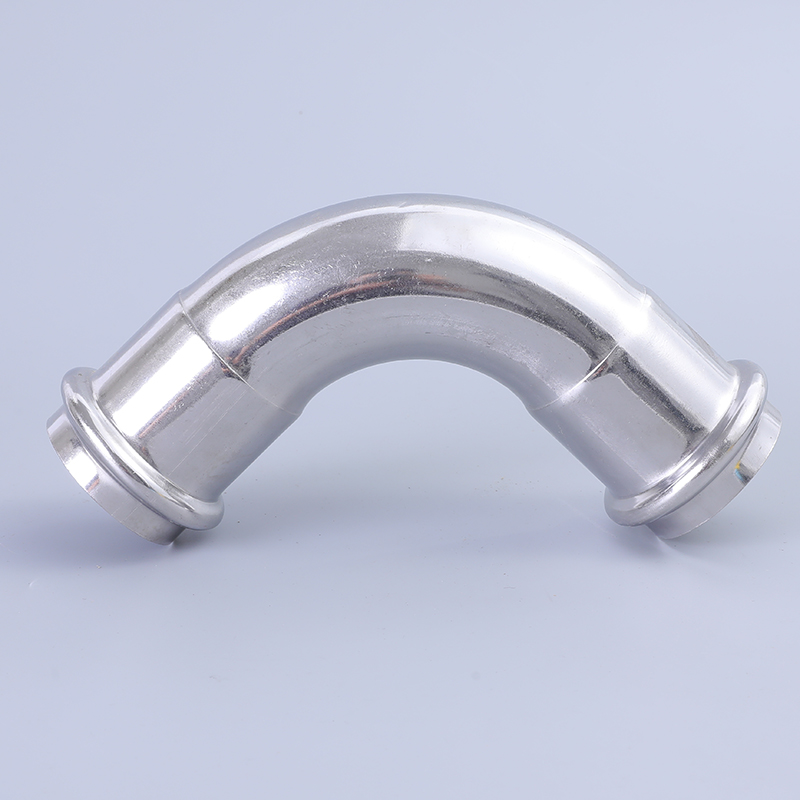
GB Double-press Elbow. The double-press connection requires no welding and is specified for a leak-proof, maintenance-free service life matching the building.
The commercial argument for this line is installation behaviour rather than metallurgy. The double-press connection needs no welding, delivers a reliable and leak-proof joint, and is specified for a service life matching the service life of the building, maintenance-free, with lower long-term operating cost. Corrosion resistance comes from the 304 or 316L body; the line is CE certified and cites EN 10312. The EPDM sealing ring is described as suitable for potable water and gas supply systems, and the assembly is hygienic and clean for direct-drinking water application. High pressure resistance and resistance to thermal expansion and contraction are part of the published profile, alongside strong mass-production capacity with a stable lead time.
Target industries for the series are urban residential buildings, gas supply systems and public constructions.
Line 3 — EN Standard press fittings (EN Standard Series)
The EN Standard Series is the European-standard press-fit line, supplied as press-fit elbow, press-fit coupling and press-fit tee. Its published dimensional, pressure and temperature envelope matches the GB Series: 304 (06Cr19Ni10) or 316L (022Cr17Ni12Mo2), DN15 (φ16) to DN100 (φ108), 1.6 MPa cold water and 1.0 MPa hot water at ≤95 ℃, −20 ℃ to 95 ℃ standard and −40 ℃ to 120 ℃ on the high-temperature model with sealing ring replacement. Sealing options are the same two: food-grade silicone (FDA certified) or EPDM, temperature and oil resistant.
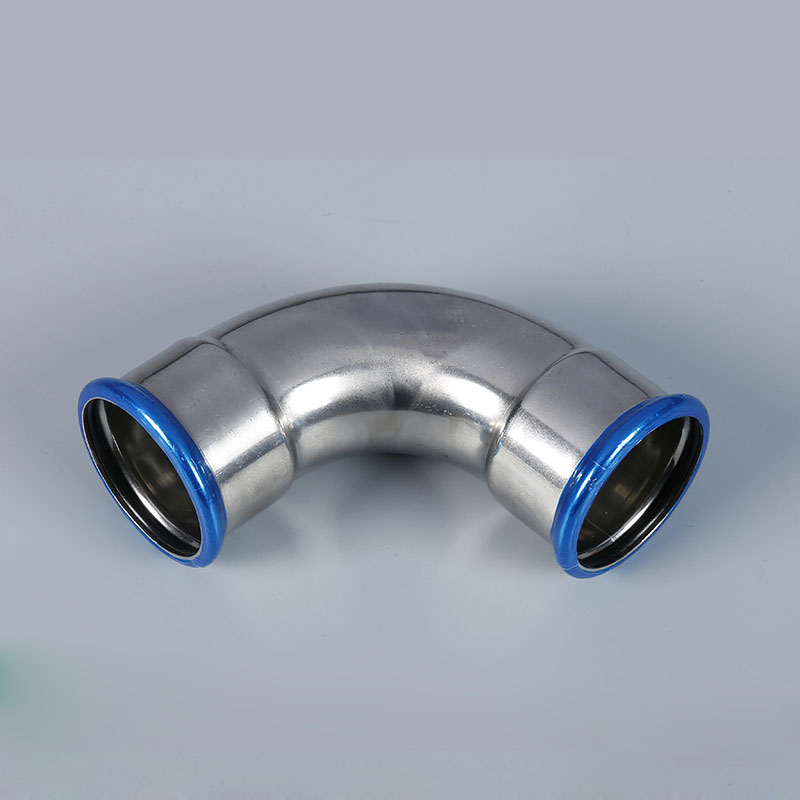
Stainless Steel Press-Fit 90 Degree Elbow. The EN Standard Series is supplied for European plumbing installations in stainless steel pipe systems.
The distinguishing point is market fit rather than numbers. These fittings are supplied for stainless steel pipe systems in building construction and are used in residential buildings, public construction, hotels and hospitals for water distribution and gas conveying. They are CE certified, cite EN 10312, and are listed for direct-drinking water systems as well as urban residential buildings, gas supply systems and public constructions.
Choosing between the two press-fit lines therefore rests on three questions: which piping standard the project is being delivered against, which market the installation sits in, and which press tools and jaws the installing contractor already owns. Where a project mixes GB and EN scope, keeping both series in the package from one manufacturer avoids mixing dimensional conventions on site.
Material grade: say 304 (06Cr19Ni10) or 316L (022Cr17Ni12Mo2), not 'stainless steel'
Both press-fit series and the socket weld range are available in 304 stainless steel (06Cr19Ni10) and 316L stainless steel (022Cr17Ni12Mo2). The grade belongs in the specification line next to the model, not in a general note, because it is the parameter that survives longest in a project file and the one least likely to be re-checked at the point of order.
For projects documented to Chinese national standards, writing the Chinese designation alongside the AISI grade removes a recurring source of confusion between the drawing set and the purchase order. Material is also one of the confirmed customization fields for OEM and ODM supply, together with logo, size and packaging, so grade changes can be handled within a single supplier relationship rather than by splitting the package.
Sealing material: FDA-certified silicone or EPDM
Two sealing materials are offered across the press-fit lines. Food-grade silicone is FDA certified. EPDM (ethylene propylene diene monomer) is specified for temperature and oil resistance, and is the seal described as suitable for potable water and gas supply systems.
The seal is also the component that governs temperature headroom. The ordinary press-fit model is rated −20 ℃ to 95 ℃; reaching −40 ℃ to 120 ℃ requires the high-temperature resistant model with the sealing ring replaced. That makes the seal a specification decision with a temperature consequence, not an accessory. It is also the first component to inspect when a joint weeps, since a damaged, aged or improperly assembled gasket is one of the documented causes of press-fit leakage.
The double-press connection: no welding, no maintenance
The GB Series uses a double-press connection. The joint is formed mechanically, with no welding required, and the published service expectation is a leak-proof, maintenance-free life matching the building's own. The company frames the same commitment as 'century-long maintenance-free performance' within its service philosophy.
Installation follows a fixed sequence, and the sequence is what protects the warranty position:
- Cut the stainless steel pipe squarely and deburr the inner and outer edges thoroughly.
- Mark the insertion depth on the pipe surface.
- Insert the pipe fully into the fitting socket up to the marked depth.
- Place the correct tool jaws around the press-fit groove position.
- Press until the tool jaws close completely.
- Pressure-test the installed system to confirm no leakage.
Matched press-fit jaws must be used for the corresponding sizes. Improper cutting, incomplete insertion or a wrong jaw position creates leakage risk, and proper PPE is required during the pressing operation.
Where the shortlist fits: application profile
The application profile is consistent across the press-fit lines. Typical projects are residential buildings, public constructions, hotels and hospitals. The function is water distribution, gas conveying and drinking-water pipeline connection. Operating conditions are potable water, gas transmission and corrosion-resistant environments, and the systems run continuously, 24/7. Special requirements are leak-proof performance, corrosion resistance and potable-water hygiene.
Supporting equipment matters as much as the fitting itself: stainless steel pipes, press-fit tools and EPDM sealing gaskets. This application profile is common in Brazil, Germany, Spain, France, Indonesia, Italy, Kazakhstan, Malaysia, Norway, Thailand, Taiwan and Vietnam.
A documented project illustrates the pattern. A potable water plumbing installation using 12,000 pieces of the EN Standard press fitting range, supplied to plumbing distributors and construction contractors across Australia, Belarus, Germany, Spain, France, the United Kingdom, Indonesia, Italy, Russia, Thailand and Taiwan, recorded corrosion-resistant and leak-free pipeline operation over a service history of 15+ years. The reported outcome was attributed to fast installation without welding combined with a long service life.
Market trend: what is shifting in European specification practice
Three developments are visible in the available data, and each has a direct bearing on how a shortlist should be written.
First, scale. A market moving from USD 3.8 billion in 2025 toward USD 6.4 billion by 2034 at a 6.0% CAGR (Dataintelo) implies volume growth in exactly the potable water, gas and HVAC segments where press fittings compete with welded and threaded work. Volume growth usually brings more suppliers rather than fewer, which raises the value of documented standards on the submittal.
Second, pressing geometry. M Profile and V Profile are the two dominant pressing geometries in Europe, with M Profile available up to 168.3 mm diameter (Eurotubi). The same source notes that the choice between M and V is often a matter of habit, since both are valid and comply with the same regulations. For buyers the practical consequence is tool compatibility: the profile and jaw set already in the contractor's inventory should be confirmed before an order is placed, because a compliant fitting pressed with a mismatched jaw is still a defective joint.
Third, the standards layer. Stainless steel press fittings for pressure purposes are required to comply with EN 10217-7 for welded tubes and EN 10312 for plumbing (Isotubi technical documentation). A specification that cites the fitting series but not the tube standard leaves the two halves of the joint governed by different documents.
Comparison with traditional solutions — and where press fittings stop
The three shortlisted lines are not substitutes for one another, and a useful comparison states the boundary as clearly as the advantage.
| Criterion | Socket weld fittings | GB Double-press (GB Series) | EN Standard press fittings |
|---|---|---|---|
| Joining method | Welded socket joint | Double-press, no welding | Press-fit, no welding |
| Pressure and temperature ceiling | Class 3000# / 6000# / 9000#, −20 ℃ to +450 ℃ | 1.6 MPa cold water, 1.0 MPa hot water ≤95 ℃, −20 ℃ to 95 ℃; −40 ℃ to 120 ℃ with high-temperature model | 1.6 MPa cold water, 1.0 MPa hot water ≤95 ℃, −20 ℃ to 95 ℃; −40 ℃ to 120 ℃ with high-temperature model |
| Primary fit | High-pressure, high-temperature, oil, gas, steam and chemical piping | Urban residential buildings, gas supply systems, public constructions | European plumbing installations, direct-drinking water, hotels and hospitals |
| Where the risk sits | Welding quality control and hot work on site | Installer discipline, jaw matching and insertion depth | Installer discipline, jaw matching and insertion depth |
The clearest limitation is the pressure and temperature envelope. The press-fit lines are published at 1.6 MPa for cold water and 1.0 MPa for hot water at ≤95 ℃, with the ordinary model rated to 95 ℃ and the high-temperature resistant model reaching 120 ℃ only when the sealing ring is replaced. Service conditions beyond that — high-pressure steam or high-temperature industrial duty up to +450 ℃ — belong to the socket weld range, not to the press-fit lines. Reading the envelope in the other direction is a specification error with a predictable failure mode.
The second limitation is execution dependency. Published troubleshooting guidance is explicit that press-fit leakage usually originates in human error: burrs left on the pipe end, insufficient insertion, misaligned or mismatched jaws, a damaged or aged gasket. A press fitting therefore moves risk from welding inspection to installation discipline and tool management, and no amount of material grade compensates for a joint pressed with the wrong jaw.
The third is procurement rhythm. Socket weld joints introduce hot work into the site programme and depend on welding procedure control, which is a real constraint in occupied buildings and in fit-out programmes with fire-safety restrictions. Against that, press-fit supply carries its own planning constraints: minimum order quantity of 100 pieces and a lead time of 25–40 days mean the release of the fitting package should be scheduled against the programme rather than against the first day of installation.
Manufacturer context for the shortlisted lines
Wenzhou Zhengxin Pipe Fittings Co., Ltd. is a Chinese manufacturer of stainless steel press-fit pipe fittings and pipeline systems, founded in August 2013 and supplying both domestic and European markets. The company operates a 9,000 m² facility with 70 employees, a 10-engineer R&D team, and an annual output of 1,000,000 stainless steel pipe fittings together with 1,000 tons of stainless steel pipes, with an annual output value exceeding RMB 100 million. Export accounts for 70% of output, with Europe as the main market.
Quality and compliance: the company has introduced the QS9000 production management system and passed ISO 9001:2000 quality management system certification, and its products are CE certified. Production capability for the shortlisted lines is stated at 83,000 pieces of fittings and 83 tons of pipes per month, supported by OEM/ODM supply with customization of logo, size, material and packaging, a minimum order quantity of 100 pieces and a lead time of 25–40 days. Quality control is 100% visual inspection plus pressure test. After-sales support covers remote technical support and installation guidance, with export markets in the EU, Southeast Asia and the Middle East.
Why this matters for a three-line shortlist: the three families share one material and one sealing logic, and sourcing them from a single manufacturer keeps the grade, the seal and the documentation consistent across the package instead of distributing them across three suppliers with three interpretations of the same standard.
Future outlook
The direction of travel is toward documented compatibility rather than product novelty. As the stainless steel press fitting market continues to expand, the differentiators that matter to a specifying engineer are likely to stay unglamorous: a stated product standard, a stated tube standard, a stated profile that matches the tools on site, and a stated seal with a temperature range attached to it.
Two shifts are worth watching. The first is the widening of press-fit scope into building types that previously defaulted to welded pipework — hospitals, hotels and public constructions — where maintenance access is difficult and a maintenance-free joint has a lifecycle value beyond its purchase price. The second is the steady tightening of hygiene and gas-safety documentation in potable water and gas supply systems, which favours suppliers who can present FDA-certified silicone, EPDM and CE certification as a package rather than as separate claims.
For socket weld, the outlook is stability rather than displacement. As long as steam, high-temperature and high-pressure duty exists, a forged fitting rated to +450 ℃ and Class 9000# will remain the correct answer, and the sensible specification keeps both families in the same document.
FAQ
Which models should a buyer shortlist for a potable water plumbing project?
A practical shortlist names three lines: socket weld fittings (90° elbow, full coupling, equal tee) per GB/T 14383-2021 for high-pressure or high-temperature branches; GB Double-press Fittings (GB Series) for urban residential buildings, gas supply systems and public constructions; and EN Standard press fittings for European plumbing installations and direct-drinking water systems. All three are available in 304 (06Cr19Ni10) or 316L (022Cr17Ni12Mo2).
What is the difference between the GB Series and the EN Standard Series in the published specification?
The two press-fit series share the same published envelope: 304 or 316L material, DN15 (φ16) to DN100 (φ108), 1.6 MPa cold water and 1.0 MPa hot water at ≤95 ℃, −20 ℃ to 95 ℃ standard operation and −40 ℃ to 120 ℃ for the high-temperature model with sealing ring replacement, with food-grade silicone (FDA certified) or EPDM seals. The GB Series is the double-press line; the EN Standard Series is the European-standard press-fit line supplied for European plumbing installations. Selection therefore follows the project's piping standard and the market of delivery.
Which material grade should be written into the specification?
Both grades are offered across the ranges: 304 stainless steel (06Cr19Ni10) and 316L stainless steel (022Cr17Ni12Mo2). The grade should be written on the same specification line as the model, using both the AISI designation and the Chinese designation where the project is documented to Chinese standards, so the drawing set and the purchase order refer to the same material.
Which sealing materials are available, and what do they limit?
Two options are offered on the press-fit lines: food-grade silicone, which is FDA certified, and EPDM, which is specified for temperature and oil resistance and is described as suitable for potable water and gas supply systems. The seal governs temperature headroom: the ordinary model is rated −20 ℃ to 95 ℃, and reaching −40 ℃ to 120 ℃ requires the high-temperature resistant model with the sealing ring replaced.
How is a stainless steel press fitting installed correctly?
Cut the pipe squarely and deburr the inner and outer edges; mark the insertion depth on the pipe; insert the pipe fully into the socket up to the mark; place the correct jaws around the press-fit groove; press until the jaws close completely; then pressure-test the installed system. Matched jaws must be used for the corresponding sizes, and improper cutting, incomplete insertion or a wrong jaw position will create leakage risk.
Why does a press-fit joint leak after installation?
Leakage usually originates in installation error rather than in the fitting itself. Documented causes are burrs left on the pipe end scratching the sealing gasket, insufficient pipe insertion depth, wrong or misaligned press jaws, a sealing gasket that is damaged, aged or improperly assembled, and visible deformation of the pipe or fitting surface. The response is to depressurise, inspect the joint and gasket, replace damaged parts, re-cut and deburr the pipe, and reinstall to the standard procedure before repeating the pressure test. Secondary pressing on an already deformed fitting is not an acceptable repair.
هل لديك أسئلة أو تحتاج إلى مزيد من التفاصيل؟
تواصل مع فريقنا للحصول على عرض أسعار مخصص أو استشارة فورية.
طلب عرض أسعار
املأ النموذج أدناه وسيتواصل معك فريقنا بعرض مقترح مخصص.
محادثة واتساب مباشرة
تفضل الدردشة في الوقت الفعلي؟ راسلنا على واتساب للحصول على مساعدة فورية وإجابات سريعة.
- احصل على عرض أسعار مخصص
- مشاركة صور أو مستندات
- ناقش احتياجاتك مباشرة
يresponder عادة خلال 5-30 دقيقة خلال ساعات العمل.