
Speed, Servo and GMP: A Buyer's Framework for Blister-Cartoning Lines
HTNXT Industry Reference · Pharmaceutical Packaging Machinery · October 2026
A blister-cartoning line is a linked packaging system in which a blister machine forms and seals the primary pack — typically PVC/Alu or Alu-Alu — and a cartoner opens, fills, closes and codes the secondary carton. In solid dosage pharmaceutical production, that line is usually the highest-throughput asset in the packaging hall, and it is also the one where a specification error is most expensive to reverse.
Buyers in the research stage tend to anchor on a single figure: blisters per minute. The figure is necessary, but it rarely answers the questions that decide the project. It does not say whether the number is a peak or a sustained rate, how blister output is balanced against carton output, which functions are independently servo-driven, or how much of the GMP obligation sits with the machine rather than with the packaging material and the facility.
The category is substantial. Custom Market Insights valued the global pharmaceutical blister packaging machine market at USD 2.57 billion in 2025 and identified Asia-Pacific as the fastest-growing region at an 8.87% CAGR to 2031. Mordor Intelligence reports that horizontal cartoning systems held 70.12% of cartoning market share in 2024 — consistent with the end-load horizontal architecture that dominates pharmaceutical secondary packaging.
This article sets out a four-part evaluation framework — throughput, servo architecture, changeover and preset discipline, and GMP alignment — and then applies it to a documented example, the HOPING DHL8005H, using manufacturer-published specifications only. Where a claim cannot be evidenced, the article says so rather than estimating.
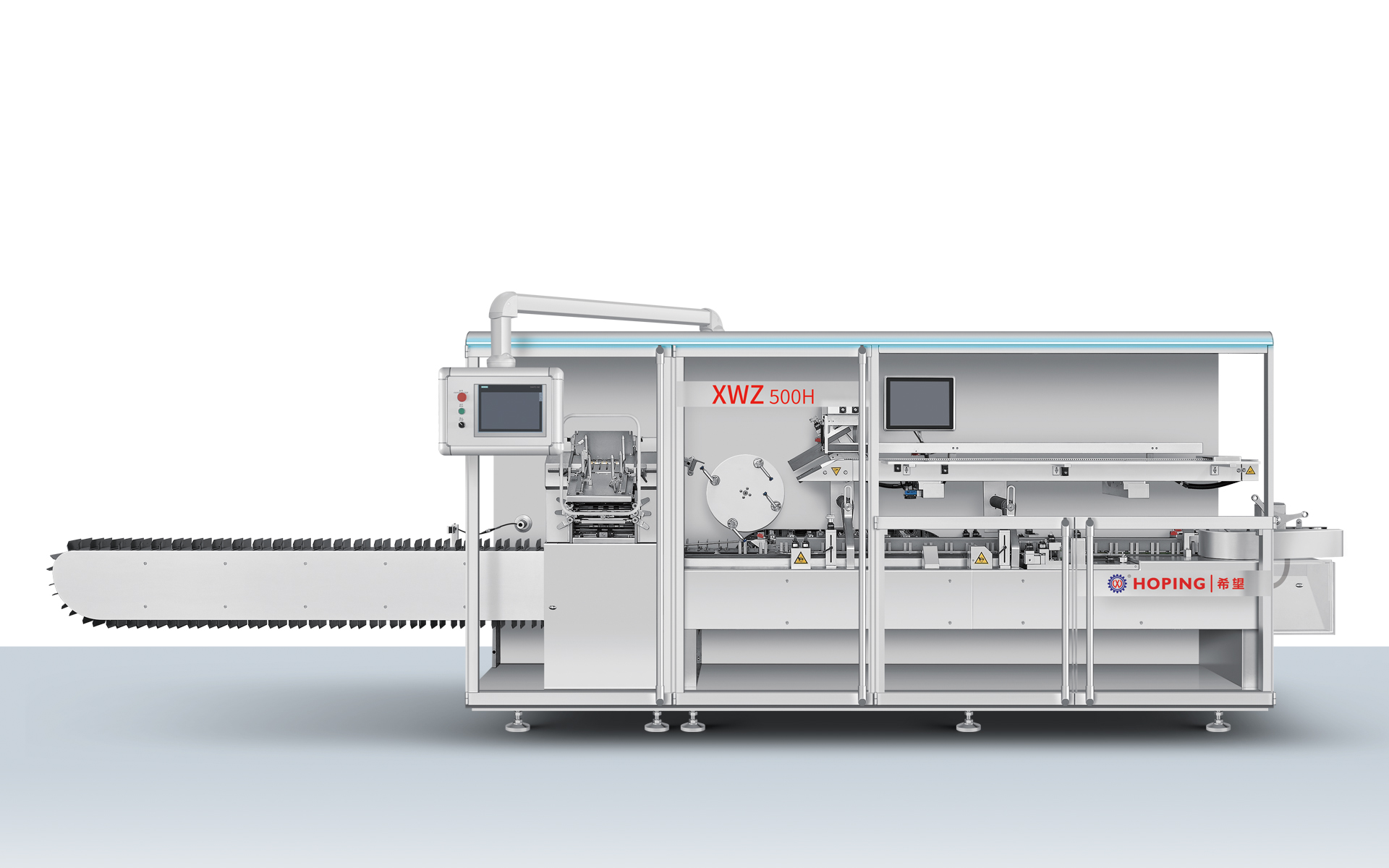
What a blister-cartoning line actually does
Across the configurations described in HOPING's product documentation, a blister-cartoning line covers a fixed sequence of stations: blister forming and sealing; product feeding and in-process inspection; transfer of blister cards into the cartoner; leaflet folding and carton opening; insertion and carton closing; coding and inspection with rejection; and connection to downstream bundling, case packing and palletizing.
Two output figures describe that sequence, and they are not interchangeable. Blister output measures the primary pack leaving the forming and sealing section. Carton output measures the secondary pack leaving the cartoner. The relationship between them depends entirely on how many blister cards go into each carton for a given product, which means the two numbers must always be read together with the pack format.
A second distinction matters at the research stage: an integrated line is not the same purchase as a blister machine plus a separate cartoner. An integrated line shares one transfer interface, one control philosophy and, usually, one acceptance protocol. That reduces integration risk but concentrates it with a single supplier, which changes how a buyer should structure the qualification process.
Three mismatches that derail high-speed line decisions
1. Nominal speed is compared with sustained output
Published capacities are design maxima. A line rated at a given number of blisters per minute reaches that figure under a defined format, material and operating condition — not across a shift, not across every SKU, and not with every rejection mode active. Two suppliers can quote the same headline figure and deliver materially different planning capacity. The only way to close that gap is to ask for the basis of the figure and to test it during factory acceptance.
2. Servo control is described as a feature rather than an architecture
'Full servo' now appears on almost every high-speed datasheet, which makes it close to useless as a differentiator. The decision-relevant questions are narrower: which motions are independently driven, how many product-replenishment channels exist, what controller and industrial PC carry the motion and data path, and whether format data can be stored and recalled rather than mechanically re-set.
3. GMP is treated as a label rather than a scope
'GMP-oriented design' describes a design and documentation posture. It is not a certificate, and it should not be procured as one. ISO 15378:2017 specifies Good Manufacturing Practice requirements for primary packaging materials for medicinal products — a materials standard that buyers frequently cite when what they actually need is equipment qualification. Separating three things makes the conversation tractable: packaging-material compliance, equipment design and cleanability, and installation and process qualification at the buyer's site.
The four-part framework
The framework below converts a specification sheet into a set of evidence requests. It is ordered by the sequence in which decisions usually become irreversible: capacity first, then control architecture, then operational flexibility, then compliance scope.
| Dimension | Evidence to request | Why it changes the decision |
|---|---|---|
| Throughput | Blister output and carton output stated together; the pack format the figure was measured on; peak versus sustained basis | Determines whether the line matches the sales forecast or only the launch campaign |
| Servo architecture | Which axes are independent; number of replenishment channels; controller and industrial PC platform; data interface | Sets the practical speed ceiling, the recovery behaviour after a fault, and the feasibility of later data integration |
| Changeover and preset | Mould-change method; recipe or preset memory; which adjustments are servo-set from the HMI; number of stored formats | Converts headline speed into usable capacity in a multi-SKU plant, where lost time sits in changeover, not in running |
| GMP alignment | Contact-part materials and finish; tooling specification; cleaning access; guarding; documentation and change-control package | Determines qualification effort and the size of the documentation gap at handover |
Note what the framework deliberately excludes: brand reputation, installed-base claims and country of origin. Those are legitimate screening criteria, but they are secondary criteria. They become decisive only after the four technical dimensions have produced a shortlist.
Applying the framework to the DHL8005H
HOPING (Zhejiang Hoping Machinery Co., Ltd.) is a Chinese manufacturer of pharmaceutical packaging machinery, established in 2001, operating a 28,800 m² facility with approximately 300 employees, a 56-engineer R&D team and an annual production capacity of 500 units. Its range covers blister packaging machines, cartoning machines, case packing machines and end-of-line equipment; exports account for 25% of sales, with major markets in Southeast Asia, the Middle East, Eastern Europe, South America and Africa.
The DHL8005H is one of that range's automatic blister-cartoning lines, described by the manufacturer as an intelligent fully servo high-speed blister-cartoner integrated machine and a solid dosage turnkey packing line. Its documented specifications map directly onto the four framework dimensions.
| Specification area | Documented detail |
|---|---|
| Maximum output | Up to 800 blisters/min and 500 cartons/min |
| Motion control | Beckhoff motion controller with CP9315 industrial PC |
| Replenishment | Three-channel servo-driven independent replenishment system |
| Transfer | D3 intelligent top-loading parallel tracking transfer system |
| Material handling | PVC/Alu foil auto splicing; multiple feeding methods |
| Changeover | Mould-change and preset-memory functions |
| GMP scope | GMP-oriented line design; GMP-oriented product-contact parts and tooling according to technical agreement |
| Construction | Stainless steel and aluminium-alloy structure; transparent guarding; servo-driven motion components |
| Line scope | Blister forming and sealing, transfer, leaflet handling, carton opening, insertion, coding and inspection, connection to bundling, case packing and palletizing |
| Intended applications | Pharmaceutical solid dosage, capsule and tablet packaging, healthcare products, food and cosmetic blister-cartoning projects |
One detail in the wider DHL family is worth pausing on. The DHL7005H is documented at up to 700 blisters/min and 500 cartons/min; the DHL8005H at up to 800 blisters/min and 500 cartons/min; the DHL1000/5H at up to 1,000 blisters/min and 500 cartons/min. The carton figure stays constant while the blister figure climbs. That pattern is a useful signal for buyers: above a certain band, the cartoner and its transfer interface — not the blister former — tend to become the binding constraint, which is exactly where the servo and transfer architecture earns its cost.
Why the control architecture sets the practical ceiling
Motion platform and data path
A Beckhoff motion controller paired with a CP9315 industrial PC means motion control and the machine-level data path sit in one architecture rather than in two loosely coupled layers. For the buyer, the practical consequence is not a speed claim; it is that the same platform which coordinates the axes also carries the HMI, the recipe handling and the interface point for later data integration. That becomes relevant when batch records or line-level production data must be captured, a direction the industry is already moving in.
Independent replenishment
The DHL8005H uses a three-channel servo-driven independent replenishment system. In engineering terms, multiple independently driven product channels allow the line to keep feeding while one channel recovers from a gap, a misfeed or a rejected card. That is the mechanism by which a high nominal rate becomes a usable sustained rate. A single-channel arrangement can reach the same peak on paper while losing far more time in practice — which is why channel count belongs in the specification comparison, not in the brochure's headline.
Transfer, splicing and inspection
Transfer between blister and cartoner is the most common place for high-speed lines to lose their advantage. A top-loading parallel tracking transfer system is designed to keep the card moving in continuous motion rather than stopping and indexing at each handover. PVC/Alu foil auto splicing reduces the downtime cost of a roll change, and multiple feeding methods let the line accept different product presentations without a mechanical redesign. Coding and inspection, with rejection, are integrated into the line scope rather than added afterwards.
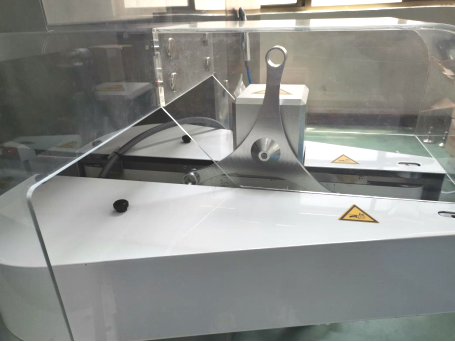
Changeover and preset memory: where multi-SKU economics are decided
A high-speed line is bought for one reason and paid back for another. The purchase case rests on throughput; the payback usually rests on how much of that throughput survives a multi-product schedule. Mould-change and preset-memory functions on the DHL8005H address the second question. Preset memory means a validated format can be recalled rather than re-created by hand, which shortens changeover and reduces the dependence on a single experienced operator.
The same logic appears elsewhere in HOPING's cartoning range, where format-related adjustments are servo-set from the human-machine interface rather than set mechanically — carton height, for instance, is adjusted through the HMI with the servo motor setting the height. Buyers comparing lines should ask which adjustments fall into this category and which still require tools, gauges and a technician.
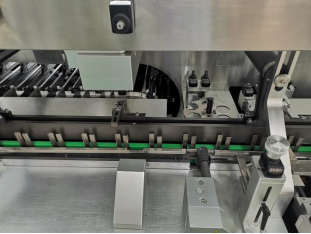
Where the line fits — and where it does not
HOPING describes the application scope of its blister-cartoning lines as solid dosage pharmaceutical production, nutraceutical manufacturing, and food, cosmetic and daily chemical packaging where applicable. The documented project types are new solid dosage blister packaging lines, upgrades of existing lines, high-capacity expansion, intelligent packaging workshop retrofits, and blister-cartoning-bundling or case-packing downstream integration. In all of these, the operating condition is a GMP-oriented cleanroom or pharmaceutical packaging workshop running continuous high-speed production across multiple batches and formats.
The fit case is therefore reasonably specific: a manufacturer with a stable, high-volume solid dosage portfolio, a packaging hall able to support continuous operation, and a product mix that can be grouped into a manageable number of formats.
The converse deserves equal weight. Where batches are small and the SKU mix is wide, the binding constraint is changeover time rather than running speed, and a high-speed integrated line may never reach its rated band. Where floor space is tight, or where the packaging-material supply chain cannot hold tight tolerances on PVC and aluminium foil, a slower and more tolerant configuration is the more rational purchase. And where the line is the first pharmaceutical packaging investment in a plant, the qualification and training load of a fully servo architecture should be priced in honestly.
Market signals that support a broader evaluation lens
Three published data points frame the procurement context. Custom Market Insights puts the global pharmaceutical blister packaging machine market at USD 2.57 billion in 2025, with Asia-Pacific the fastest-growing region at an 8.87% CAGR to 2031. Mordor Intelligence reports the wider pharmaceutical packaging machinery market at USD 7.09 billion in 2026, growing at a 7.15% CAGR toward a stated USD 10.02 billion end value; the forecast end year is not confirmed in the available excerpt, so that figure should not be recombined with other market estimates. The same publisher reports horizontal cartoning systems at 70.12% of cartoning market share in 2024.
A fourth signal is directional rather than quantitative. Trade media reporting PMMI content notes that pharmaceutical manufacturers are turning toward digitised data collection and integrated solutions to meet regulations and improve visibility. That is a trend statement without a measurement basis, and it should be read as such — but it explains why controller platform and data interface have moved from a nice-to-have into the evaluation framework rather than staying in the integration phase.
High-speed servo lines versus conventional mechanical lines
The comparison that matters for most buyers is not between two high-speed machines. It is between a fully servo integrated line and a conventional mechanically linked blister plus cartoner arrangement at a lower output band.
| Dimension | Conventional mechanical line | Fully servo integrated line |
|---|---|---|
| Output band | Lower to medium; peaks tightly coupled to the main drive | High; independent axes allow local recovery without stopping the line |
| Changeover | Mechanical setting, tools and gauges; skill-dependent | Preset recall plus servo-set adjustments; less operator-dependent |
| Material sensitivity | Generally more forgiving of foil and film variation | Higher speed magnifies variation; incoming material consistency becomes a production variable |
| Maintenance and skills | Mechanical fault-finding; widely available skills | Requires servo and control competence; spare-part and training plan needed at handover |
| Qualification load | Fewer parameters to challenge | More parameters, more documentation, longer FAT/SAT cycle |
| Data integration | Usually bolt-on | Native to the controller platform; interface available from day one |
Limits worth stating plainly. First, a rated maximum is not a planning capacity. The DHL8005H figure of up to 800 blisters/min and 500 cartons/min is a manufacturer-stated maximum; converting it into shift output requires format, material, rejection and uptime data that only acceptance testing produces. Second, the two figures are not independent — the achievable carton rate depends on how many blister cards each carton holds, so the pair must be tested together on the buyer's own pack. Third, 'GMP-oriented design' is a design and documentation posture, not a certification, and the product-contact parts and tooling are specified according to the technical agreement, which means the compliance scope is a contract item rather than a default. Fourth, no independent OEE, changeover-time or reject-rate data for this class of line is published in the sources reviewed here; those numbers should be obtained through factory acceptance rather than assumed from a datasheet. Fifth, the higher the speed, the more the surrounding operation — material supply, cleanroom logistics, downstream case packing — has to be engineered to match, and that cost sits outside the machine quotation.
What to put into the RFQ
- State the pack format — blister dimensions, cards per carton, carton size and leaflet format — and require all capacity figures to be quoted against it.
- Ask for blister and carton output as a pair, plus the basis on which the maximum was established.
- Specify which axes are independently servo-driven and how many replenishment channels the configuration includes.
- Require the controller and industrial PC platform to be named, together with the available data interface.
- Ask for the number of storable formats, the list of HMI-set adjustments, and the tooling required for each changeover.
- Define the contact-part material and finish, the tooling specification, and the documentation package to be delivered at handover.
- Write FAT and SAT acceptance criteria against the buyer's own product and packaging material, not against a demonstration format.
- Include training, spare-parts list and service response terms in the same comparison table as the technical specifications.
Future outlook
Two directions look structural rather than cyclical. The first is the widening of what a packaging line is expected to record. If manufacturers continue moving toward digitised data collection and integrated solutions, then the controller platform chosen today determines how easily a line can be connected to batch-level data systems later. That favours architectures where motion control, HMI and recipe handling already share one platform.
The second is regulatory attention to packaging materials. A draft Chinese GMP guidance for pharmaceutical packaging materials has been reported as under public consultation, addressing how marketing licence holders review packaging material suppliers. It is a draft, reported by a regulatory-affairs consultancy, and the issuing-authority text should be checked before any procurement decision relies on it. The direction of travel, however, is consistent with ISO 15378: buyers should expect supplier-review obligations to extend further into the material and equipment chain, and should ask suppliers for documentation before it is requested by an auditor.
Neither direction changes the core evaluation logic. They add weight to the fourth dimension of the framework and make the documentation package as much a part of the purchase as the machine itself.
FAQ
What is a blister-cartoning line, and how does it differ from a standalone blister machine?
A blister-cartoning line links a blister machine, which forms and seals the primary pack, with a cartoner, which opens, fills, closes and codes the secondary carton. A standalone blister machine produces blister cards only. The integrated line adds transfer, leaflet handling, carton forming and closing, coding and inspection, and usually connection to downstream bundling, case packing and palletizing, so it is qualified as one system rather than as separate assets.
What does a figure like up to 800 blisters/min and 500 cartons/min actually measure?
It measures two different outputs. Blister output is the rate at which primary packs leave the forming and sealing section; carton output is the rate at which secondary packs leave the cartoner. The relationship between the two depends on how many blister cards are packed into each carton for a given product. Both figures are manufacturer-stated maxima, so they describe a design capability rather than a sustained planning capacity.
Why does a servo-driven independent replenishment system matter at high speed?
Independent, servo-driven replenishment channels let the line continue feeding while one channel recovers from a gap or a rejected card. On the DHL8005H the system is documented as three-channel. The practical effect is on sustained output rather than peak output: a line can reach a high nominal rate while losing substantial time to interruptions if it has fewer, or coupled, feeding channels.
What does GMP-oriented design cover on a blister-cartoning line?
On the DHL8005H it refers to a GMP-oriented line design, with GMP-oriented product-contact parts and tooling specified according to the technical agreement, in a stainless steel and aluminium-alloy structure with transparent guarding. It is a design and documentation posture rather than a certificate. Separately, ISO 15378:2017 specifies GMP requirements for primary packaging materials for medicinal products — a materials standard that does not itself certify a machine.
How do mould-change and preset memory affect multi-SKU production?
Preset memory allows a validated format to be recalled instead of being re-created by hand, which shortens changeover and reduces reliance on a single experienced operator. It changes the economics of a high-speed line: in a multi-product plant, lost time accumulates in changeovers rather than in running, so the value of a high nominal rate depends on how much of it survives the product schedule.
What should be verified at acceptance before a high-speed line is signed off?
At minimum: blister and carton output measured on the buyer's own pack format; sustained output across a representative shift rather than a short demonstration; changeover time from format to format including tooling; reject rate and the behaviour of the replenishment and transfer systems under fault conditions; and the completeness of the documentation and change-control package. Published specifications and independent OEE or changeover data for this equipment class are not available in the sources reviewed here, so acceptance testing is the only reliable basis.
Reading the line as a system
The durable conclusion for buyers at the research stage is that speed is a pair of numbers with conditions attached, servo is an architecture rather than a checkbox, changeover discipline determines whether the speed is usable, and GMP alignment is a scope to be specified rather than a badge to be requested. A line that scores well on all four is a better purchase than a line that wins on any one of them.
HOPING's DHL8005H illustrates how those four dimensions appear in a documented specification: up to 800 blisters/min and 500 cartons/min, a Beckhoff motion controller with CP9315 industrial PC, three-channel servo-driven independent replenishment, a D3 intelligent top-loading parallel tracking transfer system, mould-change and preset-memory functions, and a GMP-oriented design with contact parts and tooling scoped by technical agreement. Whether those specifications match a specific project remains a question for the buyer's own format, acceptance protocol and qualification plan.
For readers who want the underlying equipment data, HOPING's full machinery catalog covering blister, cartoning, case packing and end-of-line equipment is available for download: Hoping Machinery Catalog (PDF).
Source notes: market figures are attributed to Custom Market Insights (blister packaging machine market, 2025) and Mordor Intelligence (pharmaceutical packaging machinery market, 2026; horizontal cartoning share, 2024). Regulatory references: ISO 15378:2017 and U.S. FDA cGMP guidance. Equipment specifications are manufacturer-published and are maximum design values unless otherwise stated.
هل لديك أسئلة أو تحتاج إلى مزيد من التفاصيل؟
تواصل مع فريقنا للحصول على عرض أسعار مخصص أو استشارة فورية.
طلب عرض أسعار
املأ النموذج أدناه وسيتواصل معك فريقنا بعرض مقترح مخصص.
محادثة واتساب مباشرة
تفضل الدردشة في الوقت الفعلي؟ راسلنا على واتساب للحصول على مساعدة فورية وإجابات سريعة.
- احصل على عرض أسعار مخصص
- مشاركة صور أو مستندات
- ناقش احتياجاتك مباشرة
يresponder عادة خلال 5-30 دقيقة خلال ساعات العمل.