
Split-Core CT vs Rogowski Coil: Buyer Comparison for Retrofit and Tight Spaces
Split-Core CT vs Rogowski Coil: An Independent Buyer Comparison
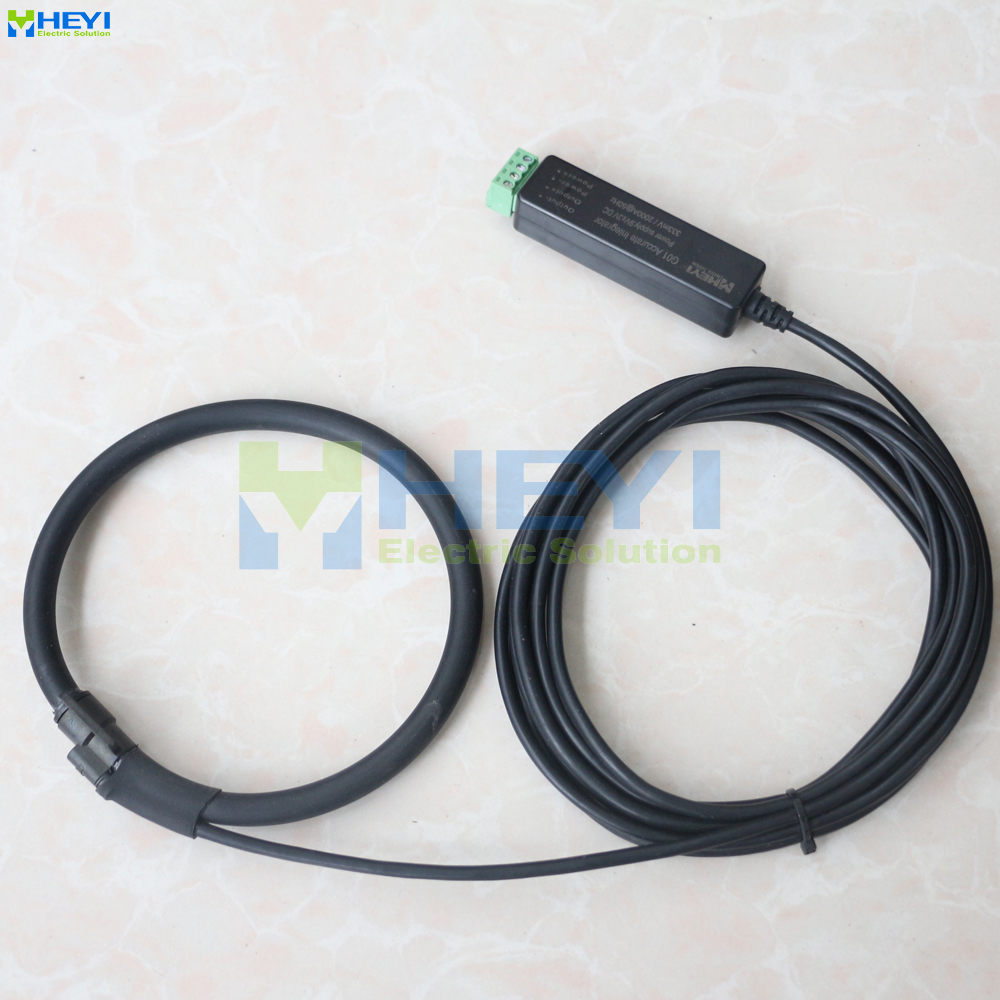
A growing share of electrical retrofit projects involves adding current measurement to panels that are already energised. In many cases the main circuit cannot be interrupted, the enclosure has no spare space, and the engineer must decide between current sensing technologies that can be mounted without cutting or disconnecting the primary conductor. Two families frequently appear in that decision: split-core current transformers and flexible Rogowski coils.
This article compares them specifically for retrofit and space-constrained applications. It uses the KCT split-core current transformer and the FRC flexible Rogowski coil as concrete reference products, then explains installation ease, accuracy class, saturation behaviour, usable current range, and the situations where each technology is the more practical starting point. The conclusion is intentionally situational: neither design is universally better, but each has a clearly different fit.
Why the Comparison Exists in Retrofit Projects
Energy monitoring, load profiling, smart metering, and fault diagnosis are often added after a low-voltage switchboard has been operating for years. Traditional through-hole current transformers require the primary cable or busbar to be threaded through the window before termination. In an existing panel, that usually means de-energising the circuit, opening cable connections, and losing production or facility time.
Retrofit-focused sensing was developed to reduce that burden. A split-core current transformer opens like a clamp and can be closed around an insulated conductor. A flexible Rogowski coil is an open-ended, flexible sensing loop that can be wrapped around a conductor even when there is little straight cable access. Both avoid the worst part of a conventional install: physically separating the conductor.
The buyer still has to choose. That choice is influenced by available window size, secondary signal type, maximum fault current, accuracy expectations, and the physical shape of the busbar or cable assembly. In the following sections, each factor is examined using published product data that can be independently checked.
Technology Definitions First
Split-Core Current Transformer
A split-core current transformer is an inductive transformer with a split magnetic path and a secondary winding. The core is opened at a hinge or mating surface, placed around the primary conductor, and then reclosed. Because the secondary winding is pre-wound on a magnetic core, the transformer converts primary current into a proportional secondary current under normal operating conditions.
In the HEYI product range, the KCT model is a split-core current transformer with a clamp-on design. The product data lists an inner diameter range of 0–50 mm, a measurement range of 0–1000 A, output options including 5 A, 1 A, mA, mV, RS485 or 4-20 mA, and accuracy classes of 3.0, 1.0 and 0.5. Its construction uses PA plastic for the housing, silicon steel sheets and ferrites for the magnetic core, and pure copper enameled wire for the winding. The KCT family is referenced in applications such as EV charging infrastructure, smart grid and switchgear panels, EMS/energy management, solar and wind energy storage, smart buildings and data centers.
For outdoor and higher-current circuits, HEYI also supplies the outdoor waterproof split-core current transformer model OCT. The OCT is rated IP65, includes UV protection, offers an inner diameter up to 120 mm and a measurement range up to 8000 A. Both KCT and OCT belong to the split-core family because their magnetic core opens around the conductor.
Flexible Rogowski Coil
A Rogowski coil has a fundamentally different sensing principle. It is an air-core transducer, often formed as a flexible rope-like coil, with no iron core and no secondary winding arranged around a gapped magnetic circuit. The coil measures the magnetic field produced by the primary current and produces a low-voltage output that is proportional to the rate of change of current.
HEYI’s FRC flexible Rogowski coil is classified in the product data as a flexible Rogowski coil, rope current sensor, non-saturating current sensor, air-core current transducer, lightweight flexible CT, and Rogowski coil with integrator in certain configured versions. It is made from silicone and pure copper enameled wire, has a listed inner diameter of 245 mm, a measurement range of 100–10000 A, and an mV output. The inner diameter, output, and color can be customized.
This construction gives the FRC a very large effective opening for a flexible product, because it can be wrapped around a conductor rather than slipped through a fixed window. The product’s listed applications include heavy industry and smelting, data centers and power retrofit, portable testing meters, and lightning and transient currents.
Head-to-Head Technical Summary
| Comparison Point | Split-Core CT (KCT / OCT) | Flexible Rogowski Coil (model FRC) |
|---|---|---|
| Core Type | Magnetic core using silicon steel sheets and ferrites | Air core; listed as non-saturating air-core current transducer |
| Opening / Inner Diameter | KCT: 0–50 mm; OCT: up to 120 mm | 245 mm inner diameter reference; flexible coil can be wrapped around conductor |
| Measurement Range | KCT: 0–1000 A; OCT: 0–8000 A | 100–10000 A |
| Output Signal | KCT: 5 A / 1 A / mA / mV / RS485 / 4-20 mA; OCT: 5 A / 1 A / mA / mV | mV output, normally used with an integrator |
| Accuracy Class | 3.0 / 1.0 / 0.5 | No accuracy class stated in the reference product data |
| Housing / Core Materials | PA or PC plastic, silicon steel sheets, pure copper enameled wire | Silicone and pure copper enameled wire |
| Typical Applications | EV charging, smart grid, EMS, solar & wind storage, smart buildings, outdoor monitoring | Heavy industry, smelting, data center power retrofit, portable testing, lightning and transient current measurement |
Please note that the accuracy and output options above are described as available configurations for each product family. A procurement specification must always be confirmed against the exact model, secondary burden, and instrument input.
Installation Ease in Existing Panels
For ordinary low-voltage feeders up to about 50 mm of cable diameter, a compact split-core CT is usually very fast to fit. The KCT opens, the installer places it around the primary cable, and the clamp is closed. There is no need to disconnect the cable. The same applies to larger outdoor feeders when the OCT family is used: the split opens wide enough to fit around weatherproof cables and can be closed in place.
The flexible Rogowski coil offers an installation advantage in a different physical situation. Because it is flexible and rope-like, it can be threaded around conductors that have very little straight access. It can also be wrapped around large busbars, cable bundles, or oddly shaped conductors where a rigid current transformer window would not fit. The FRC’s 245 mm inner diameter is not a rigid boundary; it is a reference value for the coil geometry, and the flexibility gives additional freedom in routing.
For space-constrained panels, the decision is therefore not simply about which device is quicker. It is about whether the target conductor has enough accessible length for a rigid clamp-on CT. If the conductor is a single cable and the clearance is adequate, a split-core CT is the most conventional. If the conductor is large, bundled, or poorly positioned, the flexible FRC avoids the need to create straight cable access.
Accuracy and Signal Compatibility
Accuracy class is the first point many buyers check. The KCT split-core CT is listed with accuracy classes 3.0, 1.0, and 0.5. The OCT outdoor split-core CT is listed with accuracy classes 3.0, 1.0, and 0.5 as well. A 0.5-class split-core CT is a practical choice for many power monitoring and submetering applications because it provides a clear, standardized accuracy level for an inductive current transformer.
The flexible Rogowski coil is different. The FRC product specification does not list conventional accuracy classes such as 0.5 or 1.0 in the same way. It outputs an mV signal that is derived from the time-rate of change of current; in practical systems, an electronic integrator is needed to reconstruct the current waveform. When HEYI documents the product as a Rogowski coil with integrator in certain configurations, that point is addressed. The buyer should therefore confirm whether the connected meter, relay, or controller can accept a low-level Rogowski signal after integration.
From a pure signal-compatibility viewpoint, a secondary output of 5 A or 1 A is still the most widespread standard for current transformers used with conventional energy meters and protective relays. The KCT range can supply those outputs. For OEM designs that already include Rogowski-conditioning electronics, however, the FRC’s mV output may be perfectly suited.
Saturation Behaviour and High-Current Performance
Core saturation is one of the strongest differentiators between these two sensing technologies. In a conventional split-core current transformer, the primary current creates a magnetic flux in the silicon steel or ferrite core. If the current becomes high enough, the magnetic core can saturate. When saturation occurs, the secondary output no longer follows the primary current linearly. This is a well-known constraint of iron-core current transformers and is one reason buyers must size the C.T. rating correctly.
The FRC is described as a non-saturating air-core current transducer. Because there is no magnetic core that can saturate, its output remains linear over a much wider current range. This is particularly valuable when monitoring circuits with high fault-current potential, transient currents, lightning currents, or widely varying loads. The product’s application list includes lightning and transient currents, which makes the non-saturating nature of the design relevant.
That does not mean a split-core CT is unsuitable for all high-current circuits. The OCT model, for example, has a measurement range up to 8000 A and is intended for outdoor overhead line monitoring and similar applications. The difference is the margin of behaviour during over-range and transient conditions, not the ability to measure a normal high current when correctly specified.
Measurement Range and Physical Fit
The KCT split-core CT has a measurement range of 0–1000 A and an inner diameter of 0–50 mm. That makes it a strong default for feeder monitoring, EV charging cabinets, building submetering, and switchgear panels where the conductor fits through the 50 mm window. The OCT extends the split-core concept to 0–8000 A and uses a larger opening up to 120 mm for outdoor cables.
The FRC flexible Rogowski coil starts at 100 A and extends to 10000 A. For a buyer measuring continuous currents above 1000 A, the FRC range reaches further than the compact KCT. For a buyer measuring currents below 100 A, the FRC’s minimum rated range may be a practical limitation. In that case, a split-core CT design remains the more direct option because it is available with lower current ratios and conventional secondary outputs.
Physical fit also goes beyond aperture diameter. A split-core CT has a rigid housing that must remain in one place near the conductor. A flexible Rogowski coil can be wrapped around a cable and then connected to a remote instrument via lead wires, making it easier to route in dense wiring troughs or around large equipment. Buyers who value portability may prefer the FRC. Buyers who need a permanent, mechanically stable clamp around a cable often prefer the split-core form factor.
Typical Use Cases for Split-Core CTs
Split-core current transformers are especially practical in low-voltage retrofit monitoring where the following conditions are present:
- The cable or busbar fits within the transformer window. For KCT that window is 0–50 mm; for OCT it is up to 120 mm.
- The instrument or meter expects a conventional secondary signal such as 1 A or 5 A.
- The project needs an accuracy class such as 1.0 or 0.5 for load data and energy allocation.
- The installation is inside a building, industrial panel, or outdoor enclosure with an IP-rated product such as the OCT.
In HEYI’s product documentation, the KCT family is associated with EV charging infrastructure, smart grid and switchgear panels, smart pole and IoT smart city projects, EMS/energy management, solar and wind energy storage, smart buildings, and data centers. The outdoor OCT is used for overhead line monitoring, outdoor solar and wind, municipal infrastructure, and railway trackside monitoring.
Typical Use Cases for Flexible Rogowski Coils
The FRC flexible Rogowski coil is better positioned when the emphasis moves to larger conductors, high currents, or difficult mechanical access. In heavy industry and smelting applications, busbars and cables can be very large, and the current can easily exceed 1000 A. The flexible coil can be wrapped around such conductors without requiring a large rigid window.
Portable testing meters are another clear application. A technician can carry a lightweight flexible coil, wrap it around the cable being tested, and remove it after the measurement. Because the FRC is listed as a lightweight flexible CT, it avoids the weight and size penalty of a large iron-core transformer.
Data center and power retrofit scenarios also appear in the FRC application list. Existing data center feeders are often densely packed, and a flexible coil may be easier to route around a busbar without disassembling the distribution block. Finally, because the product is non-saturating, it can be used for lightning and transient current studies where the waveform contains very large peaks.
Market Trend Context
The broader demand for both technologies is supported by the growth of energy monitoring and smart grid investment. According to market data cited from Grand View Research, the global current transformer market was estimated at USD 2.63 billion in 2024 and is projected to reach USD 3.90 billion by 2030. That growing installed base means more retrofit opportunities for both split-core and flexible sensing solutions.
Separately, industry analysis from Fact.MR identifies split-core current transformers as the fastest-growing segment in the current transformer market because of their ease of installation in retrofitting and smart grid applications. This trend explains why many OEMs and distributors now carry a split-core family as a standard product line. Flexible Rogowski coils remain a more specialised choice, but they occupy a durable niche where non-saturation and flexible routing are more important than conventional accuracy class documentation.
For the buyer, the market trend is not a reason to choose one technology automatically. It is a signal that supply options for split-core CTs are broad and well-established. Rogowski products should be evaluated on their ability to solve specific access and linearity problems.
Comparison with Traditional Solid-Core Solutions
A traditional solid-core current transformer is often considered the reference for accuracy and long-term stability, because the magnetic circuit is continuous and the design has been standardised for decades. However, it has a major retrofit limitation: the primary conductor must be physically disconnected, threaded through the window, and reconnected. That process creates downtime and can require additional switchgear work.
Split-core CTs solve the downtime problem by opening around the conductor. They still use a magnetic core, which means they inherit core-related considerations such as saturation and burden. Their accuracy can be good, but the split path introduces an additional interface that should be checked when very high accuracy is required.
Rogowski coils also solve the access problem, but they move the burden of linearisation and signal conditioning to the connected electronics. A flexible air-core coil will not saturate, but it produces an mV-level signal that must be integrated. This is an important boundary: an engineer cannot assume that a Rogowski output can be wired directly into an instrument designed for a 5 A secondary current transformer.
One additional limitation is visible in HEYI’s own product structure. The revenue-grade current transformer model RECT is documented as a separate resin-insulated product with 0.15S accuracy, IEEE C57.13 compliance, and anti-saturation characteristics. It is not a split-core clamp product in the same category as KCT. For buyers whose specification demands utility-grade billing accuracy, the decision should therefore be made at the level of the certified product, not only at the level of the sensing topology.
Decision Checklist for Buyers
The following checklist is intended to help a buyer translate the physical situation into a technology shortlist:
- If the existing conductor fits inside a 50 mm split-core window and the current is below 1000 A, a KCT-style split-core CT is the most conventional starting point.
- If the conductor is outdoors, weather-exposed, or larger, an OCT-style outdoor split-core CT with IP65 protection and up to 120 mm opening should be considered.
- If the conductor is large, obscure, or has very little straight access, a flexible Rogowski coil removes the fixed window constraint.
- If the circuit operates continuously below 100 A, check the minimum range of the Rogowski product before selecting it; the FRC listing starts at 100 A.
- If the connected meter uses a standard 5 A / 1 A CT input, a split-core CT is likely to be the simpler interface.
- If the instrument is designed for low-level Rogowski signals and includes an integrator, the FRC becomes viable for higher-current measurement.
- If the project demands a formal revenue-grade accuracy class, verify the certified product and applicable standard rather than relying on the topology alone.
Conclusion
Split-core current transformers and flexible Rogowski coils are not direct competitors in every installation. The split-core CT is most useful when a rigid magnetic transformer can be clamped around an accessible conductor and when the instrument side expects a conventional secondary output. The KCT family’s 0–50 mm opening and the OCT family’s weatherproof 0–120 mm opening illustrate the breadth of that solution.
The flexible Rogowski coil is most useful when conductor access is poor, the current is high, and non-saturating performance matters. The FRC’s flexible silicone construction, 245 mm inner diameter reference, and 100–10000 A range show why it earns a place in heavy industry, portable testing, and power retrofit inventories. Accuracy documentation, secondary burden, and the connected instrument’s input stage should always be part of the final specification.
FAQ
What is the main difference between a split-core current transformer and a Rogowski coil?
A split-core current transformer uses a magnetic core made from silicon steel sheets or ferrite, and it can be opened to clamp around a conductor. A Rogowski coil is an air-core current transducer, often flexible, that is wrapped around the conductor. The split-core CT produces a secondary current output, while the flexible Rogowski coil produces an mV output related to the changing current and normally uses an integrator.
Can a Rogowski coil replace a split-core CT in a retrofit application?
In some retrofit applications, yes. If the existing conductor is large or difficult to access and the connected instrumentation is compatible with a Rogowski signal, the flexible coil can be the better mechanical fit. However, if the current is below the Rogowski product’s rated minimum or the meter expects a 5 A / 1 A secondary input, a split-core CT may be the more practical solution.
Does a Rogowski coil saturate under high currents?
A Rogowski coil is an air-core design and is described in the reference product data as a non-saturating current sensor. Because there is no magnetic core to saturate, it can maintain more linear measurement behaviour under very high currents and transient conditions. Iron-core current transformers such as split-core CTs can saturate if the core is driven beyond its design limit, so correct sizing remains important.
What accuracy classes are available on HEYI split-core CTs?
In the reference product data, the KCT split-core CT and the outdoor OCT split-core CT are both listed with accuracy classes of 3.0, 1.0, and 0.5. The available output options include 5 A, 1 A, mA, mV, and in some KCT versions RS485 or 4-20 mA. The exact accuracy and output should be confirmed with the selected model and secondary burden.
Which product is more suitable for high-current monitoring above 1000 A?
The flexible Rogowski coil FRC has a measurement range of 100–10000 A, so it is suitable for high-current industrial circuits. The outdoor split-core OCT also supports measurement up to 8000 A with a weatherproof IP65 housing. The choice depends on whether the conductor can be enclosed by a rigid split-core window or needs the flexible wrapping capability of the Rogowski coil.
For buyers who need full specification tables, corporate background, and product-family documentation, HEYI provides a public brochure at this link: HEYI Electrical product brochure (PDF).
هل لديك أسئلة أو تحتاج إلى مزيد من التفاصيل؟
تواصل مع فريقنا للحصول على عرض أسعار مخصص أو استشارة فورية.
طلب عرض أسعار
املأ النموذج أدناه وسيتواصل معك فريقنا بعرض مقترح مخصص.
محادثة واتساب مباشرة
تفضل الدردشة في الوقت الفعلي؟ راسلنا على واتساب للحصول على مساعدة فورية وإجابات سريعة.
- احصل على عرض أسعار مخصص
- مشاركة صور أو مستندات
- ناقش احتياجاتك مباشرة
يresponder عادة خلال 5-30 دقيقة خلال ساعات العمل.