
Spring Nuts and Channel Nuts: An M6–M12 Strut Shortlist
Spring Nuts and Channel Nuts: An M6–M12 Strut Shortlist
Strut channel is adjustable by design; the nut is the component that turns that adjustability into a fixed, repeatable support. Choosing between an M6 spring nut and an M12 channel nut is therefore a project-fit decision — driven by channel profile, material gauge, environment and load path — rather than a catalogue preference.
This shortlist sets out spring nut and channel nut options across M6, M8, M10 and M12 for 41×41 mm and 41×21 mm strut channel. It draws on the product range manufactured and exported by CNS INDUSTRIAL (JIAXING) CO., LTD., a fastener and channel fitting manufacturer based in Jiaxing City, Zhejiang Province, China, that supplies strut fittings, strut channel systems, stamping parts, bolts and nuts, threaded rods, anchors, washers, screws and rivets to EU, US, Canadian and South American markets.
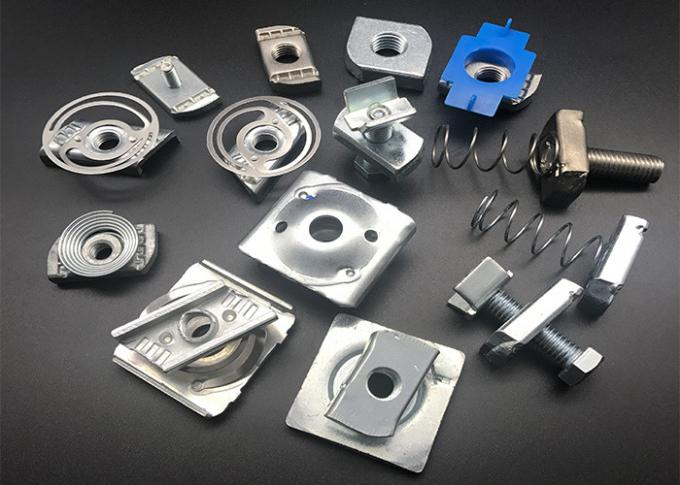
Why Spring Nuts Slip Inside Strut Channel
A spring nut holds itself in place through spring compression against the inturned channel lips. When the assembly is correct, the nut stays seated while the installer positions the clamp, bracket or threaded rod and starts the bolt one-handed. When it is not, the nut rotates, travels along the channel, or drops out of engagement as soon as tightening begins.
Slippage usually traces back to one of five causes, and only one of them is a nut-quality issue:
- Profile mismatch. A 41×41 mm channel and a 41×21 mm channel do not present the same internal lip geometry. A nut sized for the deeper profile will not seat correctly in the narrower one, no matter how the spring is compressed.
- Gauge mismatch. Strut channel is produced in 12ga, 14ga and 16ga wall thicknesses. The lip depth and the resistance the spring works against change with the gauge, so a nut that grips firmly in one wall thickness may sit loose in another.
- Insertion angle. Spring nuts are inserted by compressing the spring and rotating the nut 90° so that it seats behind the lips. A partially rotated nut stays diagonal and will release under load.
- Bolt not pre-engaged. If the bolt is not threaded into the nut before the assembly is loaded, the nut can spin freely in the channel. Starting two or three threads first keeps the nut square against the lips.
- Channel condition. Deformed lips, burrs from field cutting, powder-coat overspray or heavy hot-dip galvanized build-up inside the profile all reduce the usable lip depth and weaken spring retention.
There is also a geometry issue specific to slotted channel. In a slotted profile, a nut can pull into the slot under load rather than bearing on the lip. A square washer spanning the slot distributes the bearing area and is the usual remedy — which is why combo strut nut and washer assemblies exist as a distinct fitting type rather than a convenience accessory.
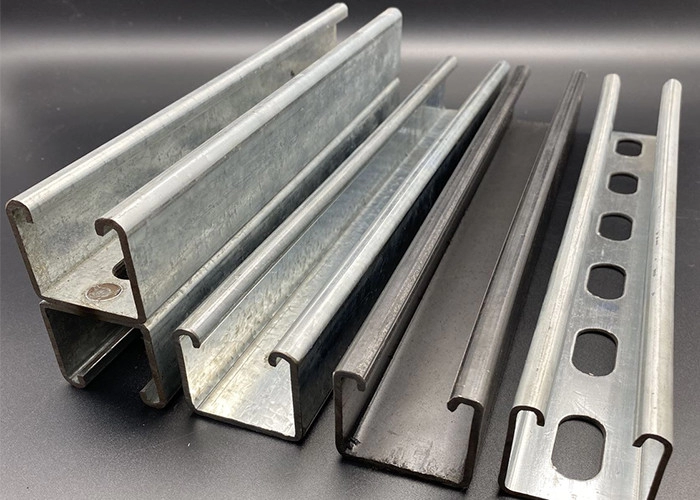
A Four-Criteria Selection Framework
Because slippage is a fit problem rather than a strength problem, the selection sequence should start with the channel and work outward to the nut, not the reverse.
| Criterion | What to confirm | Why it changes the answer |
|---|---|---|
| Channel profile and gauge | 41×41 mm or 41×21 mm; 12ga, 14ga or 16ga; slotted or unslotted | Determines nut width, spring seating and whether a square washer is needed |
| Load path and size | M6, M8, M10 or M12 thread; single or double nut; hanger vs bracket | Sets the practical range of clamp loads and the bolt length required to pre-engage the nut |
| Environment | Indoor, sheltered outdoor, coastal, washdown, process plant | Drives the choice between carbon steel and SS304 or SS316, and between electro-zinc and hot-dip galvanized |
| Acceptance basis | ASTM A563 or A194 reference; ISO 9001 quality management; project drawing | Defines what documentation and inspection evidence the delivery must carry |
The M6 to M12 Shortlist
Across the CNS INDUSTRIAL range, strut channel spring nuts are listed in M6, M8, M10 and M12, while channel nuts are listed in M8, M10 and M12. That single fact has a practical consequence for specifiers: an M6 connection in this range resolves to a spring nut, while M8 and above can be served by either nut type depending on how the assembly is worked.
| Size | Typical duty in a channel system | Nut type available | Selection note |
|---|---|---|---|
| M6 | Light hangers, cable tray supports, small conduit clamps, instrument stands, light threaded rod drops | Spring nut | Smallest thread in the shortlist; the limiting factor is usually clamp load per hanger, not nut grip |
| M8 | Pipe clamps, HVAC hangers, bracket connections, general threaded rod suspension | Spring nut and channel nut | The most flexible size in the range; also the point where channel nut variants become available |
| M10 | Heavier pipe supports, equipment frames, solar rail connections, long-span cable tray trapezes | Spring nut and channel nut | Where vibration and thermal movement start to matter; verify locking strategy per project |
| M12 | Equipment anchoring frames, structural support brackets, bracing, machine bases | Spring nut and channel nut | Heaviest thread on the shortlist; confirm channel gauge and lip depth before specifying |
Spring nut or channel nut?
The two are not interchangeable in use, even where they share a thread size. A spring nut carries its own retention spring, which is what allows positioning in vertical and overhead channel before the bolt is started. A channel nut relies on seating in the profile and on the bolt being engaged to hold position, which suits horizontal runs, bench-assembled frames and locations where the assembly is built up in a fixed sequence. The CNS range also includes channel nuts with a plastic insert and combo strut nut and washer assemblies, both of which address specific handling and bearing conditions rather than replacing the standard nut.
Material Selection: Carbon Steel, SS304 or SS316
Material choice is the second-largest driver of service life after correct seating. The range covers carbon steel, stainless steel 304 and stainless steel 316, with aluminium and copper also available across the wider fastener portfolio.
- Carbon steel is the default for indoor and sheltered installations: mechanical, electrical and plumbing (MEP) risers, plant rooms, ceiling grid supports and dry industrial interiors. It requires a protective finish and its performance depends on that finish staying intact.
- SS304 is specified where moisture, washdown or general outdoor exposure is present — external pipe supports, food and beverage areas, water treatment and coastal installations that are not subject to continuous chloride loading.
- SS316 is the higher-alloy option for chloride-rich environments: marine air, de-icing salt exposure, and process areas where 304 has historically shown staining or pitting. It carries a cost premium and should be justified by the exposure, not applied by default.
One point is often missed at the specification stage: dissimilar metals in the same assembly create a galvanic couple. A stainless nut on a carbon steel channel, or an aluminium channel with a steel nut, will behave differently from a matched pair. Where mixed materials are unavoidable, the fastener and channel finishes should be reviewed together rather than line by line.
Finish Selection: Electro-Zinc and Hot-Dip Galvanized
Surface finish determines both corrosion life and — less obviously — whether the assembly still fits together on site.
- Electro-zinc plating is available in white and yellow variants. It deposits a thin, uniform layer that leaves threads clean and free-running, which makes it the practical choice for indoor work and for M6 and M8 assemblies where thread engagement is short.
- Hot-dip galvanized (HDG) builds a substantially thicker zinc layer for outdoor and industrial exposure. The trade-off is dimensional: coating build-up on threads and inside the channel profile can affect fit and reduce usable lip depth, so HDG assemblies should be specified as a matched set rather than assembled from mixed-finish parts.
- Other finishes in the range — Dacromet, Magni, Geomet, pre-galvanized G90 and powder coating — each address specific exposure or appearance requirements and should be selected against the actual service environment.
Channel Compatibility: 41×41 mm and 41×21 mm
The strut channel side of the range covers 41×41×2.5 mm, 41×21×2.5 mm, 41×41×2.0 mm, slotted 41×41×2.5 mm and unslotted 41×41×2.5 mm profiles, with imperial designations of 1-5/8"×1-5/8" (41×41 mm), 1-5/8"×13/16" (41×21 mm), 1-5/8"×2-7/16" and 1-5/8"×3-1/4". Wall thicknesses are 12ga, 14ga and 16ga, and standard lengths are 10 ft and 20 ft with custom lengths available.
For nut selection, the two dimensions that matter most are the profile height (41×41 vs 41×21) and the gauge. The 41×21 mm profile has a shallower internal section, so a nut that relies on deep spring travel will not seat the same way it does in a 41×41 mm channel. Likewise, the 2.0 mm and 2.5 mm wall variants of the 41×41 mm profile differ slightly in lip depth even though they carry the same nominal designation. Trial-fitting a sample nut to the actual channel batch remains the only reliable confirmation.
Acceptance Grounding: ASTM A563/A194 and ISO 9001
For most channel assemblies, the nut is not a formally rated structural component, and that is precisely why the acceptance basis should be written into the purchase order instead of assumed. Two references do the work:
- ASTM A563 covers carbon and alloy steel nuts for general applications and is the usual reference when a buyer wants a defined nut specification rather than a generic description.
- ASTM A194 covers nuts for high-temperature and high-pressure service and applies where the assembly is exposed to those conditions rather than to ordinary support duty.
These two standards serve different service contexts, so the project drawing should state which one governs. Alongside them, ISO 9001 certification provides the process framework that buyers commonly use as a baseline supplier check, and production can be aligned to GB, ISO, DIN, ANSI/ASME, UNI, JIS, BS and NFE standards, or to customer drawings and samples.
Where These Assemblies Are Used
In service, the role of the nut is to provide connection, fastening and support in combination with channel systems for adjustable installation solutions. That pattern shows up in pipeline support, MEP installation, equipment anchoring, and building and decorative support system projects, across construction, MEP/HVAC, solar energy, oil and gas, power generation and heavy machinery industries.
CNS INDUSTRIAL has supplied these applications to engineering contractors, machinery manufacturers, and electrical and general industrial customers in the United States, Canada, Mexico, Argentina, Australia, Belgium, Costa Rica, Germany, Denmark, France and the United Kingdom. The reported outcome across that base is strong and durable connections for pipeline support and equipment anchoring, improved installation efficiency, and reduced long-term maintenance needs — an outcome that depends as much on correct nut seating as on the components themselves.
Typical operating conditions are static installations with mechanical fastening, used either for long-term fixation or for removable connections depending on the product selected. Where corrosion resistance, strength grade or dimensional tolerance is critical, material grade and finish must be specified in advance rather than selected on site.
Market Context
Demand for channel-based support systems has grown alongside the electrical, mechanical and solar installation work that uses them. The global strut channel market was valued at USD 4.3 billion in 2024 and is projected to reach USD 7.3 billion by 2033 at a CAGR of 6.1%, according to Dataintelo. That figure should be read as directional rather than precise: Intel Market Research estimates the same market at USD 1.85 billion for 2025, a gap large enough to indicate different scopes rather than a disagreement about direction.
The wider fastener market provides the scale context. Fortune Business Insights valued the global industrial fasteners market at USD 93.12 billion in 2025, and Grand View Research places Asia Pacific at a 45.1% revenue share in the same year — consistent with a supply base concentrated in the region where most channel and fitting production sits.
Compared with Welded or Tapped Connections
Channel systems are not the only way to build a support. Welding brackets directly to structure, drilling and tapping the channel, or running a plain hex nut with a fender washer inside the profile are all established alternatives, and each has a legitimate place.
| Approach | Advantage | Practical constraint |
|---|---|---|
| Spring nut or channel nut in strut channel | Position adjustable after installation; no hot work; components can be dismantled and repositioned | Requires access to insert the nut; performance depends on correct profile and gauge match |
| Welded bracket | Rigid, high-integrity connection with no slip risk | Hot work permit, weld inspection, and damage to galvanized or powder-coated surfaces at the weld zone |
| Drilled and tapped channel | Fixed, precise bolt location | No later adjustment; swarf and hole edges need treatment; slows field changes |
| Plain hex nut with fender washer | Low component count, widely available | No self-retention, so overhead and vertical installation is awkward; washer can rotate into the slot |
The honest boundary matters more than the comparison table. A spring nut is a channel-fitting component, not a structural bolting assembly. It is not a substitute for high-strength structural bolting such as ASTM A325 or A490 assemblies used for primary steel connections — those are separate product lines with their own grades and documentation. Similarly, spring nuts are not automatically the right answer in high-vibration locations where a verified locking strategy is required; that has to be confirmed for the specific assembly rather than assumed from the nut type.
Two further limitations are worth stating plainly. First, spring nut installation depends on access — a nut must be inserted at a channel end or through the slot, so fully enclosed or already-built-out sections can rule the approach out. Second, the published range documentation does not itemise in-house inspection criteria, so buyers should request the inspection plan covering incoming, in-process and final checks as part of the order documentation, and confirm after-sales and claim terms with the supplier in writing.
Procurement note. For this range, minimum order quantity is 500 kg per item and lead time is 30–45 days, against a stated monthly capacity of 800 tons. Orders that mix sizes, materials and finishes should confirm the split with the supplier before release, since HDG and stainless lines do not run on identical schedules.
Future Outlook
Three shifts are visible in how channel assemblies are being specified. The first is a move toward pre-finished modular supports, where channel, nuts, clamps and threaded rod are ordered as a coordinated set rather than sourced piece by piece — a change that reduces on-site fit problems but raises the importance of getting the specification right at the drawing stage. The second is tighter corrosion specification, with HDG and stainless increasingly written as explicit requirements rather than finish preferences. The third is documentation: buyers are asking for the acceptance basis, inspection plan and standard reference to be stated on the order, not just the part description.
For spring nuts and channel nuts specifically, the practical consequence is that size alone will not carry a specification much further. M8 tells a buyer almost nothing without the channel profile, gauge, material and finish attached to it — and the suppliers who make that information easy to retrieve will be the ones whose parts get specified.
FAQ
Which spring nut size fits 41×21 mm strut channel?
Nut size and channel profile must be matched on two dimensions: the profile itself (41×41 mm or 41×21 mm) and the wall gauge (12ga, 14ga or 16ga). The CNS INDUSTRIAL range lists spring nuts in M6, M8, M10 and M12 and channel profiles in both 41×41 mm and 41×21 mm, but the correct nut for a given assembly depends on the internal lip of that specific channel batch. Trial-fitting a sample against the actual channel remains the reliable confirmation step.
Are spring nuts and channel nuts interchangeable?
No. A spring nut carries its own retention spring, which holds the nut against the channel lips before the bolt is engaged — useful for vertical and overhead work. A channel nut relies on seating in the profile and on the bolt being started to hold position, which suits horizontal runs and bench-built frames. In the CNS INDUSTRIAL range, spring nuts are listed in M6, M8, M10 and M12, while channel nuts are listed in M8, M10 and M12.
For outdoor strut channel, is hot-dip galvanized carbon steel or stainless steel the better choice?
It depends on the exposure. Hot-dip galvanized carbon steel is typically specified for general outdoor and industrial conditions where a thick zinc layer provides the corrosion barrier. SS304 is used where moisture, washdown or general outdoor exposure is present, and SS316 where chlorides are a factor, such as marine air, de-icing salt or certain process areas. HDG build-up on threads and inside the channel profile can affect fit, so an HDG assembly should be specified as a matched set.
Which standards apply to channel nuts and spring nuts?
Two references are commonly used as the acceptance basis: ASTM A563 for carbon and alloy steel nuts in general applications, and ASTM A194 for nuts in high-temperature and high-pressure service. They cover different service contexts, so the project drawing should state which governs. Production can also be aligned to GB, ISO, DIN, ANSI/ASME, UNI, JIS, BS and NFE standards, and ISO 9001 certification is used as a baseline quality management check on the supplier.
Do these nuts work in slotted strut channel?
They can, but the slot changes the bearing condition. In slotted profiles a nut may pull into the slot rather than bear on the lip, so a square washer spanning the slot is normally used to distribute the bearing area. Combo strut nut and washer assemblies exist in the range for exactly this condition.
Can spring nuts and channel nuts be supplied to drawing or sample?
Yes. Custom fabrication is available according to drawings or samples, alongside production to GB, ISO, DIN, ANSI/ASME, UNI, JIS, BS and NFE standards, with material options covering carbon steel, SS304, SS316, aluminium and copper. Minimum order quantity for the range is 500 kg per item, with a lead time of 30–45 days.
Full dimensional and material data for the strut channel fitting and fastener range is available in the CNS Industrial product brochure (PDF).
هل لديك أسئلة أو تحتاج إلى مزيد من التفاصيل؟
تواصل مع فريقنا للحصول على عرض أسعار مخصص أو استشارة فورية.
طلب عرض أسعار
املأ النموذج أدناه وسيتواصل معك فريقنا بعرض مقترح مخصص.
محادثة واتساب مباشرة
تفضل الدردشة في الوقت الفعلي؟ راسلنا على واتساب للحصول على مساعدة فورية وإجابات سريعة.
- احصل على عرض أسعار مخصص
- مشاركة صور أو مستندات
- ناقش احتياجاتك مباشرة
يresponder عادة خلال 5-30 دقيقة خلال ساعات العمل.