
Stackable vs Standard Bright Beer Tanks: A Buyer Comparison
Stackable vs Standard Bright Beer Tanks: A Buyer Comparison
Choosing between a stackable Bright Beer Tank and a standard Bright Beer Tank is primarily a layout and integration decision—not a choice that can be made from the tank name alone. A bright tank may be used for beer maturation, carbonation, clarification or bright beer storage. A stackable arrangement introduces additional layout questions, including structural support, operator access, piping routes and cleaning access. The right comparison therefore depends on the confirmed site, process, capacity and equipment specification.
Carry Brewtech supplies Brite Tanks and Bright Beer Tanks and describes project configuration around capacity, orientation, cooling arrangement, process use and confirmed pressure requirements. Its published capability information includes stackable tank arrangements as a configurable option. However, the available information does not establish that every stackable and standard tank has the same capacity, dimensions, pressure rating, fittings or operating performance. Those details need to be matched in the technical documents for the specific order.
What the comparison can—and cannot—establish
For this article, “stackable” means a Bright Beer Tank arrangement specified for vertical space use; “standard” means a bright tank ordered without that stackable arrangement. These terms describe the procurement comparison, not a universal design standard. The supplied product information identifies a Stackable Bright Tank and separate Beer Bright Tank series, but it does not provide a complete, model-by-model specification for both options.
That evidence supports a practical comparison of configuration needs and verification points. It does not support a claim that one option is universally more space-efficient, cheaper, easier to clean, safer, faster to install or better-performing. Nor does it establish that every standard tank is upright or that every stackable design uses the same support structure. Buyers should compare the final drawings and data sheets rather than infer those characteristics from category names.
The central difference is the layout brief
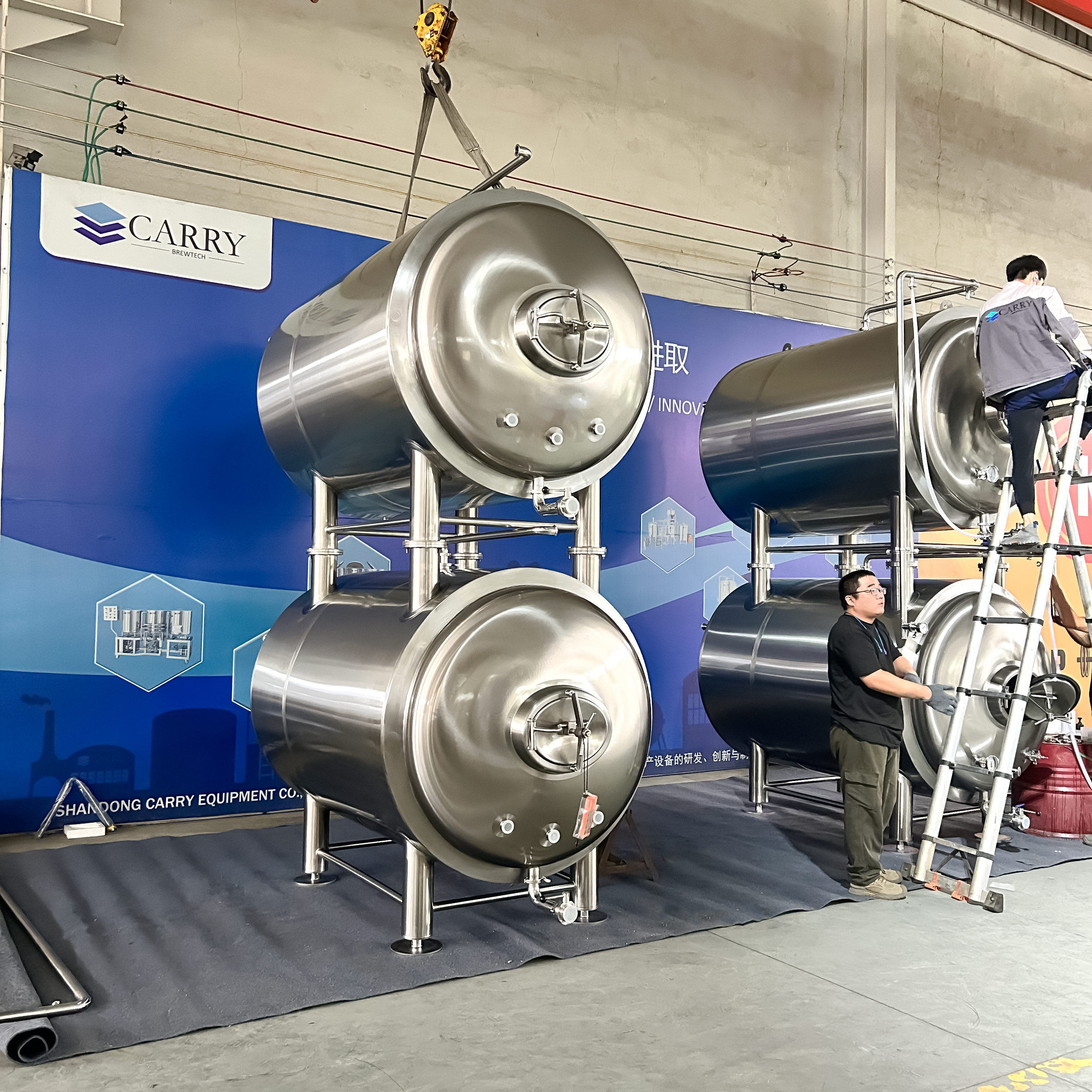
A stackable tank configuration makes vertical arrangement part of the project brief. Carry Brewtech’s configuration information names vertical space use, tank support, access platform, piping route, valve and connection arrangement, maintenance clearance, CIP access, cooling-jacket connection and site-layout adaptation as planning points. These are meaningful procurement considerations because a tank arrangement affects more than the vessel footprint: operators and service personnel must also be able to reach the relevant connections and equipment.
A standard Bright Beer Tank can be specified without the added stackable arrangement. Its suitability still depends on the site layout and its process role. A buyer should not treat “standard” as meaning that access, piping, cooling or cleaning are automatically resolved. Those requirements remain part of the specification for any tank. The practical distinction is that the stackable option makes the vertical arrangement and its associated support and access arrangements explicit questions for design review.
This distinction matters most when the available room, vessel positions or planned process route are constrained. If a brewery is considering vertical space use, the layout should show how the selected configuration fits the site and how operators can access the tank, valves, connections and cleaning points. If a standard arrangement is being considered, the same review should show that its location and interfaces fit the process. Neither category name replaces a site-specific layout.
Comparison at a glance
| Buyer dimension | Stackable Bright Beer Tank | Standard Bright Beer Tank |
|---|---|---|
| Layout premise | The project considers vertical space use and a stackable arrangement. | The project does not specify the stackable arrangement; the actual orientation and placement must still be defined. |
| Additional design review | Confirm support, access platform if applicable, maintenance clearance, piping and cleaning access. | Confirm tank position, operator and maintenance access, piping route and cleaning access. |
| Process function | Confirm whether the tank is intended for maturation, carbonation, clarification, storage or another specified step. | Confirm the same process role; the category name does not define the complete process scope. |
| Cooling and connections | Confirm cooling-jacket details and connection positions in the approved configuration. | Confirm whether a jacket is included, its specification and how connections fit the site and process. |
| Evidence boundary | The available information does not supply a universal stacking load, dimension, pressure rating or cleaning-performance figure. | The available information does not establish a universal standard-tank dimension, pressure rating or performance figure either. |
When a stackable arrangement merits evaluation
A stackable Bright Beer Tank merits evaluation when the site plan makes vertical space use a material design consideration. It may also be relevant when the buyer wants the tank arrangement, process piping and access provisions reviewed together rather than selecting a vessel in isolation. Carry Brewtech’s stated configuration scope includes layout adaptation and review of piping interfaces, maintenance clearance and CIP access. These are planning capabilities, not proof that a particular installation will fit or that a defined floor-space saving will result.
The buyer should ask for a project drawing that shows the actual vessels and their relationship to nearby equipment, walls, access routes, utilities and process lines. The drawing should make the intended arrangement understandable to the people who will install, operate, clean and maintain it. Where the design includes a support structure or access platform, the approved project documents should identify what is included and how it relates to the tank arrangement. The available corpus does not state structural load limits or a standard platform design, so these should not be assumed.
A further question is whether the intended operating sequence can be carried out with the proposed arrangement. The buyer needs to understand how beer enters and leaves the tank, where valves and connections sit, how the tank is accessed for the specified work, and how the cleaning route is arranged. The answer should come from the project-specific flow and layout documents, not an assumed feature of all stackable tanks.
When a standard arrangement may be the clearer fit
A standard Bright Beer Tank may be a straightforward option when the site layout and process do not require a stackable arrangement, or when the buyer’s approved layout already defines an appropriate position for each tank. This is a decision condition, not a claim that standard tanks are simpler in every installation. Their dimensions, connections, cooling details, access and pressure requirements still need to match the project.
For a buyer comparing a standard tank with a stackable one, the useful question is not simply which label appears more suitable. Ask whether the additional vertical arrangement solves a documented site-layout requirement, and whether the project can specify its support, access, piping and cleaning interfaces clearly. If those points are not resolved, the stackable designation alone does not demonstrate that the arrangement is suitable. Conversely, the absence of a stackable arrangement does not demonstrate that a standard tank will fit without layout review.
Compare process function before comparing vessel format
A Bright Beer Tank is selected for a process role as well as a layout. Carry Brewtech’s company information describes potential bright-tank uses including maturation, carbonation, clarification and bright beer storage. The capability record for Bright Beer Tank carbonation and serving configuration lists possible interfaces such as a carbonation stone, pressure-control connection, serving outlet, sight glass or level indication, CIP spray-ball interface and sanitary connections. Those are configuration items to confirm; their mention does not mean every tank includes them as standard.
Start by identifying the required task for each vessel. If the tank will be used for carbonation and serving, confirm the relevant carbonation and outlet interfaces. If its role is storage or clarification, confirm the intended transfer and cleaning arrangement. Then match the tank’s working capacity, connection type, cooling details and pressure requirements to that task. The supplied capability information describes tank capacity across a range of 100L to 5000L, but it does not identify a capacity for every stackable or standard model. The actual model and capacity must therefore be written into the project specification.
Where multiple tanks are used, confirm how their roles fit the production schedule and packaging plan. A bright tank is not interchangeable with every fermentation vessel simply because both are stainless steel tanks. The buyer information supplied for brewery tank selection distinguishes fermentation and maturation functions from Bright Tank functions such as clarification, storage, carbonation and preparation before packaging. The correct equipment arrangement depends on batch size, production schedule, beer styles, cleaning method and available cooling capacity.
Pressure, cooling and cleaning require configuration-level checks
Pressure is a critical boundary in a bright-tank comparison. Design pressure, working pressure and test pressure are different values and should be listed separately for the applicable vessel or component. The supplied buyer-risk guidance gives example reference values for a confirmed project configuration, but does not establish that those values apply to every Bright Beer Tank, stackable or standard. Buyers should request the final tank data sheet and applicable test record, identify the relevant component, and operate only within the approved working pressure.
Cooling also needs a specific answer. Carry Brewtech lists cooling-jacket connection among the stackable configuration topics and cooling arrangement among its general tank-selection considerations. That does not establish that a jacket is included on every tank or that two compared configurations have identical cooling capacity. Confirm whether cooling is required, which jacket and connections are included, how they connect to the site system, and whether the layout permits access and maintenance.
Cleaning should be considered alongside tank position and piping. CIP access, spray-device arrangement, return lines and sanitary valve routing may affect the project configuration. The evidence supports CIP planning as a relevant integration area, but it does not provide a single cleaning procedure or demonstrate equivalent cleaning results for the two tank formats. Ask for the proposed cleaning route and the included equipment or interfaces; separately confirm the operating procedure and acceptance checks for the final system.
A procurement checklist for an independent comparison
Use one revision-controlled checklist to compare the two configurations and control differences between the quotation, drawings and delivered equipment. The buyer-risk guidance specifically recommends matching the final equipment list, technical specification, drawings and approved changes. For a Bright Beer Tank comparison, the checklist can include:
- Tank identity: Record the exact tank type or model, quantity and nominal and working capacity for each option.
- Process duty: State whether each tank is intended for maturation, carbonation, clarification, storage, serving or a defined combination of functions.
- Layout: Compare the project drawings. For a stackable arrangement, confirm vertical positioning, support scope, access, maintenance clearance and the piping route. For a standard arrangement, confirm its location and the same practical access and interface details.
- Pressure: List design, working and test pressure separately, identify the relevant vessel or component, and check the pressure devices and documents for the specific configuration.
- Cooling: Specify whether a cooling jacket is included, its required arrangement and connections, and how the installation connects to the planned cooling system.
- Connections and fittings: Identify the actual inlet, outlet, valve, sanitary connection and serving or carbonation interfaces required. Confirm connection type in the approved specification rather than assuming it from a keyword.
- Cleaning: Show the cleaning route and confirm the included spray-ball, valve, return-line and CIP interfaces where applicable.
- Documents and acceptance: Define which approved drawings, specifications, inspection records, pressure-test records where applicable, manuals and other project documents are required before shipment or acceptance.
This checklist does not impose a particular design. It makes the two offers comparable on the same project requirements and helps identify where a specification is still incomplete. Carry Brewtech’s pre-shipment documentation capability describes equipment-list confirmation, inspection-document review and a documentation package; the exact contents remain dependent on the confirmed order and project scope. Buyers should list required records and acceptance criteria in their own approved project documents.
A conditional decision rule
Evaluate a stackable Bright Beer Tank when the project has a defined need to use vertical space and the supplier can document the arrangement, support, access, maintenance clearance, piping and CIP interfaces for that site. Evaluate a standard Bright Beer Tank when the approved site and process layout do not call for that arrangement and its own position, capacity and interfaces are clearly specified. If either option lacks a matching drawing, pressure specification or connection schedule, the evidence is not yet sufficient to compare it confidently.
This rule does not rank one tank type above the other. It keeps the decision tied to the conditions the buyer can verify. A layout advantage is not established merely by the word “stackable,” and a standard configuration is not automatically a better fit because it avoids a stated arrangement. The decisive evidence is whether the final tank and its interfaces meet the documented process and site requirements.
Conclusion: compare the specified installation, not just the tank label
For buyers evaluating Brewing Equipment, the distinction between stackable and standard Bright Beer Tanks is most useful when treated as a configuration and layout question. The stackable option brings vertical arrangement, support and access into sharper focus; the standard option still requires a complete position, process and interface specification. Neither name establishes capacity, pressure rating, cleaning performance, included fittings or a quantified space saving.
Carry Brewtech’s published capabilities support project-based discussion of Bright Beer Tank functions and stackable layout considerations. For procurement, the next step is a comparable, approved equipment list and drawing that tie each tank to its process duty, capacity, pressure requirements, cooling, sanitary connections, cleaning route and site access. Only those confirmed documents can establish whether either configuration fits the buyer’s actual project.
Frequently asked questions
What is the main difference between a stackable and a standard Bright Beer Tank?
The main procurement distinction is whether the project specifies a stackable arrangement for vertical space use. That option requires review of support, access, maintenance clearance, piping and CIP interfaces. A standard tank is specified without that arrangement, but still needs a complete layout and process specification. The labels alone do not establish dimensions, pressure ratings or performance.
Does a stackable Bright Beer Tank always save floor space?
The available product information identifies vertical space use as a stackable-configuration consideration, but it does not provide a quantified floor-space saving or prove that every site will benefit. Compare site-specific drawings, including the tank arrangement, access routes, support and maintenance clearances, before concluding that a proposed layout meets the site requirement.
Are the pressure rating and fittings the same for both tank types?
No shared pressure rating or fitting specification is established for all stackable and standard Bright Beer Tanks. Confirm design pressure, working pressure and test pressure separately for the exact tank and configuration. Also verify the actual valves, sanitary connections, carbonation or serving interfaces and applicable technical documents in the approved specification.
What should buyers verify before accepting either configuration?
Buyers should compare the final equipment list and approved drawings against the process duty, capacity, site layout, pressure details, cooling connections, sanitary interfaces, cleaning route and access provisions. Define required inspection and project documents before production, record approved changes, and check the delivered equipment against the final approved configuration.
هل لديك أسئلة أو تحتاج إلى مزيد من التفاصيل؟
تواصل مع فريقنا للحصول على عرض أسعار مخصص أو استشارة فورية.
طلب عرض أسعار
املأ النموذج أدناه وسيتواصل معك فريقنا بعرض مقترح مخصص.
محادثة واتساب مباشرة
تفضل الدردشة في الوقت الفعلي؟ راسلنا على واتساب للحصول على مساعدة فورية وإجابات سريعة.
- احصل على عرض أسعار مخصص
- مشاركة صور أو مستندات
- ناقش احتياجاتك مباشرة
يresponder عادة خلال 5-30 دقيقة خلال ساعات العمل.