
Stacking Storage Rack FAQ: Q235, Load Ratings, Finish, Packing
Stacking Storage Rack Procurement FAQ: Q235, Load Ratings, Finish, Packing
Once a stackable steel storage rack has survived selection, the questions that decide whether a purchase order is repeatable are narrower and more technical: which steel grade, which post size, what the load rating actually covers, which finish survives the site, and how many sets fit in a container. This reference answers those questions using two models — HM-PP001 and HM-PP002 — as working examples for buyers who are past shortlisting and into execution.
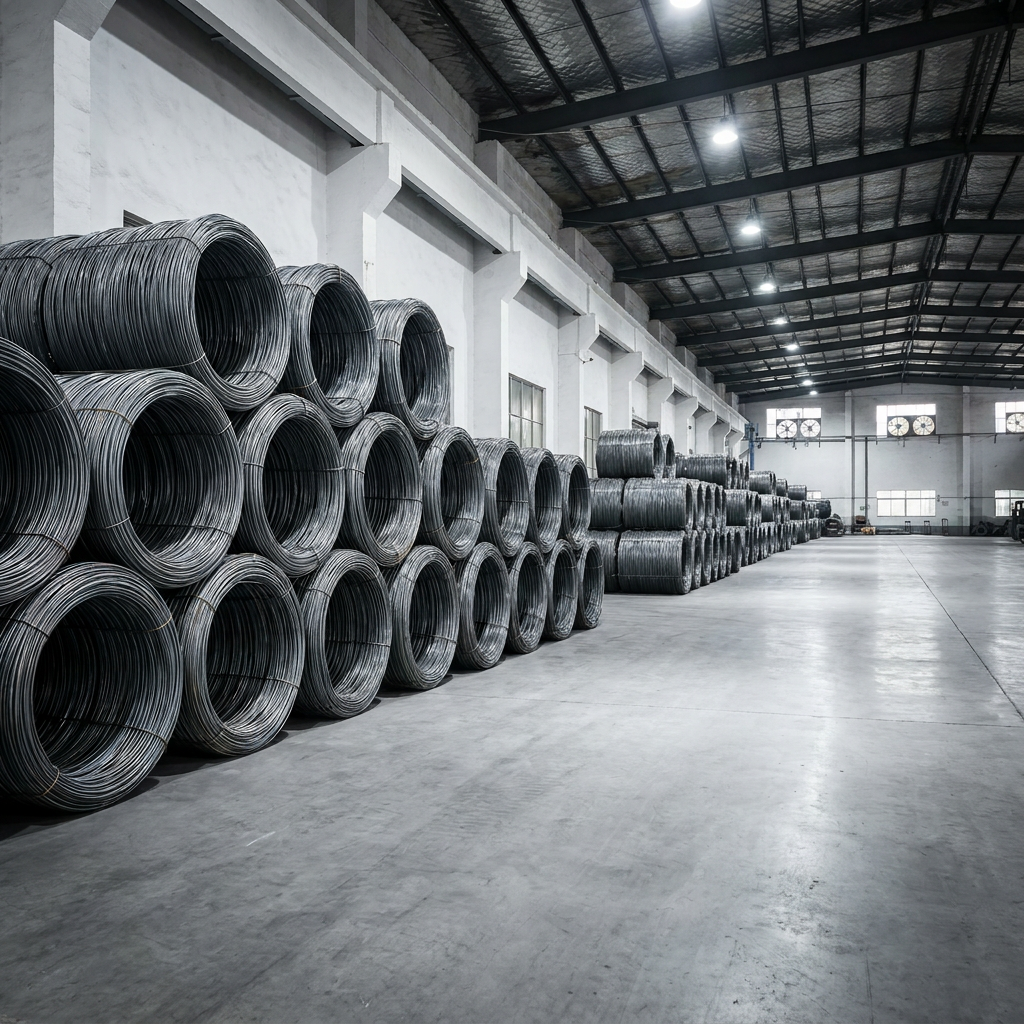
Q235 mild steel staged in the HM Group workshop before tube cutting, bending and welding.
Why the same questions come back at the execution stage
Stackable steel storage racks are bought as a system that will be re-ordered, not as a single purchase. A warehouse that buys one container to test a layout usually returns for a second and third order within the same planning cycle, and that is when specification drift becomes expensive: a batch of posts that does not seat cleanly into the base sockets, a coating that fails in a humid corner of the building, or a container that holds fewer sets than the planning sheet assumed.
The pattern is visible in how buyers phrase their requests. At the evaluation stage the question is which rack type fits the load. At the execution stage the question becomes whether the second shipment will stack with the first. Answering that requires four specifications to be written into the purchase order rather than left to the drawing: material grade, post geometry, finish, and packing density.
HM Group (Dalian HuaMao Logistics Equipment Group Co., Ltd.) is a Chinese manufacturer of warehouse storage and logistics metal products — wire mesh containers, cage pallets, stillage, tire racks, nestainer racks, fabric roll racks, barrel racks and stackable steel storage racks — founded in 2003 and exporting its full output to the EU, North America, Asia and the Middle East. Its stackable steel rack range, including HM-PP001 and HM-PP002, is the reference point for the answers below.
The two reference models and their published specifications
HM-PP001 and HM-PP002 share the same construction logic and differ mainly in footprint and rated load. Both use Q235 mild steel and φ60 × 2.5 mm posts, both stack up to four loaded units, and both are offered in three finish options. The table below is the specification set a buyer should be able to reproduce on a quotation before ordering.
| Specification | HM-PP001 | HM-PP002 |
|---|---|---|
| Base size (L × W × H) | 1395 × 1060 × 310 mm | 1875 × 1060 × 310 mm |
| Post | φ60 × 2.5 mm | φ60 × 2.5 mm |
| Material | Q235 mild steel | Q235 mild steel |
| Load rating | 1,500 kg | 2,000 kg |
| Stacking | Up to 4 units | Up to 4 units |
| Finish options | Zinc, hot-dip galvanized, powder coating | Zinc, hot-dip galvanized, powder coating |
| Container reference | 250 sets per 40'HQ | Confirmed per order |
The practical reading of this table is that the larger base is the load-bearing choice, not the default. HM-PP002 carries 2,000 kg on a 1875 × 1060 mm footprint, while HM-PP001 carries 1,500 kg on 1395 × 1060 mm. A buyer filling a mixed warehouse will typically standardise on one footprint for layout simplicity and accept the lower rating, or split the fleet by bay type. Both decisions are legitimate; what matters is that the rating and the footprint travel together on the purchase order.
Q235 and the φ60 × 2.5 mm post: the two specifications to confirm first
Q235 is a Chinese standard mild carbon steel grade, and the designation refers to a minimum yield strength of 235 MPa — the number in the grade name is the specification, not a marketing figure. For stackable rack bodies this matters because the posts carry the entire vertical load of the units above them, and yield behaviour under a repeated static load is what determines whether a four-high stack stays square over years of handling.
HM Group's material policy prohibits the use of spliced material and inferior steel grades, and mandates Q235 for high-strength requirements. That policy is worth reading as a purchasing instruction rather than a quality slogan: if a supplier substitutes a lower grade or joins post sections to reduce scrap, the visible dimensions can still match the drawing while the stacking behaviour changes.
The post diameter and wall thickness are the second confirmation point. A φ60 mm post with a 2.5 mm wall is a specific combination; a nominally 60 mm tube with a thinner wall looks identical at arm's length and cannot be checked by eye. Buyers running repeat orders should verify wall thickness with a caliper at goods-in, on a sample drawn from each batch, and record it against the model.
Post geometry also controls assembly. Posts must seat into the base sockets without force; internal weld beads, oval deformation or incorrect necking dimensions cause exactly the fit failures that appear as leaning stacks six months later. HM Group's process control addresses this through jig inspection before each welding session, holding verticality within a strict angle error, continuous full-welding at sockets, stacking bowls and tube-to-tube joints, and dimensional control on overall size and diagonals.
Finish options: zinc, hot-dip galvanized or powder coating
Finish is the specification most often decided by habit. The three options offered on HM-PP001 and HM-PP002 serve different environments, and each has a verification method that belongs in the acceptance criteria.
| Finish | Where it fits | What to verify at acceptance |
|---|---|---|
| Zinc (electroplated) | Dry, indoor warehousing where the rack is not exposed to standing water or aggressive air | Uniform coverage, no bare patches, no white spots or early rust bloom on welds |
| Hot-dip galvanized | Humid, unheated or semi-exposed storage where a heavier zinc layer is preferred | Flow holes present and clear, no zinc blockage inside sockets, sharp edges ground, no zinc slag on handling surfaces |
| Powder coating | Clean production and distribution warehouses, including colour-coded zone systems | Cross-cut adhesion test result, furnace temperature records, no peeling, blistering or thin coverage at edges |
Two details decide whether a finish choice becomes a defect. The first is socket fit after coating: hot-dip galvanizing adds a zinc layer to every surface, so the necking dimensions and flow-hole placement must account for it, otherwise posts that fitted before treatment will not seat afterwards. The second is edge preparation. Burrs and zinc slag are handling injuries waiting to happen, and both are removal operations rather than coating operations — they belong in the supplier's process, not in the buyer's warranty claim.
HM Group's surface-treatment protocol uses flow holes to prevent zinc blockage with manual grinding to remove sharp edges on galvanized parts, and cross-cut adhesion testing plus furnace temperature monitoring for powder coating. Both are verifiable: a buyer can request the adhesion test result and inspect sockets on arrival.
Load ratings: what 1,500 kg and 2,000 kg actually cover
The rating is the single most quoted number in a rack quotation and the least defined. A stated 1,500 kg or 2,000 kg per unit should always be read together with three conditions: whether it refers to a uniformly distributed load or a concentrated one, whether it is a static storage condition, and what safety factor the supplier applied.
In a four-high stack the load path compounds. The bottom unit carries its own payload plus the weight of three loaded units above it, transmitted through the posts and stacking bowls. A buyer therefore needs two different confirmations from the supplier: the per-unit rating, and confirmation that the four-high configuration itself is within the design envelope at the intended payload. These are not the same statement, and a quotation that lists only the first is incomplete.
A disciplined RFQ asks for the load figure, the basis of the figure, and the test or calculation behind it. Where an independent load test report is not available, that absence should be recorded rather than assumed away — it becomes a factor in the buyer's own risk assessment and in how the racks are deployed on site.
Stacking four units high: layout, handling and equipment requirements
Four-unit stacking is what converts a stackable rack from floor-level storage into vertical density. It is also a site requirement, not only a product feature: the building must have the clear height, the floor must be flat and capable of carrying the concentrated load of a loaded stack, and the handling fleet must be able to place and retrieve the top unit safely.
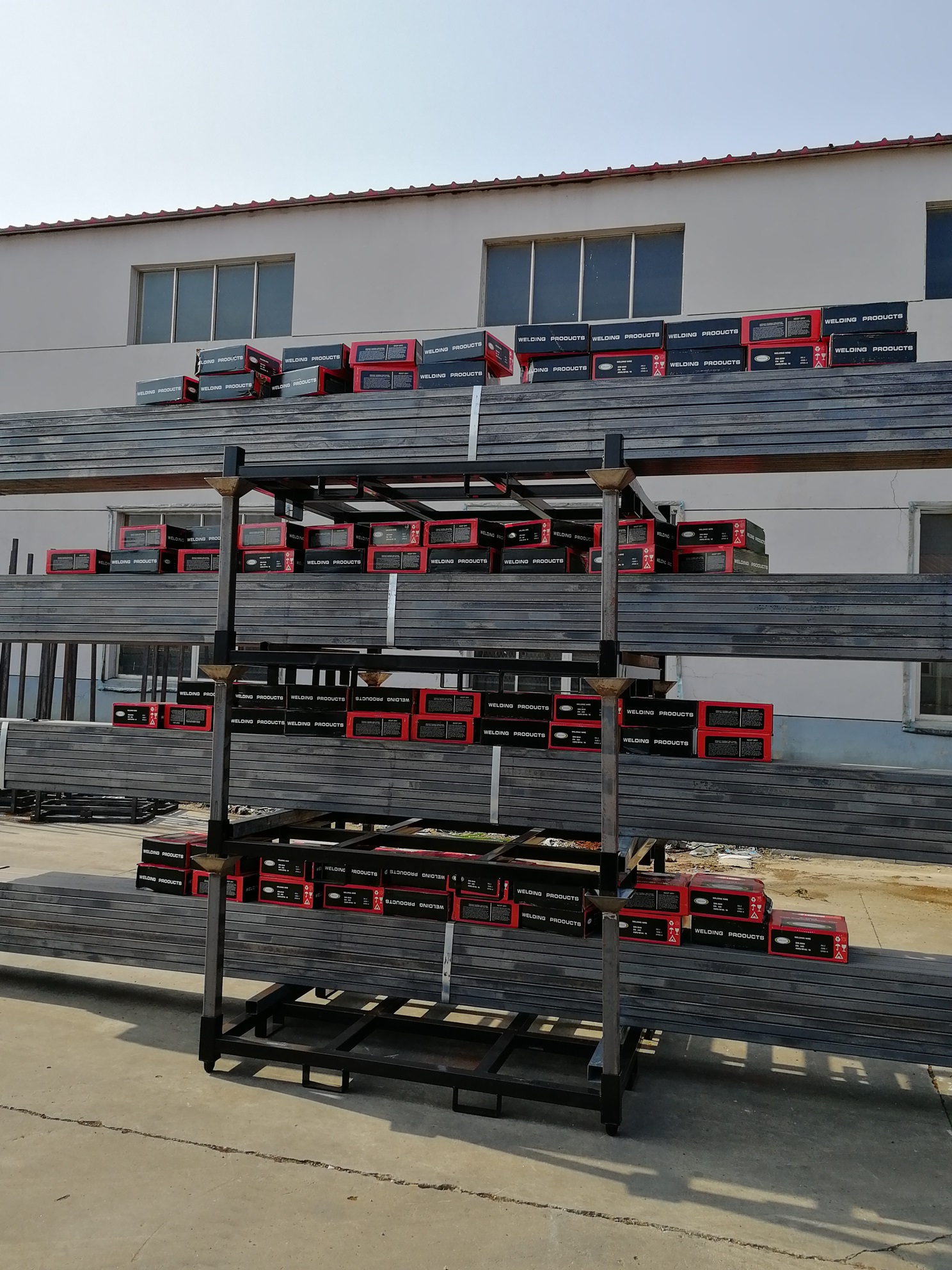
Stacking and loading check on a finished stackable rack before packing.
These racks require supporting equipment such as high-reach forklifts and electric pallet stackers. Buyers planning a four-high configuration should confirm the lift height of the equipment on site before confirming the rack order, because a rack fleet sized for four-high stacking that can only be serviced to three-high delivers the cost without the density.
Compared with fixed pallet racking, the structural logic is different in a way that suits certain operations. Stackable racks need no floor bolting and no installation crew; they can be moved, re-laid out and returned to service when a lease ends. They nest or fold when empty, which matters in seasonal warehouses where the rack itself must give back floor space between campaigns. The same characteristic makes them a poor fit for fully automated high-bay installations, where racking is engineered as a building-scale structure and handled by stacker cranes rather than forklifts.
The application range within the HM Group portfolio follows load geometry rather than a single product shape: stacking tire racks and truck tire racks for tyre storage, fabric roll storage racks and carpet pad storage racks for roll goods, barrel storage racks for 50 L to 500 L containers, and bulk bag storage racks for flexible intermediate bulk containers. A buyer comparing a fabric roll storage rack against a carpet storage rack is comparing two different geometries, not two grades of the same product.
Packing and container fill: reading 250 HM-PP001 sets per 40'HQ
Container fill is a procurement number, not a logistics footnote. The published reference for HM-PP001 is 250 sets per 40'HQ, and its value is that it turns a quotation into a landed-cost calculation and a delivery schedule. A buyer ordering two containers is ordering approximately 500 sets; a buyer who needs 300 sets should expect to discuss part-container loading or a mixed order rather than assume the rate scales freely.
Three caution points belong with that figure. First, container fill is tied to the model and the packing method, so the HM-PP001 rate should not be transferred to HM-PP002 without confirmation. Second, finish and packaging specification can affect how sets are nested and stacked inside the container, which is why the fill rate should be re-confirmed per order rather than copied from an older purchase order. Third, minimum order quantity is 1 × 20GP, so the 40'HQ rate sits comfortably above the commercial threshold.
Verification at shipment is straightforward if it is requested in advance. HM Group provides assembly and disassembly videos and loading photographs, and accepts pre-shipment inspection or third-party inspection. Standard delivery terms are EXW, FOB, CIF, DDP and DDU, with payment by T/T (30 percent in advance, 70 percent against copy of B/L) or L/C. For a repeat buyer, these terms are the part of the agreement that should stay fixed while the specification sheet is re-confirmed each cycle.
Acceptance checks for dimensions, load rating and finish
An acceptance routine converts the specification sheet into something a receiving team can actually enforce. The checks below are the ones that catch the defects most likely to appear in a stackable rack shipment.
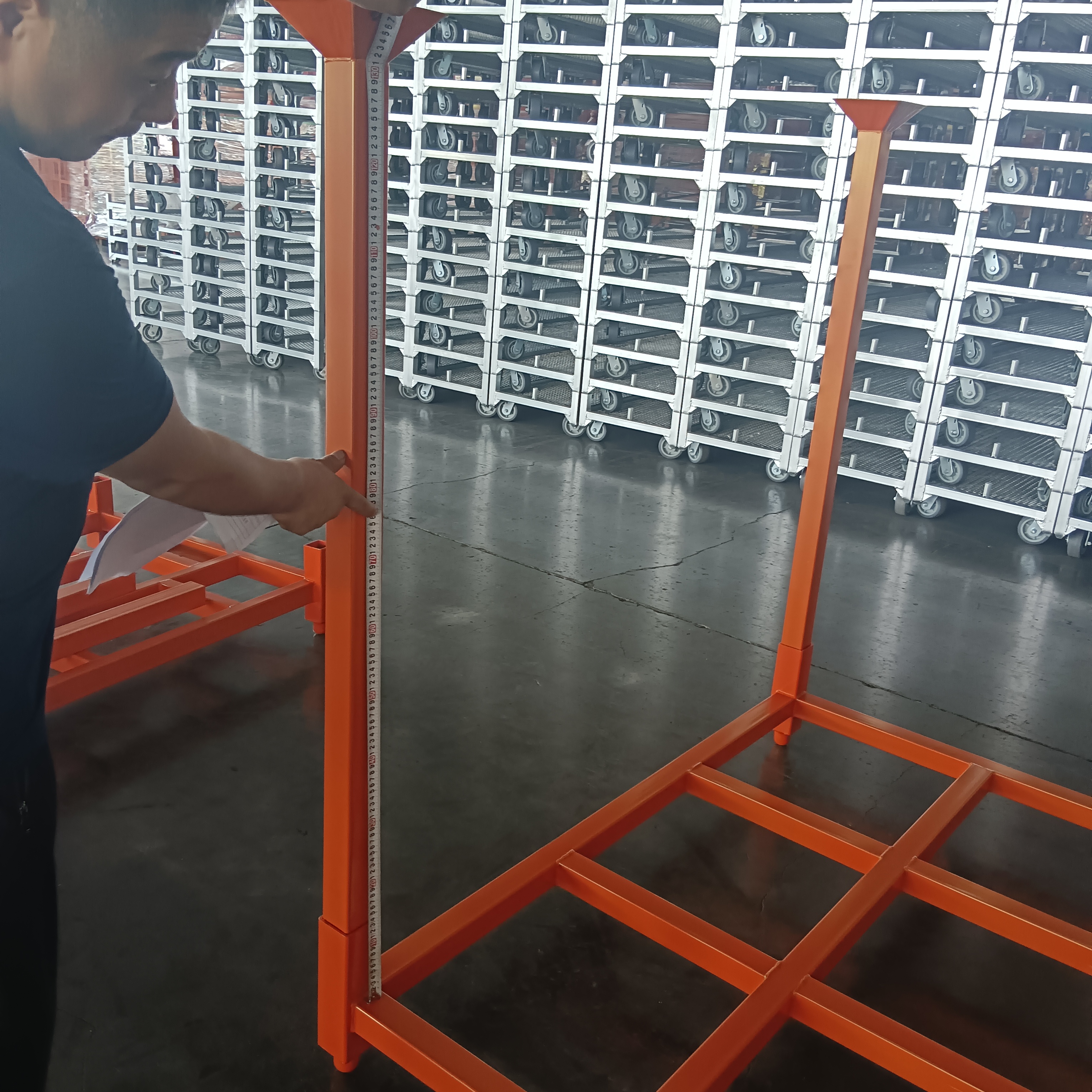
Post dimension measurement on a finished rack as part of pre-shipment inspection.
| Check | Method | What a pass looks like |
|---|---|---|
| Base dimensions | Tape measure on overall length, width and height | 1395 × 1060 × 310 mm for HM-PP001; 1875 × 1060 × 310 mm for HM-PP002, within the tolerance stated in the order |
| Squareness | Measure both diagonals of the base frame | Diagonals equal within the agreed tolerance; no visible twist when placed on a flat floor |
| Post diameter and wall | Caliper on φ60 mm diameter and 2.5 mm wall, sampled across the batch | Consistent diameter, wall not below specification, no spliced post sections |
| Socket fit and verticality | Assemble two units and inspect the stack line | Posts seat without force, stack stands vertical with no rocking or lean |
| Weld integrity | Visual inspection at sockets, stacking bowls and tube joints | Continuous welds at critical joints, no gaps, no spatter left on seating surfaces |
| Finish | Visual plus adhesion test for powder coating | Uniform coverage, no burrs or zinc slag, no peeling or bare patches |
| Loading behaviour | Stacking and loading trial on a sample unit | Stack stable under load, no deformation at post-to-base connections |
| Packing and loading | Loading photographs and container plan | Load distributed as planned, no unstable stacking in the container |
The supplier-side counterpart to this checklist is a full-unit inspection regime rather than sampling alone. HM Group reports 100 percent self-inspection on every unit for internal quality release, an OK versus NOK visual handbook used on the production floor, and a 10 percent pre-shipment sampling inspection for customers. For a repeat buyer, the efficient arrangement is to review the first shipment against the full checklist and then reduce to a defined sample in later cycles, with the full checklist reinstated whenever the model, finish or packing changes.
How stackable steel racks compare with floor stacking and fixed racking
The comparison that matters at the execution stage is not which system is better in general, but which requirements each one fails to meet.
| Criterion | Floor stacking | Fixed pallet racking | Stackable steel racks (HM-PP001 / HM-PP002) |
|---|---|---|---|
| Vertical density | Limited to what the product can bear on itself | High, determined by beam levels | Up to four loaded units, set by the rack rating |
| Installation | None | Engineering, anchoring and installation crew | No floor bolting; units are placed and stacked |
| Relocation | Immediate | Costly; effectively fixed | Whole units can be moved with the load in place |
| Empty-state footprint | None | Permanent, occupied floor | Reduced by nesting or folding when empty |
| Handling requirement | Manual or basic pallet truck | Reach truck per aisle | High-reach forklift or electric pallet stacker |
| Fit with full automation | Not applicable | Designed for it | Not intended as an automated high-bay solution |
Three boundaries deserve to be stated plainly. Stackable racks depend on operator discipline and on equipment reach; a four-high stack is a maximum configuration under controlled load distribution, not a target to be exceeded when a bay looks empty. Q235 with a standard finish is not intended for aggressive chemical or marine atmospheres without a finish upgrade, and buyers storing such goods should treat the finish decision as an engineering one. And where a site requires automated high-bay storage, engineered fixed racking remains the correct system — a stackable rack fleet will not substitute for it, however good the density figures look on paper.
A fourth limitation is commercial rather than structural. Because stackable racks are bought in fleets and re-ordered, the quality of the second and third orders matters more than the quality of the sample. Buyers should treat batch consistency as a contractual item: the same grade, the same post specification, the same finish process, and the same acceptance sample in every cycle.
Repeat orders: what long-term supply consistency depends on
For a buyer building a fleet rather than making a single purchase, supplier capacity and process stability are part of the specification. HM Group reports a monthly production capacity of 80,000 sets, an annual output of 2,000,000 units and a 62,000 m² manufacturing footprint supported by bases in Xiamen, Nanjing and Qingdao, with a 10-person research and development team. Because 100 percent of sales are exports to the EU, North America, Asia and the Middle East, export documentation and container planning are routine rather than occasional activities.
Proximity matters for the after-sales side of a long-term relationship. HM Group maintains sales, technical and service teams across the United States, Canada, Mexico, Argentina, Brazil, South Africa, Saudi Arabia and other key regions. For a distributor or a multi-site operator, that changes the practical question from how quickly a replacement can be shipped from China to who confirms a technical point in the buyer's own time zone.
The honest boundary here is documentation. Available public sources do not include independent third-party load test reports or published certification numbers for these stackable models. Buyers who require them should put the request into the RFQ and treat the response as part of supplier qualification, rather than assuming that a stated load rating and a certified load rating are the same thing.
Market context: density pressure and documented compliance
Demand for stackable and specialty storage racks sits inside a larger racking market. Market Research Future reports the global industrial racking systems market at USD 16.76 billion in 2024, a figure that describes the category rather than any single supplier's position within it. The direction of demand is more useful than the total: as floor space becomes the binding constraint in leased warehouses, buyers look for density that can be added without construction work, which is precisely the argument for a rack that stacks four high and bolts to nothing.
Compliance expectations have moved in parallel. In the United States, OSHA 29 CFR 1910.176(b) requires that storage of material in tiers be stable and secure against sliding or collapse. The clause says nothing about a specific product, but it sets the standard a buyer has to be able to evidence: that the stacking configuration on the floor is stable under the load actually applied. That is why acceptance records, stacking trials and loading photographs have become procurement documents rather than quality-department extras.
Specialisation has also segmented the category. The verified evidence available for this market shows rack portfolios organised by load geometry — tire, barrel, carpet, fabric and roll formats — and a comparable specialty-rack presence among suppliers in both China and the United States. For buyers, the implication is procedural: specify the stored product, its dimensions and its weight distribution before comparing suppliers, because a carpet pad storage rack and a bulk bag storage rack are not interchangeable items with different prices.
What changes next in stackable rack procurement
The near-term shift is from product comparison to documentation comparison. Specifications such as Q235, φ60 × 2.5 mm posts, 1,500 kg and 2,000 kg ratings and three finish options are already common across suppliers on paper; what differentiates them in practice is whether the supplier can evidence the same values in the batch that ships next year. Buyers consolidating supplier lists are therefore adding three items to the RFQ package: the basis of the load rating, the finish verification method, and the batch acceptance sample.
A second shift is fleet standardisation. Once a warehouse has a working four-high layout, the cost of introducing a second footprint or a second finish is paid in handling errors and spare-part complexity. Standardising on one base size and one finish per site, and re-confirming container fill per order, is a low-effort way to protect the original layout decision.
FAQ
What is the difference between HM-PP001 and HM-PP002?
Both are stackable steel storage racks built from Q235 mild steel with φ60 × 2.5 mm posts and up to four-unit stacking. HM-PP001 has a 1395 × 1060 × 310 mm base and a 1,500 kg load rating; HM-PP002 has a larger 1875 × 1060 × 310 mm base and a 2,000 kg load rating. The choice is driven by payload and footprint rather than by a quality difference between the two models.
Why does the φ60 × 2.5 mm post specification matter in a stackable rack?
The posts carry the combined weight of every loaded unit above them, so diameter and wall thickness determine how the stack behaves under sustained load. A thinner wall can look identical externally while changing that behaviour. Buyers verify it with a caliper at goods-in rather than by visual inspection, and confirm that post sections are not spliced.
Which finish should be specified: zinc, hot-dip galvanized or powder coating?
Zinc plating suits dry indoor warehousing, hot-dip galvanizing suits humid or semi-exposed conditions where a heavier zinc layer is preferred, and powder coating suits clean production and distribution environments including colour-coded zones. Finish choice also has a fit consequence: galvanizing adds a zinc layer, so socket and necking dimensions must account for it, and flow holes must remain clear.
How many HM-PP001 sets fit in a 40'HQ container?
The published reference is 250 HM-PP001 sets per 40'HQ. Because packing method and finish specification can affect how sets are nested inside the container, the figure is best treated as a planning reference to be re-confirmed per order rather than transferred automatically to HM-PP002 or to a different packing configuration. The stated minimum order quantity is 1 × 20GP.
What should be checked at acceptance for dimensions, load rating and finish?
Dimensions: measure overall base size against the model specification and compare both base diagonals. Posts: caliper the φ60 mm diameter and 2.5 mm wall on a batch sample, and assemble two units to confirm posts seat without force and the stack stands vertical. Welds: check sockets, stacking bowls and tube joints for continuous welding. Finish: check coverage, absence of burrs and zinc slag, and adhesion test results for powder coating. Load: request the basis of the rating and confirm the four-high configuration is within the design envelope at the intended payload.
How should a buyer verify a 1,500 kg or 2,000 kg rating before placing repeat orders?
Ask for the load figure, the conditions it refers to (uniformly distributed or concentrated, static or dynamic) and the calculation or test behind it. Where an independent load test report is not available, record that gap and reflect it in the site deployment plan. On repeat orders, re-confirm the rating on the quotation alongside the model number, since the two should always travel together.
What are the practical limits of stacking four units high?
Four-unit stacking requires sufficient clear height, a flat floor able to carry the concentrated load of a loaded stack, and handling equipment such as a high-reach forklift or electric pallet stacker with adequate lift height. The four-unit figure is a maximum for controlled, uniformly distributed loads and is not intended to be exceeded. Stackable racks are also not a substitute for engineered fixed racking in automated high-bay installations.
What are the standard procurement terms for these racks?
HM Group states a minimum order quantity of 1 × 20GP, delivery terms of EXW, FOB, CIF, DDP and DDU, payment by T/T with 30 percent in advance and 70 percent against copy of B/L, or by L/C, and acceptance through pre-shipment inspection or third-party inspection. Assembly and disassembly videos and loading photographs are provided for verification.
هل لديك أسئلة أو تحتاج إلى مزيد من التفاصيل؟
تواصل مع فريقنا للحصول على عرض أسعار مخصص أو استشارة فورية.
طلب عرض أسعار
املأ النموذج أدناه وسيتواصل معك فريقنا بعرض مقترح مخصص.
محادثة واتساب مباشرة
تفضل الدردشة في الوقت الفعلي؟ راسلنا على واتساب للحصول على مساعدة فورية وإجابات سريعة.
- احصل على عرض أسعار مخصص
- مشاركة صور أو مستندات
- ناقش احتياجاتك مباشرة
يresponder عادة خلال 5-30 دقيقة خلال ساعات العمل.