
Stainless Pillow Block Inserts: SSER, SUK2, SNA2, SSA2, SSB2
Stainless pillow block bearing inserts are the interchangeable core of a mounted bearing unit: they carry the shaft, provide the rolling contact, and determine how the outer housing locks onto the shaft. For buyers working with food processing, pharmaceutical, marine, chemical, or washdown equipment, the insert code is often the single specification that decides whether a replacement fits, whether an OEM assembly performs, and whether a spare-parts program stays economically viable.
This article takes an independent buyer's view of eight stainless steel insert code families — SSER, SUK2, SNA2, SSA2, SSB2, SUER2, SUE2, and SUC2 — and sets out how to evaluate them for replacement or OEM sourcing. It covers lock styles, innner-ring geometry, housing compatibility, adapter sleeve requirements, and custom grease options, using verified product data and published case evidence.
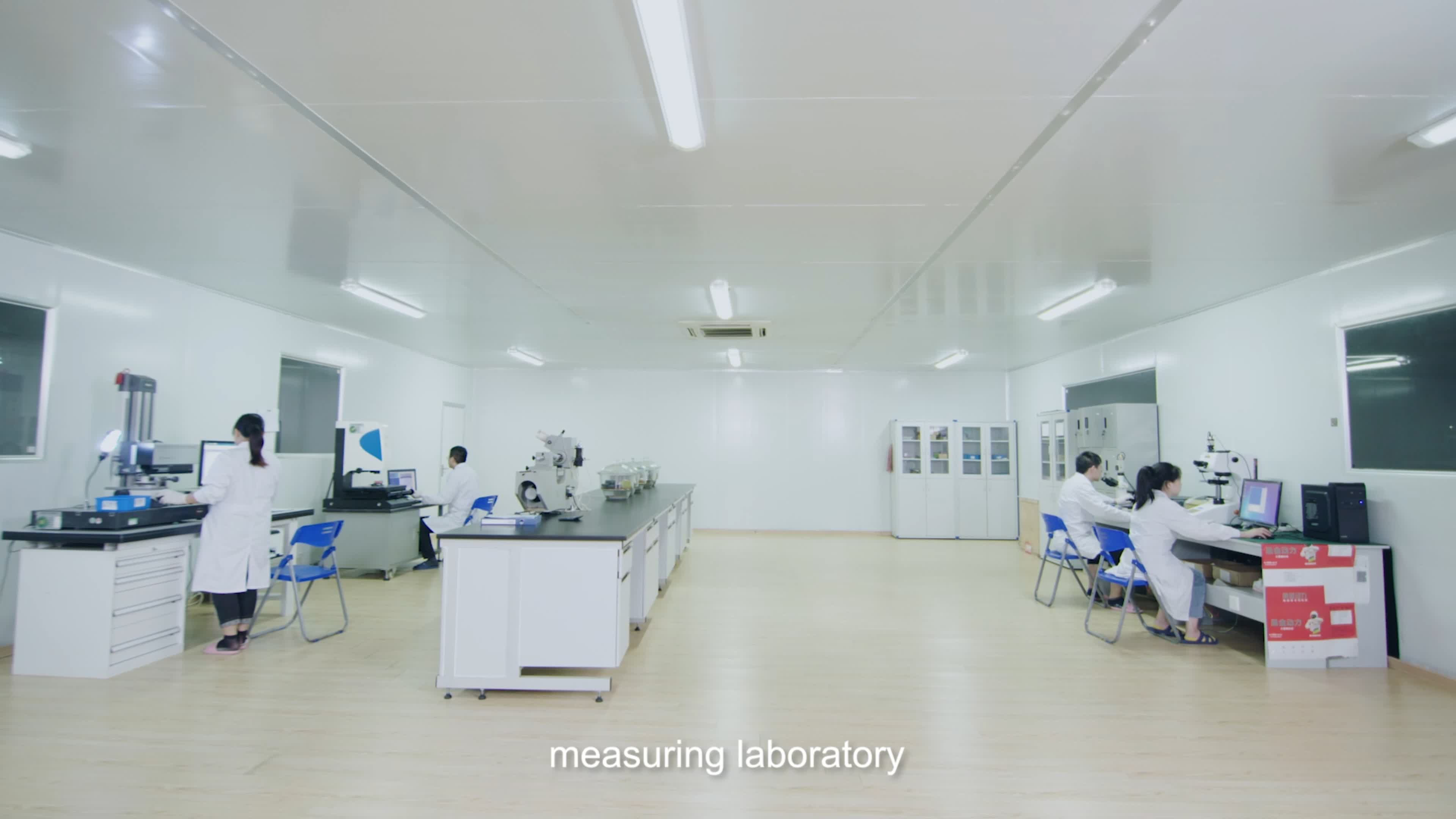
Measurement room used for dimensional verification of stainless bearing inserts and housings. Image: LDK Bearings.
Why the Insert Code Matters More Than the Housing Code
A mounted bearing unit is two parts: the housing and the insert. The housing code (for example, SSUCP2, SSUCFL2, SSUCT2) tells you the mounting configuration — two-bolt pillow block, four-bolt flange, take-up, or cartridge. The insert code tells you what the bearing actually does: how it grips the shaft, how it accommodates misalignment, and how it seals against contamination.
In stainless steel mounted units, the insert is usually the more constrained choice. Housings are available in a finite number of mounting geometries, but inserts multiply across lock style, inner-ring width, and bore range. LDK, for example, reports more than 100 combinations of material and housing type across its mounted bearing range, with insert bore sizes from 10 mm to 140 mm. A buyer who specifies the housing first and the insert second often discovers that the preferred lock style is not available in the required bore — or that the insert on the shelf does not match the housing's bore-to-centre-height relationship.
The practical rule is the reverse: specify the insert by application requirement (shaft grip, misalignment, washdown, temperature), then confirm the housing that accepts it. The eight stainless insert codes below are the starting point for that decision.
Stainless Insert Code Families at a Glance
The table below summarises the eight stainless insert codes covered in this article. All are stainless steel 440 constructions from LDK, supplied with food-grade grease and silicon rubber seals as standard, and all are self-aligning and relubricable.
| Insert Code | Locking Style | Inner Ring | Bore Range | Distinctive Feature |
|---|---|---|---|---|
| SSER | Set screw | Standard | 20–55 mm | Cylindrical outer ring with snap ring |
| SUK2 | Adapter sleeve | Tapered bore | 20–55 mm | Tapered bore for sleeve mounting |
| SNA2 | Eccentric locking collar | Wider | 20–60 mm | Wider inner ring, eccentric collar |
| SSA2 | Eccentric locking collar | Narrow | 20–60 mm | Narrow inner ring, eccentric collar |
| SSB2 | Set screw | Narrow | 20–60 mm | Narrow inner ring, set screw lock |
| SUER2 | Concentric locking | Wider | 12–60 mm | Cylindrical outer ring with snap ring |
| SUE2 | Concentric locking | Wider | 12–60 mm | General-purpose concentric lock |
| SUC2 | Set screw | Wider | 12–60 mm | Widest bore coverage, set screw lock |
Two patterns stand out. First, inner-ring width correlates with load capacity and shaft contact area: wider rings (SNA2, SUER2, SUE2, SUC2) are generally preferred for higher radial loads and better shaft grip, while narrow rings (SSA2, SSB2) suit lighter-duty applications where space or cost is the constraint. Second, the locking method determines installation time, shaft damage risk, and vibration resistance — not just holding force.
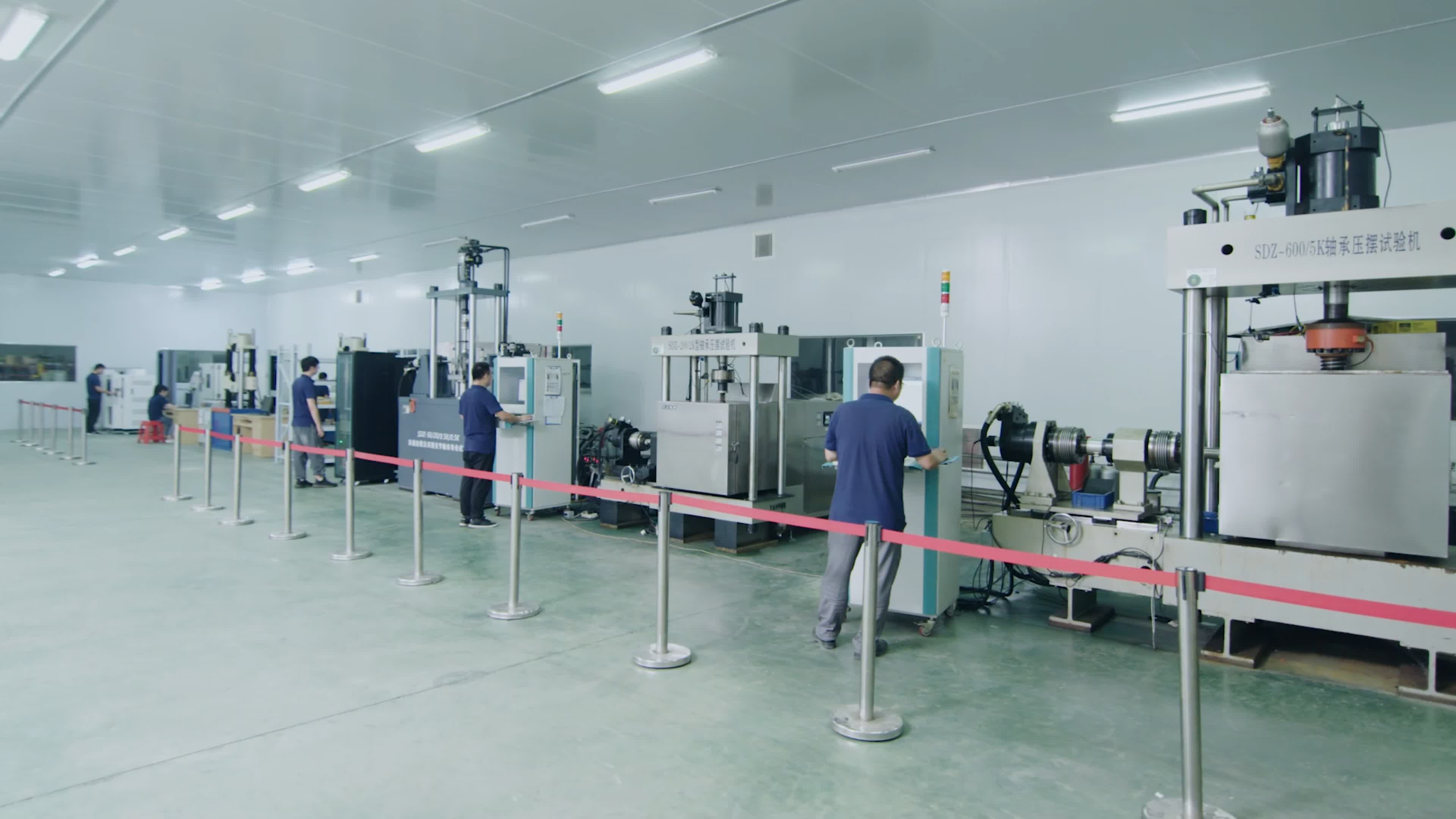
Reliability testing room. Verification of insert performance supports buyer-side evaluation of lock style and sealing. Image: LDK Bearings.
Locking Styles Compared: Set Screw, Eccentric, Concentric, and Adapter Sleeve
Set screw locking (SSER, SSB2, SUC2)
Set screw locking uses one or more socket set screws in the inner-ring extension that bear directly on the shaft. It is the simplest and lowest-cost method, and it is the most common choice in general-purpose stainless mounted units. SUC2, with its wider inner ring and 12 mm to 60 mm bore range, is the broadest-coverage set-screw stainless insert.
The limitation is equally clear: set screws concentrate load on a small shaft area, can loosen under vibration, and can mark the shaft if over-torqued. For replacement buyers, this matters because a damaged shaft from a set-screw insert may require the same insert family again — not because it is superior, but because the shaft condition no longer suits a different lock style.
Eccentric locking collar (SNA2, SSA2)
Eccentric locking uses a collar with an eccentric bore that rotates against the inner-ring extension and locks when turned in the direction of shaft rotation. It distributes holding force over a larger contact area than a set screw and is easier to install and remove. SNA2 and SSA2 differ mainly in inner-ring width: SNA2's wider ring suits higher radial loads, while SSA2's narrow ring suits lighter-duty applications.
For food and beverage equipment where shafts are frequently changed during sanitation cycles, eccentric locking is often preferred over set screws because it reduces shaft marking. The trade-off is that eccentric collars require enough axial space for the collar and a locking direction that matches shaft rotation.
Concentric locking (SUER2, SUE2)
Concentric locking uses a collar or ring that grips the shaft uniformly around its circumference, providing the highest concentricity of the mechanical lock styles. This reduces vibration and runout — a critical factor in food processing machinery where bearing vibration can accelerate seal wear and contaminate product zones. SUE2 is the general-purpose concentric insert; SUER2 adds a cylindrical outer ring and snap ring, which is useful where axial location matters.
The buyer implication is that concentric locking usually costs more and requires more careful installation than set screws, but it can extend service life in applications where vibration or shaft damage would otherwise drive premature replacement.
Adapter sleeve locking (SUK2)
SUK2 is a tapered-bore insert that mounts on an adapter sleeve. The sleeve slides onto the shaft, the insert is pushed onto the sleeve, and a lock nut drives the insert up the taper to create an interference fit. This is the preferred method for applications where the shaft is already hardened or where a keyless, non-marring grip is required.
The trade-off is complexity: adapter sleeve locking requires the correct sleeve size, correct nut torque, and correct axial clearance after mounting. SUK2 covers bore sizes from 20 mm to 55 mm and is typically specified where shaft concentricity is high and the application demands a secure grip without set screws.
Matching Inserts to Stainless Housings
Stainless insert codes are designed to fit specific stainless housing families. The table below shows the typical pairing between LDK's stainless insert codes and its stainless mounted unit series.
| Housing Series | Mounting Type | Compatible Insert Codes | Bore Range |
|---|---|---|---|
| SSUCP2..ESB / SSUCP2..A | Two-bolt pillow block | SUC2 (set screw) | 20–60 mm |
| SSUEP2..ESB | Two-bolt pillow block | SUE2 / SUER2 (concentric) | 20–60 mm |
| SSUCF2..ESB / EHB / A | Four-bolt flange | SUC2 (set screw) | 20–60 mm |
| SSUEF2..ESB / EHB | Four-bolt flange | SUE2 / SUER2 (concentric) | 20–60 mm |
| SSUCFL2..ESB / EHB / A | Two-bolt flange | SUC2 (set screw) | 20–60 mm |
| SSUEFL2..ESB / EHB | Two-bolt flange | SUE2 / SUER2 (concentric) | 20–60 mm |
| SSUCT2 / SSUET | Take-up | SUC2 / SUE2 | 20–60 mm |
| SSUCFC / SSUEFC | Flange cartridge | SUC2 / SUE2 | 20–60 mm |
| SSUCPA / SSUCPA..A | Tapped-base pillow block | SUC2 (set screw) | 20–50 mm |
| SSUEPA..A | Tapped-base pillow block | SUE2 (concentric) | 20–50 mm |
| SSUCFB..A / SSUEFB..A | Three-bolt flange bracket | SUC2 / SUE2 | 20–50 mm |
The compatibility logic is straightforward: housing series ending in C (SSUCP, SSUCF, SSUCFL, SSUCT, SSUCFC, SSUCPA) take set-screw inserts, while series ending in E (SSUEP, SSUEF, SSUEFL, SSUET, SSUEFC, SSUEPA) take concentric-locking inserts. Flange and pillow-block variants exist in both families, so buyers can match mounting configuration and locking style independently.
Two constraints deserve attention. First, stainless housings are typically offered in a narrower bore range than cast-iron equivalents: LDK's stainless mounted units cover 20 mm to 60 mm for most configurations, while cast-iron series extend to 140 mm. Second, not every stainless housing is available with every insert lock style — the SSER and SSA2/SSB2 inserts are not listed in LDK's stainless mounted-unit series, which means buyers seeking those codes for replacement may need to source the insert independently or confirm availability with the manufacturer.
When SUK2 Requires an Adapter Sleeve
SUK2 is a tapered-bore insert, which means it cannot mount directly on a cylindrical shaft. It requires an adapter sleeve: a split, tapered sleeve that slides onto the shaft and provides the mating taper for the insert bore. LDK supplies adapter sleeves across a broad range, from H204 through H2356 in the H series, plus H3024 through H3080 in the H30 series, and HE/HA/HS inch-series equivalents.
Adapter sleeve selection follows bore size and shaft diameter. For a SUK2 insert, the sleeve part number is determined by the insert bore series: for example, a SUK2 20 mm bore requires an H204-series sleeve, while a 55 mm bore requires an H211-series sleeve. The sleeve's lock nut and lock washer are supplied as part of the assembly.
The buyer implication is that SUK2 sourcing is a two-part decision: the insert must match the housing, and the sleeve must match both the insert bore and the shaft diameter. Ordering a SUK2 insert without confirming sleeve availability creates a project risk that does not exist with set-screw or eccentric-locking inserts.
Custom Grease and Temperature Boundaries
Standard stainless inserts from LDK are supplied with food-grade grease and silicon rubber seals. For applications outside the standard temperature or lubrication envelope, LDK offers custom bearing inserts with special grease (product 4234), a customizable option that includes high- or low-temperature grease, appropriate internal clearance, silicon rubber seals, and special fit and alignment torque for high-temperature service.
The published case evidence gives a concrete reference point: a cold-storage application in New Zealand used 5,000 units of product 4234 for low-temperature conveyors, operating properly at –50 °C with stable low-temperature performance and longer service life. The project was completed within 12 months.
For buyers, custom grease is not a cosmetic upgrade. It changes the insert's service temperature range, relubrication interval, and seal compatibility. A standard food-grade grease may be adequate for a 0 °C to 40 °C washdown environment but unsuitable for a –50 °C freezer or a high-temperature oven discharge conveyor. The specification question is therefore not "does it have custom grease" but "what temperature and lubrication envelope does the application actually require, and does the grease specification match it?"
Application Fit: Where Each Insert Family Makes Sense
The following framework maps insert families to common application requirements. It is intended as a starting point for buyer evaluation, not a substitute for application-specific engineering review.
Food and beverage processing
Stainless inserts with food-grade grease and silicon rubber seals are the baseline. SUC2 (set screw) and SUE2 (concentric) are the most common choices in stainless mounted units for conveyors, mixers, and filling equipment. Concentric locking (SUE2, SUER2) is often preferred where vibration reduction and high concentricity matter, while set-screw locking (SUC2) remains common in lower-speed, lower-vibration positions.
A UK food-processing OEM case used 15,000 units of a related stainless product with grip lock and solid lube, achieving a 30% reduction in equipment ownership and maintenance cost through contamination prevention and high concentricity/low vibration. The project was completed within 12 months.
Pharmaceutical and medical equipment
The same corrosion-resistant stainless construction applies, with concentric locking preferred where shaft concentricity affects product quality or equipment vibration. Custom grease options may be specified for sterilization or low-temperature environments.
Marine and offshore processing
Corrosion resistance is the primary driver. A US offshore processing equipment project used 70,000 units of product 4126 (SSUCP2..ESB, a set-screw stainless pillow block) with a patent-pending coating that provided enhanced corrosion resistance compared to conventional stainless steel, achieving 500 hours of rust-free performance and RoHS/REACH compliance. The project was completed within 2 years.
Cold storage and low-temperature conveyors
Standard grease may stiffen or fail at low temperature. Custom grease inserts (product 4234) are specified for low-temperature service. The New Zealand cold-storage case noted above illustrates the requirement: –50 °C operation with stable performance and longer service life.
Washdown and chemical exposure
Stainless housings and inserts are the baseline, supplemented by custom grease and seal options where chemical exposure or frequent washdown accelerates lubricant degradation. The 110,000-unit New Zealand sorting machinery project, which used plastic bearing units for high corrosion resistance, illustrates that material selection is application-specific: plastic housings may be preferred where weight and chemical resistance outweigh the load capacity of stainless.
Procurement and Verification: What to Confirm Before Ordering
Stainless insert sourcing involves more than matching a code to a bore size. The following procurement checks apply to replacement and OEM programs alike.
Inspection and quality documentation
LDK operates IATF 16949 and ISO 9001 certified manufacturing facilities and implements self-inspection and verification, second-party audit, and third-party audit as quality control processes. For buyers, the relevant question is not whether a certificate exists but whether the inspection record for the specific insert lot can be retrieved. LDK's published procurement guidance notes that digital inspection records support skip-to-line audits — relevant where a buyer wants to reduce incoming inspection for a qualified supplier.
RoHS and food-contact compliance
LDK holds SGS RoHS verification reports covering stainless and chrome steel bearing insert ranges, including reports for UC-series inserts (UC206 L3, UCFC205, UCF207 L3) and SB205/UD200 inserts. The reports cite the EU RoHS Directive (EU) 2015/863 amending 2011/65/EU. For food-contact applications, LDK holds a TÜV Rheinland test report for thermoplastic bearing housing under U.S. FDA 21 CFR.
Lead time, MOQ, and delivery terms
LDK's published capability data lists monthly capacity of 300,000 units, lead time of 30–90 days, and MOQ of 5,000 units for standard production. The company also states that flexible manufacturing allows low-to-high volume production, and its procurement guidance describes MOQ as low as 1 piece for specialized long-tail items. Delivery terms include FOB, CIF, DDP, and DDU, with vendor-managed inventory (VMI) arrangements available for major OEM accounts.
Payment terms and credit
LDK's procurement guidance states that payment terms may include usance L/C or O/A 30–60 days for verified long-term OEM clients, subject to case-by-case finalization. This is a commercial term, not a product specification, but it affects total procurement cost and should be confirmed during supplier qualification.
Limits and Boundaries of Stainless Insert Selection
Stainless inserts are not universally superior to chrome steel or cast-iron alternatives. Three boundaries are worth stating plainly.
Load capacity. Stainless steel 440 is corrosion-resistant but generally has lower load capacity than through-hardened chrome steel (GCr15/AISI52100) of comparable dimensions. For heavy radial or impact loads, a chrome steel insert in a cast-iron or ductile-iron housing may be the better engineering choice, with corrosion protection addressed through coatings or material selection elsewhere in the assembly.
Bore range. LDK's stainless mounted units cover a narrower bore range (typically 20–60 mm) than its cast-iron mounted units (up to 140 mm). Buyers specifying large shafts should confirm that a stainless option exists before designing around it.
Insert availability by lock style. Not every insert code is offered in every housing series. SSER, SSA2, and SSB2 appear in LDK's bearing insert catalogue but not in the stainless mounted-unit series listings reviewed for this article. Buyers seeking these codes for replacement should verify availability directly rather than assuming a standard housing pairing.
Future Outlook
The demand context for stainless mounted bearings remains favourable. Third-party market research cited in this article estimates the global pillow block bearings market at USD 2.8 billion in 2024, projected to reach USD 4.7 billion by 2033 at a 5.7% CAGR, while the broader mounted bearing market was valued at approximately USD 1.48 billion in 2023. Asia Pacific accounted for roughly 49.5% of mounted bearing revenue in 2025, reflecting the concentration of food processing, pharmaceutical, and industrial equipment manufacturing in the region.
For buyers, the practical implication is that stainless insert availability and lead times may improve as capacity expands, but the selection logic — matching lock style, bore range, housing compatibility, and grease specification to the application — will remain the same. The insert code is not a commodity label; it is the specification that determines whether a mounted bearing unit performs in its intended environment.
FAQ
What do the stainless insert codes SSER, SUK2, SNA2, SSA2, and SSB2 mean?
They are stainless steel 440 bearing inserts defined by locking style and inner-ring geometry. SSER uses set-screw locking with a cylindrical outer ring and snap ring (20–55 mm bore). SUK2 uses a tapered bore for adapter-sleeve mounting (20–55 mm). SNA2 uses an eccentric locking collar with a wider inner ring (20–60 mm). SSA2 uses an eccentric locking collar with a narrow inner ring (20–60 mm). SSB2 uses set-screw locking with a narrow inner ring (20–60 mm). All are supplied with food-grade grease and silicon rubber seals as standard, and all are self-aligning and relubricable.
How should a buyer choose between set screw, eccentric, concentric, and adapter sleeve locking?
The choice depends on four application factors: shaft condition, vibration level, installation access, and required concentricity. Set screw locking (SSER, SSB2, SUC2) is simplest and lowest cost but concentrates load on a small shaft area. Eccentric locking (SNA2, SSA2) distributes force over a larger area and is easier to remove, reducing shaft marking. Concentric locking (SUER2, SUE2) provides the highest concentricity and lowest vibration, at higher cost and installation care. Adapter sleeve locking (SUK2) provides a keyless, non-marring grip for hardened shafts but requires correct sleeve selection and mounting torque. No lock style is universally superior.
Which stainless housing series accept which insert codes?
In LDK's stainless mounted unit range, housing series ending in C accept set-screw inserts: SSUCP2, SSUCF2, SSUCFL2, SSUCT2, SSUCFC, and SSUCPA pair with SUC2. Series ending in E accept concentric-locking inserts: SSUEP2, SSUEF2, SSUEFL2, SSUET, SSUEFC, and SSUEPA pair with SUE2 or SUER2. Bore ranges are typically 20–60 mm for full-range configurations and 20–50 mm for tapped-base and three-bolt bracket variants.
When does a SUK2 insert need an adapter sleeve, and how is the sleeve selected?
SUK2 has a tapered bore and cannot mount directly on a cylindrical shaft, so it always requires an adapter sleeve. Sleeve selection follows insert bore size: for example, a 20 mm SUK2 bore requires an H204-series sleeve, while a 55 mm bore requires an H211-series sleeve. LDK supplies H-series sleeves from H204 through H2356 and H30-series from H3024 through H3080, plus HE/HA/HS inch-series equivalents. The sleeve, lock nut, and lock washer are supplied as an assembly. Ordering a SUK2 insert without confirming sleeve availability creates a project risk.
What does custom grease change, and when is it needed?
Custom grease changes the insert's service temperature range, relubrication interval, and seal compatibility. LDK's custom bearing insert option (product 4234) includes high- or low-temperature grease, appropriate internal clearance, silicon rubber seals, and special fit and alignment torque for high-temperature service. Published case evidence includes 5,000 units operating at –50 °C in a New Zealand cold-storage conveyor application. Custom grease is specified when the standard food-grade grease envelope does not match the application's temperature or lubrication requirements.
What are the purchasing terms and acceptance criteria for stainless bearing inserts?
LDK's published procurement guidance states: MOQ is flexible, with manufacturing allowing low-to-high volume production and MOQ as low as 1 piece for specialized long-tail items. Delivery terms include FOB, CIF, DDP, and DDU, with vendor-managed inventory (VMI) available for major OEM accounts. Acceptance criteria are supported by digital inspection records that enable skip-to-line audits. Payment terms may include usance L/C or O/A 30–60 days for verified long-term OEM clients, finalized case by case. Standard capability data lists monthly capacity of 300,000 units, lead time of 30–90 days, and MOQ of 5,000 units for standard production.
For product documentation, specifications, and company information, the LDK Bearings catalogue is available for download: LDK product brochure (PDF).