
Stainless Steel Balls: Grades, Precision Classes and Fit
Stainless Steel Balls: Grades, Precision Classes and Fit
A stainless steel ball is a spherical component manufactured from a corrosion-resistant stainless grade and supplied in a defined diameter and precision class. Its value is not maximum load capacity — that role belongs to through-hardened chrome steel — but resistance to corrosion, washdown chemistry and humid or chlorinated environments. Buyers entering this category for the first time usually assume that the word “stainless” describes one material. In practice it describes two metallurgical families, several common grades and a precision scale that runs from G3 to G1000. Which combination is chosen determines whether the component lasts the life of the assembly or becomes the corrosion failure point inside it.
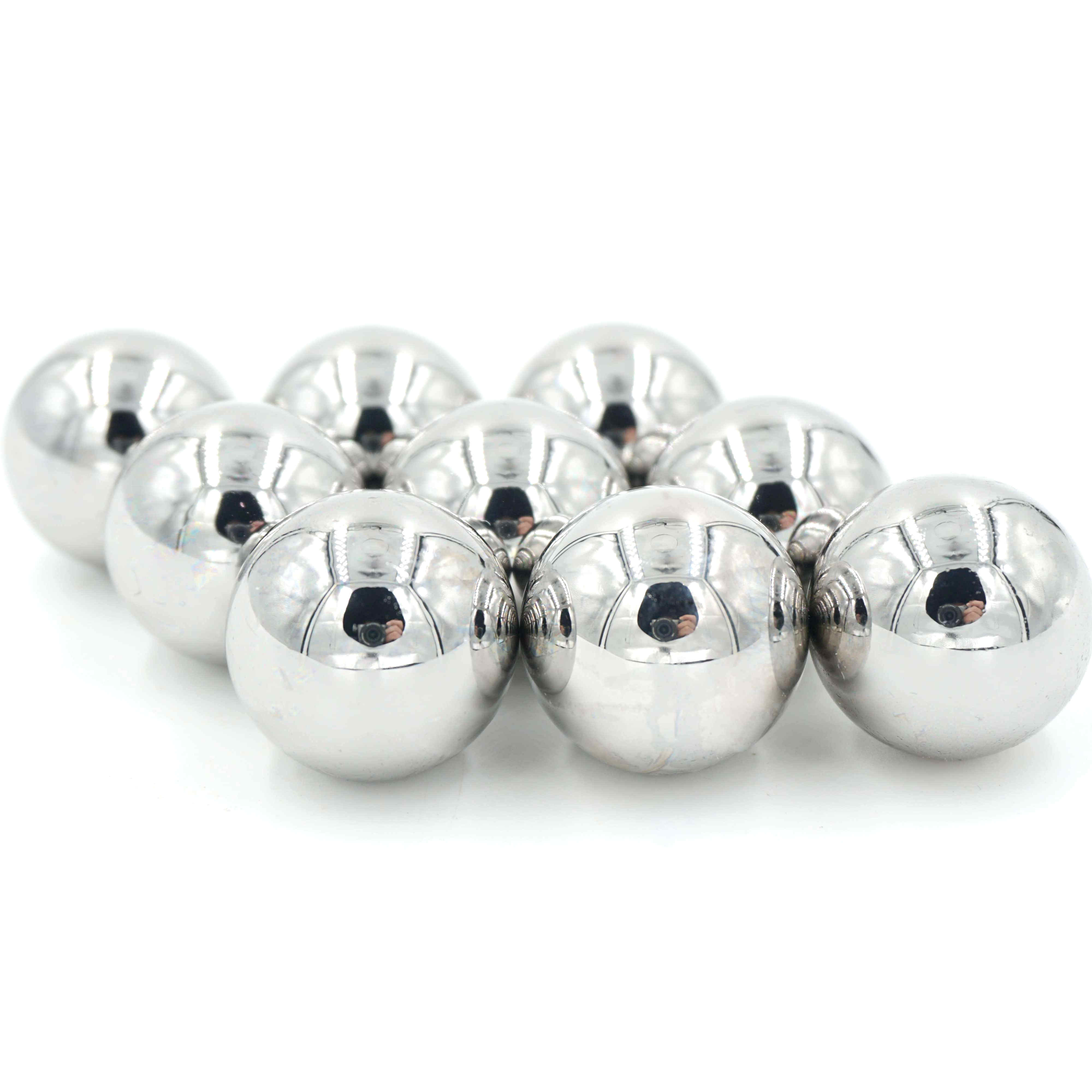
What a Stainless Steel Ball Is — and What It Is Not
A stainless steel ball is a solid spherical component available in austenitic (general-purpose, non-hardenable) grades and martensitic (heat-treatable) grades. Published product data for this category describes austenitic stainless balls at diameters from 0.5 mm to 50.8 mm (0.020–2.000 in) in ABMA precision grades G10 to G1000 at HRC 25–39 in the annealed condition, and martensitic balls from 1.0 mm to 50.8 mm in grades G10–G100 at HRC 50–55 after heat treatment, with high-carbon martensitic variants reaching HRC 58–65 in grades G5–G100. Material designations in common use include AISI 304 / S30400, AISI 316 / S31600, AISI 420 / UNS S42000, AISI 440C / S44004 and AISI 430 / UNS S43000.
Finished stainless balls for rolling-bearing duty are commonly referenced against ISO 3290 / ABMA Std 10, while hot-formed and general-purpose deliveries are frequently quoted against DIN 5401. Those standards matter at the specification stage because they define what a grade number actually controls: diameter variation, sphericity, surface roughness and lot tolerance — not corrosion performance and not load rating.
The Discovery-Stage Problem: One Search Term, Several Different Components
Most first-time enquiries for stainless steel balls begin with a single specification line — a diameter and the word “stainless.” Three assumptions behind that line cause most of the mismatches that appear later at sampling or in service.
- Stainless is assumed to mean corrosion-proof everywhere. It is not. AISI 304 is the economical choice for indoor, freshwater, dry-food and decorative service, but it is not the correct grade for seawater, coastal air, chloride washdown or CIP/pharmaceutical duty. That distinction is a material selection error, not a manufacturing defect.
- Stainless is assumed to mean one hardness. Austenitic grades are supplied annealed, in the HRC 25–39 band. Martensitic grades are heat-treated to HRC 50–55 (420C range) or HRC 58–62 (440C range). A part specified as “stainless” without a hardness requirement can therefore arrive fully fit for a washdown conveyor and entirely unfit for a load-bearing pivot.
- Stainless is assumed to mean one precision level. Grade G10 and grade G1000 are both stainless, and both may carry the same diameter. The difference is in sphericity, diameter variation and surface finish — the parameters that determine noise, vibration and life in a rotating assembly.
Resolving those three points before a quotation is requested is, in most projects, the entire technical content of the sourcing decision.
Stainless Grades and Their Operating Envelopes
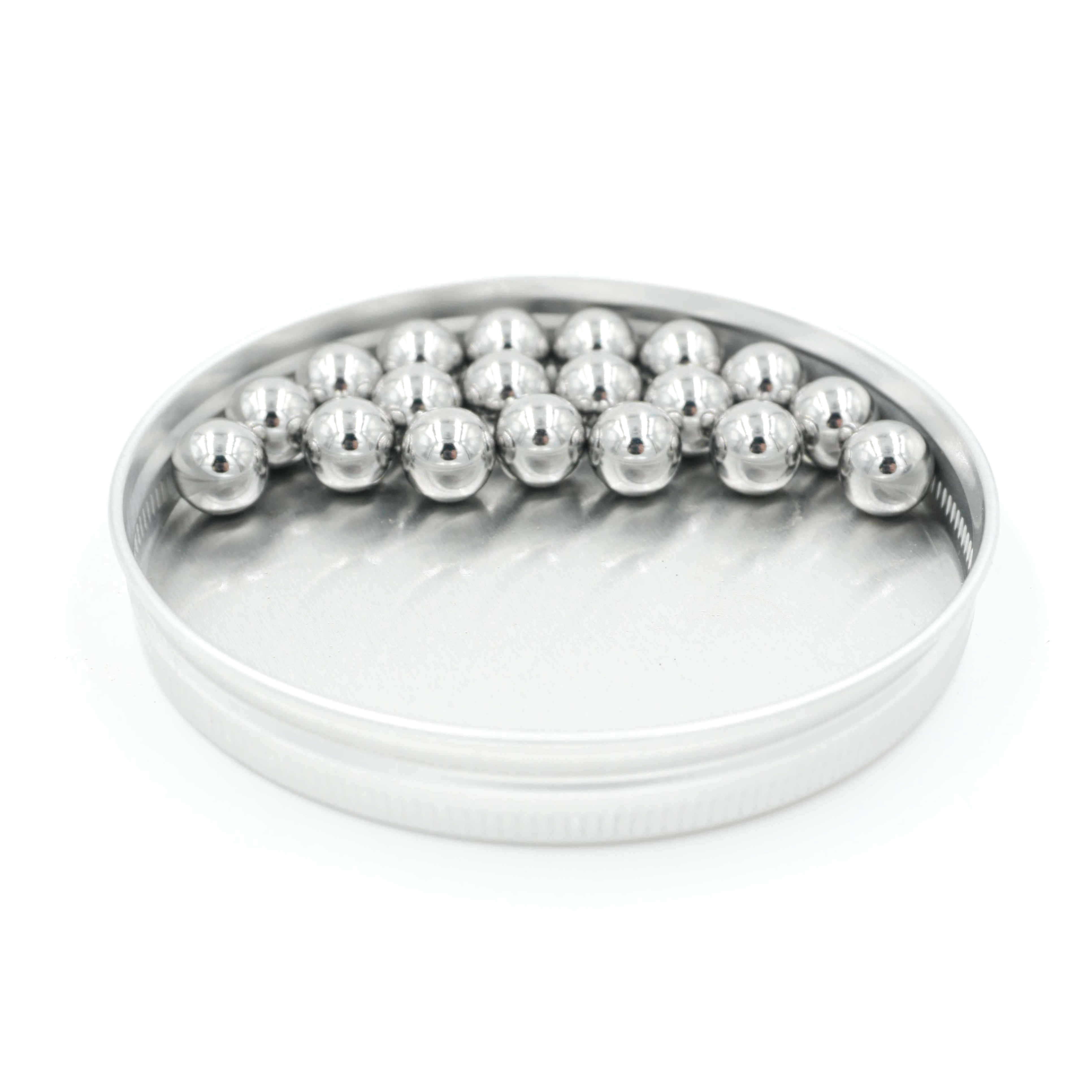
| Grade | Family | Typical supplied condition | Where it fits | Where it stops |
|---|---|---|---|---|
| AISI 304 / S30400 | Austenitic | Annealed, HRC 25–39; grades G100–G1000 typical; mirror polish available | Food and beverage equipment, decorative hardware, plumbing valve assemblies, architectural fittings, cryogenic tanks | Seawater, coastal and chloride service; high-load wear positions |
| AISI 316 / S31600 | Austenitic, molybdenum-alloyed | Annealed, HRC 25–39; grades G100–G1000 typical | Marine hardware, chemical processing, pharmaceutical and food equipment, saltwater valves, offshore rigging | Sustained high load; severe acids and high-chloride service where 316 still corrodes |
| AISI 420 / UNS S42000 (420C) | Martensitic, heat-treatable | Heat-treated, HRC 50–55; grades G25–G1000 | Bearings in mild corrosive environments, food-processing machinery, pump valves, marine hardware, wash-down and humid-duty bearing assemblies | Strong chloride, acid and high-humidity corrosion duty |
| AISI 440C / S44004 | Martensitic, high-carbon | Heat-treated, HRC 58–62; grades G10–G1000; max 0.07% P/S | High-precision bearings, surgical and dental instruments, aerospace actuators, chemical pumps, watch movements | Not the corrosion ceiling of the family — 316 offers higher chloride resistance |
| AISI 430 / UNS S43000 | Stainless material option listed in the product range | Quoted per order | Specified where a corrosion-resistant stainless option is required at a defined price point | Performance envelope must be confirmed against the drawing before selection |
The 304-versus-316 decision is the single most common material question in this category, and it has a measurable basis. Grade 316 adds approximately 2–3% molybdenum and 10–14% nickel relative to 304. That shifts the pitting resistance equivalent number (PREN) to roughly 23–28 for 316 against roughly 18–20 for 304. The practical translation is straightforward: 304 for indoor, freshwater, dry-food and decorative service; 316 for seawater, coastal, chloride, CIP and pharmaceutical environments. Both remain soft austenitic balls. If the application is governed by load or wear rather than corrosion, the correct direction is toward a martensitic stainless grade or a through-hardened bearing steel, not toward a higher austenitic grade.
Market Context: Where Stainless Sits in the Steel Ball Category
The global steel ball market is estimated to reach USD 12.91 billion by 2026 (Coherent Market Insights). Within the material mix, chrome steel balls are projected to hold a 45.7% share of that market in 2026, which places stainless and other corrosion-resistant grades in an application-driven secondary position: specified where hygiene, chemicals or humidity govern, rather than where volume or load governs.
Growth projections for the category diverge more than the size estimates do. One published forecast puts the 2026–2035 CAGR at 5.2%, while other sources report 3.6% and 6.2%. The spread is a methodology difference rather than a contradiction — reports weighted toward large grinding media for mining show lower growth, while reports weighted toward small precision balls used in electric vehicles and automation show higher growth. For planning purposes, the durable signal is that precision and corrosion-resistant segments are expanding faster than commodity grinding media, while the exact rate depends on which segment is being measured.
Technical Explanation: How Hardness, Corrosion and Precision Interact
Hardness is set by the family, not by the word “stainless”
Austenitic grades are supplied annealed because they harden by work rather than by heat treatment; their delivered hardness sits in the HRC 25–39 range. Martensitic grades are through-hardened: 420C to approximately HRC 50–55 and 440C to approximately HRC 58–62. For reference, through-hardened chrome steel 52100 reaches HRC 60–66 with a surface roughness of Ra ≤ 0.05 µm in bearing-grade deliveries, and M50 high-speed alloy reaches HRC 62–66 while retaining hot hardness at elevated temperatures. The consequence for buyers is that “stainless” and “hard” are separate purchase lines, and a hardness figure belongs in every stainless ball specification where the part carries load.
Corrosion resistance is set by alloy content and environment
Molybdenum content drives chloride resistance, which is why 316 outperforms 304 in salt-laden service. Where chloride stress-corrosion cracking becomes the governing failure mode, duplex stainless such as UNS S32205 / S31803 (2205) is used: it is an austenitic-ferritic structure with roughly twice the yield strength of 316 and resistance to pitting and chloride stress-corrosion cracking. Where strong oxidizing and reducing acids are present, nickel-based alloys such as Hastelloy C-276 / C-22 are specified. These are genuine escalation steps — stainless is a family of options with a gradient, not a single answer.
Precision class is an independent decision
ISO 3290-1:2014 specifies requirements for finished steel balls for rolling bearings and defines grades from G3 to G700. The grade number controls diameter variation, sphericity and surface finish. Note that a G1000 designation — commonly offered for general industrial stainless balls — sits outside that ISO grade series; it corresponds to looser tolerance intended for non-bearing duty such as transfer media, decorative and hardware applications. When a stainless ball is going into a rotating bearing position, the grade requirement should be stated explicitly rather than inferred from the diameter. Underlying material standards also matter: ASTM A295/A295M governs high-carbon anti-friction bearing steel such as Grade 52100, and steel balls for bearings are classified under HS Code 8482.91 for trade purposes.
Application Fit: Where Stainless Steel Balls Are Specified
| Industry / environment | Typical stainless selection | Reason for the selection |
|---|---|---|
| Food and beverage, dairy processing | 304, 316 | Food contact, frequent washdown, mild detergents, general corrosion resistance with a cleanable surface |
| Pharmaceutical and specialty chemical | 316 (low-carbon option), duplex 2205, Hastelloy C-276 | Aggressive solvents, acids and bases, frequent CIP/SIP, high-purity surface finish and full material traceability |
| Marine, offshore and desalination | 316, duplex 2205 | Seawater and chloride exposure, salt-laden air, resistance to pitting and chloride stress-corrosion cracking |
| Medical and dental instruments | 316, 440C | Repeated autoclave sterilization, body-fluid exposure, mirror polish; 440C where pivot hardness is also required |
| Industrial bearings and power transmission | 440C where corrosion and hardness coincide; 52100 chrome steel where corrosion is not the driver | High-speed rotation, continuous radial and axial load, low noise and vibration |
| Valve and fluid control | 316, duplex 2205, 440C, drilled variants | Sealing and shut-off duty, quarter-turn actuation, drilled balls for flow-through and pressure-bleed designs |
| Automotive, EV and electronics | 440C, electroplated balls (zinc, nickel or chrome over a carbon or alloy steel core) | Powertrain and e-axle bearings on one side; corrosion-protected and conductive contact parts on the other, with RoHS-compliant plating |
| Architectural and decorative hardware | 304, 316, hollow and drilled variants | Mirror-polish finish and uniform appearance, with hollow construction reducing mass against a solid ball |
| Custom and non-standard assemblies | Non-standard and machined stainless balls to drawing | Applied where standard catalog sizes, grades or geometries do not match the required specification |
Manufacturer Capability in Context
Haimen City Mingzhu Steel Ball Co., Ltd. is a China-based manufacturer specialising in the research, development and production of high-precision steel balls. Established in 1992, the company operates from Haimen, Jiangsu Province, with more than 30 years of manufacturing experience in this component category. Its production base covers 7,500 m², is equipped with 105 sets of professional processing and production equipment, and runs at a stated annual capacity of 2,500 tons with approximately 40 staff, including an R&D team of 8 engineers. Export business accounts for 25% of sales, with the United States, Germany and Brazil identified as principal markets.
The product portfolio covers bearing steel balls, chrome steel balls, stainless steel balls, carbon steel balls, machined steel balls, non-standard and precision steel balls, drilled, electroplated and hollow steel balls, duplex stainless steel balls, M50 steel balls and Hastelloy steel balls. The company holds an IATF 16949:2016 quality management system certificate for the automotive industry, and its published certificate listing additionally references ISO 9001. Stainless balls are manufactured against mainstream international standards including ISO, DIN, JIS and AISI.
Quality control is structured as a whole-process regime. Raw material batches are sampled before entering production, and finished balls pass through 100% automated screening on roller-bar sorting equipment and photoelectric surface defect detectors, supported by hardness, roundness, microstructure, roughness and material verification such as PMI or chemical analysis. Documentation available includes material test reports (MTR), EN 10204 2.1 / 3.1 and COA, with PPAP, FAI, NACE MR0175 and AMS certificates on request. Beyond standard product, the company provides hole drilling and CNC precision machining, which is what allows non-standard, drilled, tapped, stepped and hollow geometries to be produced to a customer drawing.
Comparison with Traditional Solutions — and the Boundaries of Stainless
Stainless steel balls are usually evaluated against two established alternatives: low-cost carbon steel balls and through-hardened chrome (bearing) steel balls. The comparison is decided by which property is being optimised, not by which material is intrinsically superior.
| Attribute | Carbon steel ball (1010 / 1015 / 1018) | Through-hardened chrome steel ball (52100 / SUJ2 / 100Cr6) | Austenitic stainless (304 / 316) | Martensitic stainless (440C) |
|---|---|---|---|---|
| Corrosion resistance | Low; zinc plating available | Low without coating | Good; 316 resists chlorides | Moderate; below 316 in chloride service |
| Typical hardness | Soft as supplied, or HRC 55–60 when hardened | HRC 60–66 | HRC 25–39 annealed | HRC 58–62 |
| Typical precision grades | G100–G2000 | G10–G1000 | G100–G1000 | G10–G1000 |
| Typical applications | Automotive steering and suspension, bicycle and caster bearings, conveyor rollers, grinding media, low-cost hardware | Ball bearings, wheel hubs, electric motors, precision spindles, aerospace control systems | Food and beverage equipment, marine hardware, chemical and pharmaceutical equipment, architectural fittings | High-precision bearings, surgical and dental instruments, aerospace actuators, chemical pumps |
| Principal limitation | Corrosion in wet or humid service | Corrosion resistance in wet, washdown or chloride environments | Limited load capacity; not a bearing-grade wear material | Corrosion resistance below austenitic grades in aggressive chloride |
The most consequential boundary to state plainly is this: austenitic stainless balls are not a wear solution. Supplied annealed at HRC 25–39, they deform and wear faster than through-hardened bearing steel when placed in a load-bearing position, regardless of how good the corrosion resistance is. Choosing 304 or 316 for a high-load rolling element is a specification error that will surface as premature indentation or noise, not as corrosion.
The second boundary runs in the opposite direction. When hardness is prioritised and 440C is selected at HRC 58–62, chloride resistance drops below that of 316. And where neither stainless family is sufficient — strong acids, high-chloride sour service, subsea environments — the escalation path is duplex 2205 or a nickel-based alloy such as Hastelloy C-276, with a corresponding increase in material cost and typically longer lead time. Stainless steel balls solve a corrosion problem at a defined hardness and precision level; they do not eliminate the need to match material to environment.
Specification Checklist for First-Time Buyers
- Environment first: freshwater or indoor (304), chloride or washdown (316), aggressive chemical or high-chloride (duplex, Hastelloy), or mild corrosion with load (420C, 440C).
- Load and hardness second: state a hardness or family requirement if the ball carries load, and accept that the austenitic grades will not deliver it.
- Diameter and series third: confirm whether the drawing is metric or inch, and whether a decimal non-standard size is required.
- Precision grade fourth: specify the ABMA / ISO 3290 grade (for example G10, G25, G100) rather than leaving tolerance implied.
- Geometry fifth: flag early whether drilled, tapped, stepped, half-spherical or hollow features are needed, since these add tooling and lead time.
- Documentation sixth: confirm whether an MTR, EN 10204 3.1, COA, PPAP or FAI package is required at delivery.
- Commercial terms seventh: clarify MOQ expectations, sampling requirement and whether the first order is a prototype or a production release.
- Lead time eighth: plan stock, standard production and custom production on separate timelines rather than one.
Future Outlook
Two structural forces are shaping demand for stainless and corrosion-resistant balls rather than for the category as a whole. The first is hygiene and traceability: food, dairy, pharmaceutical and medical supply chains continue to tighten surface finish, cleanability and documentation requirements, all of which favour austenitic and martensitic stainless grades with material test reports. The second is electrification and automation, where higher-speed rotating equipment in vehicle powertrains, spindles and robotics places a premium on precision grade and dimensional consistency.
It is worth keeping the proportions in view. Chrome steel still represents the largest single material segment of the steel ball market, and stainless remains the corrosion-driven sub-segment within it. The realistic outlook is not a wholesale substitution of stainless for bearing steel, but a continued split of applications: through-hardened chrome steel where load and fatigue life govern, stainless where environment governs, and duplex or nickel alloys where both corrosion and strength are pushed to their limits. Buyers who define which of those three situations applies to their equipment before requesting a quotation will generally converge on the correct specification on the first attempt.
FAQ
What materials and grades of stainless steel balls are commonly supplied?
Stainless balls are typically supplied in austenitic grades AISI 304 / S30400 and AISI 316 / S31600, with AISI 430 / UNS S43000 also listed as a stainless material option, and in the martensitic family as AISI 420 / UNS S42000 and AISI 440C / S44004. Austenitic grades are delivered annealed in the HRC 25–39 range in ABMA grades typically G10–G1000; martensitic 440C is delivered heat-treated at approximately HRC 58–62 with grades G10–G1000 available. Material verification and material test reports are issued per lot on request.
Which is better for my application, 304 or 316 stainless steel balls?
Grade 304 is the economic choice for indoor, freshwater, dry-food and decorative service. Grade 316 adds approximately 2–3% molybdenum and 10–14% nickel, raising the pitting resistance equivalent number to roughly 23–28 compared with roughly 18–20 for 304, so it is the appropriate grade for seawater, coastal, chloride, CIP and pharmaceutical duty. Both are soft austenitic balls, so where high load or wear resistance is the governing requirement, a martensitic grade such as 440C or a through-hardened chrome steel is the correct direction instead.
What diameter sizes and tolerance grades can be provided?
Stainless ball diameters are typically offered from 0.5 mm to 50.8 mm (0.020–2.000 in) in both metric and inch series, with non-standard decimal sizes produced to drawing. Precision grades follow ABMA / ISO 3290 and range from G3 to G1000; grades G10–G25 serve precision demand while G100–G1000 covers common stock and general industrial use. Roundness, diameter variation, waviness and surface finish are reported by grade.
Can non-standard, drilled, threaded or hollow stainless balls be made to drawing?
Yes. Non-standard diameters, drilled (through or blind), threaded (metric and UNC/UNF), stepped, half-spherical and hollow balls are produced to drawing, with diameter, depth, concentricity and thread class controlled against the specified tolerances. Soft stainless grades machine more easily, while hardened 440C or M50 require specialised tooling and longer lead time. Hollow balls are available in seamless or welded configurations in AISI 304, AISI 316 or carbon steel, and are used where mass reduction, internal routing, buoyancy or aerostatic behaviour is required.
How are the balls inspected, and what quality documents are provided?
Balls pass 100% automated machine-vision sorting for size, roundness, surface defects and appearance, supported by hardness, roundness, microstructure, roughness and material verification checks such as PMI or chemical analysis. Raw material batches are sampled before production begins. Documentation includes material test reports (MTR), EN 10204 2.1 / 3.1 and COA, with PPAP, FAI, NACE MR0175 and AMS certificates available on request.
What is the minimum order quantity, and can samples be ordered?
Standard catalog sizes carry a low minimum order quantity and can be ordered by bag or piece, with samples available. Non-standard and CNC-machined balls typically start from 50–500 pcs depending on the setup required, and prototype quantities of 10–50 pcs are workable for simple parts. MOQ is treated as negotiable for first-time cooperation and NDA projects.
What lead time should be planned?
Stock sizes and common materials can often ship in 5–10 days. Standard production runs are typically 15–30 days, while non-standard sizes, special alloys or CNC-machined features take 20–60 days depending on tooling and inspection requirements. Rolling stock and backup tooling support repeat supply, and monthly production status updates are provided on active orders.
The manufacturer's published product brochure, covering the full steel ball range and technical data, is available for download: Haimen Mingzhu Steel Ball product brochure (PDF).