
Stainless Steel Cut Wire Shot: A 304/316 Compliance Guide
HTNXT Industry Reference | Metal Abrasives
Stainless steel cut wire shot is a cylindrical metallic abrasive cut from 304 or 316 stainless steel wire, with cut length equal to wire diameter. It is specified when iron contamination, rust transfer and dust are qualification issues rather than afterthoughts. The compliance question is practical: can the declared grade, diameter, hardness and particle-size distribution be checked batch by batch?
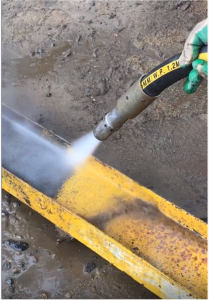
Cover: an industrial blasting application scene where stainless and non-ferrous workpieces are prepared before coating or final finishing.
Stainless steel cut wire shot is not a generic replacement for every steel abrasive. It is a specific media family: wire cut into uniform cylinders, offered in 304 and 316 stainless steel, in diameters from 0.2 mm to 1.6 mm, with a declared hardness range of HRC 25–45. Its buying case rests on contamination control and surface consistency. Its compliance case rests on documents that can be checked.
The compliance problem: a stainless workpiece does not make the blast circuit stainless
A stainless steel sheet, an aluminum die casting and a precision casting can all be damaged by the blast circuit before the media is even considered. Carbon steel shot or grit used earlier in the same machine can leave iron-rich dust in the recovery system, elevator, separator and dust collector. Wet or humid storage can create rust transfer. Fine dust can reduce visibility and increase cleaning load. These are process risks, not only product risks.
Qualification evidence therefore has to separate three layers:
- Media composition: is the wire declared as 304 or 316, and is there a batch chemical analysis?
- Physical consistency: do diameter, cut length and hardness match the purchase order, and is there a sieve analysis?
- Contamination control: is the lot free of free iron, and does handling prevent rust transfer and dust carry-over?
A supplier statement that covers one layer is not a compliance package. The useful package covers all three and states the test method behind each claim. That is the difference between a grade name and a qualification record.
What 304/316 certification should mean in a purchase order
304 and 316 are the two stainless steel wire grades in the Huiteng stainless cut wire shot series. The distinction matters because 316 is generally selected where higher corrosion resistance is required, while 304 is the more common stainless grade. The grade name alone does not prove the batch chemistry, and it does not prove performance in a specific service environment.
In a purchase order, '304/316 certification' should be translated into four documents rather than one label:
| Document or record | What it verifies | What it does not verify |
|---|---|---|
| Declared wire grade, 304 or 316 | The grade the supplier commits to for the order | That the delivered lot matches the declaration |
| Batch chemical composition analysis | Alloy composition of the tested sample | Corrosion performance in every service environment |
| Hardness test record | Hardness of the tested sample against the declared HRC 25–45 range | Uniformity of every particle in the lot |
| Sieve analysis report | Particle-size distribution of the tested sample | Cut-length variation or shape uniformity |
| No free iron declaration or third-party test | Contamination status of the tested lot | That the whole blast circuit is iron-free |
A document titled '304 certificate' that only repeats the trade name is weak evidence. A chemical composition report tied to a batch ID is stronger. A third-party test is stronger again where the application is sensitive. Huiteng quality control includes chemical composition analysis, hardness testing and particle-size sieve analysis, with SGS third-party testing available. That is the type of record a buyer can attach to an incoming inspection file.
Diameter range 0.2–1.6 mm: what the size declaration covers
The Huiteng stainless steel cut wire shot series covers 0.2 mm, 0.3 mm, 0.5 mm, 0.8 mm, 1.0 mm, 1.2 mm and 1.6 mm diameters. Cut length is equal to diameter. Specific gravity is 7.9 g/cm³, and the series is described with 2500+ recyclable cycles.
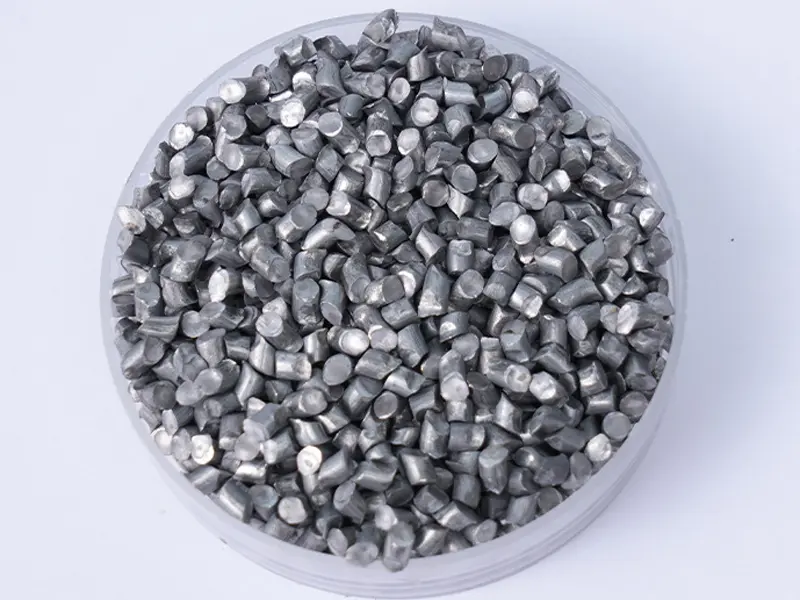
Feedstock view: 304 and 316 stainless steel wire is the starting point for cylindrical cut wire shot. Wire grade and diameter are fixed before cutting.
| Declared diameter | Cut length | Procurement check |
|---|---|---|
| 0.2 mm | 0.2 mm | Confirm sieve series and fine-particle handling |
| 0.3 mm | 0.3 mm | Confirm the report includes undersize data |
| 0.5 mm | 0.5 mm | Confirm sample mass and test method |
| 0.8 mm | 0.8 mm | Confirm batch-to-batch consistency |
| 1.0 mm | 1.0 mm | Confirm cut-length control |
| 1.2 mm | 1.2 mm | Confirm agreement on nominal versus median size |
| 1.6 mm | 1.6 mm | Confirm upper-size limit and oversize allowance |
The size declaration covers diameter and cut length, not performance. Two lots can both be described as 0.5 mm and still differ in particle-size distribution, cut quality and surface condition. That is why the sieve analysis has to accompany the size designation rather than replace it.
There are two clear boundaries. First, this series stops at 1.6 mm; larger media are outside the declared range. Second, fine sizes such as 0.2 mm are more sensitive to sampling and sieve method than coarse sizes. A buyer who needs a tight distribution should agree the sieve series, sample mass and acceptance limits before the first order, not after a complaint.
Hardness verification for HRC 25–45
HRC 25–45 is the declared hardness range for the series. It is a range, not a single value. Two lots can both pass as 'HRC 25–45' and behave differently if one sits near the lower bound and the other near the upper bound. Buyers who need repeatability should specify a tighter target window inside the declared range and ask for the distribution of readings, not only a pass or fail statement.
A useful hardness record states the test method, the number of readings, the sample location and the batch ID. Hardness testing on fine wire is method-sensitive: test load, mounting, sample preparation and the number of readings all affect the result. Agreeing the method before shipment is more valuable than arguing about a single number after delivery.
Hardness also positions the product against other media. Cast steel shot is listed at HRC 40–50 or HRC 55–65. Cast steel grit is listed at GP 42–52, GL 53–60 and GH 60–64. Stainless steel shot is listed at HRC 32–50. Stainless cut wire shot at HRC 25–45 is therefore a comparatively softer family. That is not a defect. It is a design boundary: the media is intended for contamination-sensitive cleaning and finishing, not for the most aggressive high-hardness cutting.
Sieve analysis: availability, report format and limits
Sieve analysis is available as part of batch quality control. For a buyer, the important question is not only whether a report exists, but whether the report defines the method well enough to be repeated by a second laboratory.
| Report field | Why it matters |
|---|---|
| Batch or lot ID | Links the report to the delivered material |
| Sieve series and aperture sizes | Defines what the size designation means |
| Sample mass | Provides the basis for percentages |
| Individual retained percentage | Shows the shape of the distribution |
| Cumulative passing percentage | Supports specification limits |
| Oversize and undersize | Reveals tails that affect finish and machine behavior |
| Method and equipment | Supports repeatability and dispute resolution |
| Date, operator and laboratory | Supports record integrity and traceability |
For cut wire shot, sieve analysis describes the diameter that passes a given aperture. Because cut length is equal to the diameter, the report does not by itself describe cut-length variation, cut angle or surface condition. Those need a visual or dimensional check. This is a real limitation of a sieve-only acceptance procedure, and it is why a trial on the actual workpiece still matters.
The sieve series should be written into the purchase order. Cast-shot size standards such as SAE J444 are written for cast shot and grit; they should not be assumed to define cut wire shot without buyer and supplier agreement. ISO 11124-3 covers high-carbon cast-steel shot and grit, not stainless cut wire. It is therefore not the correct conformity anchor for this product. ISO 11124-1 provides a general framework for metallic blast-cleaning abrasives, but the specific acceptance criteria still have to be agreed in the purchase order.
Qualification evidence: no free iron, no rust transfer and low dust
The Huiteng series is described with no free iron contamination, no rust transfer to workpieces and low dust operation. Those are useful qualification claims because they address the failure modes that matter in stainless and aluminum work. They should still be read as product claims with process boundaries.
| Claim | Evidence to request | Boundary |
|---|---|---|
| No free iron contamination | Batch declaration and, where required, SGS third-party test | The product claim does not make the machine, fixtures or prior carbon steel work iron-free |
| No rust transfer to workpieces | Dry storage record, packaging condition and handling procedure | Wet storage or a humid workshop can still cause rust |
| Low dust operation | Solid cut wire construction with no hollow or porous particles, plus a machine dust-collection check | Dust generation also depends on separator condition, dust collector and blast parameters |
| Bright, consistent surface finish | Trial report on the actual substrate | Finish depends on size, pressure, angle and cycle time |
| 2500+ recyclable cycles | Supplier service-life statement and reference to application conditions | Actual cycle life depends on machine settings, separation and media mix |
The most important boundary is the first one. 'No free iron contamination' is a statement about the media lot. It is not a statement that the blast circuit is clean. A buyer who previously ran carbon steel media in the same machine should inspect and clean the recovery system before switching to stainless cut wire shot. Otherwise the media can be compliant and the workpiece can still be contaminated.
Where 304/316 cut wire shot fits
The series is listed for stainless steel sheet and profile blasting, aluminum die casting, motorcycle and automotive parts, electronics and hardware, precision casting, and non-ferrous metal surface finishing. The common thread is a substrate that cannot tolerate iron-rich contamination or a finish that must stay bright and uniform.
In an automotive trim or die-cast housing line, the media choice is often driven by what must not happen after blasting: rust bloom, embedded iron or a dull surface that requires extra polishing. In electronics and hardware work, a uniform cylindrical shape and consistent size support repeatable coverage. In precision casting and non-ferrous finishing, the softer HRC 25–45 range can be an advantage where a more aggressive media would damage the surface.
For automated shot blasting lines, the series is described as suitable for automatic operation, with 2500+ recyclable cycles. That recyclability is part of the commercial case, but it should be confirmed on the actual machine. Separation efficiency, dust collection and media mix determine how much of that cycle life a buyer actually realizes.
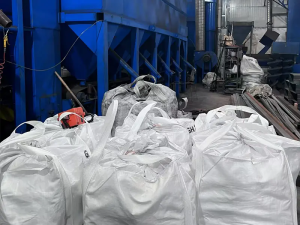
Production environment: batch inspection, screening and packing routines determine whether a compliance claim can be repeated lot after lot.
Comparison with traditional media: where stainless cut wire stops
Stainless cut wire shot is not the aggressive stripping choice. Cast steel grit is angular and is used for heavy rust, mill scale and old coating removal. Cast steel shot is spherical and is used for peening and general cleaning. Stainless cut wire is cylindrical and is selected for iron-sensitive work. If the job is thick rust on carbon steel, a carbon steel grit is usually the more direct fit; specifying stainless cut wire would not play to the media's contamination-control value.
| Media | Geometry and size | Hardness | Typical fit | Boundary |
|---|---|---|---|---|
| Stainless cut wire shot, 304/316 | Cylindrical, 0.2–1.6 mm, length equal to diameter | HRC 25–45 | Iron-sensitive stainless, aluminum and non-ferrous finishing | Not for heavy rust or sizes above 1.6 mm |
| Cast steel shot | Spherical, S70–S930 | HRC 40–50 or HRC 55–65 | Shot peening, surface strengthening, general cleaning | Can introduce iron contamination on stainless work |
| Cast steel grit | Angular, G12–G120 | GP 42–52, GL 53–60, GH 60–64 | Heavy rust, mill scale and coating removal | Aggressive cut is a contamination risk for stainless |
| Stainless steel shot | Spherical, grades 195, 201, 304 and 430, from 0.1 mm upward by grade | HRC 32–50 | Iron-free spherical cleaning and finishing | Different geometry and size range from cut wire |
The hardness range is the clearest technical boundary. HRC 25–45 sits below the common 40–65 HRC band of cast steel shot and grit shown in the product data. A buyer who needs high-hardness cutting should not force this series into that role. The 0.2–1.6 mm range is the second boundary. The third is contamination control: the media can be free of free iron, but the buyer still owns the isolation step in the machine and storage area.
Market trend: documentation is becoming part of the product
The global metal abrasives market was valued at USD 6.7 billion in 2025 and is expected to reach USD 7.1 billion in 2026, according to Grand View Research. Steel abrasives held an 89.9% share of the material segment in 2025, and Asia Pacific accounted for 56.0% of revenue. The steel shot sub-segment was valued at USD 1.664 billion in 2025 and is projected to reach USD 2.5 billion by 2035, according to WiseGuyReports.
These figures describe the wider market, not stainless cut wire shot alone. The available dataset does not break out stainless cut wire shot as a separate market, so buyers should not treat the headline growth rate as a stainless cut wire forecast. The procurement implication is narrower: as more buyers formalize incoming inspection, a supplier's ability to issue batch chemistry, hardness and sieve records becomes part of the qualification, especially for stainless and aluminum work.
That is consistent with the structure of the market. Steel abrasives dominate by volume and value, while stainless media serve a smaller set of contamination-sensitive applications. The specialty segment does not need a separate market-size number to justify documentation. The cost of a failed stainless batch is often higher than the media price difference, which is why records matter.
Future outlook: from grade names to repeatable records
Expect more purchase orders to specify test methods, not only grade names. A 304 or 316 declaration will increasingly be paired with a batch chemical analysis, a hardness method and a sieve report. Third-party testing will be used selectively where contamination risk is high. Suppliers with in-house chemical, hardness and sieve analysis can shorten qualification; those without will rely on external reports and slower response.
Zouping Huiteng Metal Abrasives Co., Ltd. is a manufacturer and exporter of metal abrasives based in Zouping City, Shandong Province, China. The company holds ISO9001 quality management system certification and reports an annual production capacity of approximately 100,000 tons. Its quality control routine includes 100% batch inspection, particle size sieve analysis, hardness testing, chemical composition analysis and microstructure inspection, with SGS third-party testing available. For a compliance-led purchase, those are the relevant capabilities because they turn a product claim into a batch record.
The direction is not more claims. It is better records. A buyer who can compare two suppliers on the same document set is in a stronger position than a buyer who compares only grade names and prices.
Procurement checklist for 304/316 cut wire shot
- State one wire grade per lot: 304 or 316. Do not mix grades in one purchase order line.
- Require a batch chemical composition analysis tied to the lot ID.
- Specify the diameter from the 0.2–1.6 mm range and confirm that cut length equals diameter.
- Agree the hardness test method and the target window inside HRC 25–45.
- Require a sieve analysis report with sieve series, sample mass, retained and passing percentages, and oversize and undersize data.
- Request a no free iron declaration and, where risk is high, a third-party test.
- Confirm dry storage and packaging, and inspect the recovery system before the first stainless run.
- Run a trial on the actual workpiece before setting a final acceptance specification.
Frequently asked questions
Which stainless steel cut wire shot size should be used for stainless steel sheet blasting?
The series covers 0.2 mm, 0.3 mm, 0.5 mm, 0.8 mm, 1.0 mm, 1.2 mm and 1.6 mm, with cut length equal to diameter. Smaller sizes are generally used for finer finishing and thin or delicate parts; larger sizes are used for faster cleaning on heavier surfaces. The final choice should be confirmed by a trial on the actual substrate and machine, because machine power, nozzle or wheel settings and target finish affect the result.
Can 304 and 316 cut wire shot be mixed in one machine?
They are different wire grades. Mixing makes batch traceability and chemical composition records ambiguous. If the work requires 316, keep 304 separate in storage, dosing and recovery. The series offers both grades, and the purchase order should state one grade per lot.
How is sieve analysis reported for 0.2–1.6 mm cut wire shot?
Sieve analysis is available as part of batch quality control. A useful report states the sieve series and aperture sizes, sample mass, individual retained percentage, cumulative passing percentage, oversize and undersize, batch ID, date and test method. For cut wire, the report describes diameter distribution; because length equals diameter, it does not by itself describe cut-length variation or shape.
What hardness evidence should be requested for HRC 25–45 cut wire shot?
Request the batch hardness record, the test method, the number of readings and the sample location. HRC 25–45 is the declared range for the series. A single reading is weaker evidence than a batch record with a stated method. Hardness testing on fine wire is method-sensitive, so the test method should be agreed before shipment.
Which applications are not a good fit for stainless steel cut wire shot?
Heavy rust and thick mill scale on carbon steel are usually better served by angular cast steel grit, which cuts aggressively. The stainless cut wire series covers 0.2–1.6 mm and HRC 25–45; it is not the series for sizes above 1.6 mm or for applications that need the higher hardness of cast steel media. Its commercial case rests on contamination control, surface consistency and recyclability, not on maximum cutting force.
How can a buyer verify no free iron contamination and no rust transfer?
Ask for a batch-specific declaration and, where the risk is high, a third-party test; SGS third-party testing is available. Separate the product claim from the process: the media can be free of free iron, but the machine, fixtures, prior carbon steel work and wet storage can still introduce iron or rust. Keep the media dry and dedicate handling where contamination is critical.
For buyers who need the full product data, the Huiteng Metal Abrasives brochure is available as a PDF: Huiteng Metal Abrasives product brochure.
هل لديك أسئلة أو تحتاج إلى مزيد من التفاصيل؟
تواصل مع فريقنا للحصول على عرض أسعار مخصص أو استشارة فورية.
طلب عرض أسعار
املأ النموذج أدناه وسيتواصل معك فريقنا بعرض مقترح مخصص.
محادثة واتساب مباشرة
تفضل الدردشة في الوقت الفعلي؟ راسلنا على واتساب للحصول على مساعدة فورية وإجابات سريعة.
- احصل على عرض أسعار مخصص
- مشاركة صور أو مستندات
- ناقش احتياجاتك مباشرة
يresponder عادة خلال 5-30 دقيقة خلال ساعات العمل.