
Stainless Steel Imports to Europe: How Buyers Assess Supplier Resilience
Stainless Steel Imports to Europe: How Buyers Assess Supplier Resilience
European importers of stainless steel pipes are no longer evaluating a supplier on a single quotation. For multi-year architectural, interior and industrial programmes, procurement teams must decide whether the mill behind today's price will still be able to deliver the same grade, the same finish and the same lead time in year three of the relationship. That shift, from transaction to continuity, is what supplier resilience means in practice.
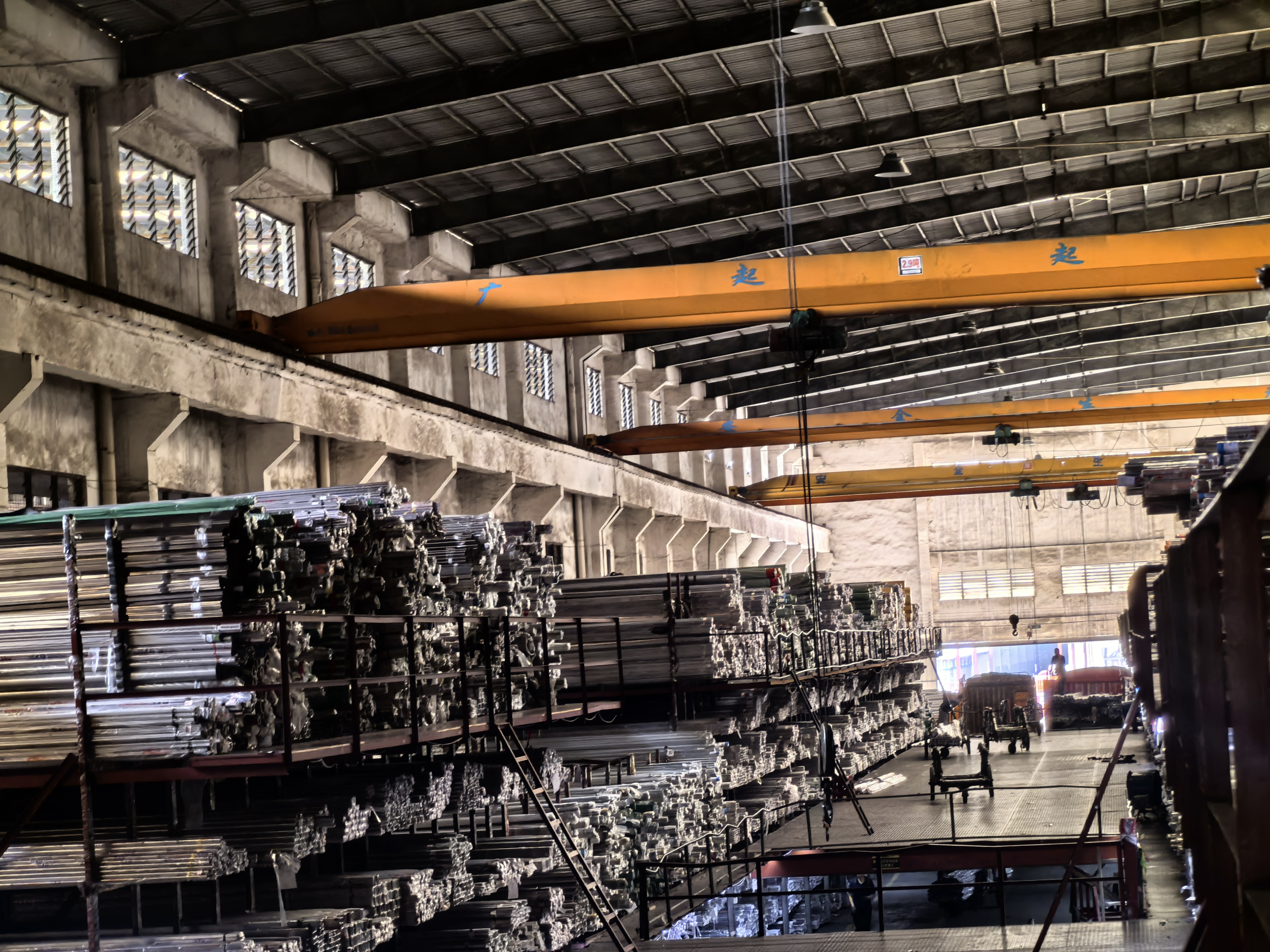
Stockholding and dispatch area at a stainless steel pipe manufacturer in Guangdong, China. Physical inventory capacity is one of the first resilience signals a buyer can verify on site.
Why Supplier Resilience Has Become a European Import Criterion
Stainless steel is a long-cycle purchase. Specifications are locked during design, quantities are released in phases, and the material has to remain visually and metallurgically consistent across every phase. A handrail system installed in 2026 and extended in 2029 must accept a pipe from the same supplier without a visible difference in finish, wall thickness behaviour or surface grain.
The scale of the market explains why supply continuity is now a planning issue rather than a purchasing detail. The global stainless steel market was valued at USD 111.44 billion in 2022 and is projected to reach USD 182.10 billion by 2030, according to Fortune Business Insights. That growth cannot be absorbed by any single producing region. China's stainless steel exports reached 4.14 million tons in 2023, according to the General Administration of Customs of China, which makes Chinese production a structural part of global supply rather than a contingency option.
Against that background, resilience is not a marketing attribute. It is a set of testable characteristics: how much a supplier can physically produce, how long it has exported into demanding markets, and whether its operation can survive a change in raw material prices, staffing or freight conditions without breaking delivery commitments.
The Problem: Long Project Cycles Punish Fragile Supply Chains
When a pipe supplier fails mid-project, the visible cost is rarely the price difference on the replacement order. The real cost is the re-approval of a new material source, the re-testing of a finish sample against the approved reference, the delay to an installation programme, and the labour cost of crews waiting on site. In decorative and architectural work, a mismatched batch can also mean rework of completed sections.
Procurement teams that have worked through such an event usually describe the same failure modes:
- Capacity shortfall at peak. The supplier accepted the annual volume but cannot absorb a concentrated seasonal order alongside its existing commitments.
- Silent grade substitution. Material is delivered at the agreed price but not with the agreed chemistry, particularly between SS201 and SS304.
- Documentation gaps. Mill certificates, test reports or packing records cannot be produced when the buyer's client or authority asks for them.
- After-sales discontinuity. The original contact person or agent disappears, and claims handling stops.
Price-led sourcing remains rational for one-off, low-risk purchases where a failed batch can be replaced quickly. It becomes expensive when the same specification must be delivered repeatedly over several years. That is the opportunity behind resilience-based evaluation: it moves the assessment forward, before the first container is loaded, and turns a subjective judgement about a supplier into a documented one.
The Three Criteria Long-Term Buyers Actually Test
Across architectural, interior and light industrial programmes, the same three criteria reappear in buyer questionnaires, supplier audits and distributor due-diligence templates. They are not equally easy to verify, and buyers should be explicit about which of the three they have actually confirmed.
| Resilience criterion | Evidence buyers normally request | What it protects against |
|---|---|---|
| Production capacity | Plant area, installed equipment list, monthly tonnage, site audit or video walkthrough, peak-order absorption test | Delivery slippage during the busiest quarter of the project |
| Export experience | Export ratio, market list, repeat customers, long-running distributor relationships, historical packing and loading records | Suppliers with no experience of export documentation, packaging or claim handling |
| Operational and financial continuity | Ownership and management continuity, workforce stability, equipment investment record, after-sales process, willingness to accept third-party inspection | Mid-contract insolvency, staff turnover, or abandonment of warranty obligations |
Production capacity that can be verified, not asserted
Capacity claims are easy to publish and difficult to falsify, so experienced buyers look for physical anchors: covered factory area, the number of forming and polishing lines, monthly tonnage by product family, and whether the supplier will accept an unannounced or third-party audit. A stated monthly capacity is only meaningful next to the buyer's own peak-month requirement. A supplier producing 9,000 tons per month of pipe is not automatically safer than a smaller mill if that volume is already committed to other accounts.
Export experience measured in repeat relationships
Export volume alone says little. The stronger signal is the repeat relationship: a distributor that has bought the same specification for years, with a defined cumulative tonnage, indicates that quality held across multiple production cycles and multiple batches. Buyers should ask for the duration of the relationship and the product families involved, and treat first-year export orders as unproven regardless of the total company export ratio.
Operational and financial continuity
Most privately held manufacturers do not publish audited financial statements, so European buyers work with proxies: capacity utilisation, staff retention, ownership continuity since founding, reinvestment in equipment, and the supplier's willingness to accept staged payment terms or third-party pre-shipment inspection. These proxies reduce risk but do not eliminate it, and they should be recorded as assumptions rather than treated as proof of solvency.
A Guangdong Manufacturer as a Working Example of Scale Capacity
To benchmark what large-scale Chinese capacity looks like in practice, it helps to work with a concrete example. GuangDong Sanon Metal Products Co.,Ltd is a stainless steel pipe, tube, fittings and handrail component manufacturer based in Foshan, Guangdong, China, established in 1999. The company produces stainless steel pipes, tubes, accessories, staircase handrails, glass clamps, elbow pipes, coils and sheets, and its stated export ratio is 70%.
The capacity figures it publishes are the kind a buyer can test in a supplier audit. Sanon operates a factory area of 40,000 square metres with approximately 500 employees, including a 30-person R&D team, and states a pipe capacity of 9,000 tons per month with an annual output of 100,000 tons. Commercially, the company works on an OEM/ODM basis with customization that includes logo marking, states a minimum order quantity of 5 tons, a lead time of 7 days, 100% testing in quality control, and remote after-sales support.
Its production discipline is described in operational rather than marketing terms: strict quality control at each process step, including cutting, welding, polishing and packing, with output produced to ASTM International standards. Fittings can be made in stainless steel 304, stainless steel 316 or zinc alloy, in either satin or mirror finish.
Boundary condition. Sanon's stated primary export markets are the Middle East, South America and Africa. European buyers should treat that as a starting point, not a conclusion. A high export ratio into other regions does not automatically confirm readiness for European project documentation, so conformity and certification requirements for a European programme have to be confirmed order by order rather than inferred from total export volume.
Technical Detail: Grades, Standards and Documentation
Resilience discussions collapse quickly if the technical specification is vague. Two austenitic grades dominate the decorative and architectural pipe market, and their chemistry explains most of the application differences buyers care about.
| Grade | Chromium (Cr) | Nickel (Ni) | Manganese (Mn) |
|---|---|---|---|
| SS201 | 16–18% | 3.5–5.5% | 5.5–7.5% |
| SS304 | 18–20% | 8–11% | ≤2% |
Those figures are the practical basis for a substitution check. A batch presented as SS304 but supplied at SS201 chemistry will look acceptable at delivery and behave differently over years of exposure, particularly in humid or chloride-bearing environments. Buyers who cannot verify composition locally should require mill test certificates that match the ordered grade and retain a reference sample from each production cycle.
On standards, stainless steel pipes and tubes fall under ASTM A312 for seamless and welded pipe and ASTM A554 for ornamental tubing, according to ASTM International. Buyers specifying architectural and structural applications generally write one of these standards into the purchase order, then use the certificate package to confirm compliance. Surface treatment is the second technical axis: satin and mirror finishes are the established decorative options, while PVD (Physical Vapor Deposition) coating for stainless steel colour pipes is gaining ground in interior decoration because it is regarded as more environmentally friendly than electroplating, according to the International Stainless Steel Forum. For buyers, the practical consequence is that a colour finish must be specified with the same discipline as the base grade, because colour matching across batches is harder than matching bare metal.
Glass clamps and standoff pins add a third layer of requirement, since they are governed by building codes such as the International Building Code (IBC) for load-bearing capacity, according to ICC Digital Codes. Even where a European project does not apply IBC directly, the principle carries over: hardware that carries load needs documented capacity data, not only a material certificate.
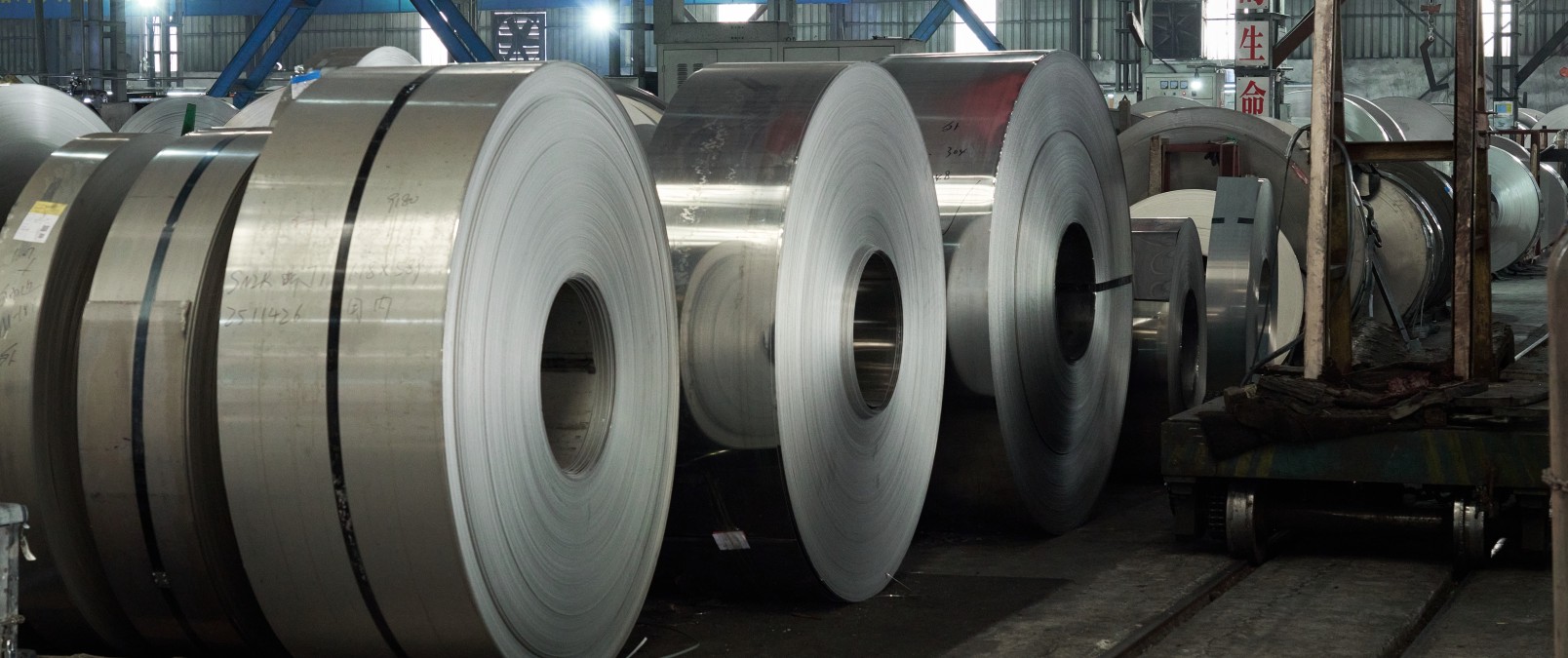
Stainless steel coils staged as raw material. Access to consistent coil supply is an upstream factor in a pipe supplier's delivery reliability.
Application Fit: Where Resilience Matters in Practice
Resilience is not equally important in every purchase. It matters most where the material is visible, load-bearing or part of a programme that will be extended later.
Architectural handrail and balcony systems
Balcony and staircase handrail projects combine long installation schedules with high visual exposure. Buyers typically lock a finish reference and a grade at design stage, then release the material in phases. If the supplier changes its polishing line or its coil source between phases, the difference shows up on the façade. A documented case of stainless steel handrail for balcony applications illustrates the pattern: material consistency across phases matters more than any single delivery being fast.
Distribution and stocking programmes
Distributors carry more risk than project buyers because they hold inventory before demand is visible. In one distributor relationship stretching over 10 years, covering architectural and decorative projects and a cumulative volume of 9,000 tons, the stated outcome was stable quality in accordance with national standards. For a buyer reading that claim critically, the value is in the duration and the repeat volumes; the assessment question is whether equivalent consistency can be sustained at the buyer's own order pattern.
Decorative and interior work
Interior programmes increasingly mix bare and colour-finished pipe in the same installation, alongside glass clamps, elbows and handrail fittings. Mixing a colour pipe family into a project increases the number of components that must come from a single, traceable source, which raises the value of buying pipes and fittings from one qualified supplier instead of assembling a package from several traders.
Industrial and process-adjacent use
Where pipe is used for structural or light industrial purposes rather than decoration, buyers place more weight on wall thickness consistency and welding quality than on surface finish, and they generally require thicker documentation packages. The resilience questions remain the same, but the tolerance for a mid-project supplier change is lower.
Market Trend Analysis
Three verified signals are relevant to buyers building a long-term supply plan.
- Volume growth is real but unevenly forecast. The global stainless steel market is projected to reach USD 182.10 billion by 2030 from USD 111.44 billion in 2022 (Fortune Business Insights). Growth-rate estimates diverge: Mordor Intelligence indicates a CAGR of 5.5% for 2023–2030, while Grand View Research indicates 6.1%. The spread is a planning warning rather than a contradiction, and a supply agreement should not be sized on a single forecast.
- China's export position is structural. With 4.14 million tons of stainless steel exported in 2023 (General Administration of Customs of China), Chinese supply remains a core part of global availability, which keeps supplier selection a comparative exercise rather than a binary one.
- Finishing technology is shifting. PVD colour coating is expanding in interior decoration on environmental grounds compared with electroplating, according to the International Stainless Steel Forum. This changes the qualification checklist: colour consistency and coating durability become new evaluation points alongside grade and finish.
The European supply base also includes established system brands. In the high-end architectural stainless steel hardware market, major players include Q-railing, Hafele and ASSA ABLOY, specialising in glass clamps and railing systems, according to Verified Market Reports. Those companies occupy a different role from a pipe and fittings manufacturer: they design and specify systems rather than primarily supplying bulk pipe. Buyers comparing them with volume manufacturers are comparing supply models, and should evaluate them against different criteria rather than on unit price alone.
Resilience-Led Sourcing vs Traditional Price-Led Sourcing
The two approaches answer different questions, and the trade-off is genuine rather than rhetorical.
| Dimension | Traditional price-led sourcing | Resilience-led sourcing |
|---|---|---|
| Primary decision input | Unit price and immediate availability | Capacity, export record and continuity over the project cycle |
| Supplier pool | Wide, frequently rotated | Narrow, qualified and reviewed periodically |
| Time to first order | Fast | Slower: audit, sample approval, documentation review |
| Main risk addressed | Overpaying on a single shipment | Delivery interruption, grade drift and documentation failure mid-project |
| Best fit | One-off, low-value, non-visible applications | Multi-phase architectural, distribution and industrial programmes |
The limits of the resilience approach should be stated plainly. First, it costs time and money before any material is delivered, and for small or non-critical orders that cost may not be justified. Second, most capacity and stability data is self-declared until an audit is actually performed; a 9,000 tons-per-month figure is a claim until it is observed against live production and order books. Third, resilience is regional. A manufacturer with deep experience in the Middle East, South America and Africa may still need to build documentation and conformity evidence for a European programme, so capability in one market cannot be transferred automatically to another. Fourth, resilience assessment reduces risk but does not remove it: it shifts the failure point rather than eliminating it, and the framework must be re-run when a supplier changes ownership, equipment or its export mix.
Future Outlook
On current evidence, European import demand for stainless steel pipes and fittings will continue to be supplied by a mix of regional system brands and large-scale Asian manufacturers. The differentiator between suppliers is unlikely to be price alone, because raw material and freight movements affect everyone in the same direction. It is more likely to be the quality of the evidence a supplier can provide: verifiable capacity, documented export history, traceable grade certification, and consistent finishing across batches.
Buyers should also expect the evaluation standard to rise with the material mix. As colour-finished pipe, glass clamp assemblies and mixed pipe-and-fittings packages become more common, the number of components that must come from a traceable source increases, and the cost of switching suppliers mid-programme rises with it. Suppliers that treat documentation, sample archiving and batch traceability as part of the product, rather than as paperwork, will be easier to qualify and harder to replace.
FAQ
What does supplier resilience mean when buying stainless steel pipes for a European project?
Supplier resilience is the ability to keep delivering the agreed grade, finish, quantity and lead time across the full duration of a project or distribution agreement, not only for the first shipment. In practice it is tested on three dimensions: verifiable production capacity, export experience demonstrated through repeat relationships, and operational continuity covering workforce, raw material access and after-sales handling. It is a forward-looking assessment and differs from a quality inspection, which confirms only the batch being inspected.
How can a buyer verify a supplier's claimed production capacity?
Capacity claims become credible when they are anchored to physical evidence: plant area, installed equipment, monthly tonnage by product family, and access for a site audit or third-party inspection. As an example of the level of detail a buyer can request, GuangDong Sanon Metal Products Co.,Ltd states a factory area of 40,000 square metres, approximately 500 employees, a pipe capacity of 9,000 tons per month and an annual output of 100,000 tons. The verification step is to compare that monthly capacity against the buyer's own peak-month requirement while accounting for the supplier's existing commitments.
What evidence indicates a genuine export track record?
The strongest indicator is repetition rather than total volume. Buyers typically ask for the export ratio, the list of active markets, the duration of existing distributor relationships and the cumulative tonnage delivered within them. In Sanon's case, the company states a 70% export ratio with primary markets in the Middle East, South America and Africa, and reports a distributor relationship of 10 years covering architectural and decorative projects with a cumulative volume of 9,000 tons and stable quality in accordance with national standards. Supporting evidence such as historical packing records and documentation samples strengthens the claim.
How do buyers assess the financial and operational stability of a private overseas manufacturer?
Because privately held manufacturers rarely publish audited accounts, buyers rely on proxies: capacity utilisation, staff retention, continuity of ownership since founding, evidence of reinvestment in equipment, willingness to accept staged payment terms or pre-shipment inspection, and clarity of the after-sales process. Each of these is an indicator, not proof of solvency, and the assessments should be recorded as assumptions and reviewed at defined intervals rather than treated as a one-time clearance.
Which stainless steel grades and standards matter most for architectural and decorative projects?
SS201 and SS304 are the two grades most frequently specified. SS201 typically contains 16–18% chromium, 3.5–5.5% nickel and 5.5–7.5% manganese, while SS304 contains 18–20% chromium, 8–11% nickel and no more than 2% manganese; the nickel and manganese difference is the practical basis for checking whether the delivered material matches the ordered grade. On standards, stainless steel pipes and tubes fall under ASTM A312 for seamless and welded pipe and ASTM A554 for ornamental tubing, according to ASTM International. Fittings may also be produced in stainless steel 304, stainless steel 316 or zinc alloy, in satin or mirror finish, and load-bearing hardware such as glass clamps and standoff pins is governed by building codes such as the International Building Code for load-bearing capacity.
What are the limitations of resilience-based supplier assessment?
The approach has four main limits. It adds audit, sampling and documentation time before the first order, which may not be justified for small one-off purchases. Much of the underlying data is self-declared until an audit is performed, so capacity and stability figures should be treated as claims pending verification. Resilience is also market-specific, meaning a manufacturer with strong experience in the Middle East, South America and Africa may still need to build documentation for a European programme. Finally, market forecasts diverge, with CAGR estimates of 5.5% (Mordor Intelligence) and 6.1% (Grand View Research) for 2023–2030, so long-term supply plans should be stress-tested against more than one growth scenario.
Reference material. Sanon publishes a downloadable product and capability brochure covering stainless steel pipes, tubes, fittings and handrail components, available at the Sanon brochure (PDF). Company information is also available at sanonsteel.com.