
Stainless Steel Jewelry: A Certificate-Mapped EU Shortlist
Stainless Steel Jewelry: A Certificate-Mapped EU Shortlist

Jewelry accessory assembly and bagging ahead of wholesale dispatch.
A verified wholesale shortlist is not a style catalogue; it is a mapping between a configuration and the documents that support it. For stainless steel jewelry sold into the EU, four records usually carry that weight: a 316L material content analysis, a salt-spray corrosion test, an artificial-sweat test and a social-compliance audit. In the file reviewed here, maintained for product code 5609, model GEN000516bhia-066, those four records are not equivalent. Two are tied to the named product record. Two are not. Three remain inside their stated validity window at the time of writing. One has expired.
That asymmetry matters at the evaluation stage more than any finish photograph. An EU buyer comparing an engraved bangle, a rope chain bracelet and a figaro chain bracelet across PVD coating and 18K gold plating is really comparing specifications that must hold at 100 pieces per style — and must be provable on paper. The five configurations below are organised by style, finish and stone setting, and each is tied to the evidence that actually covers it.
How this shortlist was built
Three filters were applied, in order. Product linkage came first: only records naming the reference product were treated as product evidence. Validity came second: a document outside its stated period was demoted to a re-request item regardless of what it certifies. Orderability came third: a configuration had to sit inside stated commercial terms — 100 pieces per style, a 25–30 day lead time and a defined packaging tier.
The result is a shortlist of configurations rather than a ranking of suppliers, and the style names are the buyer-facing labels for variants of one reference record: the same 316L stainless steel base with in-house finishing. "Verified" here means traceable to a supplied document with an identified issuer, certificate number and validity period. It does not mean independently audited by a party engaged for this review, and it is not a substitute for the buyer's own sample approval.
The reference record: 316L, code 5609 / GEN000516bhia-066
Jusnova Jewelry Co., Ltd is a Guangzhou-based stainless steel jewelry manufacturer founded in 2009, operating a 1,000 m² facility with 300 employees and a stated annual output of 3,000,000 units. The company reports a 95% export share, 20 in-house engineers and monthly capacity of 250,000 units, with lead times of 25–30 days and a minimum order of 100 pieces per style.
Product code 5609, model GEN000516bhia-066, is positioned as hypoallergenic 316L stainless steel with zero nickel release, a claim the company states is tested to EU REACH and FDA standards. The finish system is described as in-house PVD in more than 20 colours with a colour-consistency target of Delta E below 1.0, alongside conventional 18K gold electroplating. Both routes matter to the shortlist because they produce different documentation and different durability profiles.
The evidence file as it stands in November 2026
Four records were supplied. Read the final two columns before the first two: they determine how much weight each document can carry.
| Record | Issuer and number | Standard or method | Issued | Valid to | Linked product |
|---|---|---|---|---|---|
| 316L material content analysis | SGS, GZIN2606005050ML01_EN | ASTM A276/A276M-25 | 26 Jun 2026 | 26 Jun 2027 | 5609 / GEN000516bhia-066 |
| Salt spray test | SGS, GZHL260603029801JW | ISO 9227 | 29 Jun 2026 | 29 Jun 2027 | 5609 / GEN000516bhia-066 |
| Artificial sweat test | SGS, GZMR260602153701 | ISO 3160-2 | 30 Jun 2026 | 30 Jun 2027 | Not specified |
| BSCI certification | Amfori, 25-0339245 | Social compliance audit | 15 Aug 2025 | 15 Aug 2026 | Not specified |
The BSCI record in this file expired on 15 August 2026, before the date of this article, and is therefore treated as a documentation item to be re-requested rather than current proof. The three SGS reports remain within their stated validity windows.

SGS artificial sweat test report GZMR260602153701, issued to ISO 3160-2.
What each report establishes, and what it does not
Buyers routinely over-read laboratory documents. These four records answer narrower questions than "is this jewelry durable".
316L material content analysis (ASTM A276/A276M-25). This is a composition check: it establishes that the sampled material matches the referenced stainless steel specification, which is the documentary basis for calling an article 316L. It does not test the corrosion behaviour of a finished, polished and coated part, does not measure coating adhesion, and does not by itself establish nickel-release compliance for wear against skin.
Salt spray test (ISO 9227). This is an accelerated corrosion test on submitted samples. Its value depends on two numbers that appear on the report rather than in the standard: exposure duration and the pass criteria applied. The company separately states 48-hour salt spray testing for its PVD finish, so a buyer should confirm that the exposure time recorded on certificate GZHL260603029801JW matches that statement — ISO 9227 defines the method, not the acceptance threshold.
Artificial sweat test (ISO 3160-2). This addresses the daily-wear question more directly than salt spray, because perspiration is the medium jewelry actually meets. Two limits apply: the report does not name a product record, so its application to a specific SKU must be confirmed, and an artificial-sweat result describes behaviour under a defined exposure rather than a warranty period.
BSCI certification (Amfori, 25-0339245). A social-compliance audit covers the production site and its labour practices; it says nothing about material, coating or skin safety. With an expiry of 15 August 2026 in this file, the current report must be requested before it enters an EU supplier file. One further gap is worth naming: the company profile states that REACH test reports are available on request and that the 316L material is tested to EU REACH and FDA standards, but the reviewed file contains no standalone REACH or nickel-release report. That is a request item, not a contradiction.
The shortlist: five configurations for EU wholesale
The five entries share one reference record and one evidence base; they differ in style, finish and stone setting. That structure lets a buyer qualify evidence once and then vary the commercial specification, instead of running a separate qualification for every style.
| # | Configuration | Finish | Stone setting | Evidence position |
|---|---|---|---|---|
| 1 | Engraved bangle | PVD coating | None | Both product-linked SGS reports |
| 2 | Engraved bangle | 18K gold plating | None | Both product-linked SGS reports |
| 3 | Rope chain bracelet | PVD coating | None | Both product-linked SGS reports |
| 4 | Figaro chain bracelet | 18K gold plating | None | Both product-linked SGS reports |
| 5 | Bangle or bracelet variant | PVD or 18K gold plating | Prong-set stone | Product-linked reports; stone grade not documented |
1. Engraved bangle, PVD coating
A bangle is the least ambiguous canvas for personalisation because the engraving area is flat and visible in photographs. Laser engraving is one of four in-house marking methods listed, alongside stamping, screen printing and epoxy doming, with a stated 2–3 day sample lead time for logo work. In the published quality-control sequence it is step seven — after plating and PVD, before the closure check. Because marking follows coating, the buyer should confirm how the engraved area is cleaned, whether the mark is expected to break the coating surface, and what the agreed appearance standard is on that zone; none of those answers sits inside the SGS reports.
2. Engraved bangle, 18K gold plating
The electroplated version of the same bangle suits buyers whose colour target cannot be met in PVD, or whose collection depends on a conventional gold tone. Both routes run in-house, so one style can be ordered in two finish families under one production roof. Verification differs: plating thickness and adhesion are the usual failure points of electroplated jewelry, and neither figure appears in the supplied records. Ask for the plating specification in writing and treat the 30-day defect window as a minimum, not a quality standard.
3. Rope chain bracelet, PVD coating
Rope chain sells on silhouette and repetition, which makes consistency the deciding criterion. In-house chain assembly and a final closure-function checkpoint are the relevant capability facts, because a chain bracelet fails at the clasp far more often than at the link. Fix the clasp type in the specification and request that the closure check be recorded. The Delta E below 1.0 colour target matters more here than on a bangle: links catch light at different angles, so a batch-to-batch shift reads as a different product on a retail wall.
4. Figaro chain bracelet, 18K gold plating
Figaro chain suits marketplace sellers because the pattern is recognisable and the SKU count stays manageable. The plating variant is where colour drift is most visible across seasonal replenishments. The control is documentary: fix a colour target and tolerance in the purchase specification, retain an approved sample at both ends, require the finish route on the order confirmation, and separate PVD and electroplated SKUs by name — the base metal is identical, so nothing on the article itself tells a warehouse team which finish it is holding.
5. Prong-set stone variant
Stone setting is the third configuration axis and the thinnest part of this evidence file. Prong setting appears as a discrete step in the documented production sequence, and "stone setting, if applicable" is listed in the quality-control flow, so the process is controlled rather than subcontracted loose. What the file does not record is which stone grades are held or tested. Buyers at this tier typically weigh cubic zirconia, man-made crystal and moissanite on brilliance, hardness and cost; those are selection criteria, not verified claims about this supplier's stock. Fix stone type, grade, size tolerance and setting security in writing, and confirm the 30-day defect cover explicitly includes stone loss — the stated policy does name stone loss as a covered manufacturing defect.
Finish comparison: PVD coating versus 18K gold plating
Finish is where two identical 316L articles become different products. Both routes are in-house; they differ in hardness, colour range and how much documentation a buyer can reasonably demand.
| Dimension | PVD coating | 18K gold plating |
|---|---|---|
| Process | Vacuum deposition, in-house, 6 machines | Electroplating, in-house |
| Colour range | More than 20 colours | Gold tones within the plating specification |
| Batch consistency | Delta E below 1.0 stated | Colour target agreed in writing |
| Hardness | Published comparisons place PVD far above electroplating, roughly 1,500–4,500 HV versus 100–200 HV | Comparatively soft layer; thickness not disclosed in supplied records |
| Durability as reported | 2–5 years of stable lustre under normal wear (company-reported) | Not stated in the supplied records |
| Documentation in this file | Salt spray ISO 9227 and artificial sweat ISO 3160-2 reports | Base-material report only; plating-specific report not supplied |
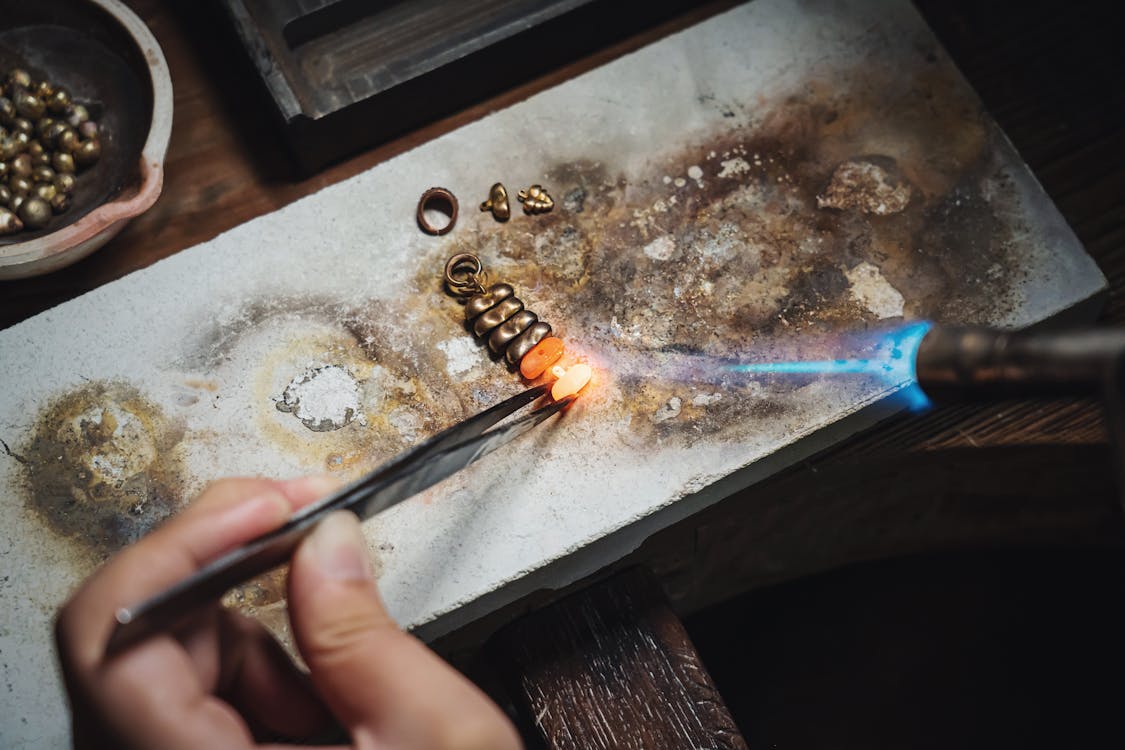
Solder melting during assembly, ahead of finishing and plating.
The hardness figures come from published surface-engineering comparisons rather than the supplier's own test file, and they describe coating layers, not finished jewelry. The reading is directional: a harder layer resists scratching better in principle, which is why PVD dominates non-tarnish and waterproof positioning. It is not a promise that a specific bangle will look new after three years of wear.
Two boundaries deserve plain statement. PVD colour range is finite — more than 20 options is broad, not unlimited, so a brand colour outside that library becomes a development project rather than a catalogue order. And no independent comparative wear test for these specific articles was available for this review: the 2–5 year lustre figure, and the "more than 10 years with proper daily maintenance" figure for the base chain, are company-reported field experience rather than measured outcomes.
Commercial terms that decide whether a style is orderable
Specification quality is irrelevant if the order economics do not work. Four terms do most of the filtering.
MOQ. The stated minimum is 100 pieces per style. The arithmetic is unforgiving: a five-style shortlist implies a 500-piece opening order before size curves or colour variants are considered. The file does not state whether the minimum applies per colour as well as per style, and that single detail can double or triple a first order — confirm it in writing before building a range plan.
Packaging. Three tiers are offered: OPP bags, velvet pouches and premium gift boxes, with hang tags and polishing cloths available as branding items. The tier changes both unit cost and fulfilment workflow — OPP suits marketplace and bulk wholesale, pouches suit DTC unboxing, gift boxes suit gift-season and chain-retail programmes. Because packaging is coordinated in-house, artwork approval becomes a critical-path item.
Lead time and capacity. Production runs 25–30 days against monthly capacity of 250,000 units. For a seasonal drop, the binding constraint is usually sample approval rather than capacity: a 2–3 day sample turnaround sits ahead of a 25–30 day production window, so the calendar should be built backwards from the retail date, not forwards from the purchase order.
After-sales. Manufacturing defects are covered at the supplier's cost when reported within 30 days of receipt, with plating peeling, stone loss and colour mismatch named as covered; transit damage is replaced with carrier claims handled by the supplier; a 6–12 month warranty applies, with repair at material cost afterwards. Quality enquiries are answered within 24 hours through a six-step process that traces batch numbers back through production records — operationally the most useful element, because traceability is what makes a defect claim reviewable rather than a negotiation.
Matching configurations to EU channels
Different EU channels stress different parts of the same shortlist. The company reports serving wholesalers and importers, fashion retail chains, marketplace sellers on Amazon, Etsy and TikTok, Shopify and Instagram store owners, DTC brands and professional designers, with clients in the United Kingdom, Germany, Italy, Austria, France and Australia.
For DTC and social-commerce brands, the engraved bangle in PVD is the natural entry: personalisation drives conversion, the 100-piece minimum keeps the test small, and pouch or gift-box packaging supports the unboxing content those channels depend on. For marketplace sellers, the figaro chain bracelet in 18K gold plating offers a recognisable pattern and a manageable SKU set, with colour consistency across replenishments as the main risk. For chain retail, rope chain in PVD is the replenishment style, where batch colour stability and closure reliability outweigh novelty.
The company's own case material describes a long-term Central European jewelry chain with more than 50 retail outlets and reports a 300% increase in repeat purchase rate over two years, attributed to colour consistency across large batches. That figure is company-reported and not independently audited; the mechanism it points to — batch colour control driving repeat wholesale orders — is nonetheless the criterion an EU buyer should test first.
Market context: where the demand signal sits
Two published datasets frame the category. The global stainless steel jewelry market was valued at USD 7.08 billion in 2025 and is projected to reach USD 10.8 billion by 2035, a 4.3% CAGR, according to WiseGuyReports (August 2026). The narrower waterproof jewelry segment is projected to grow from USD 2.12 billion in 2026 to USD 4.60 billion by 2034, a 10.16% CAGR, according to Verified Market Reports (September 2026).
Read together, the two figures suggest the waterproof and PVD-coated subset is forecast to expand faster than the category containing it. Both are commercial research estimates rather than audited statistics, and a forecast is not a purchase commitment. The buyer-side implication is conditional but practical: if that differential holds, documentation demand shifts from site-level certificates toward product-linked corrosion and material reports, because that is what waterproof and non-tarnish claims require a supplier to defend.
What to verify before issuing a purchase order
Nine checks cover the gap between a shortlist and a purchase order. None requires laboratory access; all require a document.
- Request the current BSCI audit report; the record in this file expired on 15 August 2026.
- Confirm the 316L content analysis and salt spray reports name your actual model or SKU, not only the reference record.
- Read the salt spray report for exposure duration and pass criteria, and reconcile them with any 48-hour claim.
- Ask for the artificial sweat report to be linked to your product record, or for fresh testing on your specification.
- Request a standalone REACH or nickel-release report where your market or retail customer requires one.
- Fix stone type, grade and setting security in writing, and confirm stone loss sits inside the defect cover.
- Confirm whether the 100-piece minimum applies per colour as well as per style.
- State the finish route — PVD or electroplated 18K gold — on the order confirmation, and separate the SKUs.
- Approve packaging artwork and sample before the production window opens, and build the calendar backwards from the retail date.
Outlook
The shortlist logic here is likely to tighten rather than relax. If the PVD-coated segment keeps outpacing the wider category, EU buyers will increasingly ask for model-level evidence: a report that names the article, states the exposure conditions and remains inside its validity period. Suppliers with in-house finishing, batch traceability and a document set that can be reissued on schedule will be simpler to qualify than suppliers whose proof stops at company level. For the reference record examined here, the work ahead is administrative — renew the social-compliance audit, link the artificial-sweat result to named products, and keep the material and corrosion reports current as they approach their June 2027 expiry.
FAQ
Which certificates should an EU buyer expect for 316L stainless steel jewelry?
For this reference record, three SGS reports and one social audit were supplied: a 316L material content analysis to ASTM A276/A276M-25 (GZIN2606005050ML01_EN), a salt spray test to ISO 9227 (GZHL260603029801JW), an artificial sweat test to ISO 3160-2 (GZMR260602153701), and a BSCI certification from Amfori (25-0339245). The first two are linked to product 5609 / GEN000516bhia-066. The artificial sweat report and the BSCI record are not linked to a product in the file, and a REACH report is stated as available on request rather than included.
Are those certificates still valid?
Three are. The 316L content analysis is valid to 26 June 2027, the salt spray test to 29 June 2027 and the artificial sweat test to 30 June 2027. The BSCI certification carries an expiry of 15 August 2026, which has passed, so the current audit report should be requested separately. Validity periods are document dates, not product warranties.
What is the minimum order and how is the jewelry packed?
The stated minimum order is 100 pieces per style, with a 25–30 day production lead time and monthly capacity of 250,000 units. Packaging is offered in three tiers — OPP bags, velvet pouches and premium gift boxes — with hang tags and polishing cloths available as branding items. The file does not state whether the minimum applies per colour in addition to per style, so that should be confirmed in writing.
How should PVD coating and 18K gold plating be compared?
PVD is a vacuum deposition process offering more than 20 colours with a stated colour-consistency target of Delta E below 1.0 and, per published comparisons, a substantially harder layer than electroplating. 18K gold plating is an electroplated route producing conventional gold tones, with plating thickness not disclosed in the supplied records. PVD suits non-tarnish and waterproof positioning; electroplating suits buyers with a fixed gold colour target. Neither route has an independent comparative wear test in this file.
What should be confirmed about stone setting before ordering?
Prong setting is documented as a production and quality-control step, and stone loss is named among the manufacturing defects covered within 30 days of receipt. The supplied documents do not record which stone grades — cubic zirconia, man-made crystal or moissanite — are held or tested, so stone type, grade, size tolerance and setting security should be fixed in the written specification, with the defect clause checked against the agreed stone.
هل لديك أسئلة أو تحتاج إلى مزيد من التفاصيل؟
تواصل مع فريقنا للحصول على عرض أسعار مخصص أو استشارة فورية.
طلب عرض أسعار
املأ النموذج أدناه وسيتواصل معك فريقنا بعرض مقترح مخصص.
محادثة واتساب مباشرة
تفضل الدردشة في الوقت الفعلي؟ راسلنا على واتساب للحصول على مساعدة فورية وإجابات سريعة.
- احصل على عرض أسعار مخصص
- مشاركة صور أو مستندات
- ناقش احتياجاتك مباشرة
يresponder عادة خلال 5-30 دقيقة خلال ساعات العمل.