
Stainless Steel Press Fittings: Long-Term Supplier Checklist
Stainless Steel Press Fittings: Long-Term Supplier Checklist
Long-term supplier evaluation for stainless steel press fittings is a repeat-order discipline, not a one-time purchasing decision. It comes down to three continuity questions: does the stainless steel grade stay identical between batches, does the sealing ring stay identical between batches, and do the compliance documents behind EN 10312, CE marking and GB/T 14383-2021 remain valid as orders repeat?
A single order can be judged on price, lead time and a sample. A supply relationship that runs across the phases of a residential development, a hospital project or a municipal direct-drinking water network cannot. It has to be judged on whether the product delivered in year three is materially the same product that was approved in year one. This article sets out a supplier checklist built around those continuity points rather than around catalogue breadth.
In this article, sustainability means the ability to keep supplying a verifiable, unchanged product over the service life of a building. It is a supply-chain and lifecycle question, not an environmental claim.
Category context explains why the question is becoming more visible. The global stainless steel press fitting market was valued at USD 3.8 billion in 2025 and is projected to reach USD 6.4 billion by 2034, a compound annual growth rate of 6.0%, according to Dataintelo. Independent estimates put the stainless steel sub-sector at roughly USD 1.03–1.30 billion in 2024, equal to 29%–38% of the total press fitting market, with Global Industry Reports recording USD 1.07 billion for the segment that year. Growth at that rate draws new suppliers into the category every season, and new suppliers are exactly when continuity checks stop being a technical footnote and become a procurement responsibility.
Why Press-Fit Pipework Creates a Long-Term Commitment
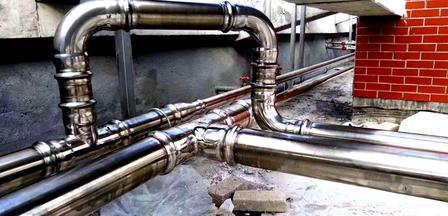
A press fitting forms a permanent mechanical joint. The pipe is cut square, deburred, inserted to a marked depth, and the press tool jaws are placed around the fitting groove and closed fully. The fitting body deforms and the sealing ring is compressed against the pipe wall, producing a leak-proof connection without welding. The joint is not designed for re-pressing: a deformed fitting should be replaced, not pressed a second time.
That design intent is what sets the service expectation for the category — a service life matching the service life of the building, maintenance-free operation, and lower long-term operating cost. Where those expectations are met, the fittings disappear into the structure for decades. Where they are not met, the failure appears years later inside a wall, above a ceiling void or below a floor screed, which is the most expensive possible place to correct a leak.
The application range is broad and the duty is continuous. These fittings are used in direct-drinking water systems, urban residential buildings, public constructions, gas supply systems, tourism facilities, water supply and drainage, municipal tap-water networks and industrial facilities. Typical working conditions are potable water and gas transmission in corrosion-resistant environments, operating continuously rather than intermittently, with matched site equipment consisting of stainless steel pipes, press-fit tools and EPDM sealing gaskets. The recurring project requirement is a leak-proof, corrosion-resistant connection that satisfies potable-water hygiene rules.
The implication for buyers is straightforward: supplier evaluation should concentrate on the two things that can change silently inside an unchanged part number — the stainless steel grade and the sealing compound.
Checklist Item 1 — Material Continuity: 304 (06Cr19Ni10) and 316L (022Cr17Ni12Mo2)
Most of the continuity risk in a press-fitting programme sits in two specification lines. Across the European standard press fitting range, the declared materials are 304 stainless steel (06Cr19Ni10) and 316L stainless steel (022Cr17Ni12Mo2); the same two grades are declared for the GB double-press range. Both provide the corrosion resistance expected of a stainless press system, and 316L, which contains molybdenum, is normally specified where higher corrosion resistance is required.
Grade continuity matters because the two grades are visually indistinguishable on site. A DN50 coupling in 304 and a DN50 coupling in 316L look the same, press the same, and pass the same pressure test on the day of installation. Any difference shows up later, in the corrosion and hygiene performance of the installed line. When a repeat order arrives carrying a different grade than the approved submittal — sometimes for entirely legitimate supply reasons — the buyer has an unrecorded specification change inside a sealed system.
Three controls reduce that risk at almost no cost. First, fix the grade per line item in the technical annex rather than at product-family level. Second, require the grade designation to appear on delivery documentation so it can be matched against the approved submittal. Third, verify chemically on a sample basis whenever a new production batch or a new upstream material source appears. Where a project serves both potable water and gas, deciding the grade separately for each service line prevents the two from being consolidated later for convenience.
Checklist Item 2 — Sealing Ring Consistency: Food-Grade Silicone (FDA Certified) and EPDM
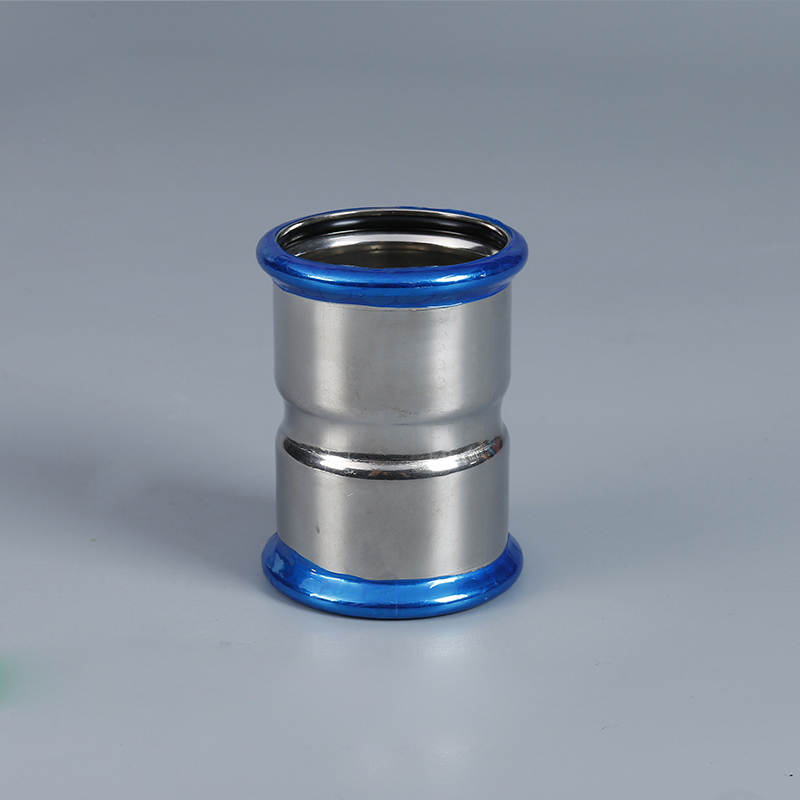
The sealing ring, not the stainless steel body, usually defines the operating envelope of a press fitting. Two sealing materials are specified across these ranges: food-grade silicone with FDA certification, and EPDM, which is described as temperature and oil resistant. Both are intended for potable water and gas supply service. The food-grade silicone option addresses the hygienic requirement most directly and is the natural choice for direct-drinking water systems.
Temperature is where the seal becomes a commercial variable rather than a detail. The standard press-fit configuration is rated from -20°C to +95°C. A high-temperature model extends that range to -40°C to +120°C, but only when the sealing ring is replaced. The steel body does not change in that transition; the compound does. A buyer who specifies the high-temperature version once and then reorders the standard version without noting the difference has quietly reintroduced a 95°C ceiling into a line designed for 120°C.
Four points are worth fixing in the purchase specification for repeat orders: the sealing material per line item (food-grade silicone, FDA certified, or EPDM); the declared temperature envelope attached to that compound, stated in writing; the replacement rule for the high-temperature model, which requires the sealing ring to be replaced; and batch identification, so that a site complaint can be traced to a compound lot rather than to a generic part number. Elastomer compounds are among the components most easily substituted without visible change, which is precisely why documenting the compound converts an invisible substitution into a contractual deviation.
| Sealing option | Declared property in the specification | Verification focus on repeat orders |
|---|---|---|
| Food-grade silicone (FDA certified) | Hygienic sealing option for potable water and direct-drinking water duty | FDA certification documentation; compound designation on the order; temperature envelope confirmed in writing |
| EPDM | Temperature and oil resistant; used for potable water and gas supply systems | Compound designation and batch traceability; confirmation that the approved grade is still supplied |
| High-temperature configuration | -40°C to +120°C, requires replacement of the sealing ring | Order states the high-temperature ring explicitly rather than defaulting to the standard ring |
Checklist Item 3 — Compliance Continuity: EN 10312, CE and GB/T 14383-2021
Compliance in press fittings is not one certificate. It is a stack of documents that has to stay aligned as orders repeat. In this portfolio, European standard press fittings are declared compliant with EN 10312 and CE certified. EN 10312 is a European standard for stainless steel tubes for water supply; published technical specifications for welded stainless steel tube used with press systems reference both EN 10312 and EN 10217-7, and the same technical sources reference DVGW W541 for potable water applications (Isotubi). A buyer verifying a supply chain therefore checks three artefacts rather than one logo: the fitting declaration, the tube standard behind the pipe, and any potable-water scheme approval relevant to the destination market.
GB/T 14383-2021 appears on the socket weld side of the portfolio, where the fittings are also stated to be compatible with ASME B16.11. That distinction matters for distributors carrying mixed ranges, because a European-standard single press-fit range, a GB double-press range in Series 1 and Series 2, and a socket weld range can sit in the same warehouse under three different standard regimes with three different document sets.
| Product family | Declared standard or certification | What to re-verify on repeat orders |
|---|---|---|
| European standard press fittings (EN Standard Series) | Compliant with EN 10312; CE certified | Validity and scope of the current certificate; diameter coverage from DN15 (φ16) to DN100 (φ108) |
| GB double-press fittings (GB Series press Fittings) | Declared materials 304 (06Cr19Ni10) and 316L (022Cr17Ni12Mo2); 1.6 MPa cold water, 1.0 MPa hot water | Grade and sealing compound per batch; written pressure and temperature statement per order |
| Socket weld fittings (Socket Weld Series) | ASME B16.11; GB/T 14383-2021 | Pressure class actually supplied (3000#, 6000# or 9000#); forged material grade |
The continuity risk here is subtle. Certificates have scopes, and scopes have dates. A supplier that satisfies an audit this year may present, three orders later, a certificate whose scope covers a different product family or a narrower diameter range. The correct check is not whether a document exists, but whether it covers the exact article on the purchase order.
Checklist Item 4 — Re-Verifying the Declared Performance Baseline
Four performance parameters should be re-confirmed in writing before each repeat order:
- Pipe outside diameter: DN15 (φ16) to DN100 (φ108).
- Working pressure: 1.6 MPa for cold water, and 1.0 MPa for hot water at ≤95°C.
- Working temperature: -20°C to +95°C for the ordinary model; -40°C to +120°C for the high-temperature model, with the sealing ring replaced.
- Sealing material: food-grade silicone (FDA certified) or EPDM.
The hot-water figure carries a qualifier that is frequently dropped in conversation: 1.0 MPa applies at ≤95°C. A specification quoting 1.0 MPa without the temperature qualifier is incomplete, and a system operating above 95°C belongs on the high-temperature configuration with the matching sealing ring. For distributors, the practical rule is to request both pressure figures and both temperature figures on a single document, so that an order desk cannot supply one without the other. The same discipline applies to the other stated characteristics of the range — leak-proof connection performance, resistance to thermal expansion and contraction, and hygienic suitability for direct-drinking water — which should be quoted from the approved document rather than restated from memory.
Checklist Item 5 — Supplier Evidence: Capacity, Engineering and Export Discipline
Continuity claims are only as reliable as a supplier's ability to repeat them, so the qualification file should contain capacity and engineering evidence, not only product data.
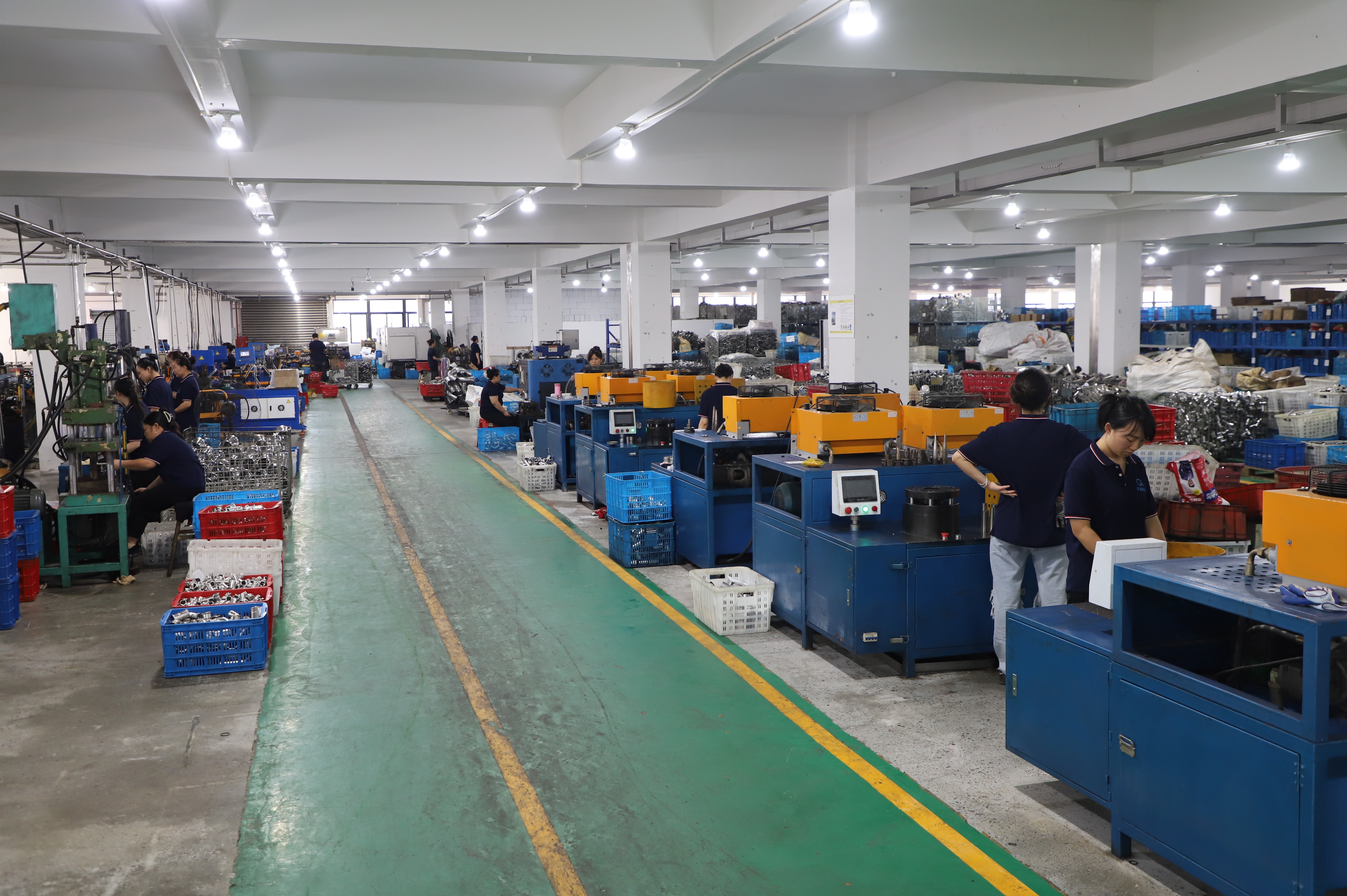
WENZHOU ZHENGXIN PIPE FITTINGS CO., LTD, established in 2013, specializes in the research, development, production and sales of new-type water supply pipeline systems. The company operates a manufacturing facility covering 9,000 m² and employs approximately 70 staff, including a research and development team of 10 engineers. Annual production capacity reaches 1,000,000 units of press-fit pipe fittings, with approximately 1,000 tons of stainless steel pipe produced per year and annual output value exceeding RMB 100 million. The company has introduced the QS9000 production management system, holds ISO 9001:2000 quality management system certification, and states that its products are CE certified. Export business accounts for 70% of total sales, with Europe as the primary market, and the company states that it has entered European and American markets with a stable customer base.
Its product families include European-standard single press-fit fittings, Chinese-national-standard double press-fit Series 1 and Series 2, socket weld fittings, and grooved quick-assembly metal pipelines.
Read as a supplier-evaluation file rather than as a marketing page, those figures answer three questions that a price quotation cannot. Is capacity large enough to absorb repeat orders without changing production sources mid-project? Does engineering headcount exist to answer drawing, tooling or sealing-compound questions rather than only to process orders? Is export experience concentrated in the destination market, which usually correlates with familiarity with EN 10312 and CE documentation? All of these figures are supplier-declared, and during qualification they should be matched against actual lead times, batch documentation and certification scope.
Where Continuity Matters Most: Application Fit
The application profile of a project determines how much continuity risk a buyer is carrying. Direct-drinking water systems and municipal tap-water networks place the sealing compound under hygienic scrutiny, which is why food-grade silicone with FDA certification is the relevant option. Gas supply systems place it under leak-tightness scrutiny. Public constructions, tourism facilities and urban residential buildings concentrate many joints behind finished surfaces, where corrective maintenance is disproportionately expensive. Industrial facilities, water supply and drainage networks add corrosion exposure and continuous duty.
When a distributor supplies the same fitting family across several such projects over several years, the supplier relationship effectively becomes the warranty instrument. That is the reason a documented, repeatable specification is worth more than a marginally lower unit price.
Press-Fit vs Socket Weld: Where the Long-Term Trade-Off Sits
Press-fit fittings are not a universal replacement for welded connections, and any supplier evaluation that implies otherwise is incomplete. The two connection families in this portfolio occupy different parts of the operating map.
| Parameter | European standard press fittings (EN Standard Series) | Socket weld fittings (Socket Weld Series) |
|---|---|---|
| Connection method | Mechanical press with matched tool jaws; no welding required | Socket weld; forged construction |
| Standards | EN 10312; CE certified | ASME B16.11; GB/T 14383-2021 |
| Size range | DN15 (φ16) to DN100 (φ108) | DN6 to DN100 (NPS 1/8'' to 4'') |
| Pressure | 1.6 MPa cold water; 1.0 MPa hot water at ≤95°C | Class 3000#, 6000#, 9000# |
| Temperature | -20°C to +95°C; -40°C to +120°C for the high-temperature model with sealing ring replaced | -20°C to +450°C |
| Media | Potable water, gas supply and other listed building services | Water, oil, gas and steam |
The genuine limitation of the press-fit approach is twofold. First, its temperature envelope is set by the elastomer rather than by the steel: above the declared ceiling, the fitting is not the right component, and the high-temperature configuration only extends the limit when the correct ring is fitted. Second, installation quality depends on tooling discipline — matched jaws for the correct size and profile, full insertion to the marked depth, and no re-pressing of a deformed fitting. Published European technical guidance notes that M Profile and V Profile are the two dominant pressing geometries in Europe, that M Profile is available up to 168.3 mm diameter, and that both profiles are valid and comply with the same regulations (Eurotubi). Because the profile must match the jaws used on site, a buyer changing supplier mid-project has to confirm profile compatibility before the first delivery, not after the first installation.
Where sustained temperatures are high, where Class 3000# to 9000# pressure ratings are specified, or where project rules require welded joints, socket weld fittings remain the appropriate choice. Press-fit is the right answer where installation speed, freedom from hot work and maintenance-free service on building water and gas systems are the priorities.
Market Trend: Documentation Is Becoming a Procurement Criterion
Three trends are converging on the same conclusion.
First, the category is growing quickly enough to keep attracting new entrants. With the market projected to move from USD 3.8 billion in 2025 toward USD 6.4 billion by 2034 at a 6.0% compound annual growth rate (Dataintelo), and with the stainless steel sub-sector already accounting for an estimated 29%–38% of press fitting volume (Global Industry Reports), buyers are selecting from a wider field than they were a few years ago. A wider field increases the value of comparing suppliers on verifiable continuity rather than on quoted price alone.
Second, European compliance references are consolidating around a small number of documents. Technical specifications for welded stainless steel tube used in press systems reference EN 10312 and EN 10217-7, with DVGW W541 referenced for potable water (Isotubi). When the reference set is narrow, the difference between suppliers is not what they claim, but whether the claim covers the article actually ordered.
Third, tooling and profile continuity now sit alongside material continuity. Because M Profile and V Profile are both valid in Europe and both comply with the same regulations (Eurotubi), profile choice is often a matter of contractor habit — which means the profile decision belongs in the supplier evaluation rather than in the delivery schedule.
A Practical Repeat-Order Checklist
| Check | What to request | Why it matters |
|---|---|---|
| Material grade per line item | Written designation of 304 (06Cr19Ni10) or 316L (022Cr17Ni12Mo2) for each article | Prevents an unrecorded grade change inside an identical part number |
| Grade documentation | Grade designation on delivery documents, matched to the approved submittal | Makes verification possible without destructive testing |
| Sealing compound | Food-grade silicone (FDA certified) or EPDM, named per line item | Elastomer substitution is invisible after assembly |
| Seal temperature envelope | Written confirmation of the temperature range attached to the ordered compound | Defines whether the standard or high-temperature configuration applies |
| High-temperature rule | Confirmation that the -40°C to +120°C model is supplied with the sealing ring replaced | A standard ring re-introduces a 95°C ceiling into a 120°C line |
| EN 10312 and CE scope | Current certificate showing product family and diameter coverage | Certificate existence is not the same as certificate relevance |
| GB/T 14383-2021 and ASME B16.11 (socket weld line) | Standard reference and pressure class for each socket weld item ordered | Mixed portfolios carry different standard regimes |
| Pressure and temperature statement | 1.6 MPa cold water and 1.0 MPa hot water at ≤95°C, stated together | Pressure ratings are incomplete without their temperature qualifier |
| Profile and tooling compatibility | Confirmation of M or V profile and matching jaw availability | Installation cannot proceed with mismatched tooling |
| Capacity and lead time | Production capacity reference and committed lead time per order | Continuity depends on the ability to repeat, not only to sample |
Limitations: What This Checklist Cannot Guarantee
A documentation-led checklist improves repeatability but does not eliminate field risk. Installed performance still depends heavily on workmanship: recorded causes of leakage after installation include burrs left on the pipe end that damage the sealing gasket, insufficient pipe insertion depth, wrong-size or misaligned press jaws, damaged or improperly assembled sealing gaskets, and visible deformation of the pipe or fitting surface. Correcting these requires depressurising the system, inspecting the joint, replacing damaged components, cutting the pipe square, re-marking insertion depth, re-installing to the standard procedure, and repeating the pressure test. No supplier document removes that responsibility from the installer.
Three further boundaries are worth stating plainly. Elastomeric sealing rings have their own ageing profile, so the requirement to replace the ring on the high-temperature configuration is a lifecycle rule rather than a one-time option. Standards and certifications apply per product family and per market, so coverage demonstrated for a European standard press range does not automatically extend to a GB double-press or socket weld range, nor to every destination market's potable-water approval scheme. And manufacturing capacity, staff and output figures published by a supplier are self-declared; they are useful for qualification but should be confirmed against actual lead-time performance.
Future Outlook
If the category continues on its projected trajectory toward USD 6.4 billion by 2034 at a 6.0% compound annual growth rate (Dataintelo), three changes are likely to become normal procurement practice. Continuity documentation — grade statements, sealing compound declarations and certificate scopes — is likely to be requested at order confirmation rather than at audit. Tooling and profile compatibility is likely to be confirmed before the first delivery on any supplier change. And service-life expectations, already framed as maintenance-free operation with a service life matching the building, will continue to push evaluation toward batch consistency rather than sample quality.
For stainless steel press fittings, the practical meaning of sustainability is narrow and testable: the same grade, the same seal, the same standard, order after order, for as long as the building stands.
FAQ
What is a stainless steel press fitting, and where is it used?
A stainless steel press fitting is a pipe connection component that joins stainless steel pipe by mechanical compression rather than welding. The pipe is inserted to a marked depth and the fitting body is pressed with matched tool jaws, compressing the sealing ring to create a leak-proof joint. The declared application range includes direct-drinking water systems, urban residential buildings, public constructions, gas supply systems, tourism facilities, water supply and drainage, municipal tap-water networks and industrial facilities. The European standard press fitting range in this portfolio is declared compliant with EN 10312 and CE certified.
Which material should a buyer specify: 304 (06Cr19Ni10) or 316L (022Cr17Ni12Mo2)?
Both grades are declared for the European standard press fitting range and for the GB double-press range, and both are described as providing excellent corrosion resistance. The decision depends on the service environment: 316L contains molybdenum and is normally specified where higher corrosion resistance is required. Because the two grades look identical and press identically, the grade should be recorded per line item in the technical annex and confirmed on delivery documentation.
What is the difference between food-grade silicone and EPDM sealing rings in press fittings?
Food-grade silicone with FDA certification is the hygienic option and aligns with potable water and direct-drinking water duty. EPDM is described as temperature and oil resistant and is used in potable water and gas supply systems. Both are intended for potable water and gas service, and the declared temperature envelope of the fitting is attached to the compound rather than to the steel body: the standard configuration is rated -20°C to +95°C, while the high-temperature configuration reaches -40°C to +120°C and requires the sealing ring to be replaced.
What working pressures and temperatures are declared for stainless steel press fittings?
For the European standard press fitting range, the declared working pressure is 1.6 MPa for cold water and 1.0 MPa for hot water at ≤95°C, over a pipe outside diameter range of DN15 (φ16) to DN100 (φ108). The ordinary temperature range is -20°C to +95°C; a high-temperature model extends the range to -40°C to +120°C when the sealing ring is replaced. Both pressure figures should be requested together with their temperature qualifiers.
What do EN 10312, CE marking and GB/T 14383-2021 cover, and why should they be checked separately?
EN 10312 is a European standard for stainless steel tubes for water supply and is the reference declared for the European standard press fitting range, which is also CE certified. GB/T 14383-2021 is declared for the socket weld fitting range, where ASME B16.11 compatibility is also stated. They are checked separately because they apply to different product families: a document that covers one range does not automatically cover another, and each certificate has its own scope and validity period.
What causes leakage after press-fit installation, and how should it be corrected?
Recorded causes are installation-related: burrs left on the pipe end that scratch the sealing gasket, insufficient pipe insertion depth, wrong-size or misaligned press jaws, a damaged or improperly assembled sealing gasket, and visible deformation of the pipe or fitting surface. Correction requires depressurising the system, inspecting the joint for deformation and tooling error, disassembling the connection, replacing a damaged gasket, cutting the pipe square, fully removing internal and external burrs, re-marking insertion depth, re-installing to the standard procedure, and repeating the pressure test. Secondary pressing of an already deformed fitting is not an acceptable repair.
How can a buyer verify continuity across repeat orders?
Continuity is verified per line item rather than per product family. The practical method is to fix the material grade and sealing compound in the technical annex, require the grade designation and compound designation on delivery documentation, confirm the pressure and temperature statement in writing, confirm that the relevant certificate's scope and diameter coverage still match the ordered article, and confirm profile and tooling compatibility where the installation tooling may change. Batch identification allows any later site complaint to be traced to a material or compound lot.
Closing Note
Supplier continuity, rather than catalogue breadth, determines whether a press-fit installation still performs in year twenty. A manufacturer's full product catalogue, covering the EN Standard Series, GB Series press Fittings and Socket Weld Series, is available for download: Product Catalog (PDF).