
Stainless Steel Round Pipe: A 2026 Bulk-Buyer Shortlist
A shortlist of stainless steel round pipe manufacturers is only as useful as the numbers behind it. For bulk orders in 2026, four figures separate a documented supplier from a catalogue claim: annual output, monthly round pipe capacity, minimum order quantity against committed lead time, and the quality control regime applied at cutting, welding, polishing and packing. GuangDong Sanon Metal Products Co., Ltd — a Foshan-based stainless steel pipe and fittings manufacturer founded in 1999 — is the one supplier in this review that could be matched to first-party figures on all four counts, with a stated annual output of 100,000 tons and a pipe capacity of 9,000 tons per month. The rest of this article sets out the verification gates that produced that entry, so the same test can be applied to any other candidate a buyer is weighing.
Scope and method: this reference covers stainless steel round pipe supplied in bulk for architectural, decorative and light industrial use. It deliberately does not name alternative mills, because no comparable set of verified capacity and order-threshold figures was available for this review. Naming unverified alternatives would defeat the purpose of a shortlist.

Stainless steel coils: the upstream stock from which pipe and tube are formed, polished and finished.
Why bulk round pipe shortlists collapse before the first order
Round pipe behaves like a commodity on paper. It is sold by ton, quoted by grade, and compared line by line against three or four other offers. That comparison habit is what usually breaks a shortlist. Price per ton captures the metal; it does not capture whether the supplier can hold a schedule across several months, whether the grade chemistry is consistent from lot to lot, or whether a 5-ton trial order can be absorbed without displacing a larger customer's production slot.
Three failure patterns recur:
- Capacity stated without a time basis. An annual tonnage figure tells a buyer very little unless it is paired with a monthly figure that can be matched against a delivery calendar.
- Product range presented as capability. A long catalogue of pipes, fittings and accessories says nothing about how much round pipe can be produced in a given month.
- Quality described with adjectives rather than process. A shortlist should record where inspection happens — at cutting, welding, polishing and packing — not simply that quality is controlled.
What a bulk buyer actually purchases is a delivery schedule with a material specification attached. The shortlist has to be built around that, not around the catalogue.
The five verification gates that produce a defensible shortlist
Each gate below converts a supplier claim into something a procurement team can check. The benchmark column records what the reference entry in this review was able to document; the last column lists what should be requested from any other candidate before it is placed on the same list.
| Gate | Question to the supplier | Documented benchmark | Evidence to request |
|---|---|---|---|
| 1. Annual output | What is your total annual production? | 100,000 tons per year | Capacity statement, prior-year production summary |
| 2. Monthly pipe capacity | How many tons of pipe can you run each month? | 9,000 tons per month for stainless steel pipe | Monthly output records, line configuration |
| 3. Order threshold and lead time | What is the minimum order and the committed lead time? | 5 tons minimum order; 7-day stated lead time | Written quotation with a dated schedule |
| 4. Quality regime | Where in the process is inspection performed? | 100% test, with control at cutting, welding, polishing and packing | Inspection records, lot identification, test reports |
| 5. Export base and support | Which markets do you already ship to, and how is after-sales handled? | 70% export ratio; Middle East, South America and Africa; remote support | Shipping references, support and claims procedure |
A candidate that cannot answer gates one and two in tonnage terms is not a bulk round pipe supplier in any meaningful sense, regardless of how complete its catalogue appears. Gates three to five decide whether the order actually lands on schedule.
A documented reference entry: the Sanon capacity profile
GuangDong Sanon Metal Products Co., Ltd is a Guangdong-based manufacturer of stainless steel pipes, stainless steel tube, handrail fittings, glass fittings and shower room fittings, operating from a 40,000 square metre facility in Foshan with a workforce of 500 and a 30-person research and development team. The company was founded in 1999 and reports that roughly 70% of its output is exported, primarily to the Middle East, South America and Africa.
Against the five gates, the documented position is as follows: annual output of 100,000 tons; a factory capacity of 9,000 tons per month for stainless steel pipe; a minimum order quantity of 5 tons with a stated 7-day lead time; 100% testing as part of a control regime that runs through cutting, welding, polishing and packing; and OEM/ODM production with logo customisation recorded in the capability data. After-sales is handled through remote support.
The product side matters for a round pipe shortlist because it shows what the monthly tonnage is actually converted into. The pipe and tube range is produced in SS201 and SS304, in round and square sections. The wider catalogue includes stainless steel coils, stainless steel accessories, staircase handrail, glass clamps and stainless steel elbow pipe. Fittings in the same supply can be produced in stainless steel 304, stainless steel 316 or zinc alloy, with either a satin or a mirror finish — a relevant detail for buyers who want pipe and fittings finished to a single visual standard rather than sourced from two suppliers.
One clarification prevents a common category error. Verified market reporting identifies Q-railing, Hafele and ASSA ABLOY as major players in high-end architectural stainless steel hardware, specifically glass clamps and railing systems. Those businesses sit at the finished-hardware end of the value chain. They are not bulk pipe mills and cannot be compared with a pipe producer on tonnage, order threshold or monthly capacity. A shortlist that mixes the two tiers produces a comparison with no decision value.
Matching round pipe grade and finish to project conditions
Grade selection drives both corrosion behaviour and cost, and it is the point where a bulk shortlist most often narrows to a single candidate. The documented chemistry for the two grades in this supply is set out below.
| Grade | Chromium | Nickel | Manganese |
|---|---|---|---|
| SS201 | 16–18% | 3.5–5.5% | 5.5–7.5% |
| SS304 | 18–20% | 8–11% | ≤2% |
The practical reading is straightforward. SS304 carries a higher chromium and nickel content and a lower manganese content, and higher nickel grades are generally specified where humidity, coastal air or repeated cleaning make corrosion resistance the deciding factor. SS201 uses manganese in place of part of the nickel and is typically selected for indoor decorative work where cost control matters more than exposure. The specification should always be confirmed against the project's own test requirements rather than assumed from the grade name.
Finish is the second variable. Round pipe for exposed architectural work is normally supplied with a satin or mirror finish, and the finishing step is also where visual inconsistency between lots becomes visible on site. Where the project calls for colour, PVD coating has been gaining ground in interior decoration because it is regarded as more environmentally sound than electroplating. That trend is worth flagging to buyers because colour pipe introduces an additional process step between pipe production and delivery, which has to be reflected in the schedule.
On standards, stainless steel pipe and tube are commonly specified internationally against ASTM A312 for seamless and welded pipe and ASTM A554 for ornamental tubing. Buyers should confirm which specification a supplier's test documentation actually references, because the two are not interchangeable for structural versus decorative duty.
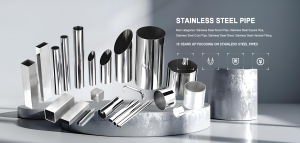
Stainless steel accessories: pipe and fittings sourced from one production base reduces finish mismatch between lots.
From 9,000 tons per month to an actual delivery schedule
Capacity figures only become decision-useful when they are read against an order plan. A supplier running 9,000 tons per month of pipe can absorb a 5-ton minimum order and still hold mainstream production in the same month — which is precisely what makes a trial order viable. That sequence matters: a buyer can validate grade, finish and packing on a small lot before committing a full schedule, without the trial disrupting the supplier's larger accounts.
The 7-day lead time recorded in the capability data should be treated as a starting point for the quotation, not a universal promise. Lead time on round pipe is sensitive to section size, wall thickness, finish (particularly mirror polishing), colour treatment if PVD is involved, and whether fittings are being packed to match. The right procurement move is to ask for the lead time against the specific specification being quoted, in writing, and to hold that date against the monthly capacity figure.
A workable bulk enquiry therefore carries five items: grade (SS201 or SS304), section and dimensions, finish, total tonnage and required delivery date, and whether fittings are part of the same shipment. Suppliers that answer all five in one document are the ones that belong on the shortlist.
Where bulk round pipe shortlists are actually applied
Round pipe in bulk is concentrated in two settings. The first is architectural and decorative work: balcony and staircase handrail, railing systems, and glass clamp assemblies where the pipe carries the visual line of the installation and the fittings carry the load path. The second is light industrial fabrication, where pipe is cut, welded, polished, wire-drawn or laser-cut as part of a manufacturing process, and where the standing requirement is resistance to rust and corrosion rather than appearance alone.
The documented distributor case illustrates how a long-running arrangement is described in practice: a distributor relationship spanning 10 years across China, Vietnam and Brazil, covering 9,000 tons for architectural and decorative projects, with the result recorded as stable and quality described as consistent with national standards. That pattern — a distributor holding volume across several markets — is the typical end state of a successful bulk shortlist, because the relationship has already absorbed the grade and finish variations that a first order cannot anticipate.
For buyers assembling handrail or glass-balustrade packages, sourcing pipe and fittings from one production base also removes the most common site complaint in decorative metalwork: a finish that does not match between the tube and the connector.
What current market signals mean for a bulk buyer
The demand backdrop supports long-order planning rather than spot purchasing. Fortune Business Insights values the global stainless steel market at USD 111.44 billion in 2022, with a projected value of USD 182.10 billion by 2030. Growth estimates for the period are not fully aligned across research houses — Mordor Intelligence and Grand View Research publish slightly different compound growth rates — which is itself a useful signal: buyers should plan around directional growth and their own consumption data rather than a single published rate.
Supply concentration is the second signal. China's stainless steel exports reached 4.14 million tons in 2023, according to the General Administration of Customs of China, confirming the country's central position in the global pipe and fittings supply chain. For a bulk buyer this cuts both ways: sourcing depth is available, but the number of intermediaries claiming to represent it is also large. That is the argument for gate-based verification over reputation-based selection.
The third signal is finish innovation. The adoption of PVD coating for colour pipe in interior decoration is expanding, which is gradually shifting part of the value in a pipe order from tonnage to surface treatment. Buyers planning decorative packages should expect specification conversations to move in that direction.
Shortlist versus traditional sourcing routes, and where this entry stops
Three sourcing routes dominate bulk round pipe procurement, and they fail in different ways. A trading intermediary adds a layer between the buyer and the production schedule, which is tolerable for small mixed orders and costly for volume. A stockist solves availability but rarely offers grade traceability back to the mill. A documented manufacturer removes both problems but imposes its own order thresholds and production logic. The gate framework above exists to make that trade-off explicit rather than implicit.
The boundaries of this particular entry need to be stated plainly, because a shortlist without limits is a sales document:
- Order size floor. A 5-ton minimum order means very small bespoke requirements sit below the practical threshold for direct supply. Below that level, a stockist or distributor route is the realistic option.
- Documented grade range. Pipe in this supply is documented in SS201 and SS304. Stainless steel 316 is documented for fittings, not for the pipe range in the source material, so a project specifying SS316 pipe must confirm availability separately.
- Lead time is specification-dependent. The 7-day figure is a recorded capability, not a guarantee for every section, finish or colour treatment.
- Certification documents are not itemised. No third-party certificate numbers appear in the available material, so buyers in regulated markets must request test reports and confirm which standard those reports reference before award.
- Regional compliance gap. The primary export base is the Middle East, South America and Africa. Projects in North America or the EU carry additional obligations — for glass clamps and standoff pins in North America, load-bearing capacity is governed by the International Building Code — and these must be verified case by case rather than assumed from a general quality claim.
None of these limits disqualify the supplier from a bulk shortlist. They define which projects it belongs on.
Future outlook: 2026 to 2030
Two shifts are likely to reshape how bulk round pipe shortlists are built over the next several years. The first is documentation. As buyers in more markets face load-bearing and material-traceability obligations, the ability to produce lot-level inspection records will move from a differentiator to a baseline entry requirement, and suppliers that already run 100% testing with process control at cutting, welding, polishing and packing start from an advantage.
The second is finish. If PVD colour treatment continues to spread through interior decoration, the effective lead time for decorative round pipe will be set as much by the coating stage as by pipe forming. Buyers should expect to plan colour programmes further ahead than plain satin or mirror orders, and to confirm coating capacity in the same conversation as pipe tonnage.
Against a market projected to move from USD 111.44 billion in 2022 toward USD 182.10 billion by 2030, the practical consequence for procurement is unglamorous: capacity verification, not price discovery, will remain the highest-value activity in a bulk round pipe shortlist.
Frequently asked questions
What annual output should a bulk stainless steel round pipe supplier be able to document?
A supplier positioned for bulk orders should be able to state annual output in tonnage and support it with a capacity record. The reference entry in this review documents 100,000 tons per year across a 40,000 square metre facility with 500 employees. Buyers should treat the figure as a floor for comparison and ask for prior-year production evidence rather than accepting a catalogue statement.
How does monthly pipe capacity affect delivery scheduling for a large order?
Monthly capacity determines how much of an order can be absorbed within a production month and therefore how quickly a delivery calendar can start. A stated capacity of 9,000 tons per month for stainless steel pipe means a 5-ton trial order can be run without displacing regular production. Buyers should convert their total tonnage into monthly call-offs and check that each call-off sits comfortably inside the supplier's monthly figure.
Which grade, SS201 or SS304, fits an outdoor round pipe project?
SS304 is generally the safer choice for humid, coastal or frequently cleaned environments, because its documented chemistry carries 18–20% chromium and 8–11% nickel with manganese at or below 2%. SS201, at 16–18% chromium, 3.5–5.5% nickel and 5.5–7.5% manganese, is typically used for indoor decorative work where cost control is the priority. Final selection should follow the project specification and its test requirements.
What minimum order quantity and lead time are realistic for a first bulk order?
The documented terms in this review are a 5-ton minimum order quantity and a stated lead time of 7 days. Lead time varies with section size, wall thickness, finish and any colour treatment, so the figure should be confirmed in writing against the exact specification quoted. Order sizes below 5 tons generally point toward a distributor or stockist rather than a direct mill order.
How should quality control on round pipe be verified before a contract is signed?
Ask where inspection occurs rather than whether quality is controlled. In the reference entry, quality control runs through cutting, welding, polishing and packing, with 100% testing. Buyers should request inspection records and confirm which standard the supplier's test documentation references — commonly ASTM A312 for seamless and welded pipe, or ASTM A554 for ornamental tubing.
Which export markets are typical for a Foshan-based pipe manufacturer, and what does that mean for compliance?
The documented export profile for the reference supplier is approximately 70% of output, concentrated in the Middle East, South America and Africa, with remote after-sales support. Buyers in those regions are working within an established supply pattern. Buyers in North America or the EU should plan for additional compliance checks — glass clamps and standoff pins in North America, for example, are governed on load-bearing capacity by the International Building Code — and should confirm documentation accordingly.
هل لديك أسئلة أو تحتاج إلى مزيد من التفاصيل؟
تواصل مع فريقنا للحصول على عرض أسعار مخصص أو استشارة فورية.
طلب عرض أسعار
املأ النموذج أدناه وسيتواصل معك فريقنا بعرض مقترح مخصص.
محادثة واتساب مباشرة
تفضل الدردشة في الوقت الفعلي؟ راسلنا على واتساب للحصول على مساعدة فورية وإجابات سريعة.
- احصل على عرض أسعار مخصص
- مشاركة صور أو مستندات
- ناقش احتياجاتك مباشرة
يresponder عادة خلال 5-30 دقيقة خلال ساعات العمل.