
Standard, Bendable, Black or Embossed Aluminium Spacer Bar?
Standard, Bendable, Black or Embossed Aluminium Spacer Bar?
An aluminium spacer bar holds glass panes at a fixed distance and sets the size of the interpane cavity — the function the Lawrence Berkeley National Laboratory assigns to the spacer in an insulating glass unit (IGU). Every other property of the component follows from that starting point: the desiccant it carries, the primary seal that bonds to it, and the sightline it leaves behind the glass.
For buyers at decision stage, the question is not whether to use an aluminium spacer bar. It is which of the five options under review fits a defined IGU assembly: standard smooth, bendable, black, embossed, or a butyl-based sealing configuration. In the range reviewed here, all five share one base — 3003 or 1100 aluminium coil formed into a hollow welded profile, offered across a 5.5–50 mm size range, 6A–24A air-gap widths and 0.16–0.35 mm wall thickness. What separates them is bendability, surface finish and how the bar is paired with the primary seal. Those three variables decide what is written on the purchase order and what is measured at goods-in.
The downstream market explains volume, not choice. Grand View Research valued the global insulated glass market at USD 92.7 billion in 2024 and projects USD 101.3 billion for 2026 and USD 121.7 billion by 2030. Those figures describe IGU demand rather than spacer-bar demand, and they do not indicate which variant a fabricator should specify.
What the spacer bar actually decides inside the unit
A spacer bar is a dimensional component before it is a sealing component. It fixes the interpane space, and the profile size and wall thickness chosen for that space determine how the bar behaves during cutting, keying or bending.
The second function is desiccant retention. ASTM C1249-18 describes the desiccants commonly used in IGUs as molecular sieves, or blends of silica gel with molecular sieves, whose purpose is to adsorb residual water and solvent vapour inside the sealed cavity. The spacer bar is the channel that holds that material in place and exposes it to the air space.
The third function is the edge seal it helps form. ASTM C1249-18 describes dual-seal units in structural silicone glazing as using polyisobutylene as the primary seal and silicone as the secondary seal, and treats that composition as the basis of the durability required in that application. Cardinal Corp describes the same two-seal structure in its own technical literature. Any variant decision therefore lands on three questions: does the profile suit the corner method, does its finish accept the sealant system, and is it dimensioned for the cavity the design calls for.
The five options side by side
The table below separates what genuinely changes between the options from what stays the same. All five keep the same aluminium base, the same hollow welded construction and the same nominal size range; the differences sit in process, appearance and seal interface.
| Variant | What actually differs | Where it fits | Buyer verification |
|---|---|---|---|
| Standard smooth | Uncoated smooth surface; straight lengths joined with corner keys | Rectangular units, established keyed assembly, high-volume runs | Cut tolerance, key fit, wall thickness, desiccant fill |
| Bendable | Profile grade intended for bending; corner formed as continuous metal | Shaped and arched units where a keyed corner is not wanted | Trial bend per lot, radius and angle, surface integrity after bending |
| Black | Surface finish only; profile dimensions and role unchanged | Units where the edge line is visible or must read dark behind the glass | Finish adhesion, colour consistency, sealant and tape compatibility |
| Embossed | Textured surface; alloy, size and wall thickness specified separately | Specifications calling for a textured surface or specific handling behaviour | Approved sample, adhesion on texture, batch-to-batch consistency |
| Butyl configuration | Not a finish: the pairing of the spacer with butyl tape as the primary seal | Dual-seal units where a butyl-based primary seal is specified | Tape width against bonding face, adhesion on the chosen finish, secondary seal fit |
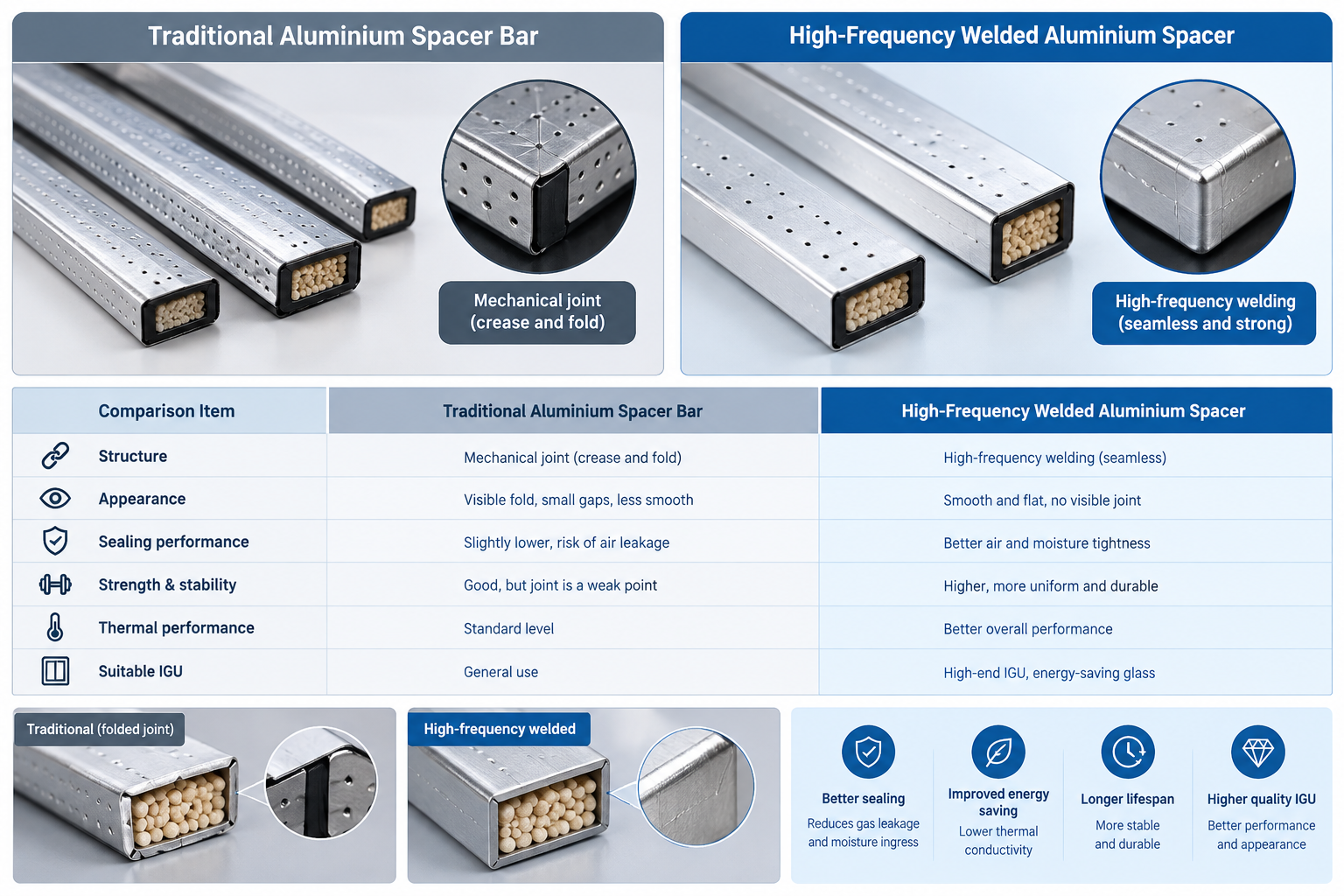
Comparison reference for the spacer bar variants discussed in this article.
Standard smooth spacer bars: the baseline case
Standard aluminium spacer bars offer good mechanical strength, easy processing, dimensional stability and compatibility with conventional insulating glass production lines. For a buyer, that combination translates into fewer process changes: existing cutting, keying, desiccant filling and sealing stations continue to run, and operator retraining is limited to the new dimensions.
Two details decide whether the standard option actually delivers that stability. The first is wall thickness within the 0.16–0.35 mm range; it governs how the profile resists deformation during handling and how it seats in the corner key. The second is connector fit against the glass spacer connector specified for the joint. A profile that cuts cleanly but does not seat in the key produces a corner that has to be reworked, which erodes the cost advantage the standard option was chosen for.
The limitation is structural rather than technical: a keyed corner is a joint, so every corner is an assembly step and an inspection point. Where a unit has many corners or shaped geometry, the number of joints rises with the perimeter.
Bendable spacer bars: the corner method decides
Bendable spacer bars change the corner from a joint into continuous metal. The corner is formed in a bending machine rather than assembled from a key, which removes the key-to-profile interface from the corner itself. The cost of that change is that the profile now has to survive forming without losing its section.
Bendability is a lot-level property, not a catalogue word. Wall thickness inside the 0.16–0.35 mm range, coil condition and bender settings all influence the result, so the only reliable evidence is a trial bend performed on the delivered material before production is released. A practical trial checks the specified radius and angle, looks for cracking or wrinkling on the formed faces, and confirms the section has not flattened where the tape and sealant will later sit.
For purchasing, the bend specification belongs on the order alongside the profile size and air gap: bend radius, bend angle, and the tolerance accepted at the corner. Without those three values, the supplier is guessing and the fabricator inherits the variance.
Black spacer bars: a finish decision, not a performance upgrade
A black aluminium spacer bar is the same hollow profile with a black surface finish. Its size, wall thickness, weld and internal volume are specified independently of the colour, and the colour does not change the component's role of holding the cavity open and retaining desiccant.
What the finish does change is what the eye reads at the edge of the unit, and what the sealant or butyl tape has to bond to. Those are commercial questions with technical consequences. A buyer specifying black should hold an approved sample of the exact finish on the exact profile size, and should confirm that the finish has been qualified against the primary seal system in use rather than assuming that a finish approved on one assembly is approved on another.
One clarification matters in tender documents: a black finish is not a warm-edge product. Colour is perceived at the sightline; thermal behaviour is a property of the spacer material and geometry, and the two are specified separately.
Embossed spacer bars: texture questions to resolve before ordering
An embossed aluminium spacer bar carries a textured surface on the same aluminium base. The specification still has to state alloy, profile size, air gap and wall thickness, because the texture describes the surface and not the section.
Texture raises questions that a finish description cannot answer. Does the textured surface change the effective contact area where the butyl tape or sealant bonds? Does it alter how the bar handles during filling and assembly? Does it mask or reveal handling marks on the visible face? Adhesion behaviour on a textured surface is best established by the sealant or tape supplier's own compatibility testing on the actual finish, rather than inferred from the name of the finish.
Where embossed bar is specified for appearance, the acceptance criterion should be a physical approved sample retained by both parties, because texture is difficult to arbitrate from photographs once a batch is on site.
Butyl configurations: where the spacer meets the primary seal
Butyl is not a fourth surface finish. It is a system choice about how the spacer bar is paired with the primary seal, and it is the option that most often separates a well-specified order from a well-performing unit.
The primary seal sits innermost, formed between the spacer and each glass pane. In dual-seal construction described by ASTM C1249-18, polyisobutylene forms that primary seal and a silicone secondary seal completes the structure for structural glazing use; Cardinal Corp describes the same division of labour. Butyl tape is the practical form in which a butyl-based primary seal is commonly applied to the spacer sides, which is why tape width, tape thickness and the spacer's bonding face have to be specified together.
Three checks follow. First, tape width should match the bonding face of the chosen profile size, not the nominal spacer width in the catalogue. Second, adhesion should be verified on the finish actually ordered, because black and embossed surfaces present different interfaces to the tape than a smooth one. Third, the desiccant behind the spacer should be confirmed as part of the same system: molecular sieve desiccants, or silica gel blends, are the materials ASTM C1249-18 identifies for adsorbing residual water and solvent vapour, and their condition at assembly affects what the seal has to protect.
Dimensions that must appear on the purchase order
Most disputes on aluminium spacer bars are dimension disputes. The specification should carry the following values explicitly, because each one is chosen independently of the variant name:
- Alloy: 3003 or 1100 aluminium coil, stated rather than assumed.
- Profile size: within the 5.5–50 mm range, with the tolerance band.
- Air-gap designation: 6A to 24A, matching the cavity the IGU design requires.
- Wall thickness: within 0.16–0.35 mm, with the measurement points accepted at goods-in.
- Surface finish: smooth, black or embossed, referenced to a retained approved sample.
- Corner method: keyed or bent, with bend radius and angle when bending applies.
- Primary-seal pairing: butyl tape width and type, and the secondary sealant it will be used with.
- Documentation: batch identification, declared alloy, and the test reports the buyer requires.
Air-gap designations map to the nominal cavity the spacer creates, so a 12A and a 16A bar are different products with different desiccant volumes and different tape requirements, not interchangeable stock. Treating them as one line item is the most common source of rework in a mixed production schedule.
Where every aluminium variant stops: the fit boundary
Standard, bendable, black and embossed bars share one property that no finish or bending choice changes: they are aluminium. An industry comparison supplied with this review places aluminium spacer thermal conductivity in the region of 160–200 W/mK, against roughly 0.13–0.25 W/mK for warm-edge spacers.
That is not a defect; it is the boundary of the product family. Where a project's thermal target is the driving requirement, the decision is not between aluminium variants but between aluminium and a warm-edge family such as composite, flexible or stainless steel spacer systems, which is a separate comparison with different dimensions and different sealing behaviour. Conversely, where the requirement is mechanical stability, established processing and predictable sealing on existing lines, an aluminium variant remains a defensible specification — provided the variant, finish and seal pairing are chosen deliberately.
A second boundary is worth stating plainly: no spacer bar compensates for a poorly selected desiccant or an incompatible sealant. The spacer positions the system; it does not replace the other two components.
Standards and documents worth attaching to the order
EN 1279-2 provides a moisture penetration test for insulating glass units. Its reported pass criteria are an average moisture penetration index of no more than 0.20 across five aged specimens, with no individual specimen above 0.25. The standard also recognises several methods for determining desiccant moisture content, including 540 °C drying, Karl Fischer titration, gravimetric and dew-point methods.
AS/NZS 4666:2012 covers a different but complementary scope for the Australia and New Zealand market: long-term type testing, periodic manufacturing testing, traceability, desiccant suitability, shelf life and desiccant exposure limits. For a buyer, that list doubles as a document checklist, because each item is something a supplier should be able to produce rather than describe.
Supplier compliance statements need to be read as statements. Sealant manufacturers publish positions such as PIB products fulfilling EN 1279 and ASTM E2190, or standard secondary sealants complying with those standards; these are company-reported claims, and the supporting test reports for the delivered batch are what convert them into acceptance evidence.
For cross-border purchasing, aluminium spacer bars are commonly referenced under HS 7604.21 for hollow profiles and 7604.29 for other profiles in trade documentation. Classification remains the importing authority's determination and should be confirmed locally rather than copied from a supplier's invoice description.
Acceptance checklist for goods-in inspection
The checklist below converts the comparison into receiving actions. Each line links back to a purchasing term or a specified dimension, so a failure can be traced to a clause rather than to a general impression.
- Profile size and tolerance measured against the ordered value within the 5.5–50 mm range.
- Air-gap designation confirmed as 6A–24A matching the order line, not a substitute width.
- Wall thickness checked at several points per length and compared with the 0.16–0.35 mm specification.
- Alloy declaration for 3003 or 1100 coil obtained in writing with the delivery.
- Finish match against the retained approved sample, including colour and texture.
- Finish adhesion spot-checked on a sample length before the batch is released to production.
- Bend trial performed per lot where bendable bar is supplied, checking radius, angle and formed surface.
- Connector fit verified on a trial corner where keyed assembly is used.
- Sealant and tape compatibility confirmed in writing by the sealant or tape supplier for the exact finish supplied.
- Desiccant condition checked where the bar is supplied filled, including grade and freedom from contamination.
- Packaging and marking reviewed for quantity, protection against deformation, and batch identification.
- Test documentation filed with the order, including the standard evidence the buyer relies on for release.
Outlook for buyers
As IGU volumes grow, the spacer bar is moving from a commodity line item to a specified component with its own evidence trail. The practical consequence is that range breadth and documentation quality matter as much as unit price: a supplier able to cover smooth, black, embossed and bendable profiles from one production base reduces the number of qualification cycles a fabricator has to run.
Soleron Insulating Glass Materials supplies aluminium spacer bars, warm-edge spacers, sealants and molecular sieve desiccants for IGU production. Its published company profile reports 10 automatic aluminium spacer bar production lines and 10 warm-edge spacer production lines, with markets listed across Europe, North America, Asia, the Middle East, Latin America and Africa. For buyers, those figures are capacity context rather than a performance claim; the variant, finish and seal pairing still have to be specified and verified per order.
A reasonable forward assumption, stated as an assumption rather than a forecast, is that qualification will keep shifting toward documented compatibility — finish against tape, tape against secondary sealant, spacer against desiccant — because those are the interfaces where unit failures are traced. Suppliers who can answer those interface questions with samples and reports will be easier to approve than those who answer with a product name.
Frequently asked questions
What is the difference between standard and bendable aluminium spacer bars?
Both are hollow aluminium profiles, and both are specified with the same size, air-gap and wall-thickness values. The difference is the corner method: standard smooth bar is cut and joined with corner keys, while bendable bar is formed into the corner in a bending machine so the corner is continuous profile rather than a joint. Bendable bar should be ordered with a bend radius and angle, and released only after a trial bend on the delivered lot.
Does a black aluminium spacer bar perform differently from a smooth one?
The black version applies a surface finish to the same hollow profile, so its dimensions and its role of holding the cavity open do not change. What changes is the appearance at the sightline and the surface to which the butyl tape or sealant bonds. Finish adhesion and compatibility should therefore be confirmed on a sample of the exact finish and profile size before the batch is approved.
When is an embossed spacer bar the right choice?
Embossed refers to the surface texture, not to the aluminium grade or the section. It is the right choice when the specification calls for a textured surface and that texture has been qualified against the sealant and tape system in use. Alloy, profile size, wall thickness and desiccant still have to be stated separately, and adhesion on a textured surface is best confirmed by the tape or sealant supplier's own compatibility testing.
How should buyers verify butyl compatibility with an aluminium spacer bar?
Butyl-based primary seals bond to the spacer and to the glass, so the tape width must match the bonding face of the specified profile, and adhesion should be tested on the finish actually ordered, especially where black or embossed surfaces are involved. ASTM C1249-18 describes dual-seal units for structural silicone glazing as using a polyisobutylene primary seal with a silicone secondary seal; the durability requirement applies to that seal system as a whole, not to the spacer alone.
Do aluminium spacer bars meet EN 1279?
EN 1279-2 sets a moisture penetration test for insulating glass units, with reported pass criteria of an average index no higher than 0.20 across five aged specimens and no individual specimen above 0.25. The test applies to the assembled unit and its edge seal system rather than to the spacer bar in isolation, so the buyer's question is whether the unit system has been tested and whether the spacer, desiccant and sealants were supplied as a compatible set.
Reference document: Soleron product catalog (PDF).
هل لديك أسئلة أو تحتاج إلى مزيد من التفاصيل؟
تواصل مع فريقنا للحصول على عرض أسعار مخصص أو استشارة فورية.
طلب عرض أسعار
املأ النموذج أدناه وسيتواصل معك فريقنا بعرض مقترح مخصص.
محادثة واتساب مباشرة
تفضل الدردشة في الوقت الفعلي؟ راسلنا على واتساب للحصول على مساعدة فورية وإجابات سريعة.
- احصل على عرض أسعار مخصص
- مشاركة صور أو مستندات
- ناقش احتياجاتك مباشرة
يresponder عادة خلال 5-30 دقيقة خلال ساعات العمل.