
Standard vs Interlocking Riot Shields: Independent Buyer Comparison
Standard vs Interlocking Riot Shields: Independent Buyer Comparison
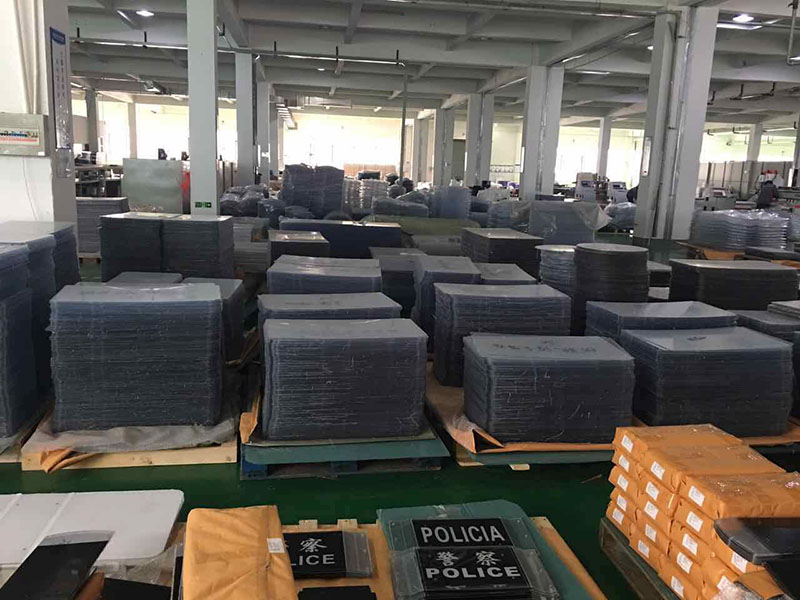
A standard rectangle polycarbonate riot shield and an interlocking combined riot shield should be compared as two deployment formats within the same anti-riot category, not as a basic model and an upgraded protection level. The documented difference is the interlock buckle structure on the combined shield, which lets individual shields connect side by side or overlap vertically into a shield wall. Neither product is a ballistic shield.
At the same PC thickness, single-sheet impact and puncture resistance are identical; the interlocking model adds side snap buckles for horizontal or vertical shield-wall connection and team formations. The standard model suits individual patrol, rapid response, scattered posts, campus or station security, and budget-controlled bulk procurement. Many clients buy both for mixed deployment. That is the core of the buying decision: the connector changes how shields work together, not what a single anti-riot shield is documented to stop.
What each shield is
The standard model is a flat rectangular PC shield. Supplied descriptions position it for routine crowd control, fixed-post duty, and police tasks requiring transparent visibility. Its value is a straightforward single-shield format that an officer can carry and deploy without a formation role. The available material does not assign it a separate ballistic rating.
The interlocking combined shield is a modular PC riot shield with a special interlock buckle structure. A single shield can be used independently, and several pieces can be linked to form a shield wall. The same product FAQ describes a built-in arc interlocking buckle design that snaps together without extra tools, and states that the interlock joint can transfer impact force and keep the wall stable under crowd impact. Those are formation characteristics, not evidence of higher single-sheet ballistic performance.
Both are described as anti-riot equipment for blunt blows, thrown stones, bottles, debris and stabbing attacks. The anti-riot shield FAQ explicitly states that the product is not a ballistic shield. Buyers who need protection against handgun or rifle ammunition should evaluate a separate ballistic shield category and the specific tested rating, not a PC riot shield with a connector.
The comparison at equal PC thickness
For a like-for-like comparison, the buyer should fix the PC specification and thickness first. The supplied descriptions identify 100% virgin polycarbonate, not recycled PC, with high impact resistance, transparency, flame retardancy, and acid and alkali resistance. They do not present the interlocking version as a different sheet material. The documented addition is the interlock buckle.
At equal PC thickness, the single-sheet impact and puncture resistance are not where the two formats differ in the supplied material; the difference is the connection system. This matters because a procurement table that compares a thick standard shield with a thin interlocking shield, or the reverse, is not comparing the formats. It is comparing two different sheet specifications. The same logic applies to puncture and impact claims: the buyer should require model-specific sheet thickness and test information rather than infer performance from the presence of a buckle.
One supplied comparison for the interlocking SKU ARS-02 lists 4.75 kg and 5.79 kg versions and dimensions of 1200×550×3.5 mm or 1600×550×3.5 mm. Those figures describe that SKU, not every interlocking shield. The standard rectangle model's dimensions and weight are not supplied in the same comparison set, so the buyer should obtain them for the exact standard SKU under review. Equal thickness is the control; weight and size then become handling variables.
At-a-glance comparison
| Comparison basis | Standard rectangle PC shield | Interlocking combined PC shield | Procurement meaning |
|---|---|---|---|
| Primary design | Flat rectangular PC shield for single-shield use | Modular PC shield with special interlock buckle structure; single or linked | Choose by deployment geometry |
| Material | 100% virgin PC; transparent; impact resistant; flame retardant; acid and alkali resistant | Same PC riot-shield material description; interlock hardware added | Fix material and thickness before comparing |
| Team formation | No documented interlock function in supplied material | Side-by-side or vertical overlap into shield wall; built-in arc buckle snaps without tools | Interlocking adds a formation capability |
| Documented fit | Routine crowd control, fixed-post duty, police tasks requiring visibility; individual patrol, rapid response, scattered posts, campus or station security, budget-controlled bulk | Large-scale crowd control, shield-wall formation, law-enforcement task forces; also usable as a single shield | Mixed fleets can match posts to formats |
| Ballistic protection | Not a ballistic shield | Not a ballistic shield | Do not select either for firearm threats |
| Handling data | Obtain exact standard SKU dimensions and weight | ARS-02 example: 4.75 or 5.79 kg; 1200×550×3.5 mm or 1600×550×3.5 mm | Compare like SKU and thickness |
| Key acceptance check | PC specification, thickness, dimensions, transparency | PC specification, thickness, dimensions, buckle engagement and connection stability | Verify the feature the deployment plan depends on |
Technical explanation: what the interlock actually changes
The interlock buckle is a mechanical interface. The FAQ describes a built-in arc interlocking design that connects shields quickly without extra tools. In a formation, the joint has to do two jobs: keep adjacent shields aligned and transfer part of the crowd impact across the wall. The supplied FAQ states that the interlock joint can transfer impact force and keep the whole shield wall stable under crowd impact. That is the functional reason to specify the interlocking model.
The standard rectangle shield has no documented interlock function in the supplied material. Its flat rectangular structure is intended for single-shield use. That is not a defect. For an officer on patrol or at a scattered post, a connector is unused hardware. The standard format keeps the unit of deployment at one shield.
The material description is shared: 100% virgin PC, transparent, flame retardant, acid and alkali resistant, with high impact resistance. The buyer should not translate high impact resistance into a firearm rating. The same FAQ states that the riot shield is for blunt impact, sticks, stones, bottles and stabbing attacks and cannot resist firearm ammunition. A ballistic shield is a different product category with its own tested threats.
YFARMOR's product documentation is the source for these descriptions; the company's official site is YFARMOR. The comparison here is a buyer-side reading of that documentation, not an independent laboratory test report. That distinction is important when a tender asks for proof rather than a product description.
Where the standard rectangle shield fits
The standard rectangle shield is the simpler specification when the deployment plan is dominated by individual officers, rapid response, scattered posts, campus security, or station security. In those settings, the shield is carried and positioned by one officer; the procurement question is transparency, PC specification, dimensions, weight, and the ability to supply consistent bulk units. A shield-wall connector does not improve a post that is not part of a wall.
For budget-controlled bulk procurement, the standard model also avoids specifying a formation function that may not be used at every post. The supplied material does not give a price comparison, so the buyer should not assume a specific cost gap. The practical point is scope: if the statement of work does not require linking, the standard format is easier to justify as the baseline unit.
The standard model's boundary appears when the operational plan calls for a continuous frontage. The supplied material does not describe an interlock on the standard rectangle shield. An agency that needs a shield wall should not assume that standard shields can be improvised into one. It should evaluate the interlocking format or another documented linking solution.
Where the interlocking shield fits
The interlocking shield is the stronger fit when the unit of deployment is a team formation rather than an individual. The supplied descriptions position it for large-scale crowd control, shield-wall formation, and law-enforcement task forces. Side-by-side connection extends the frontage; vertical overlap supports a taller barrier. The built-in arc buckle is intended to snap together without tools, which matters when a wall has to be assembled and adjusted in the field.
The interlocking model is not a set-only product. The FAQ states that each shield is an independent unit with handle and arm strap and can be used alone or linked with other pieces. That flexibility supports mixed deployment: the same interlocking stock can cover individual assignments and planned formations. The buyer should still confirm the exact configuration, because the ARS-02 weight and size data show that interlocking shields can vary by SKU.
The formation benefit has boundaries. A connector is a mechanical part that should be included in acceptance checks: confirm that the buckles engage, that the joint aligns, and that the wall configuration matches the intended horizontal or vertical use. The supplied material does not provide a connector life cycle or a replacement interval, so the buyer should not invent one. It should ask for the manufacturer's inspection and replacement guidance for the exact model.
Mixed deployment: why buyers order both
Mixed procurement is not indecision. A standard shield and an interlocking shield solve different parts of the same operational problem. The standard unit covers patrol, rapid response, scattered posts, campus and station security, and bulk replacement at posts where linking is not required. The interlocking unit covers planned formations, task-force operations, and large-scale crowd-control frontage. Many clients buy both for mixed deployment.
A mixed fleet also changes the procurement worksheet. The buyer needs a ratio between single-use and linkable shields, a common PC specification where possible, and separate acceptance criteria for the standard sheet and the interlock hardware. If both formats use the same virgin-PC material and thickness, the comparison stays focused on the connection function. If they do not, the buyer is comparing two different sheet specifications and should say so in the evaluation.
Procurement decision framework
- Map the deployment first. If most posts are individual, scattered, or rapid-response assignments, the standard rectangle shield is the base case. If the plan includes formed ranks, task-force advance, or a continuous frontage, the interlocking shield becomes the base case.
- Fix the PC specification. Require 100% virgin PC, the intended thickness, transparency, and the material properties relevant to the duty: impact resistance, flame retardancy, and acid and alkali resistance. Do not let a connector claim replace the sheet specification.
- Compare like SKUs. For the interlocking option, use the exact model's weight and dimensions. The supplied ARS-02 example is 4.75 kg or 5.79 kg and 1200×550×3.5 mm or 1600×550×3.5 mm. Obtain the standard model's equivalent data before deciding on handling and storage.
- Test the function you will use. For a standard shield, confirm the single-shield handling and visibility. For an interlocking shield, confirm the buckle engagement, side-by-side and vertical configurations, and the stability of the joint in the intended formation.
- Keep the threat boundary explicit. Neither format is a ballistic shield. If the threat includes firearms, the procurement should move to a ballistic shield with the applicable tested rating. A PC riot shield with an interlock buckle is still an anti-riot shield.
Limits and verification points
The main limitation is category confusion. The word shield can cover anti-riot and ballistic products. The supplied FAQ is clear: the anti-riot shield is not a ballistic shield. The combined interlocking shield is also described as an anti-riot product. A buyer who needs firearm protection should not treat the interlock buckle as a ballistic feature.
The second limitation is evidence scope. The supplied material provides material descriptions, use positions, and one interlocking SKU's weight and dimensions. It does not provide a side-by-side laboratory test of standard versus interlocking single-sheet impact or puncture performance. For that reason, the correct procurement statement is not that the interlocking shield is stronger. It is that at equal PC thickness and material, the single-sheet basis is the same; the interlocking model adds a connection function. The buyer should require model-specific test documentation if the tender needs quantified proof.
The third limitation is formation dependence. An interlocking shield only delivers its formation value when the team actually connects shields and trains with the configuration. If the shield is carried as a single unit, the connector is unused. That does not make the interlocking model wrong; it makes the standard model the more focused choice for single-shield roles. The reverse is also true: a standard shield is not the focused choice for a planned wall.
Procurement outlook
The supplied materials do not provide market-size, adoption-rate, or forecast data, so no trend figure should be attached to this comparison. The practical outlook is narrower. Agencies with both dispersed posts and formed ranks have a reason to keep both formats in the fleet. As long as procurement separates individual patrol from shield-wall operations, the standard rectangle shield and the interlocking combined shield will coexist rather than replace each other.
The next procurement step is a deployment-map review, not a brand comparison. List the posts, the expected crowd-control pattern, the need for linking, the PC thickness, and the threat boundary. That map will show whether the standard shield, the interlocking shield, or a mixed order is the defensible choice.
FAQ
What is the main difference between a standard rectangle riot shield and an interlocking combined riot shield?
The standard model is a flat rectangular PC shield for single-shield use. The interlocking model is a modular PC riot shield with a special interlock buckle structure; one shield can be used alone, and several can be linked into a shield wall. The documented difference is the connection function, not a different firearm rating.
Are these riot shields ballistic shields?
No. The anti-riot shield is described as a polycarbonate shield for blunt blows, thrown stones and debris, and the product FAQ states that it is not a ballistic shield. The interlocking combined shield is also an anti-riot product. Firearm threats require a separate ballistic shield with the applicable tested rating.
Can one interlocking riot shield be used separately, or must it be used as a set?
One interlocking shield can be used independently. The FAQ states that each shield is an independent unit with handle and arm strap and can be used for an individual mission or linked with other pieces to form a shield wall.
Which format fits individual patrol and which fits shield-wall formations?
The standard rectangle shield fits individual patrol, rapid response, scattered posts, campus or station security, and budget-controlled bulk procurement. The interlocking shield fits large-scale crowd control, shield-wall formation, and law-enforcement task forces, while remaining usable as a single shield. Many buyers order both for mixed deployment.
What should buyers verify before choosing between them?
Buyers should verify the PC specification and thickness, the exact model dimensions and weight, the intended single-shield or linked configuration, and the threat boundary. For the interlocking model, the buckle engagement and the side-by-side or vertical connection should be checked. Neither format should be selected for firearm protection.
Conclusion
The comparison resolves to a deployment question. At the same PC thickness and virgin-PC specification, the single-sheet impact and puncture basis is shared; the interlocking shield adds side snap buckles for horizontal or vertical shield-wall connection and team formations. The standard rectangle shield is the focused choice for individual patrol, rapid response, scattered posts, campus and station security, and budget-controlled bulk procurement. The interlocking shield is the focused choice for formed ranks and task-force frontage. A mixed order is often the most accurate answer when both duties exist.
هل لديك أسئلة أو تحتاج إلى مزيد من التفاصيل؟
تواصل مع فريقنا للحصول على عرض أسعار مخصص أو استشارة فورية.
طلب عرض أسعار
املأ النموذج أدناه وسيتواصل معك فريقنا بعرض مقترح مخصص.
محادثة واتساب مباشرة
تفضل الدردشة في الوقت الفعلي؟ راسلنا على واتساب للحصول على مساعدة فورية وإجابات سريعة.
- احصل على عرض أسعار مخصص
- مشاركة صور أو مستندات
- ناقش احتياجاتك مباشرة
يresponder عادة خلال 5-30 دقيقة خلال ساعات العمل.