
Standard vs Low-Chloride Magnesium Sulphate Fertilizer
Standard vs Low-Chloride Magnesium Sulphate Fertilizer
Magnesium sulphate fertilizer is bought for the magnesium and sulphur it delivers. The chloride it may carry is rarely a selling point, yet chloride content has become one of the more consequential lines in an agricultural fertilizer specification, because it helps decide whether a grade fits a chloride-sensitive crop programme or sits awkwardly inside one.
The commercial context supports that shift. Commercial market research aggregated for this reference places the global magnesium sulphate market at USD 1.8 billion in 2025, with a projected USD 1.9 billion for 2026, and estimates that agriculture and fertilizers accounted for roughly 41.6% of global market share in 2025. Heptahydrate (Epsom salt) represented about 54% of global commercial production in the same year — the form most often applied through soil, fertigation systems and leaf sprays. The larger the share of magnesium sulphate that moves through irrigation and foliar routes, the more attention buyers pay to what else is travelling in the bag.
Short answer: a low-chloride grade is not a different molecule. It is a control and verification statement applied within the magnesium sulphate family. Comparing a standard agricultural grade with a low-chloride grade means comparing chloride control, heavy-metal control, assay stability, batch documentation and solubility behaviour — not two different chemistries.
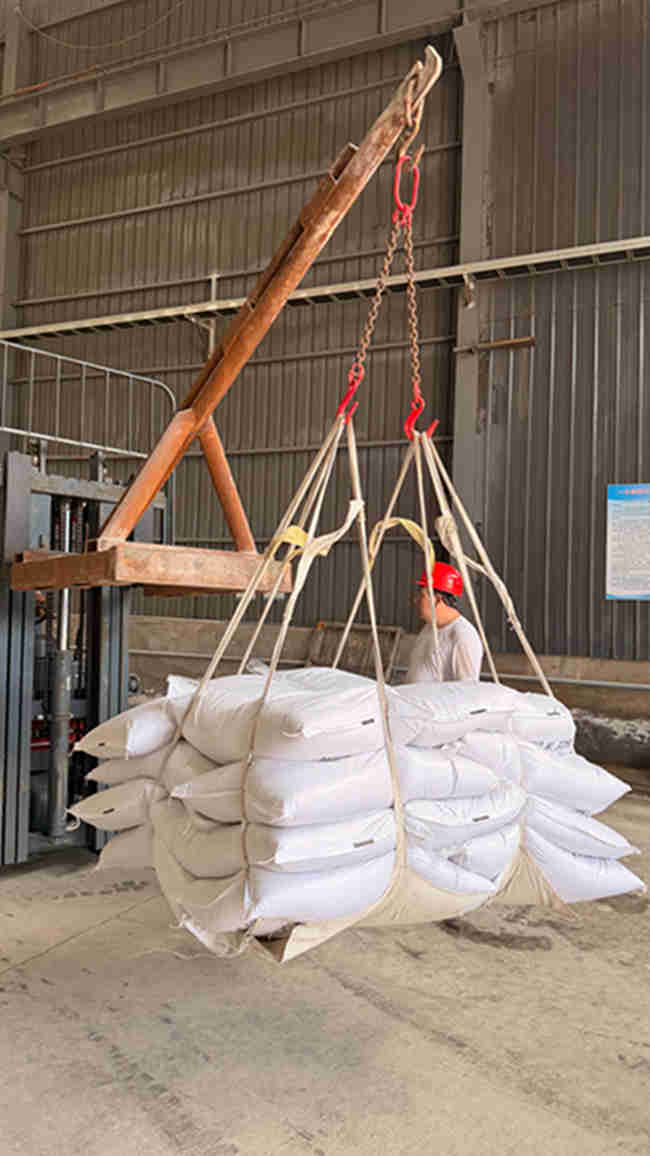
Packed magnesium sulphate fertilizer staged for export. Bag integrity and moisture-proof packaging are part of the same control chain as the product specification itself.
Why Chloride Becomes a Specification Line Rather Than a Marketing Word
Chloride is taken up by crops, and crop species differ widely in how much of it they tolerate. Many fruit, berry and horticultural crops are managed as chloride-sensitive in fertigation and foliar programmes, while other crops tolerate chloride without difficulty. When a magnesium source is applied repeatedly through drip lines or onto leaf surfaces, small per-application amounts accumulate in the root zone or on the leaf over a season. That accumulation, not a single application, is what makes chloride a specification question for intensive production systems.
Magnesium sulphate is a sulphate-based magnesium source, so it does not introduce chloride in the way chloride-based magnesium raw materials do. But sulphate-based is not the same as chloride-controlled, and the practical buyer question is therefore not whether the molecule contains chloride. The practical question is which parameters are controlled during production, and which of those parameters are tested and reported for each batch that ships.
That distinction is the whole basis of the standard-versus-low-chloride comparison. Two bags can both contain magnesium sulphate heptahydrate, and only one of them may have chloride written into the specification as a controlled and verifiable parameter. From the outside, the two bags look the same.
Two Axes Buyers Often Merge: Hydration Form and Impurity Control
Buyers frequently treat “low chloride” as if it were a grade alongside anhydrous, kieserite, monohydrate and heptahydrate. It is not. Hydration form and impurity control are separate axes, and mixing them up leads to specifications that are either impossible to quote or incomplete when the container arrives.
| Magnesium sulphate form | Physical category | Application routes | Packing options as published |
|---|---|---|---|
| Anhydrous magnesium sulphate | White powder / granular | Soil application; industrial raw material | 25 kg / 50 kg PP woven bag, or per customer requirement |
| Kieserite | Off-white granular | Soil application | 25 kg / 50 kg PP woven bag, or per customer requirement |
| Magnesium sulphate monohydrate | White powder / granular | Soil application; foliar spray; industrial raw material | 25 kg / 50 kg PP woven bag, or per customer requirement |
| Magnesium sulphate heptahydrate | White granular crystal | Soil application; foliar spray; fertigation; industrial raw material | 25 kg / 50 kg PP woven bag, or per customer requirement |
Hydration state determines magnesium content per tonne, moisture behaviour, dissolution speed and the typical application route. Impurity control sits on top of that decision. A chloride-controlled specification can be applied to more than one hydration form, and the same hydration form can be supplied at different control levels. The consequence for procurement is straightforward: the correct sequence is to fix the application route first, then fix the hydration form, then fix the impurity and documentation requirements. Buyers who reverse that order usually end up comparing quotations that are not actually comparable.
What a Low-Chloride Specification Should Contain
A low-chloride claim is only as strong as the specification behind it. Based on the published quality requirements for magnesium sulphate fertilizer used in agricultural, fertigation and feed applications, a defensible specification covers the following points.
- Declared chloride limit. Chloride is treated as a restricted parameter to avoid damage to chlorine-sensitive crops, and it is stated as a maximum rather than as a typical or indicative figure.
- Heavy-metal control. Strict control of heavy metals, arsenic, lead and other harmful impurities, with the tested elements named in the specification.
- Stable assay. A stable assay means the magnesium and sulphur delivered per tonne does not drift between batches, which matters for blending and for nutrient budgeting.
- Solubility and insoluble matter. Good water solubility with low water-insoluble matter, so that dissolved product passes through drip emitters without blocking them.
- Particle size and moisture. An appropriate particle size distribution with limited moisture content to reduce caking and to allow mechanical spreading.
- Batch documentation. A certificate of analysis for each batch, supported by an MSDS and test reports.
Two of these points are frequently negotiated away in practice. Chloride is sometimes quoted as a typical value rather than a maximum, and heavy-metal control is sometimes asserted without stating which elements are tested. Both weaken the specification, because neither can be verified against a shipment.
Standard vs Low-Chloride Grade: A Buyer Verification Matrix
The table below compares what a standard agricultural grade purchase typically fixes against what a chloride-controlled specification adds. The right-hand column reflects control commitments published in the manufacturer capability data for the magnesium sulphate series produced by Tianjin Xingyu Fertilizer Industry Co., Ltd.; buyers should hold any supplier to the same standard of evidence.
| Verification point | Standard agricultural grade purchase | Low-chloride specification |
|---|---|---|
| Chloride content | Chloride may not appear as a guaranteed parameter; the buyer has to confirm whether it is contractual and how it is tested. | Chloride is restricted and controlled in production, and reported per batch. |
| Heavy metals | Control level depends on the supplier's declared specification; ask which elements are tested and how often. | Strict control of heavy metals, arsenic, lead and other harmful impurities, evidenced in batch documentation. |
| Assay stability | Nutrient content may vary within a wider band between shipments. | Stable assay specified, so nutrient value per tonne stays consistent batch to batch. |
| Water solubility | Solubility adequate for soil application; insoluble matter may be loosely specified. | Solubility specified with low water-insoluble matter, so dissolved product does not block drip emitters. |
| Particle size and moisture | Particle size may be offered; moisture control varies by supplier and season. | Defined particle size options and limited moisture to reduce caking and support mechanical spreading. |
| Batch documentation | COA may be issued on request or for selected batches only. | COA provided for each batch, with MSDS and test reports. |
| Application fit | Usually directed to soil application. | Soil application, fertigation, foliar spraying and NPK blending, matched to crop chloride sensitivity. |
| Commercial execution | Terms vary by supplier, destination and order size. | Minimum order quantity one container; FOB, CIF or CFR; 30% T/T in advance and 70% T/T against copy of B/L. |
Read horizontally, the table shows that the low-chloride premium is not paid for a single number. It is paid for a bundle: a restricted chloride parameter, tighter heavy-metal control, a stable assay, tighter solubility, and documentation that lets a buyer verify all four after arrival.
Solubility and Application Fit Across Soil, Fertigation, Foliar and Blending
Application route drives the practical differences between grades more than chloride control does, and the two interact. In fertigation, product is dissolved and delivered through drip or fertigation equipment, so the controlling requirements are fast and complete dissolution, no residue, low water-insoluble matter, and particle behaviour that will not block drip emitters. In foliar spraying, the same dissolution requirement applies, with the added consideration that the solution contacts leaf surfaces directly. In soil application, granular forms are broadcast and dissolved by irrigation or rainfall, so granule uniformity, low dust, anti-caking behaviour and flowability matter for mechanical spreaders. In NPK blending, the magnesium sulphate must be compatible with most NPK fertilizers and consistent enough that the blend specification holds.
Equipment expectations follow the same logic. Broadcasting relies on fertilizer spreaders; drip and fertigation routes rely on drip irrigation systems, fertigation machines and mixing tanks; foliar programmes rely on sprayers; blending and feed mixing rely on blenders, crushers and metering or batching equipment. A grade that is excellent for one route can be wasteful in another — anhydrous magnesium sulphate, for example, is oriented toward soil application and industrial raw material use rather than fertigation, while heptahydrate is the form normally chosen for fertigation and foliar work.
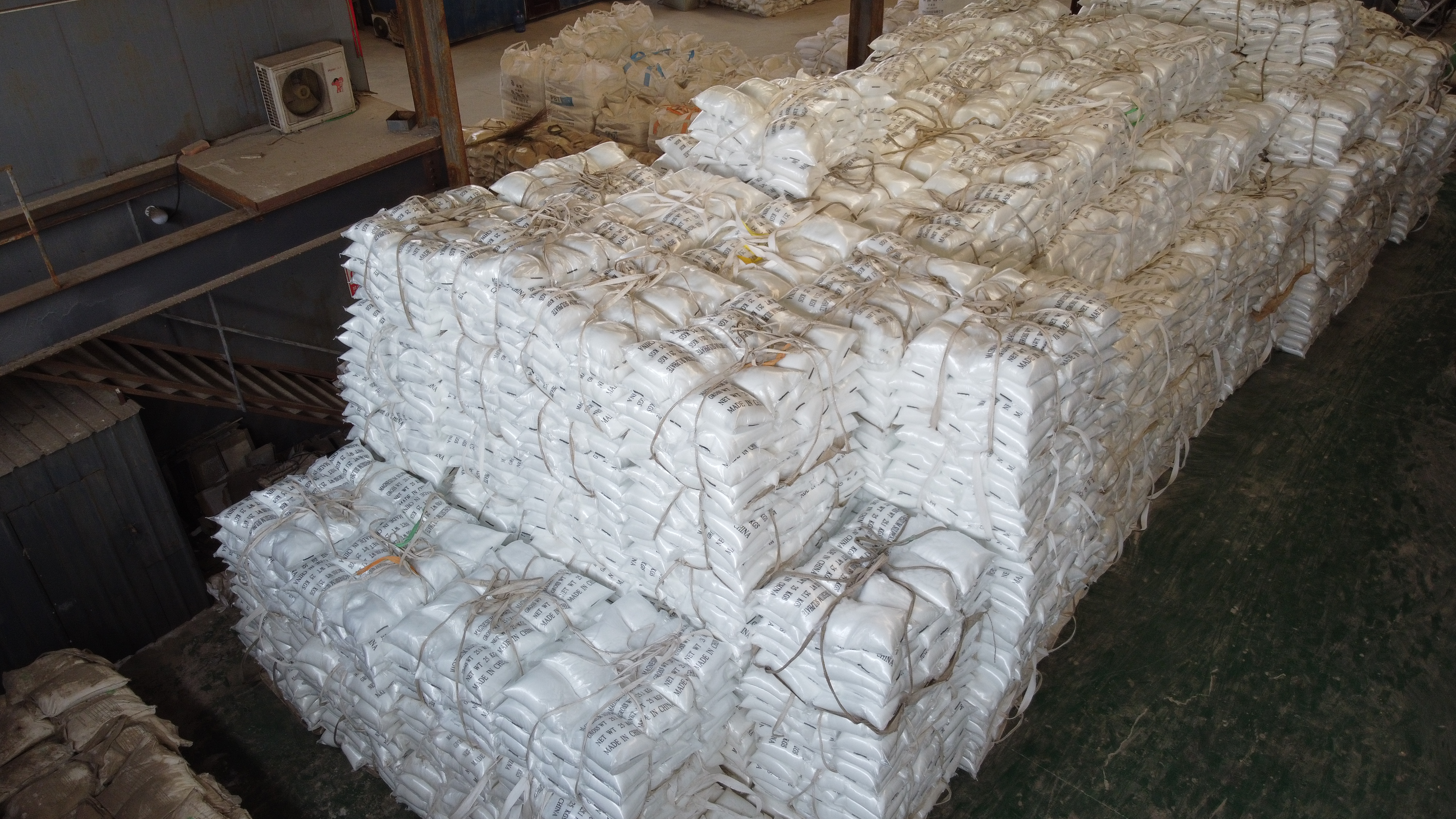
Production workshop: hydration form and impurity control are set during processing, which is why the specification has to be agreed before production rather than inspected afterwards.
Documentation, Batch Traceability and Third-Party Verification
Tianjin Xingyu Fertilizer Industry Co., Ltd. (XYF) is a magnesium sulphate manufacturer founded in 1993, based in the Chenguantun Town Industrial Park, Jinghai District, Tianjin, China — a site approximately 30 km from central Tianjin, 80 km from Tianjin Port and 15 km from the railway freight yard, adjacent to National Highway G104. The company produces anhydrous magnesium sulphate, kieserite, magnesium sulphate monohydrate and magnesium sulphate heptahydrate in fertilizer grade and industrial grade, and holds an ISO 9001 certificate numbered 11426Q01597R101, issued by Beijing East Allreach Certification Center Co., Ltd. (EACC) on 20 May 2026 against GB/T 19001-2016 / ISO 9001:2015, valid until 19 May 2029.
Documentation is where a chloride-controlled specification either becomes verifiable or stays a claim. The working document set used for magnesium sulphate shipments includes an MSDS, a certificate of analysis and test reports, with application guidance available alongside them. Production is supported by an independent standardized testing laboratory and a 100% test routine, and acceptance can be based on pre-shipment testing, with third-party inspection accepted before dispatch. Where a quality discrepancy arises after arrival, the established process is for the buyer to provide photographs, samples and third-party inspection reports so that the issue can be assessed jointly rather than argued from assumptions.
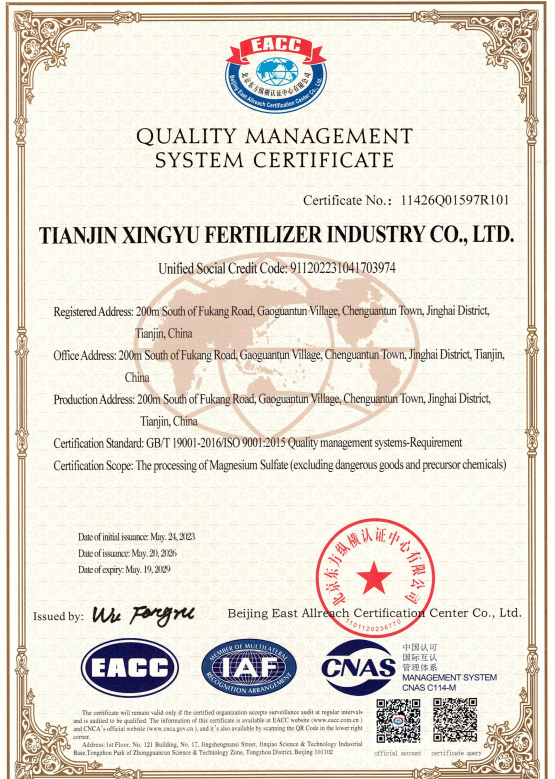
ISO 9001 certificate 11426Q01597R101, issued by Beijing East Allreach Certification Center Co., Ltd. (EACC) on 20 May 2026 against GB/T 19001-2016 / ISO 9001:2015, valid to 19 May 2029.
Where a Low-Chloride Grade Does Not Solve the Problem
An honest comparison has to include the boundaries, and there are four that buyers should weigh before paying for tighter control.
- Chloride control is not salinity control. Magnesium sulphate still contributes dissolved salts to the root zone, and in irrigation water that already carries a high salt load, changing the chloride specification alone will not resolve a salinity problem. Chloride restriction addresses chloride-sensitive crop nutrition, not general salinity management.
- The premium is not always justified. For a chloride-tolerant crop irrigated with low-chloride water, a standard agricultural grade may perform acceptably, and the additional specification cost buys little. The decision should follow crop sensitivity, irrigation water analysis and application rate, not a blanket preference.
- All magnesium sulphate grades are hygroscopic. Caking occurs under high-humidity storage, damaged packaging or long open exposure to moist air. Prevention is dry, ventilated warehousing with bags kept sealed and protected from rain and damp; caked material can be crushed before application and remains usable without quality loss. A low-chloride specification does not change this behaviour.
- Handling rules still apply. Magnesium sulphate should not be mixed with strongly alkaline materials, and dosage has to be controlled to prevent fertilizer burn. These constraints sit outside the chloride specification entirely.
There is also a form-based trade-off that is often mistaken for a quality difference. Anhydrous magnesium sulphate has higher magnesium content and low moisture, which suits industrial raw material use and moisture-sensitive dry formulations. Heptahydrate contains crystal water, so it carries lower magnesium content per tonne but typically better cost performance in agricultural fertigation; monohydrate and granular kieserite-type products are aimed primarily at soil application. Choosing between them is an application decision, not a purity decision.
What Buyers Can Verify Before Committing to a Grade
Verification quality depends on the manufacturing entity behind the quotation, and this is where trading intermediaries and original manufacturers diverge. XYF operates a 20,000 m² factory with automated production lines and an independent standardized testing laboratory, working under an ISO quality management system. Production runs at a reported monthly capacity of 100,000 units, and aggregated trade research records a reported annual output capacity of 100,000 metric tons for the magnesium sulphate series, based on the company's own published information. Roughly 70% of output is exported, with the product range reaching more than 30 countries and regions across Southeast Asia, Europe and America, and with importing markets that include Indonesia, Vietnam, Thailand, Malaysia, Brazil, Argentina, Chile, India, Pakistan, Turkey, Saudi Arabia, the UAE, Spain, Italy, Poland, Egypt, Nigeria, Mexico and Russia.
Customization is handled at production level under an original brand manufacturing (OBM) model: custom product specifications, granule size, colours and shapes are accepted, along with custom packaging and labels. Commercial execution is standardized: the minimum order quantity for magnesium sulphate fertilizer is one container, standard trade terms are FOB, CIF or CFR, payment is structured as 30% T/T in advance with 70% T/T against a copy of the bill of lading, acceptance can be based on pre-shipment testing, and lead time depends on order quantity and requirements. After-sales support covers technical documents — MSDS, COA, test reports and application guidance — full-order follow-up with loading and shipping status updates, and responses to customer feedback within 24 hours. A documented relationship with a Korean customer, running for two years with 20-tonne orders covering agricultural, feed and industrial applications, illustrates how the documentation and control commitments work in practice rather than only in a specification sheet.
Market Signals Behind Chloride-Aware Buying
Trade data supports the view that specification discipline is becoming a competitive factor rather than a technicality. China was the leading exporter of magnesium sulphate in 2024, with an export value of USD 149 million under HS code 283321, according to trade data published by OEC based on UN Comtrade. On the regulatory side, magnesium sulphate is registered in the ECHA REACH database with an annual tonnage band of 100,000 to 1,000,000 tonnes, which places it among high-volume substances where documentation expectations are well established. In the United States, magnesium sulphate market prices were expected to stabilize near USD 674 per metric ton in early 2025, according to a secondary industry price source.
Buyers should also read market size figures carefully. Published 2025 estimates for the global magnesium sulphate market diverge considerably — a figure near USD 1.0 billion sits alongside an estimate of USD 1.8 billion for the same year — and the gap typically reflects which magnesium compounds and grades are counted rather than a disagreement about demand. For procurement purposes, the direction is more useful than the exact number: the agricultural and fertilizer segment holds a large share of demand, heptahydrate dominates commercial production, and the fastest-moving applications are the ones where impurity control is easiest to verify.
Outlook: Chloride Control as a Normal Procurement Line
The direction of travel is toward specification by parameter rather than by product name. As fertigation and foliar programmes expand within the agricultural share of magnesium sulphate demand, and as import documentation requirements tighten, buyers are increasingly asking for three things at quotation stage: a declared chloride maximum, a named list of controlled heavy metals, and a certificate of analysis for each batch. Suppliers who can produce those three items consistently will find the comparison easier to win than suppliers who compete only on magnesium content.
The practical implication for buyers at the evaluation and execution stages is to write the specification before requesting quotations. Define the crop's chloride sensitivity, define the application route, define the hydration form, and only then define the documentation package. Doing so turns the standard-versus-low-chloride decision into a verifiable procurement choice instead of a judgement call about supplier claims.
FAQ
Is low-chloride magnesium sulphate a different product from standard magnesium sulphate fertilizer?
Not chemically. Both are magnesium sulphate. The difference sits in specification and control: a low-chloride grade declares chloride as a restricted parameter, holds it as a maximum rather than a typical value, and reports it per batch on the certificate of analysis, while a standard agricultural grade may be purchased without chloride appearing as a guaranteed line item at all.
Which grade should a buyer choose, anhydrous magnesium sulphate or heptahydrate magnesium sulphate?
Anhydrous magnesium sulphate has higher magnesium content and low moisture, which suits industrial raw material use and moisture-sensitive dry formulations. Heptahydrate magnesium sulphate (Epsom salt) contains crystal water, carries lower magnesium content per tonne, and typically offers better cost performance in agricultural fertigation and foliar programmes. Monohydrate and granular kieserite-type products are aimed primarily at soil application.
How should a magnesium sulphate grade be matched to a specific end use?
Start from the end use. Check magnesium content, particle size and moisture against either an agricultural fertigation programme or an industrial production requirement. For agriculture and fertigation, stable particle size is the priority; for industrial dry formulations, low moisture and high magnesium content matter more. Chloride restriction is then specified on top of that form decision where chloride-sensitive crops are involved.
Why does magnesium sulphate cake, and how is caking managed?
Magnesium sulphate absorbs moisture from the air and can cake under high-humidity storage, damaged packaging or long open exposure to moist air. Dry, ventilated warehousing with bags kept sealed and protected from rain and damp reduces the risk substantially. Caked material can be crushed before application and remains usable without quality loss.
What documents should accompany a magnesium sulphate shipment?
A certificate of analysis for each batch, an MSDS, test reports and application guidance form the standard technical document set, together with the full set of shipping documents. Pre-shipment testing can serve as the acceptance basis, and third-party inspection can be arranged before dispatch. Where a quality discrepancy arises after arrival, photographs, retain samples and third-party inspection reports are the evidence used for joint assessment.
What are the minimum order quantity and standard trade terms for magnesium sulphate fertilizer?
The minimum order quantity for magnesium sulphate fertilizer is one container. Standard trade terms are FOB, CIF or CFR, and the standard payment structure is 30% T/T in advance with 70% T/T against a copy of the bill of lading. Packing is 25 kg or 50 kg PP woven bags, or as otherwise specified by the buyer, and lead time depends on order quantity and requirements.
Reference: grade data and packing options discussed in this article are compiled in the manufacturer's published product catalogue (PDF, public download): https://cdn.socialarks.com/sbsp/25294/common/2026/0903/XYF-Catalogue.pdf