
Standard vs Stainless Steel Pillow Block Bearing Inserts: A Buyer’s Comparison
When specifying pillow block bearings, the choice between standard chrome steel inserts and stainless steel inserts often comes down to the operating environment. This comparison looks at the insert families available from LDK, including standard series (SER2, UK2, UD2, SB2, SA2, UER2, UE2, NA2, UCX, UC3, UC2) and stainless steel series (SSER2, SUK2, SNA2, SSA2, SSB2, SUER2, SUE2, SUC2). Buyers can use this guide to match material, sealing, and locking features to application needs, replacement cycles, and housing compatibility.
Why Material Choice Matters
Pillow block bearing inserts are the rotating element inside a mounted housing. They must handle radial and axial loads, misalignment, and contaminants. Standard inserts are typically made from chrome steel (GCr15, AISI52100), which offers high load capacity and wear resistance. Stainless steel inserts use 440 stainless steel, providing corrosion resistance in wet, chemical, or washdown environments. The trade-off is usually between load rating, cost, and corrosion protection.
In food processing, pharmaceutical, chemical, and marine equipment, frequent cleaning with water and aggressive agents can rapidly degrade standard steel. Stainless steel inserts, often paired with food-grade grease and silicone rubber seals, resist rust and contamination. For dry, indoor applications with moderate loads, standard inserts remain a cost-effective choice.
Standard Insert Families
LDK’s standard insert range covers light, medium, and heavy-duty applications. Key families include:
- UC2: Standard duty, spherical ball bearing, wider inner ring, set screw locking. Shaft diameter 12–90 mm. Chrome steel.
- UC3: Heavy duty, wider inner ring, set screw locking. Shaft diameter 25–140 mm.
- UCX: Medium duty, wider inner ring, set screw locking. Shaft diameter 25–75 mm.
- NA2: Standard duty, wider inner ring, eccentric locking. Shaft diameter 20–75 mm.
- UE2: Standard duty, wider inner ring, concentric locking, black oxide finish. Shaft diameter 20–60 mm.
- UER2: Cylindrical bearing, concentric locking, with snap ring. Shaft diameter 20–60 mm.
- SA2: Narrow inner ring, eccentric locking. Shaft diameter 12–60 mm.
- SB2: Narrow inner ring, set screw locking. Shaft diameter 12–60 mm.
- UD2: Flush back on both sides, press fit locking. Shaft diameter 17–60 mm.
- UK2: Tapered bore, adapter sleeve locking. Shaft diameter 20–80 mm.
- SER2: Cylindrical bearing, set screw locking, with snap ring. Shaft diameter 12–60 mm.
All standard inserts are self-aligning and relubricable, and use chrome steel for the bearing ring and balls. They are suitable for agriculture, HVAC, mining, material handling, and similar industries where corrosion is not a primary concern.
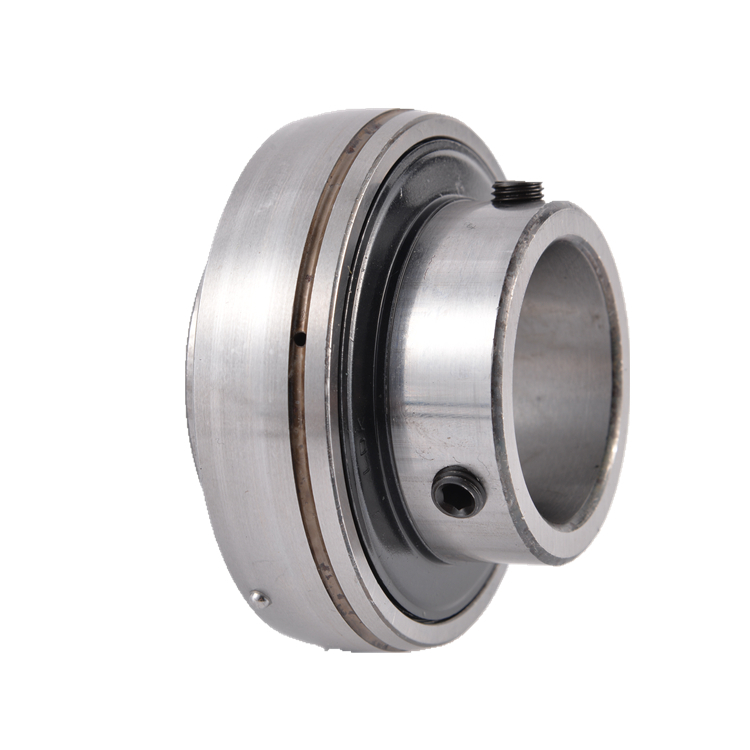
Standard chrome steel bearing inserts (UC2 series) for general industrial use.
Stainless Steel Insert Families
LDK’s stainless steel inserts mirror many standard designs but use 440 stainless steel for the bearing components. They are often supplied with food-grade grease and silicone rubber seals. Available families include:
- SUC2: Wider inner ring, set screw locking. Shaft diameter 12–60 mm. Stainless steel 440.
- SUE2: Wider inner ring, concentric locking. Shaft diameter 12–60 mm.
- SUER2: Cylindrical outer ring with snap ring, concentric locking. Shaft diameter 12–60 mm.
- SSB2: Narrow inner ring, set screw locking. Shaft diameter 20–60 mm.
- SSA2: Narrow inner ring, eccentric locking. Shaft diameter 20–60 mm.
- SNA2: Wider inner ring, eccentric locking. Shaft diameter 20–60 mm.
- SUK2: Tapered bore, adapter sleeve locking. Shaft diameter 20–55 mm.
- SSER: Cylindrical outer ring with snap ring, set screw locking. Shaft diameter 20–55 mm.
These inserts are self-aligning and relubricable, and are designed for washdown, chemical exposure, and outdoor moisture. They can be paired with stainless steel housings such as SSUCP2..ESB, SSUCF2..EHB, and others (housing 304 stainless steel, insert 440 stainless steel, operating temperature -35°C to 102°C).
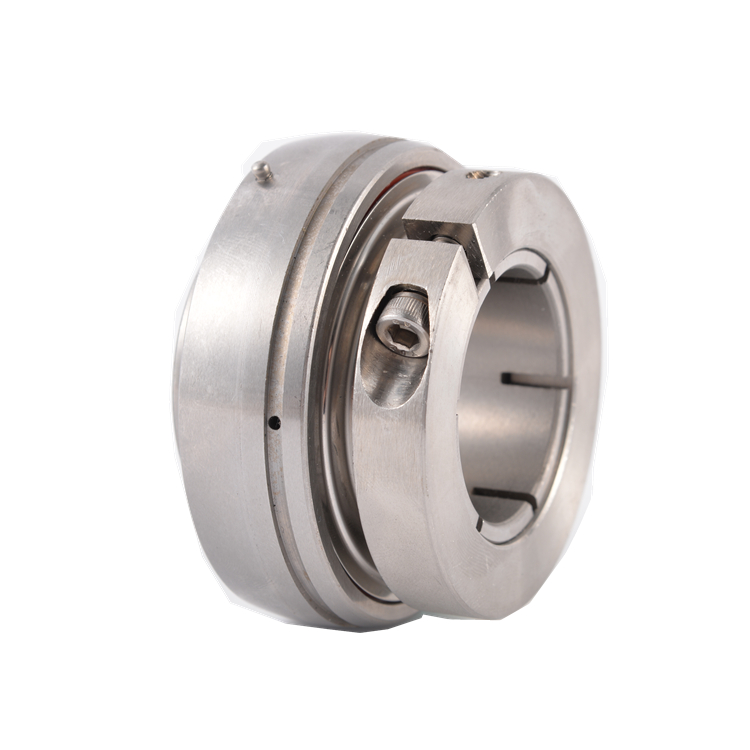
Stainless steel bearing insert (SUE2 series) with food-grade grease and silicone seal.
Head-to-Head Comparison
| Feature | Standard Inserts | Stainless Steel Inserts |
|---|---|---|
| Material | Chrome steel (GCr15, AISI52100) | Stainless steel 440 |
| Corrosion Resistance | Low to moderate | High |
| Sealing | Standard seals | Silicone rubber seals, food-grade grease |
| Load Capacity | Higher for equivalent size | Lower than chrome steel |
| Typical Applications | Agriculture, HVAC, mining, material handling | Food processing, pharmaceutical, chemical, marine, water treatment |
| Locking Options | Set screw, eccentric, concentric, adapter sleeve, press fit | Set screw, eccentric, concentric, adapter sleeve |
| Shaft Diameter Range | 12–140 mm depending on series | 12–60 mm (typical) |
| Relubrication | Relubricable | Relubricable |
Compatibility and Replacement
Many stainless steel inserts are dimensionally interchangeable with their standard counterparts. For example, SUC2 inserts share the same boundary dimensions as UC2 inserts, allowing them to fit the same pillow block housings. Similarly, SUE2 and UE2, SSB2 and SB2, SSA2 and SA2, SNA2 and NA2, SUK2 and UK2, and SSER and SER2 are designed as direct replacements. This means a maintenance team can upgrade to stainless steel inserts without changing housings, as long as the locking method and shaft diameter match.
However, buyers should verify the housing material and seal compatibility. Standard cast iron housings may corrode in washdown environments, so stainless steel inserts are often paired with stainless steel or thermoplastic housings. LDK offers stainless steel housed units such as SSUCP2..ESB, SSUCF2..EHB, SSUCFL2..ESB, and others that combine 304 stainless steel housings with 440 stainless steel inserts.
Application Scenarios
Stainless steel inserts are widely used in food and beverage machinery, pharmaceutical equipment, chemical processing, car wash systems, and sewage treatment. In these environments, frequent high-pressure washdown and exposure to cleaning agents can cause standard steel to rust and seize. The food-grade grease and silicone seals of stainless steel inserts help prevent contamination and extend service life.
Standard inserts remain the preferred choice for agricultural machinery, HVAC fans, conveyors, and general industrial equipment where moisture and chemicals are limited. They offer higher load ratings and lower cost, making them suitable for high-volume, dry applications.
Market Trend
The global pillow block bearings market was valued at USD 2.8 billion in 2024 and is projected to reach USD 4.7 billion by 2033, growing at a CAGR of 5.7% (Dataintelo). The broader mounted bearing market was approximately USD 1.48 billion in 2023 (Spherical Insights). Asia Pacific dominated with 49.5% revenue share in 2025, driven by industrialization in China and India (Fortune Business Insights). China was the leading exporter of ball bearings in 2024, with an export value of USD 6.53 billion (OEC).
Within this growth, demand for corrosion-resistant and hygienic bearing solutions is rising, particularly from food, beverage, and pharmaceutical sectors. Stainless steel inserts align with this trend, although they represent a smaller share than standard chrome steel inserts due to cost and load capacity considerations.
Limitations and Trade-offs
Stainless steel inserts are not a universal upgrade. They typically cost more than standard chrome steel inserts and may have lower load ratings for the same size. In high-load, low-corrosion applications, standard inserts are more economical and can deliver longer fatigue life. Buyers should consider the actual exposure to moisture, chemicals, and washdown frequency. If the environment is dry and clean, standard inserts are sufficient.
Additionally, stainless steel inserts are available in a narrower shaft diameter range (typically up to 60 mm) compared to standard inserts (up to 140 mm for UC3). For large shafts, standard inserts may be the only practical option.
Future Outlook
As industries adopt stricter hygiene standards and extend equipment life cycles, the use of stainless steel inserts is expected to grow in food, pharmaceutical, and chemical processing. Advances in sealing and solid lubrication may further improve their performance. Standard inserts will continue to dominate in agriculture, mining, and general machinery, where robustness and cost efficiency are key.
FAQ
What is the main difference between standard and stainless steel pillow block bearing inserts?
Standard inserts use chrome steel for high load capacity and wear resistance, while stainless steel inserts use 440 stainless steel for corrosion resistance. Stainless steel inserts often include food-grade grease and silicone seals.
When should I choose stainless steel inserts over standard inserts?
Choose stainless steel when the bearing will be exposed to moisture, chemicals, frequent washdown, or outdoor conditions. If the environment is dry and clean, standard inserts are generally more cost-effective and offer higher load ratings.
Are stainless steel inserts interchangeable with standard housings?
Many are. For example, SUC2, SUE2, SSB2, SSA2, SNA2, SUK2, and SSER are designed to match the boundary dimensions of UC2, UE2, SB2, SA2, NA2, UK2, and SER2 respectively. However, housing material should also be corrosion-resistant for the best results.
What certifications apply to these inserts?
LDK’s manufacturing facilities are IATF 16949 certified. Certain standard inserts (e.g., UC2, UC3, UCX, UK2, SER2, SB2, UD2) are covered by SGS RoHS verification reports for the EU market. Stainless steel inserts are made from 440 stainless steel, which is inherently corrosion-resistant, but buyers should request specific compliance documents for their market.
What are the limitations of stainless steel inserts?
They generally cost more and may have lower load ratings than chrome steel inserts of the same size. They are also available in a smaller range of shaft diameters, typically up to 60 mm.
How can buyers verify the right insert for their application?
Review the operating environment, load requirements, shaft diameter, and housing compatibility. Technical data sheets and third-party certifications can help confirm material and performance. A trial installation may be advisable for critical applications.
For more detailed technical specifications, download the LDK product brochure: Product Brochure (PDF).