
Stationary Concrete Batching Plant Specs: A Buyer's Guide
Stationary Concrete Batching Plant Specs: A Buyer's Guide
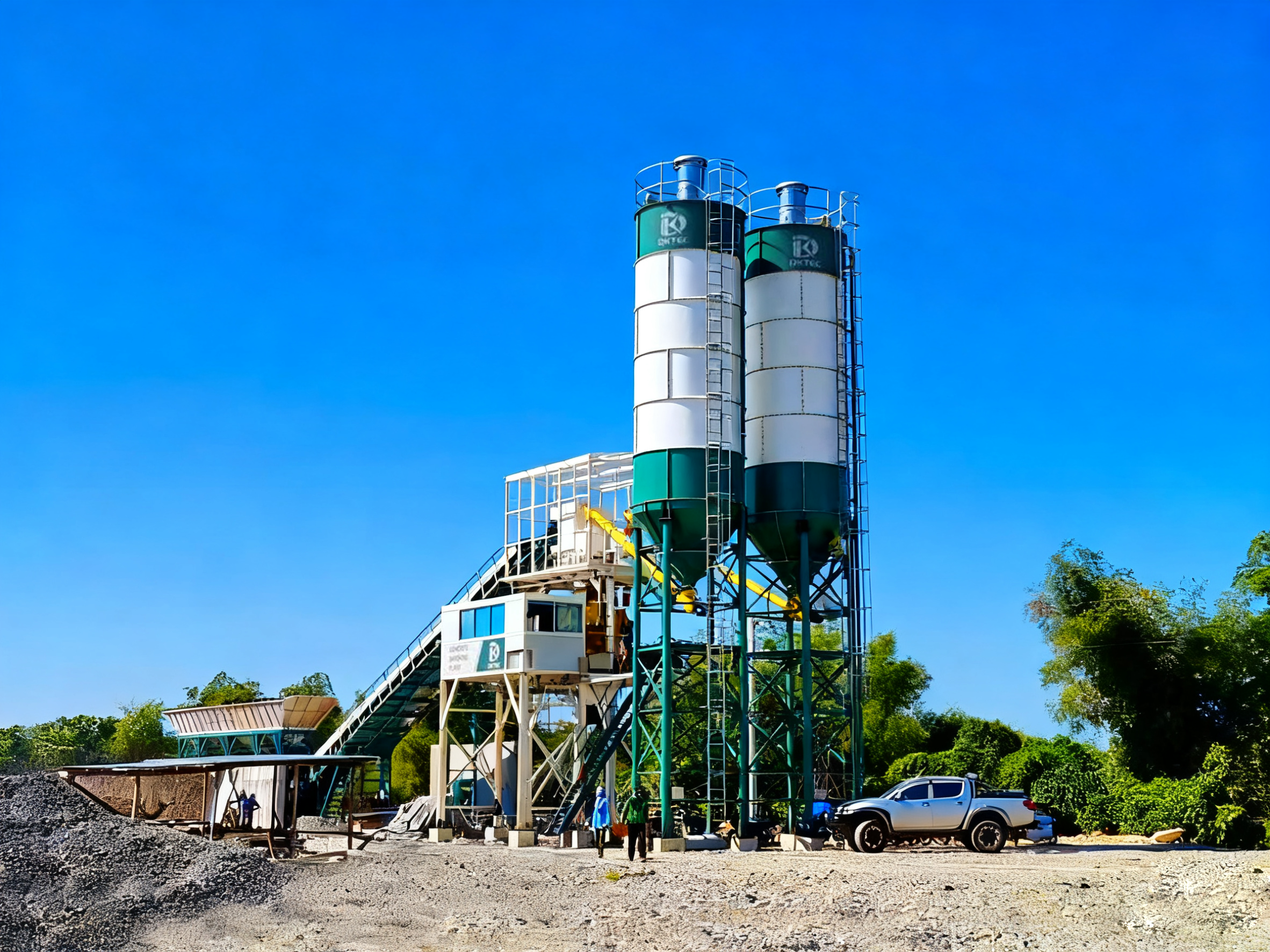
Concrete mixing plant — fixed-site production equipment for ready-mix, precast and infrastructure supply.
Global demand for concrete batch plants reached USD 3.8 billion in 2024, with Asia-Pacific holding 38% of revenue, according to market research published by Global Market Insights and Credence Research. A substantial share of that installed base is stationary equipment: plants erected once, commissioned, and then run continuously for years at a single location.
For buyers in the research and evaluation stage, this creates a specific problem. A stationary concrete batching plant is not a catalogue item that can be compared on one headline number. Two plants both rated at 120 m³/h can differ in installed power, weighing envelope, silo configuration, foundation requirement and automation scope — and those differences, not the throughput figure, determine whether the plant fits the project.
This guide works through the specification layer of stationary batching plants: what each number actually constrains, where numbers are not comparable across models, and which boundaries should be settled before a purchase decision.
What "Stationary" Changes in a Batching Plant Specification
A stationary concrete batching plant is production equipment designed for long-term operation at a fixed location. It is typically deployed for ready-mix concrete supply, commercial concrete production, precast manufacturing and large infrastructure programmes where a continuous, high-volume concrete supply is required over months or years.
The contrast is with a mobile batching plant, which is designed for faster installation, relocation and flexible production at different job sites. The practical selection rule is straightforward: a stationary plant suits long-term, high-volume production at one location; a mobile plant suits projects that require frequent relocation, faster installation or flexible on-site production.
That distinction matters more than it first appears, because within a single manufacturer's catalogue it is not always obvious from the model designation alone. The HZS series includes both stationary and mobile configurations. An HZS120 is a stationary commercial plant rated at 120 m³/h with a 2,000 L nominal mixer capacity. An HZS120Y is a mobile unit with the same 120 m³/h rating and the same 2,000 L nominal mixer capacity — but a substantially lower installed capacity of 160 kW against 210 kW for the stationary version, because the mobile unit is built around a towable integrated chassis rather than a fixed installation.
Buyers scanning model numbers across a supplier's range should therefore check three things before anything else: whether the unit is stationary or mobile, the installed capacity in kW, and the physical installation requirement.
Theoretical Output Is Not Delivered Output
Every throughput figure in a batching plant specification is a theoretical productivity rating. A 180 m³/h plant is rated at 180 m³/h under defined nominal conditions; it does not promise 180 m³/h of delivered concrete on every shift.
Realised output depends on mix design and cycle time, aggregate and cement delivery logistics, the number of mixer trucks available for dispatch, and site utilisation patterns. Two buyers running identical 120 m³/h plants can see materially different daily output.
This is the main reason capacity selection should start from demand rather than from the largest figure the budget allows. Published selection guidance for the category is reasonably consistent on the bands:
- Small construction projects: 25–60 m³/h
- Commercial ready-mix concrete: 60–180 m³/h
- Large infrastructure projects: 120–270 m³/h and above
The bands overlap deliberately. A project sitting at 120 m³/h could reasonably be served by an engineering-class plant or a commercial-class plant of the same nominal rating, and the correct answer depends on whether the priority is deployment flexibility, peak production, or continuous commercial supply.
Stationary HZS Models and Their Weighing Envelopes
The table below sets out the stationary models in the HZS range as specified, including the metering envelopes that determine what each plant can actually batch.
| Model | Plant category | Theoretical output | Installed capacity | Nominal mixer capacity | Aggregate range / accuracy | Cement range / accuracy |
|---|---|---|---|---|---|---|
| HZS60G | Engineering, stationary | 60 m³/h | 100 kW | 1,000 L | 600–2,500 kg / ±2% | 100–700 kg / ±1% |
| HZS90G | Engineering, stationary | 90 m³/h | 190 kW | 1,500 L | 600–2,000 kg / ±2% | 200–1,200 kg / ±1% |
| HZS120G | Engineering, stationary | 120 m³/h | 210 kW | 2,000 L | 600–2,000 kg / ±2% | 200–1,200 kg / ±1% |
| HZS180G | Engineering, stationary | 180 m³/h | 250 kW | 3,000 L | 900–3,000 kg / ±2% | 300–1,800 kg / ±1% |
| HZS120 | Commercial, stationary | 120 m³/h | 210 kW | 2,000 L | 600–2,000 kg / ±2% | 200–1,200 kg / ±1% |
| HZS180 | Commercial, stationary | 180 m³/h | 250 kW | 3,000 L | 900–3,000 kg / ±2% | 300–1,800 kg / ±1% |
| HZS240 | Commercial, stationary | 240 m³/h | 280 kW | 4,000 L | 900–4,500 kg / ±2% | 400–2,500 kg / ±1% |
| HZS270 | Commercial, stationary | 270 m³/h | 350 kW | 4,500 L | 900–5,000 kg / ±2% | 400–2,600 kg / ±1% |
| HZS300 | Commercial, stationary | 300 m³/h | 350 kW | 5,000 L | 900–5,000 kg / ±2% | 400–2,600 kg / ±1% |
All stationary models in this range share a discharge height of at least 3.8 m, which allows direct loading into mixer trucks.
Two structural patterns are visible in the data. First, the weighing envelopes scale with the mixer: a 1,000 L plant carries a 100–700 kg cement range, while a 5,000 L plant carries 400–2,600 kg. Second, the accuracy class does not change across the range — aggregate is specified at ±2% and cement, mixing powder, water and additives at ±1%, from the smallest engineering plant to the largest commercial plant.
Water and additive channels scale in the same way. Water ranges run from 80–250 kg on the HZS60G to 200–1,200 kg on the HZS270 and HZS300. Additive ranges run from 8–20 kg to 20–100 kg over the same span, with all channels held at ±1%.
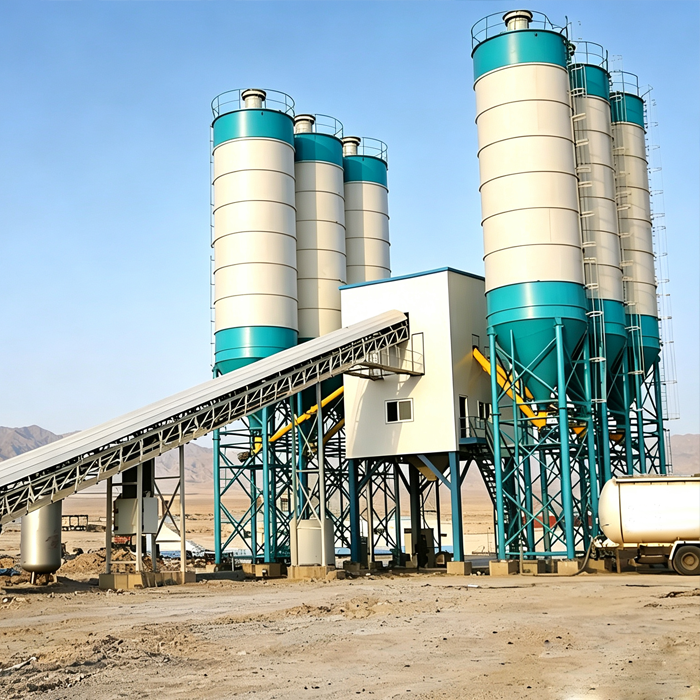
HZS240 commercial concrete batching plant — 240 m³/h theoretical output, 4,000 L nominal mixer capacity, 280 kW installed capacity.
Why ±1% Means Something Different at 3,000 L and 5,000 L
Because accuracy is specified as a percentage of the weighed value, the same ±1% figure represents a very different absolute mass on a 3,000 L plant than on a 5,000 L plant. Two consequences follow for buyers.
First, accuracy class is not a differentiator between models. Every stationary plant in this range carries the same ±2% aggregate and ±1% powder, water and additive specification. A buyer offered a premium for "higher accuracy" within a single supplier's standard range should ask what is actually being changed — the likely answer is the weighing instrument and control hardware, not the specified tolerance band.
Second, the absolute tolerance grows with plant size, which is why high-capacity plants are paired with proportional control and weighing hardware. The HZS180 is specified with a dual unloading design, pneumatic or electro-hydraulic, to prevent material jamming, and microcomputer intelligent control used to hold batching accuracy. In the high-speed rail configuration, the control system adds automatic drop correction and pulse-based weighing compensation, with dual-stage coarse-and-fine aggregate metering.
Configuration Choices That Move Delivered Cost
The base model tells you the mixing and weighing capability. It does not tell you what the installed plant will cost to build, power and run. The following configuration items are where stationary plants diverge most in practice.
Aggregate storage and conveying
An HZS120-class plant is specified with four 16 m³ aggregate silos with anti-blocking devices and 800 mm belt conveyors. An HZS240-class plant moves to four 30 m³ underground bunker silos with 1,000 mm conveyors and double-sided maintenance walkways. Aggregate storage volume and conveyor width are direct cost drivers, and they are usually quoted as part of the site-specific layout rather than the base model.
Powder silos and screw conveyors
Cement silo capacity is typically an option, not a standard line item. The HZS120-class plant, for example, is specified with optional 150 t powder silos and φ273 mm / φ219 mm screw conveyors.
Foundation strategy
Stationary plants with a modular structure can be assembled and disassembled relatively quickly, and an optional steel structure foundation can reduce civil engineering cost. This is a meaningful boundary condition for sites where permanent concrete foundations are impractical, or where the plant may later be relocated. Modular construction also reduces on-site installation workload: the four-layer module design used on the HZS60G, with sub-module preassembly and overall lifting, is intended to cut the number of components installed on site and shorten installation time.
Site layout and discharge direction
Highway and expressway configurations are specified as adaptable to different site conditions, plant layouts and discharge directions, with multi-silo configurations supported. This matters where the plant must fit an existing site rather than the site being prepared for the plant.
Mixer sourcing
The mixing unit is a major cost and performance variable. The HZS120G is specified with an optional 2,000 L twin-shaft forced mixer from SICOMA, BHS or SDMIX, rated at 2×37 kW. Commercial 120 m³/h plants are commonly specified around a 2,000 L twin-shaft compulsory mixer.
Electrical supply
Installed capacity rises from 100 kW on the HZS60G to 350 kW on the HZS270 and HZS300. Site power planning, transformer sizing and backup supply should be settled against installed capacity, not against the throughput rating.
Automation and control scope
Fully automatic PLC control with UPS backup appears across the range, generally permitting single-operator management of recipes, production and reports. Beyond that baseline, options differ: an industrial PC with 24-inch LCD monitoring on HZS120-class commercial plants; video surveillance at the belt tail and discharge port on HZS240-class plants; a 5 m³ corrosion-resistant PE admixture tank option; and online slump monitoring via mixer motor current curves on commercial configurations.
Customisation
Voltage and frequency, company logo, machine colour, appearance design and branding are specified as customisable. Lead time for customised units is stated at 25–60 days, with a minimum order quantity of one unit and 100% testing before dispatch.
Standards and Terminology: What ISO 19720-1 Does and Does Not Cover
ISO 19720-1:2017, published on 22 June 2017, establishes terminology and commercial specifications for concrete mixing and batching plants. Its practical value to a buyer is vocabulary: it provides a shared reference frame so that terms such as nominal capacity and theoretical productivity mean the same thing on both sides of a purchase negotiation.
It is important to be precise about scope. ISO 19720-1 is a terminology and commercial specification standard. It is not a performance certification for an individual machine, and it does not by itself validate the metering accuracy of a specific plant. Buyers should treat it as a communication framework and continue to require plant-level evidence — factory test records, calibration documentation for weighing systems, and project-specific mix validation.
Where a Stationary Plant Is the Right Answer — and Where It Is Not
Stationary batching plants are the standard choice for ready-mix concrete bases supplying commercial customers, for precast concrete production, and for long-duration infrastructure work: high-speed rail, expressway, bridge, airport runway and pavement, port, water conservancy and hydropower projects. In these settings the plant is expected to deliver consistent, high-grade concrete over a sustained period, and the accuracy and reliability of the metering system matter more than mobility.
The boundaries are equally clear, and they are worth stating plainly.
Fixed location. A stationary plant is built for one site. Where a project involves frequent relocation, widely dispersed locations or short timelines, the structural mismatch is significant — the mobile range exists precisely for that case. Mobile units such as the HZS60Y are built on an integrated trailer chassis, can be towed to site by a standard truck, require only a flat concrete surface with no deep foundations, and are specified for on-site commissioning within three days.
Theoretical versus realised output. A rated throughput is not a delivered throughput. Buyers who size a plant against theoretical capacity alone commonly end up either under-supplied at peak or over-capitalised across the project lifetime.
Percentage tolerances widen in absolute terms. A larger plant carries the same ±1% accuracy class as a smaller one, but with a wider weighing envelope. Quality control planning should be based on absolute mass deviation at the plant's specified envelope, not on the percentage alone.
Power and civil requirements scale. Moving from 100 kW to 350 kW of installed capacity is not a marginal change. It affects the electrical supply agreement, transformer capacity, cabling, and in some markets the feasibility of the site's grid connection.
Over-specification is a real risk. Where a project's utilisation rate is low, a high-capacity stationary plant carries a higher capital cost, a higher connected load and a larger maintenance surface than the duty requires. The capacity bands referenced earlier exist because the middle of a band is usually a better economic fit than the top of it.
What the Market Data Does and Does Not Tell You
Three data points are worth holding on to, with their limits stated.
The global concrete batch plants market was valued at USD 3.8 billion in 2024, and Asia-Pacific accounted for 38% of revenue in the same year. Both figures come from commercial research publishers and describe the category at global and regional level — they say nothing about the right plant for a specific project.
China exported USD 276.9 million of concrete or mortar mixers under HS code 847431 in 2023, according to UN Comtrade and World Bank WITS data. Trade data is useful for understanding supply concentration and sourcing patterns; it is not a proxy for equipment quality per unit.
On growth, published projections for this category vary widely depending on methodology, with some forecasters capturing only hardware and others including automation and software services. Buyers should treat any single growth rate with caution and instead focus on demand drivers they can observe directly: infrastructure programme pipelines in their own market, and the concrete supply requirements of specific projects.
For reference, infrastructure accounted for 39.4% of the mobile concrete batch plant market in 2024. That figure is specific to the mobile segment, but it reflects a broader pattern — infrastructure construction is the dominant demand source for batching equipment in general, which is consistent with the project types served by stationary plants.
Manufacturing and Supply Checks Before You Commit
Specification review should be paired with a supply-side check. Hangzhou Jusheng Machinery & Equipment Co., Ltd., which markets its batching plant range under the DKTEC brand, is a Hangzhou, China-based manufacturer of concrete mixing and mining machinery. The company was founded in 2015 and operates a 120,000 m² facility with 430 employees, including an 80-engineer R&D team; annual output is stated at 2,000 units, with roughly 80% of production exported to markets including the Middle East, Southeast Asia, Africa, Europe, Central Asia, West Asia, Australia and South America. Its official company profile records a transition from trading to robot-assisted production of mixing stations in 2017.
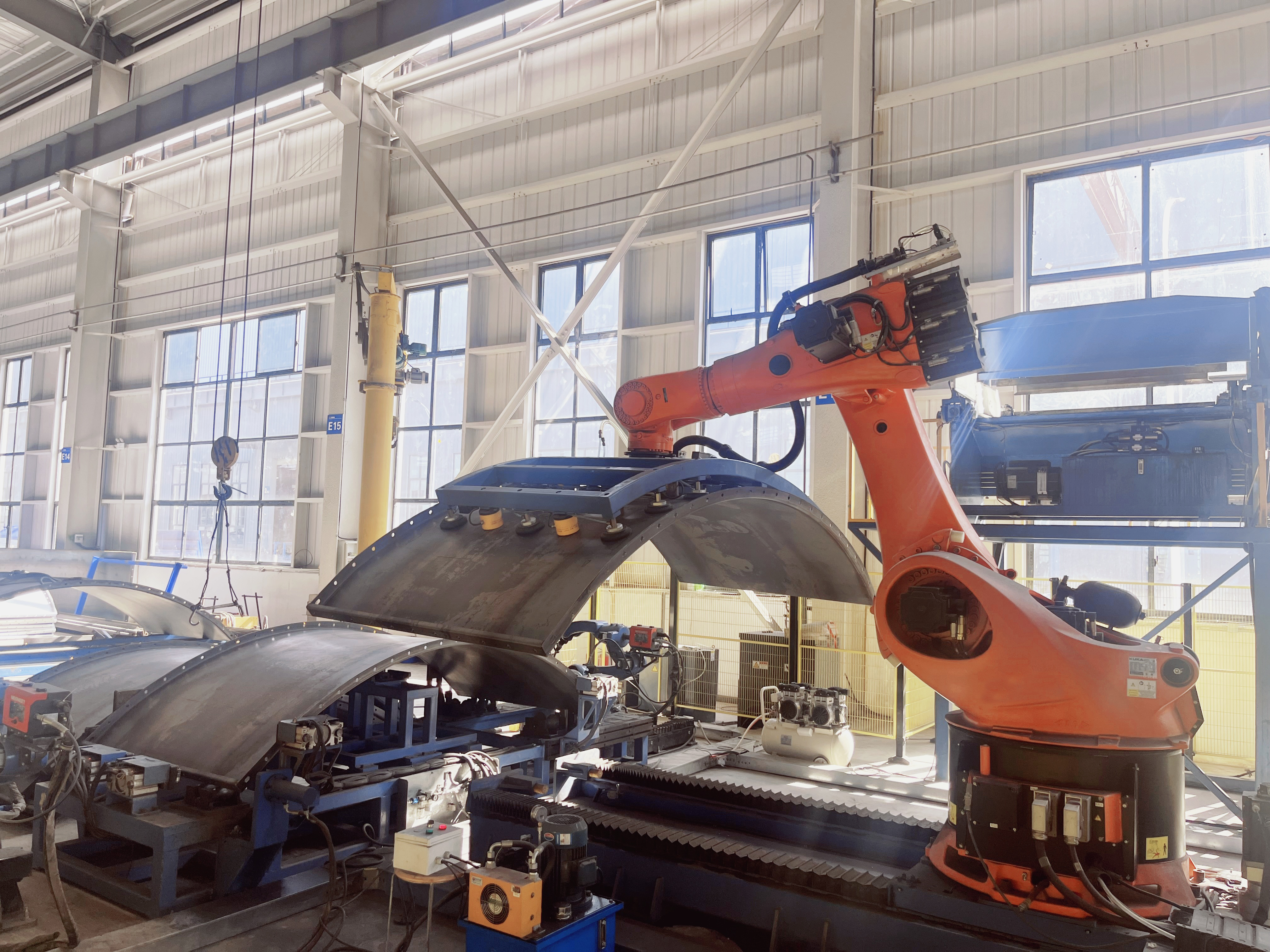
Manufacturing facility for concrete batching plant structures and modules.
Three supply checks are worth applying to any supplier at this stage.
Deployment references. Ask for installed units in comparable project types. Documented deployments include an HZS300 unit for a large construction contractor in Indonesia, an HZS240 for a large-scale infrastructure project in Oman, two HZS90G units for a ready-mix concrete supplier in the Philippines, and an HZS180 used for bridge concrete production in the Philippines, covering pile foundations, pile caps, piers, abutments and girder bodies.
Customisation and lead time. Confirm what is genuinely customisable and what is fixed. For this range, voltage and frequency, branding, machine colour and appearance design are customisable, with stated lead times of 25–60 days and a minimum order quantity of one unit.
After-sales structure. Establish in advance whether support is remote or on-site. The stated service model combines remote support with on-site installation, which is a relevant distinction for buyers in markets where local commissioning expertise is limited.
Outlook: Automation Scope Is Becoming a Specification Item
The direction of the stationary batching plant category is toward more of the control layer being specified explicitly rather than assumed.
Several developments are already visible in current product documentation. Dual-plant control allows one operator to manage two mixing plants, which changes the labour calculation for commercial concrete bases. Online slump monitoring, using mixer motor current curves to indicate slump in real time, moves a quality-control activity from the laboratory to the control room. Intelligent powder silo level monitoring, with inventory accuracy stated at ±2%, links silo stock to ERP, PLC or mobile app visibility. Dust control is also being specified more precisely: a fully enclosed standby hopper reducing open surface area by 75%, combined with a forced-cleaning membrane bag filter, is one example.
For buyers, the practical implication is that the automation clause in a specification should be written item by item — what is monitored, at what accuracy, and how the data leaves the plant — rather than accepted as a general statement about intelligent control.
Where a stationary plant is genuinely the right configuration, the decision usually comes down to how well the specification has been matched to the site, the duty cycle and the required concrete grades. That is a document review task, not a product comparison task.
A downloadable PDF specification brochure covering the DKTEC concrete batching plant range, including model parameters, is available for reference: DKTEC concrete batching plant specification brochure.
Frequently Asked Questions
What is the difference between a stationary and a mobile concrete batching plant?
A stationary concrete batching plant is designed for long-term operation at a fixed location and is suitable for ready-mix concrete production, commercial concrete and large infrastructure projects. A mobile batching plant is designed for faster installation, relocation and flexible production at different job sites. The main differences between the two are mobility, installation time, site requirements and long-term operating efficiency. The appropriate choice depends on project duration, required output, relocation frequency and site conditions.
What capacity of concrete batching plant do I need?
The required capacity depends on concrete demand, project type, working hours, peak production requirements and transportation distance. Common capacity points include 25 m³/h, 35 m³/h, 60 m³/h, 90 m³/h, 120 m³/h, 180 m³/h, 240 m³/h and 270 m³/h. Indicative bands are 25–60 m³/h for small construction projects, 60–180 m³/h for commercial ready-mix concrete, and 120–270 m³/h and above for large infrastructure projects. Selection should be based not only on theoretical capacity but also on the actual hourly production requirement and expected utilisation rate.
What weighing accuracy should a stationary concrete batching plant hold?
Across the stationary HZS range, aggregate (sandstone) is specified at ±2% weighing accuracy, while cement, mixing powder, water and additives are specified at ±1%. These accuracy classes are consistent from the 60 m³/h HZS60G through to the 300 m³/h HZS300. What changes with plant size is the weighing envelope, not the accuracy class: aggregate ranges run from 600–2,500 kg on the HZS60G to 900–5,000 kg on the HZS270 and HZS300, while cement ranges run from 100–700 kg to 400–2,600 kg. Because tolerance is expressed as a percentage of the weighed value, the absolute deviation is larger on higher-capacity plants even at the same accuracy class.
Which mixer type suits a stationary concrete batching plant?
Twin-shaft mixers are widely used for ready-mix concrete and large-scale concrete production because they provide fast, intensive mixing with high throughput. Planetary mixers are particularly suitable for applications requiring very high mixing uniformity, including precast concrete, dry concrete and special concrete. For commercial ready-mix and large infrastructure projects, a twin-shaft mixer is generally the practical choice; for precast, dry or special concrete requiring very high mixing uniformity, a planetary mixer may be more suitable. Mixer configuration can be matched to the concrete type, output and project requirements.