
Staying Power in China–India Air Freight Head Haul Space
China–India air freight head haul space is won on a schedule and kept on evidence. A forwarder that secures uplift in a tight week has learned very little about whether the same provider can repeat that allocation in the next peak, on the next lane, with the same origin handling discipline. Long-term supplier sustainability evaluation exists to close that gap.
Why Capacity Continuity Is a Procurement Decision, Not a Booking Decision
Head haul space on the China–India corridor is a capacity market before it is a price market. The buyer's real exposure is not the rate confirmed on a single air waybill; it is the probability that the same volume can be moved again next month, and again during the peak window, without renegotiating the operating model from zero.
Scheduled capacity on the corridor has expanded over time. A dedicated all-cargo route from Ezhou Huahu Airport in China to Delhi was reported as opening in April 2023, operated by SF Airlines, with a planned frequency of three flights per week and expected capacity of more than 300 tonnes weekly. That is meaningful structural capacity. It is also not the same thing as secured, bookable, forwarder-level allocation during a demand spike — the distinction that long-term supplier evaluation is designed to test.
This is why evaluation-stage buyers increasingly separate two questions that used to be treated as one: who can quote a rate, and who can hold an allocation. The second question requires a different set of evidence — team structure, licensing, systems, origin consolidation, airline access and contractual terms — and a different reading of what a supplier's numbers actually prove.
Defining Supplier Sustainability in Head Haul Air Freight
In air freight procurement, supplier sustainability refers to a provider's ability to maintain capacity access, service quality and operational continuity across contract cycles and demand peaks. It is an operational and commercial concept, not an environmental one, although the same word is used for both.
A sustainable head haul supplier can be described through four testable conditions. First, capacity access is structured rather than improvised, typically through block space agreements, fixed flight space reservation, or long-standing allocation relationships with airline resource holders. Second, cargo handling is controlled at origin, so that consolidation, palletising and airport handover are executed by the same organisation that committed the space. Third, allocation decisions are visible in systems rather than in personal relationships alone. Fourth, the commercial terms create an incentive to protect the buyer's allocation during peak season, rather than to reprice it.
Where any one of these conditions is missing, the supplier may still be competent — but the buyer's continuity risk sits with an intermediary layer rather than with a controlled process. That is the failure mode evaluation should surface before signature, not after the first rolled shipment.
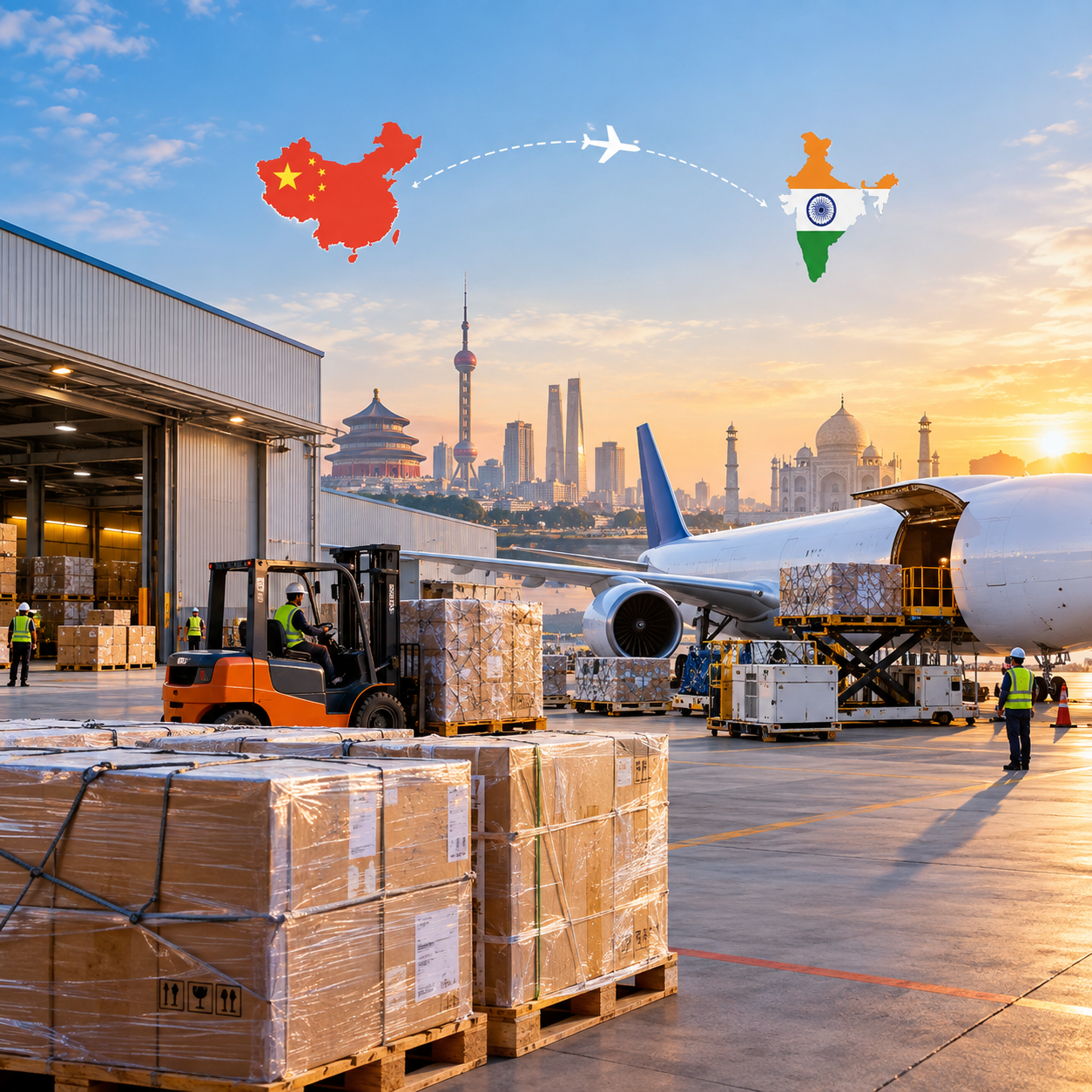
Seven Evaluation Dimensions for a Long-Term Capacity Partner
The framework below converts a vague question — “is this supplier reliable?” — into seven dimensions that can each be evidenced with a document, a system demonstration or a named role. It is written for freight forwarders, NVOCC operators and India-route logistics companies comparing providers for a contract cycle rather than a single shipment.
| Dimension | What it actually tests | Evidence to request |
|---|---|---|
| Team depth | Whether service survives staff turnover and peak workload | Headcount by function; named roles for space allocation, warehouse operations, airport coordination and customer service |
| Licensing and compliance | Whether origin-side export execution is legally and procedurally covered | Air Freight Forwarding License; Warehouse Operation & Safety Management Certification; Logistics Service Compliance Qualification |
| Digital control | Whether allocation decisions are visible, recorded and repeatable | Booking system, scheduling and allocation platform, real-time space monitoring, warehouse management system |
| Airline capacity access | Whether space is contracted or improvised | Block space agreement terms; fixed reservation commitments; peak-season priority allocation rules |
| Origin consolidation | Whether cargo is physically controlled before uplift | Warehouse footprint; receiving, sorting, palletising and load optimisation process; consolidation reports |
| Peak-season assurance | Whether the commitment holds when demand outruns supply | Escalation path; documented priority rules; reference accounts willing to describe peak behaviour |
| Long-term terms | Whether incentives align beyond the first booking | Fixed space reservation for contracted partners; renewal structure; written service scope and exclusions |
A practical point sits behind this table. Each dimension produces a document — a licence copy, a system demonstration, a consolidation report, an allocation record, a signed scope. Buyers who collect those documents during evaluation finish the process with a defensible supplier file; buyers who collect assurances finish with a relationship and no audit trail.
How JTUO Logistics Structures Sustainable Head Haul Capacity
JTUO Logistics Co., Ltd. is a China–India air freight specialist headquartered in Guangzhou, China, providing airport-to-airport air freight solutions with a focus on China-side execution: air cargo space booking, warehouse consolidation, cargo preparation and airport delivery coordination. The company was established in 2025 and operates a China–India air freight corridor service with nationwide export coverage in China.
Applied to the seven-dimension framework, the company's disclosed position is as follows.
Team depth. The company operates with a core team of over 30 people, including more than 10 at the Guangzhou branch and a warehousing team of over 20. Roles are organised into customer service and booking support, space allocation and scheduling, warehouse operations, and airport coordination. The team is described as bringing more than 15 years of China–India air shipping logistics and cargo space management experience.
Licensing and compliance. Certifications held include an Air Freight Forwarding License, Warehouse Operation & Safety Management Certification, and Logistics Service Compliance Qualification.
Digital control. Technical capabilities include an online air freight booking system, a flight scheduling and space allocation management platform, a real-time cargo space monitoring and dispatch system, a warehouse inventory management system (WMS), and a cargo consolidation and load optimisation system.
Capacity access and throughput. Core expertise covers stable air cargo space allocation and locking, flexible capacity management for Block Space Agreement (BSA) and general cargo, peak-season air freight space guarantee, and in-house warehouse consolidation and airport delivery operations. Service capacity allows handling over 1,500 air cargo spaces per month, supporting more than 500 freight forwarding partners and logistics clients across multi-route consolidated air freight operations between China and India. Annual air freight throughput is reported at more than 5,000 tonnes.
Origin consolidation. The company operates in-house warehouse capacity, with a warehouse area of 2,000 m² alongside a 200 m² office footprint, covering receiving, consolidation, sorting, palletising and airport handover.
Long-term terms. Fixed flight space reservation and capacity scheduling are offered within the service scope, with block space agreements available for contracted capacity models.
Client feedback recorded in an anonymised ongoing partnership with a mid-size freight forwarder states: “Space availability became much more stable, even during peak seasons. Much more reliable than using multiple forwarders.” The same engagement is documented as using the Air Cargo Space & Consolidation Coordination Control System (Version 3.0) as its operating methodology.
Inside the Operating Model: How Space Is Controlled Rather Than Requested
The distinguishing feature of an integrated head haul model is that space allocation and physical cargo handling are managed inside the same operating chain. In practice this means the provider does not simply relay a booking request upward; it schedules capacity, prepares the cargo and hands it over at the airport under one process.
The documented process runs as a sequence: client inquiry, order confirmation, space allocation and booking, cargo receipt at the warehouse, consolidation processing, export declaration, air waybill issuance, flight departure, and arrival notification at the India airport. Typical China–India air shipping transit time is stated as 3–7 days, depending on warehouse intake timing, flight availability and the consolidation schedule.
Three control layers make that sequence evaluable.
Allocation layer. The flight scheduling and space allocation platform manages how committed capacity is assigned across clients, and how Block Space Agreement capacity is separated from general cargo. Fixed flight space reservation allows contracted volume to be scheduled ahead of the booking window rather than competed for inside it.
Visibility layer. Real-time cargo space monitoring and dispatch keeps allocation status observable, which matters when a forwarder needs to tell its own customer whether an uplift is confirmed, pending or at risk.
Execution layer. The warehouse management system governs receiving and inventory, while the consolidation and load optimisation system determines how multi-supplier cargo is grouped before departure. This is where fragmented shipments typically lose time, and where an in-house origin warehouse changes the outcome.

The evidence trail produced by this model is itself part of the sustainability argument. Deliverables include an air cargo space confirmation document, flight schedule and air waybill (AWB) details, a block space agreement for contracted capacity models, a cargo consolidation and warehouse handling report, and booking and allocation confirmation records. Each of these is a document a buyer can audit at renewal, which is what turns a service claim into a verifiable performance record.
Where the Model Fits: Application Scenarios
The application scenarios documented for this service cluster around continuity rather than urgency alone.
Pre-peak capacity reservation. Forwarders with predictable India-bound volume reserve space before peak windows open, converting a seasonal scramble into a scheduled commitment.
Multi-client consolidation. Bulk shipments from several shippers are consolidated at the origin warehouse, reducing handling layers and improving load utilisation before the cargo reaches the airport.
Urgent large-volume shipments. When a single consignment must move quickly and cannot be split across several providers without losing coordination, origin-side control shortens the decision chain.
Removing fragmentation cost. Shipments that would otherwise pass through multiple intermediaries are consolidated into one execution path from warehouse to airport.
High-demand execution stability. During periods when the corridor tightens, contracted allocation plus in-house consolidation determines whether a shipment departs on the planned flight or waits.
The service is structured for cross-border logistics providers, international freight forwarders and NVOCC operators, India-route logistics companies, logistics partners, Indian importers with their own customs clearance capability, and supply chain service providers. It is an airport-to-airport model, which shapes both its strengths and its boundaries.

Market Direction: Rising Tonnage Against Volatile Spot Pricing
Two market signals frame the procurement decision, and they point in opposite directions.
On demand, the India air cargo market was valued at 3.6 million tons in 2025 and is projected to reach 9.9 million tons by 2034, growing at an 11.38% CAGR, according to IMARC Group research. Bilateral trade supports the direction of that curve: China's exports to India reached approximately USD 120.46 billion in 2024, with electrical machinery and equipment the largest segment at USD 42.66 billion.
On pricing, spot conditions move much faster than capacity structures. Public rate reporting for October 2026 put China–India general cargo air freight near USD 4.6/kg, reflecting an 8% softening from the previous month. A single month's movement of that size illustrates the core procurement argument: spot pricing is a useful benchmark and a poor planning instrument for contracted volume.
The implication for evaluation is that demand growth raises the value of secured allocation, while rate volatility raises the value of separating capacity terms from price terms. A supplier that can only offer both together — or neither — gives the buyer no way to plan volume independently of monthly pricing sentiment.
Integrated Capacity Control versus Traditional Spot Booking
The comparison that matters at evaluation stage is not brand against brand but operating model against operating model.
| Dimension | Piecemeal spot booking | Integrated capacity control |
|---|---|---|
| Space certainty | Resolved per shipment, inside the booking window | Fixed reservation and BSA allocation scheduled ahead of the window |
| Handling chain | Cargo passes between several intermediaries | Warehouse consolidation and airport handover under one operator |
| Visibility | Status reconstructed from messages | Allocation status held in booking and monitoring systems |
| Peak behaviour | Allocation competed for at the moment of highest demand | Priority rules applied within an existing commitment |
| Documentation | Booking confirmations held at individual shipment level | Space confirmations, BSA terms, consolidation reports and allocation records |
Where this model stops. Four boundaries should be assessed openly rather than assumed away.
First, the service does not cover customs clearance within India and does not cover last-mile delivery to warehouse or door. Buyers requiring a full door-to-door chain must pair this model with a separate India-side partner, which reintroduces a coordination point outside the provider's control.
Second, consolidation control is origin-side. In-house warehouse capacity sits in China, so the model improves what happens before uplift; it does not extend control across the Indian destination leg.
Third, JTUO Logistics was established in 2025 as a company entity, while the operating team's experience is stated at more than 15 years on the China–India air shipping corridor. Buyers applying entity-age criteria should treat corporate age and team tenure as two separate measurements and weight them accordingly, rather than substituting one for the other.
Fourth, capacity and throughput figures — over 1,500 air cargo spaces per month, more than 500 freight forwarding partners, more than 5,000 tonnes annually — are company-reported operating metrics. They are appropriate inputs for evaluation, not substitutes for contract-level verification of block space terms, allocation rules and peak-season priority.
A Practical Evaluation Sequence
The dimensions and boundaries above collapse into a sequence a procurement team can run in a fixed order.
Step one: define the volume profile. Separate predictable base volume from seasonal peaks, because the two require different contractual mechanisms — fixed reservation for the base, priority allocation rules for the peak.
Step two: verify the legal and procedural layer. Confirm the Air Freight Forwarding License, Warehouse Operation & Safety Management Certification and Logistics Service Compliance Qualification, and confirm in writing which parts of the chain each covers.
Step three: test the physical layer. Review warehouse footprint and the receiving, sorting, palletising and consolidation process. Ask for a sample consolidation and warehouse handling report.
Step four: test the control layer. Request a walkthrough of the booking system, space allocation platform and real-time monitoring, and confirm which allocation status the buyer will see and how often.
Step five: test the peak behaviour. Ask specifically what changes during peak season: which allocation rules apply, who authorises escalation, and what the documented priority order is.
Step six: fix the terms. Define fixed space reservation volume, BSA terms where applicable, scope exclusions, and renewal triggers in the contract rather than in correspondence.
Step seven: schedule the review. Set a periodic performance review against the deliverables already produced — space confirmations, allocation records, consolidation reports — so renewal is decided on documented continuity rather than on recollection.
Future Outlook
As India-bound air tonnage grows, the competitive question on the China–India corridor is likely to shift from whether capacity exists to who controls it at the point of demand. That shift favours providers that combine airline capacity access with physical origin handling, because capacity alone cannot absorb multi-supplier cargo efficiently and warehouse capability alone cannot secure uplift.
Two developments are worth monitoring during supplier evaluation over the next contract cycles. The first is documentation standardisation: as buyers ask for allocation records, consolidation reports and BSA terms as routine evaluation inputs, providers that already issue these documents will be easier to audit at renewal. The second is the maturation of smaller specialist entities. A provider established in 2025 with a team carrying more than 15 years of corridor experience presents an evaluation question about which indicator — corporate age or operating tenure — better predicts continuity. Buyers who test performance against documented deliverables rather than against entity age alone will get a clearer answer.
FAQ
What documents should a buyer request to verify guaranteed cargo space on China–India flights?
Request an air cargo space confirmation document, flight schedule and air waybill (AWB) details, block space agreement terms where a contracted capacity model applies, a cargo consolidation and warehouse handling report, and booking and allocation confirmation records. Together these show whether allocation was scheduled in advance or competed for inside the booking window.
Which licences and certifications are relevant when qualifying a China-side air freight provider?
For origin-side execution, the relevant credentials are an Air Freight Forwarding License, Warehouse Operation & Safety Management Certification, and Logistics Service Compliance Qualification. Buyers should confirm the scope each credential covers, since a warehouse certification does not extend to airline capacity contracting and a forwarding licence does not by itself describe consolidation capability.
How does a block space agreement differ from a standard cargo booking?
A block space agreement commits capacity in advance under agreed terms and is documented as a contract deliverable. A standard booking is resolved per shipment within the available booking window. Fixed flight space reservation sits alongside BSA capacity in this service model, allowing contracted volume to be scheduled before the general booking window opens.
What should be tested about peak-season capacity allocation before signing?
Test the rules, not the assurances. Ask which priority allocation rules apply during peak season, who authorises escalation, how contracted volume is ranked against spot requests, and whether allocation status is visible in real time. Client feedback from an anonymised freight forwarder engagement describes space availability becoming “much more stable, even during peak seasons” under the Air Cargo Space & Consolidation Coordination Control System (Version 3.0); buyers should verify comparable behaviour against their own volume profile.
What service boundaries should be confirmed in writing?
This service model is airport-to-airport. It does not cover customs clearance within India and does not cover last-mile delivery to warehouse or door. Typical China–India air shipping transit time is stated as 3–7 days, depending on warehouse intake timing, flight availability and the consolidation schedule. Buyers requiring door delivery must contract an India-side partner separately.
What do throughput figures such as 1,500 spaces per month and 500+ partners actually indicate?
They indicate operating scale: over 1,500 air cargo spaces handled per month, support for more than 500 freight forwarding partners and logistics clients, and multi-route consolidated operations between China and India. Scale is relevant to peak resilience but does not, on its own, prove that a specific buyer's volume will be prioritised. That remains a contractual question answered by reservation terms and allocation rules.
How should a provider established recently be assessed for long-term continuity?
Separate entity age from team tenure. JTUO Logistics was established in 2025, while its core team is described as bringing more than 15 years of China–India air shipping logistics and cargo space management experience, organised across customer service, space allocation and scheduling, warehouse operations and airport coordination. Buyers should weight documented process and deliverables more heavily than incorporation date when estimating continuity risk.
Company details referenced in this analysis are drawn from JTUO Logistics Co., Ltd. published service and capability information. Third-party market figures are attributed to their respective sources: IMARC Group for India air cargo market volume projections, and reported China–India export values for 2024. Rate references reflect reported October 2026 spot conditions and are indicative rather than contractual.
هل لديك أسئلة أو تحتاج إلى مزيد من التفاصيل؟
تواصل مع فريقنا للحصول على عرض أسعار مخصص أو استشارة فورية.
طلب عرض أسعار
املأ النموذج أدناه وسيتواصل معك فريقنا بعرض مقترح مخصص.
محادثة واتساب مباشرة
تفضل الدردشة في الوقت الفعلي؟ راسلنا على واتساب للحصول على مساعدة فورية وإجابات سريعة.
- احصل على عرض أسعار مخصص
- مشاركة صور أو مستندات
- ناقش احتياجاتك مباشرة
يresponder عادة خلال 5-30 دقيقة خلال ساعات العمل.