
Steel Mill Coil Pallet vs AGV Chassis: An Independent Buyer Comparison
Steel Mill Coil Pallet vs AGV Chassis: An Independent Buyer Comparison
Two custom steel chassis programs sit at opposite ends of the same procurement label. A Japanese steel mill ordered 30 coil-pallet chassis recorded at 10 tons and 15 x 2.5 x 2.1 m, built from S355JR / A572 Grade 50 structural plate and NM400 wear plate. A Dutch automation customer ordered 345 AGV chassis recorded at 10.5 tons and 15 x 2.7 x 3 m, rated to 30 tons. Both are sheet metal fabrication and welding projects. They are not interchangeable purchases. This independent buyer comparison sets out what the two case records show, what they leave unstated, and what a buyer should verify in drawings, acceptance criteria and delivery terms before award.
Why "Steel Chassis" Is Not One Buying Category
Chassis procurement becomes specific as soon as the application is named. A coil-pallet chassis carries concentrated steel coils in a mill environment where abrasion, impact and continuous handling shape the design. An AGV chassis carries the vehicle's structure and interfaces, so flatness, hole position, repeatability across units and integration with drive and lift systems matter alongside raw strength. The two records differ in program size, load definition, material schedule, dimensions and service evidence.
| Comparison point | Japanese coil-pallet chassis | Dutch AGV chassis |
|---|---|---|
| Program size | 30 units | 345 units |
| Recorded weight / rating | 10-ton unit; basis to confirm in the drawing | 10.5-ton chassis; rated to 30 tons |
| Dimensions (L x W x H) | 15 x 2.5 x 2.1 m | 15 x 2.7 x 3 m |
| Structural material | S355JR / A572 Grade 50 | Not stated in the case record |
| Wear material | NM400 plate | Not stated in the case record |
| Service evidence | 30-year supply; 20 years of stable operation | More than 4 years of AGV operation |
| Primary buyer focus | Wear, load path, long-term supply | Repeatability, interfaces, batch consistency |
The empty cells in Table 1 are deliberate. The AGV case record supplied for this comparison does not state material grades, and the coil case does not separate tare weight from payload. A buyer should treat those gaps as questions for the drawing set, not as evidence of weakness or strength in either design.
Case One: 30 Coil-Pallet Chassis for a Japanese Steel Mill
The Japanese program covers 30 coil-pallet chassis, each recorded at 10 tons and 15 m long, 2.5 m wide and 2.1 m high. The material schedule cites S355JR / A572 Grade 50 structural plate and NM400 wear plate. The case record also reports a 30-year supply relationship and 20 years of stable operation.
Three procurement signals follow from those facts. First, the material schedule separates a structural grade from a wear-resistant grade, which indicates that the design addresses at least two degradation mechanisms: general structural loading and localized wear. Second, a 30-unit order supported by a 30-year supply history points to repeatability over a long horizon rather than a one-off build. Third, 20 years of stable operation is useful only if the term is defined; "stable" can mean different things in availability, maintenance burden and replacement frequency.
The dimensions also matter commercially. A 15 m chassis is a large welded assembly that must be handled, machined where required, inspected, packed and shipped without losing its geometry. Buyers should confirm lifting points, transport saddles and the maximum single-piece weight before comparing freight quotes.
Case Two: 345 AGV Chassis for a Dutch Automation Program
The Dutch program covers 345 AGV chassis recorded at 10.5 tons and 15 m long, 2.7 m wide and 3 m high, with a 30-ton rating. The record reports more than four years of AGV operation. At the same 15 m length, the AGV chassis is wider and taller than the coil chassis, which changes shipping envelopes, workshop bay requirements and handling equipment even before technical differences are considered.
AGV chassis procurement adds interface control to structural requirements. Mounting points, flatness and dimensional repeatability affect how each unit integrates with the vehicle's drive, lift and control systems. The case record does not list the interface tolerances, so a buyer should obtain them from the drawing set rather than infer them from the tonnage rating. The 345-unit quantity also changes the economics of inspection: first-article approval, in-process checks and batch sampling carry more weight than they would on a 30-unit order.
The 10.5-ton chassis weight and the 30-ton rating are separate figures. That separation is useful because it shows why a single tonnage number is a weak basis for comparison. A buyer needs to know whether a quoted tonnage refers to tare weight, payload, rated load or design load, and which load distribution the figure assumes.
Reading the Comparison: Load, Material, Dimensions and Service Evidence
Read together, the two records show four differences that should drive different purchasing questions.
- Load definition. The AGV record separates 10.5-ton chassis weight from a 30-ton rating. The coil record gives a single 10-ton figure. The first question for the coil program is therefore definitional: does 10 tons describe the chassis, the coil payload or a design load?
- Material schedule. The coil chassis cites S355JR / A572 Grade 50 and NM400. The AGV record does not state grades. A buyer should not fill that gap by assumption.
- Dimensions. Both are 15 m long. The AGV unit is 0.2 m wider and 0.9 m taller. Those differences affect transport, lifting and bay layout.
- Service evidence. Twenty years of stable operation and more than four years of AGV operation are different kinds of evidence. One speaks to long-term continuity; the other to a shorter, higher-volume automation program.
What the Material Grades Do and Do Not Establish
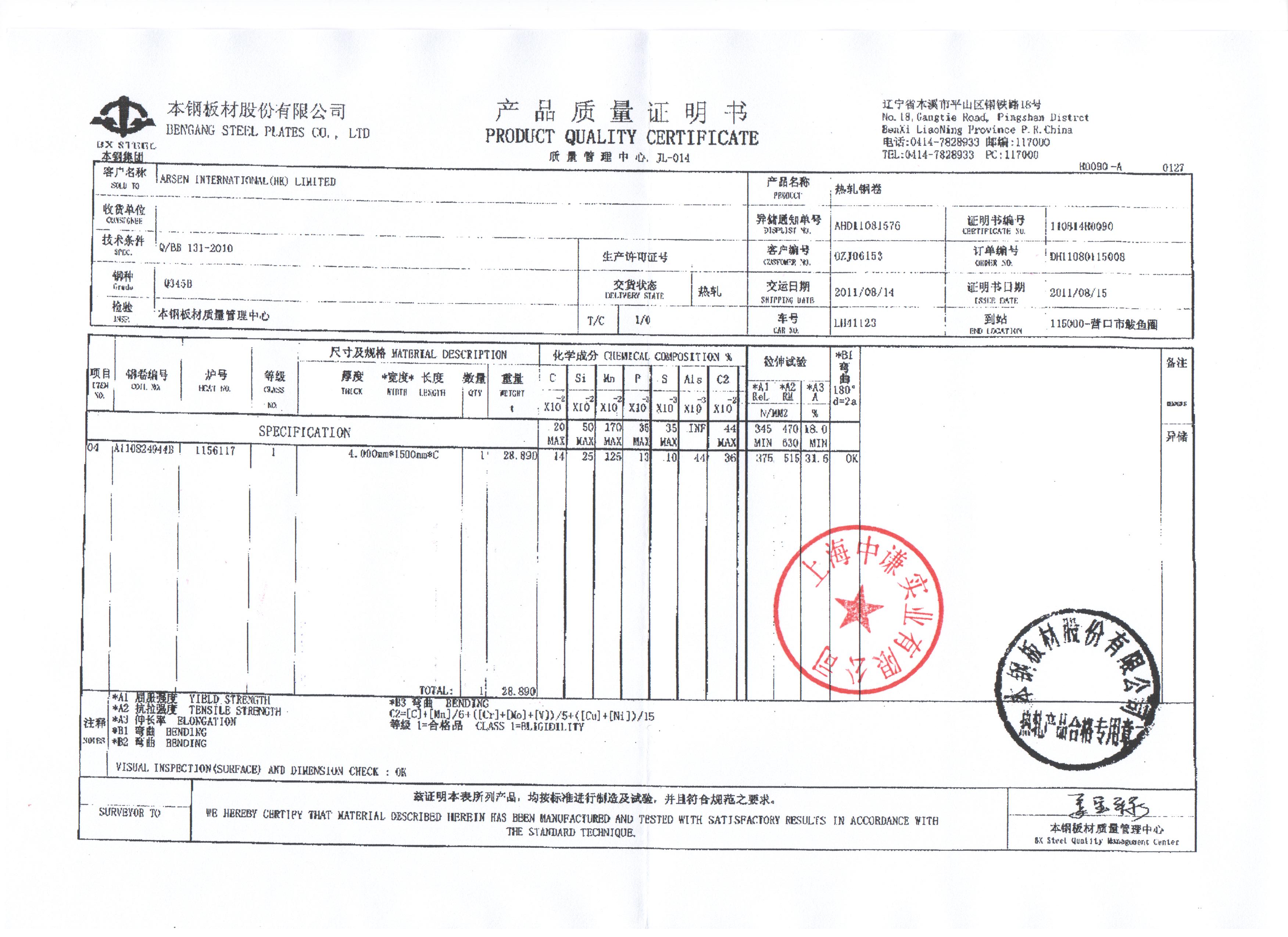
S355JR and A572 Grade 50 are structural steel designations, and NM400 is a wear-resistant plate grade. Naming them in a drawing does not by itself prove that the delivered chassis matches the drawing. That link is established by material certificates, incoming inspection and, where mechanical properties are specified, tensile testing. The documented control set includes steel mill certificate checks at material intake, in-house tensile testing for mechanical properties and inspection reports tied to material traceability.
The paired "S355JR / A572 Grade 50" designation deserves a drawing check of its own. A buyer should confirm whether the two grades are approved alternates for the same plates or apply to different parts of the chassis. The answer affects certificate review, weld procedure qualification and spare-part replacement years later.
NM400 should be read as a wear-resistant grade, not as a guarantee of a specific service life. Wear life depends on coil contact pressure, surface condition, sliding distance and maintenance practice—variables the case record does not quantify. Buyers should ask where NM400 is used, how it is attached, and whether worn sections are designed for replacement.
The AGV case record does not disclose material grades. That absence is not evidence that the AGV chassis uses a lower grade. It means the material comparison cannot be completed from the available record, and the buyer should request the AGV drawing's material schedule directly.
Drawing Checks Before Award
For either chassis type, the drawing set—not the quotation—should carry the technical answer. Six checks matter most.
- Load definition and load path. Require tare weight, rated load, design load, safety factors and the load distribution assumed: concentrated coil loads in one case, distributed AGV loads in the other. Confirm which members carry the load and how it reaches the ground or the vehicle interface.
- Material schedule and plate sizes. Record grades, thicknesses and plate dimensions. Confirm whether S355JR and A572 Grade 50 are alternates, and where NM400 is used.
- Critical dimensions and tolerances. On a 15 m assembly, specify length, width, height, diagonal difference, flatness, hole position and interface datums. Unspecified tolerances become disputes after delivery.
- Weld requirements. Define weld sizes, inspection methods and acceptance levels where the application needs them. The case records do not state weld acceptance classes, so buyers should not assume a class from the tonnage.
- Surface treatment. Where galvanizing or coating is specified, define the system and the measurement method; film-thickness checks are part of the documented inspection set.
- Drawing revision and change control. This matters most on a 30-year supply program. A buyer should know which revision is being built, how changes are approved and how the supplier retains drawings for future spares.
Acceptance Criteria That Match the Application
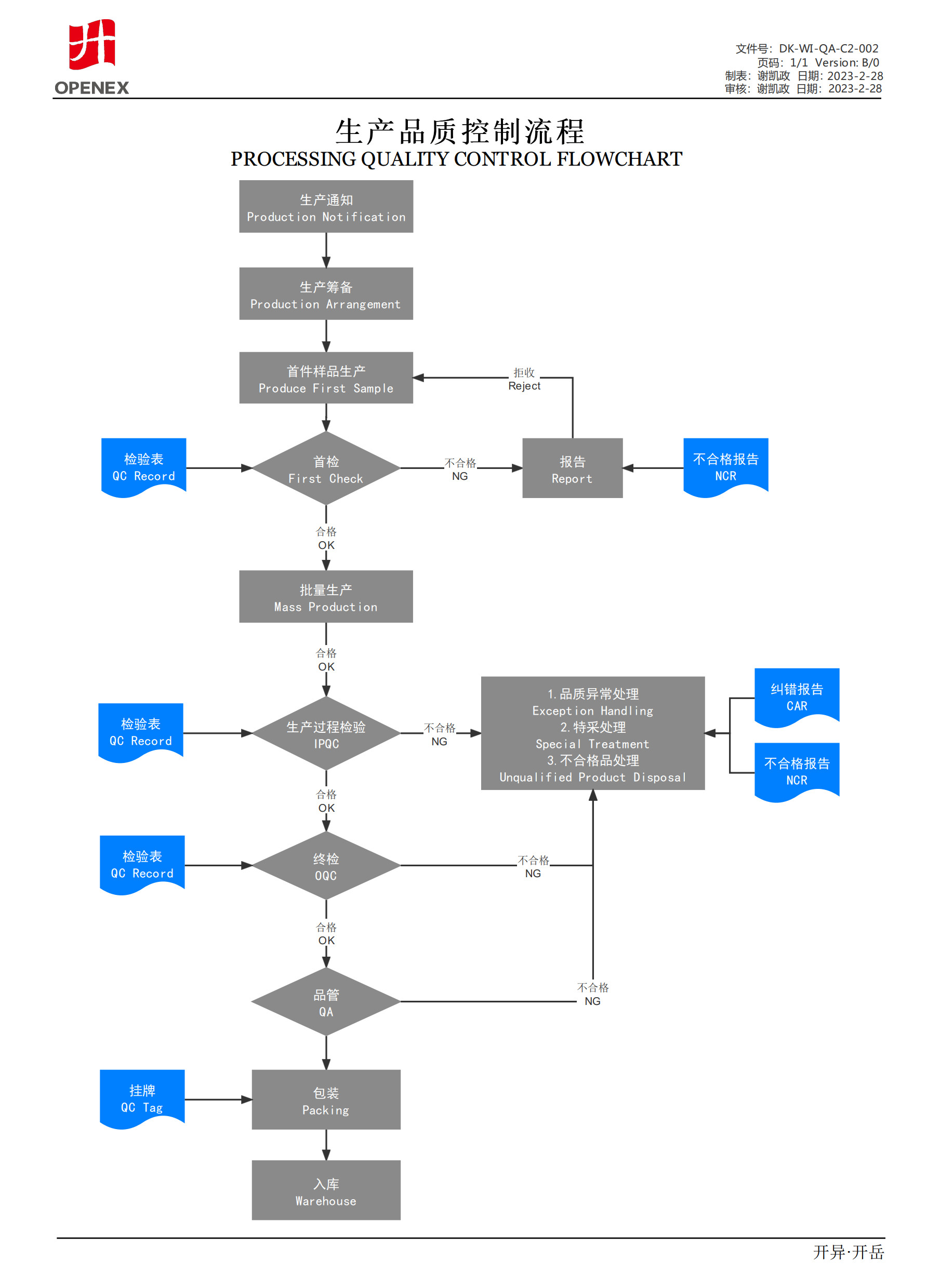
Acceptance criteria should follow the application, not a generic checklist. For both programs, a workable baseline includes first-article inspection, in-process control, final inspection and an inspection report. The supplier's documented quality-control procedures, inspection reports and material traceability form the standard control method, with steel mill certificates and tensile testing supporting incoming material checks.
For the 345-unit AGV order, first-article approval is the anchor. Once the first unit is accepted, the criteria should define what is checked on every unit—interface holes, critical dimensions and weld appearance—and what is sampled, such as flatness, coating thickness or material certificates by heat number. Batch consistency deserves explicit language because 345 units multiply small process drifts.
For the 30-unit coil program, material traceability and long-term reproducibility carry more weight. The criteria should tie each chassis to its drawing revision, material certificates and inspection report, so that a replacement unit built years later can be compared with the original. Dimensional inspection should cover the full 15 m envelope, including diagonals, because a long welded frame can distort in ways a short check does not reveal.
Both programs should define who inspects, against which drawing revision, with which instruments, and what happens when a result falls outside tolerance. Those four answers turn an inspection clause into an enforceable acceptance process.
Delivery, Supply Continuity and Fit-for-Use
Delivery is where the two programs diverge most. The coil program's 30-year supply horizon makes continuity a technical requirement: the supplier must be able to repeat material grades, drawings, welding procedures and inspection criteria over decades, and must document change control. The AGV program's 345 units make delivery pacing and batch consistency the operational priority, with first-article approval gating the rest of the run.
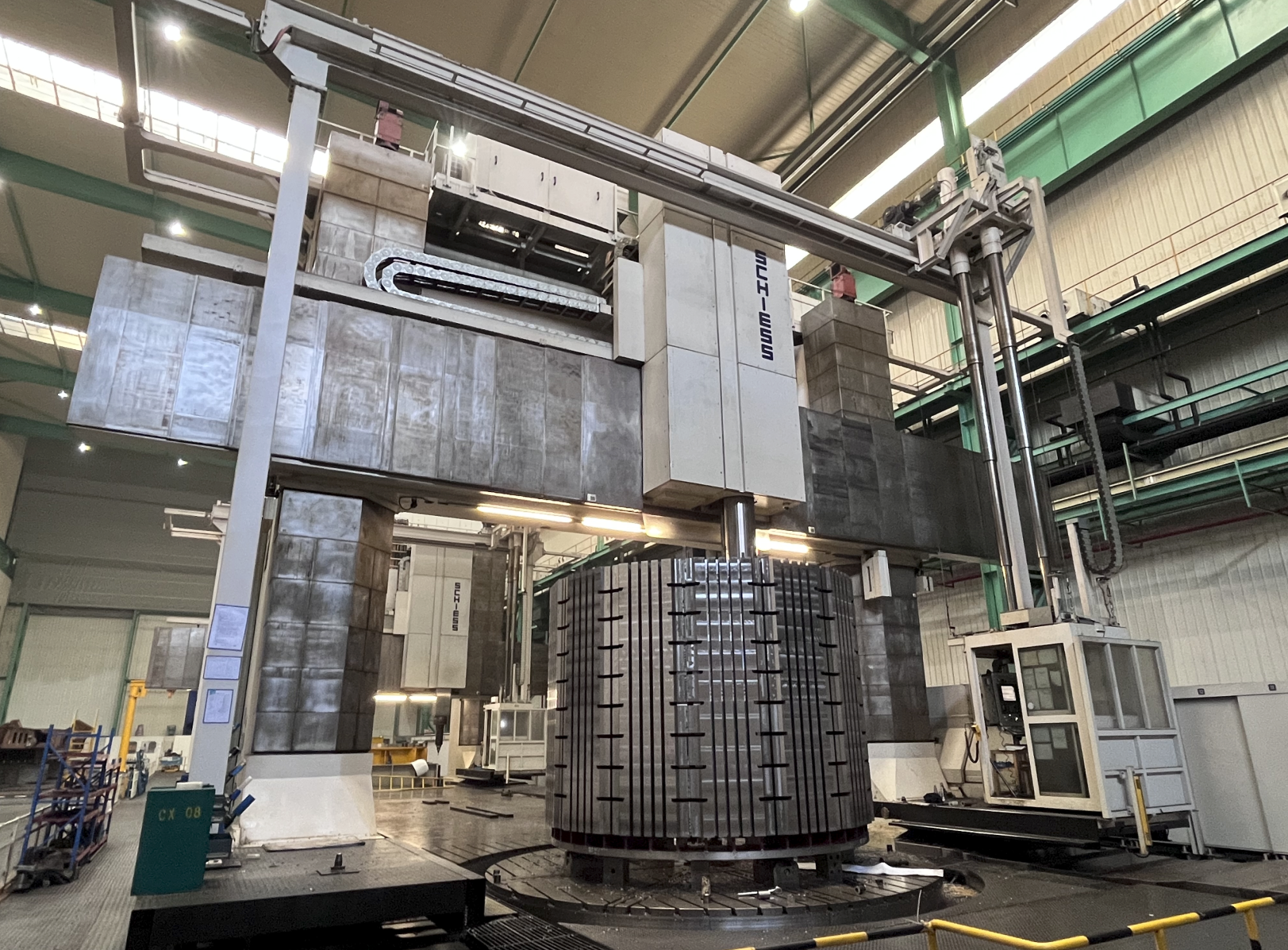
Openex's published profile is relevant to both: two manufacturing premises near Xiamen Port and Shanghai Port, an annual output of 20,000 tons, overhead crane capacity above 250 tons, press-brake capacity over 18 m and 10,000 tons, and CNC machine travel up to 50 m x 8 m x 7 m. Those capabilities support large welded assemblies and post-weld machining, but they are capacity facts, not proof that any specific chassis will meet its drawing. Buyers should still verify the specific work content, inspection plan and delivery schedule for their own order.
"Fit-for-use" adds checks that stop at the factory gate in many orders: lifting points, transport saddles, sea-freight protection, unloading instructions and site assembly sequence. A 15 m chassis that passes dimensional inspection but cannot be lifted or shipped without distortion is not fit for use. The buyer should ask for the handling and packing plan as part of the technical offer.
What the Market Context Suggests—and What It Does Not
Market data explains why large custom chassis programs remain relevant, but it does not validate any individual supplier. Grand View Research values the global sheet metal market at USD 181.8 billion in 2024 and projects USD 272.3 billion by 2030, with Asia Pacific accounting for 65.0% of global revenue in 2023 and China representing more than 69% of the Asia Pacific share. Global Market Insights values metal fabrication services at USD 87.3 billion in 2025, rising to USD 136.5 billion by 2035. Grand View Research also expects the automotive and transportation segment to grow at a 7.03% CAGR through 2030, driven by EV enclosures.
For a chassis buyer, the useful reading is narrower than the headline growth. A larger fabrication market does not mean every supplier can hold a 15 m tolerance or repeat a 345-unit batch. It means capacity is available, so the differentiator shifts to evidence: drawings, inspection records, material traceability and service history. The EV-enclosure growth signal is relevant to automation and energy-storage supply chains, but it should not be stretched into a claim about AGV chassis demand; the verified data does not provide that figure.
Where Each Chassis Type Fits—and Where It Does Not
The coil-pallet chassis fits steel-mill coil handling where wear, concentrated load and a multi-decade supply horizon dominate. Its natural verification focus is material schedule, wear-part design, load path and drawing continuity. The AGV chassis fits automated vehicle programs where repeatability, interface control and batch consistency dominate. Its natural verification focus is first-article approval, dimensional repeatability, interface datums and process control across hundreds of units.
Neither case supports a claim that one chassis type is better than the other. They serve different duty profiles, and the records do not include a common performance test. The cases also do not provide a baseline against a generic welded frame, so no superiority claim is made against conventional solutions. A buyer with a different load, route, climate or maintenance model should treat both cases as reference points for questions, not as proof of fit.
Frequently Asked Questions
What distinguishes a steel mill coil-pallet chassis from an AGV chassis?
The two cases differ in program size, load definition, material schedule and service evidence. The Japanese coil-pallet program covers 30 units at 10 tons and 15 x 2.5 x 2.1 m, with S355JR / A572 Grade 50 structural plate and NM400 wear plate, backed by a 30-year supply record and 20 years of stable operation. The Dutch AGV program covers 345 units at 10.5 tons and 15 x 2.7 x 3 m, rated to 30 tons, with more than four years of operation. The coil chassis is shaped by wear and long-term supply; the AGV chassis by repeatability and integration.
How should a buyer interpret the "10-ton" figure for the coil chassis?
The case record describes a 10-ton, 15 x 2.5 x 2.1 m coil chassis but does not state whether 10 tons is chassis weight, payload or design load. The AGV case separates a 10.5-ton chassis weight from a 30-ton rating, which shows why the distinction matters. Buyers should require the approved drawing to define tare weight, rated load, design load and load distribution before comparing quotations.
Which acceptance criteria fit a custom steel chassis order?
A workable set includes first-article inspection, in-process checks, final inspection and an inspection report, supported by material certificates and, where mechanical properties are specified, tensile testing. Dimensional checks should cover the 15 m length, width, height, diagonals, flatness and interface locations. For a 345-unit AGV order, batch consistency and sampling should be agreed in advance; for a 30-unit long-life coil order, material traceability and drawing version control carry more weight.
What does a 30-year supply record change in supplier evaluation?
It shifts part of the evaluation from unit price to continuity: whether the supplier can repeat the same material grades, drawings, welding procedures and inspection criteria over decades, and whether change control is documented. The case record's 30-year supply and 20-year operation are evidence of continuity, but buyers should still ask for the definitions behind those figures—what was supplied, at what intervals and against which drawing revisions.
What does four years of AGV operation prove?
It shows that the chassis design has been used in service for more than four years in the Dutch program, which is relevant evidence for wear, fastening integrity and dimensional stability. It does not by itself prove performance under a different duty cycle, payload or route profile. Buyers should ask for operating conditions, maintenance records and failure history, and compare them with their own application.
Buyer takeaway. The two programs show that chassis procurement is decided before the first weld: in load definitions, material schedules, tolerance callouts, acceptance criteria and delivery planning. Buyers who compare suppliers on those documents—rather than on a single tonnage figure—will get a more useful answer from every quotation.
For further detail on fabrication and machining capabilities, download the Openex fabrication brochure (PDF).
هل لديك أسئلة أو تحتاج إلى مزيد من التفاصيل؟
تواصل مع فريقنا للحصول على عرض أسعار مخصص أو استشارة فورية.
طلب عرض أسعار
املأ النموذج أدناه وسيتواصل معك فريقنا بعرض مقترح مخصص.
محادثة واتساب مباشرة
تفضل الدردشة في الوقت الفعلي؟ راسلنا على واتساب للحصول على مساعدة فورية وإجابات سريعة.
- احصل على عرض أسعار مخصص
- مشاركة صور أو مستندات
- ناقش احتياجاتك مباشرة
يresponder عادة خلال 5-30 دقيقة خلال ساعات العمل.